 PalV's Kasti
On this page
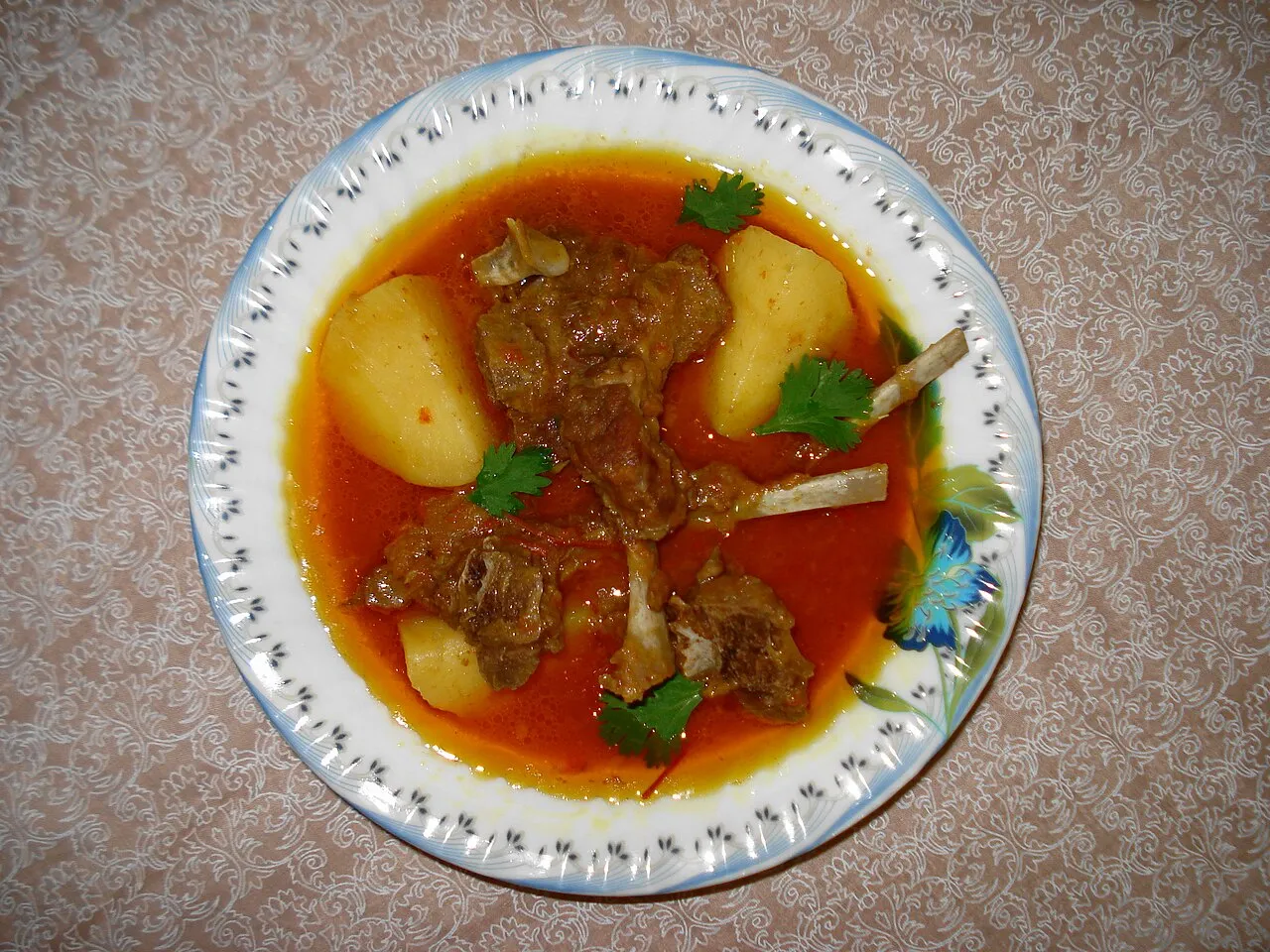
Ghambar nu papeta ma gosht is the mutton and potato stew that turns up at a Parsi gahambar, the communal feast that closes each of the six Zoroastrian seasons. Papeta ma gosht means meat with potatoes. The meat is browned with whole spices, onions and a ground paste of ginger, garlic, chillies and cumin, then simmered with tomatoes until tender. Potatoes are fried separately and folded in just before serving, with a pinch of ground cardamom on top. In Dawn's account of the feast it comes after the chutneys and pickles, eaten with hot chapatis, before the dhansak arrives.
શહેરેવર રોજ
Shehrevar Roj, Tir Mah · 1396 Y.Z.
What does "ghambar nu papeta ma gosht" mean?
The name ties the dish to a particular occasion. "Ghambar" is a spelling of gahambar, the seasonal feast. A 2012 Express Tribune piece from Karachi calls the feast a ghambar throughout, and Dawn's 2011 report spells the plural "Ghambaars".
The dish itself goes by several spellings. FEZANA's 2012 cookbook Eat, Live, Pray prints it as Papeta ma Gos, Dawn writes Papeta ma gosh, and the Tribune uses papeta ma gosht. All three describe the same thing: meat with potatoes. In the FEZANA glossary, papeta is simply the word for potato.
Why is papeta ma gosht cooked for a gahambar?
A gahambar is a meal shared by the whole community, and FEZANA's book notes that it was traditionally cooked and served by volunteers. Mary Boyce, writing in the Encyclopaedia Iranica, defines the gahambars as the feasts that close each of the six seasons in the Zoroastrian year. FEZANA's book gives the same count of six and links each one to one of the six creations of Ahura Mazda. Both sources describe each one as lasting five days. FEZANA's account sets aside the first four for prayers and liturgical services, starting with the Afrin or Afrinagan benediction, and keeps the fifth for eating together.
Contribution is at the heart of it. Boyce records that the gahambar liturgy makes it everyone's duty to bring an offering, from cattle for sacrifice down to a single stick of dry wood, and that someone destitute could offer a prayer instead. Writing about the gahambars of ancient Iran, FEZANA's book says the Afringan of the gahambar asked people to add whatever they could afford to the communal pot, whether meat, vegetables or grain, and that those who had nothing to give could give their time and labour. Both sources say the feast seats rich and poor together. FEZANA calls the gahambar "a great equalizer".
Two more details are worth knowing. Boyce notes that Parsis kept the feasts devoutly down to the mid-20th century, though only men attended the communal observances, and that since the 1970s Parsis have revived gahambars locally with women taking full part. FEZANA's book adds a belief about the food itself: that the aroma of a good meal draws spiritual beings, and that at the gahambars the spiritual and the living share the meal together.
Practice varies between families and Agiaries; your family priest's guidance comes first.
The six gahambars, as FEZANA names them
| Gahambar | FEZANA's description | Creation it honours |
|---|---|---|
| Maidyozarem | Mid-spring feast | Sky |
| Maidyoshahem | Midsummer feast | Water |
| Paitishahem | Harvest feast | Earth |
| Ayathrem | Herding feast | Plants |
| Maidyarem | Mid-winter feast | Animals |
| Hamaspathmaidyem | Feast of all souls | Humans |
Where does papeta ma gosht come in the gahambar meal?
In Dawn's account it is the first cooked dish to reach the table. Dawn's 2011 description of a Parsi feast gives the order plainly: chutneys and pickles first, then papeta ma gosh with hot chapatis, then dhansak, and Parsi custard to finish.
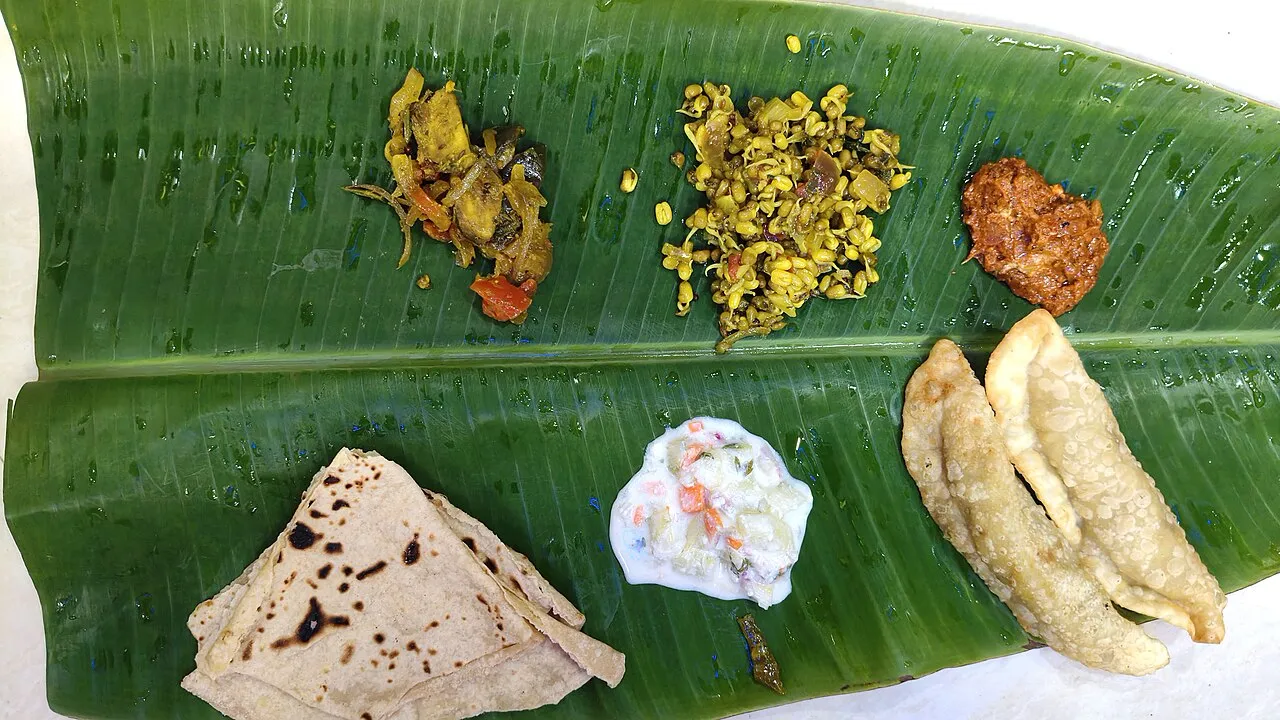
FEZANA lists a slightly different Indian spread. Its traditional gahambar menu runs to ambakaliyu (a mango chutney), dhansak, kevab or meatballs, kachumbar of onions in vinegar, and meat with potatoes, closing with mango ice cream or kulfi. Both lists include meat with potatoes and dhansak.
Karachi's version, as Dilaira Dubash described it for the Express Tribune, opens with prayers or a jashan led by priests in the evening, followed by a three-course meal. Each Parsi residential compound hosts its own ghambar and invites the others. She writes that if you smell papeta ma gosht and dhansak chawal being served, you can safely assume you're at a ghambar.
Banana leaves and long tables
Dawn says the food is traditionally served on a banana leaf in place of a plate. In Pakistan and much of India, it adds, long tables are set parallel with everyone seated on one side, facing the row across. The narrow gap between tables leaves room for the servers. Dubash noted how this has changed in Karachi: caterers now cook, cardboard sheets lined with butter paper have replaced the banana leaves, and dessert is more often ice cream.
How do you make papeta ma gosht for a gahambar?
This method follows Armin Wandrewala's Papeta ma Gos, printed in the gahambar section of FEZANA's Eat, Live, Pray: A celebration of Zarathushti cuisine (2012). It serves six to eight. The quantities follow the original. The wording is ours.
Ingredients
- 1 kg (2 lb) boneless mutton, in pieces
- 4 marrow bones, cut into 5 cm (2 inch) lengths
- For the paste: 100 g (3½ oz) ginger, 20 g (4 tsp) garlic, 4 fresh green chillies, 8 dried Kashmiri red chillies, 10 g (2 tsp) toasted cumin seeds
- Whole spices: 4 pieces of cinnamon bark, 13 black peppercorns, 8 cloves, 8 green cardamom pods
- 80 ml oil
- 300 g (10 oz) onion, finely diced
- 500 g (1 lb) tomatoes, chopped fine
- 500 g (1 lb) potatoes, peeled and cut into medium dice
- 10 green cardamom seeds, ground
- Salt to taste
Method
- Grind the ginger, garlic, both kinds of chilli and the toasted cumin into a smooth paste, loosening it with a little lukewarm water if needed. Set it aside to rest so the flavours settle.
- Heat the oil in a heavy-based pan. Let the whole spices crackle, then add the onions and fry them until golden.
- Put in the mutton and marrow bones and brown them well. Stir in the ground paste and keep browning, scraping often so the meat doesn't catch on the base.
- Add the tomatoes and cook until they too have browned into the masala. Pour in enough water to cook the meat through and simmer until the mutton is tender.
- While the meat cooks, parboil the potatoes in hot water until about half done. Drain and leave them in a colander to dry. Fry them until golden and salt them straight away.
- When the mutton is ready to serve, fold in the fried potatoes and scatter the ground cardamom over the top.
Two details in Wandrewala's method are easy to miss. Marrow bones go into the pot with the boneless meat. And the potatoes never simmer in the gravy: Wandrewala has them parboiled, dried, fried golden and salted on their own, and they meet the mutton only at serving time.
Where can you find more Parsi dishes like this one?
Our guide to Parsi recipes covers the traditional dishes and which ones to cook first. If you want a festive dish with a sweet edge, try Jardaloo ma murghi, chicken cooked with apricots. Our Ghau nu dhoodh breakfast post covers a protein-rich Parsi breakfast. And for the wider story of the community's table, start with Parsi food.
Frequently asked questions
What is papeta ma gosht?
Papeta ma gosht is a Parsi stew of mutton with potatoes. In Armin Wandrewala's FEZANA recipe, the meat and marrow bones are browned with whole spices, onions and a ginger, garlic and chilli paste, then cooked with tomatoes. Fried potatoes are folded in at the end with ground cardamom. It is also spelled papeta ma gos.
What is served at a Parsi gahambar?
Dawn's 2011 account lists chutneys and pickles, then papeta ma gosh with hot chapatis, then dhansak, ending with Parsi custard. FEZANA's traditional Indian menu names ambakaliyu mango chutney, dhansak, kevab, kachumbar and meat with potatoes, finished with mango ice cream or kulfi. Both lists include meat with potatoes and dhansak, so the two dishes belong together on a gahambar table.
How many gahambars are there in a year?
There are six gahambars a year, one closing each of the six Zoroastrian seasons, according to the Encyclopaedia Iranica and FEZANA. Each is kept over five days. FEZANA describes the first four days as given to prayers and liturgical services and the fifth to the communal feast, where dishes such as papeta ma gosht are shared.
What do you eat papeta ma gosht with?
At a gahambar, papeta ma gosht is eaten with hot chapatis, according to Dawn's account of the Parsi feast. It follows the chutneys and pickles and comes before the dhansak. Dawn says the food is traditionally served on a banana leaf at long tables, though the Express Tribune reports that Karachi caterers now use cardboard sheets lined with butter paper.
Is a ghambar the same as a gahambar?
Yes. Ghambar is a spelling of gahambar used in the Karachi press: the Express Tribune headlined the feast as a Parsi-style thanksgiving, and Dawn wrote of six annual Ghambaars. The Encyclopaedia Iranica gives gahambar as the Middle Persian name for the six seasonal feasts. The dish name ties papeta ma gosht to that feast.


