 PalV's Kasti

On this page
Parsi food is the home cooking of the Parsis, the Zoroastrians who left Iran for the coast of Gujarat more than a thousand years ago. It keeps a Persian liking for meat, dried fruit and nuts, takes its coconut, seafood and sweetness from Gujarat and the west coast, and picked up custards and egg-thickened sauces in the colonial period. The flavour that ties it together is tikhu-khatu-mithu, a balance of hot, sour and sweet, usually built with chillies, vinegar and jaggery. The dishes most people know are dhansak, patra ni machhi, sali boti, akuri and lagan nu custard. Eggs turn up almost everywhere, often cracked over vegetables or meat in "per eedu" dishes.
અદીબેહેસત રોજ
Ardibehesht Roj, Tir Mah · 1396 Y.Z.
Where does Parsi food come from?
Parsi food comes from the long move of a Zoroastrian community out of Iran after the Arab conquest of the Sasanian empire, and its settlement in Gujarat. Writers do not agree on when the first group landed. Sona Bahadur, writing in Scroll, places the arrival sometime in the 8th century. Niloufer Mavalvala, author of The Art of Parsi Cooking, gives a range between the 8th and 10th centuries, and a Deccan Herald piece says the 7th. The Encyclopaedia Iranica explains why: the only account of the journey, the Qissa-i Sanjan, works in round figures rather than precise dates, and it says of itself that it was written down in 1600 from oral tradition.
According to the Qissa, the settlers at Sanjan agreed to use the local language and that their women would wear local dress. Saveur's Meher Mirza puts it simply: the community gave up Persian for Gujarati. In the version of the story Deccan Herald retells, the local ruler Jadi Rana sent the newcomers a full glass of milk and they answered by stirring sugar into it. We look at that story, and what it says about how the food blended in, in Sugar in the milk and Parsi food.
From the 17th century Surat was a major Parsi centre, Iranica notes, and as trade moved to Bombay in the 19th century many Surat Parsis moved too, with some going north to Karachi. For what the community ate before any of this, see Ancient Parsi cuisine and Zoroastrian food and migration. For the changes after settlement, read Evolution of Parsi cuisine.
Which influences shaped Parsi cuisine?
Parsi cuisine was shaped by Persian, Gujarati and wider Indian cooking, and later by European trade and British rule. The Asian Age lists Maharashtrian, Gujarati, Iranian and British influences, and Saveur adds Goa and Maharashtra to the mix.
What is Persian in Parsi food?
The Persian layer shows in a love of meat and offal and in the dried fruit and nuts that go into festive dishes. Mavalvala credits Persia with the dry fruits, nuts and sweet "shirini" notes of Parsi cooking. Home chef Nilufer Babaycon, speaking to The Telegraph, described the dried-fruit base as Persian. Apricots (jardaloo), almonds, cashews and raisins all appear in Parsi recipes. The kebab side of this heritage has its own page, Parsi kebab tradition, and Irani cooking is a separate story, told in Parsi vs Irani food.
What did Gujarat and the rest of India add?
Gujarat gave Parsi food its coastal side, with seafood and coconut. Babaycon thinks the sweet note in so many Parsi dishes "probably is an influence of Gujarati cuisine". Mavalvala credits India with the ginger, garlic, chillies and spices. Our page on Indian influences on Parsi food goes dish by dish.
Parsi families also settled well beyond Gujarat and Bombay. We follow them city by city in Hyderabad Parsi food, Chennai Parsi food and Bangalore Parsi food, and across the border in Parsi food: India vs Pakistan.
What came from Britain and Europe?
Saveur's Meher Mirza traces Parsi custards, stews and "saas" (egg-thickened sauces) to the colonial period, and quotes the cookbook writer Bhicoo Manekshaw comparing saas to a Western béchamel. Mirza also notes that Dutch, Portuguese and English trading communities of the 17th century influenced Gujarat's bakeries, and that Surat's Dotivala bakery still claims descent from the Dutch bakeries of that time. Mavalvala writes that French caramel custard has long been counted as part of the Parsi table. The full story is in European influences on Parsi food, and the odd chapter of Parsi delicacies sold to Londoners is told in Parsi delicacies in Victorian London.
What does Parsi food taste like?
Parsi food tastes hot, sour and sweet at the same time, a balance Parsis call tikhu-khatu-mithu. Mavalvala's book The Art of Parsi Cooking, quoted in The Telegraph, calls it "the Holy Trinity of Parsi cooking". The Telegraph says cooks usually get there by adding a little jaggery and vinegar, or lime, to a spiced dish. The vinegar Saveur singles out is a dark, aged sugarcane vinegar made only in Navsari, and both Saveur and The Telegraph name Kolah's. Read more in Tikhu-khatu-mithu.
Mavalvala describes garlic, ginger, onion and tomato as the base of most recipes, with cinnamon, turmeric, cumin and chillies as the everyday spices. Saveur lists the other pantry staples:
- Toddy (tari): fermented palm sap, stirred into meat stews and kadhi.
- Sugarcane vinegar: the Navsari vinegar, balanced with jaggery or sugar.
- Dried Bombay duck (boomla): crisp-fried or roasted, or made into Tarapori patio.
- Coconut: the milk for kharo rus, the flesh for chutneys and masala pastes.
- Salli: crisp fried potato sticks scattered over chicken and mutton in gravy.
- House spice mixes: dhansak masala, sambhar masala, garam masala and dhana jeera. Packets exist, but Saveur says most Parsi home cooks make their own.
For the spice cupboard in detail, see Parsi spices and herbs. The crunchy topping has its own guide, Dishes served with salli. The pots, stoves and routines that produced all this are described in Traditional Parsi kitchen, and the question of how all these pieces add up to a cuisine of its own is answered in What makes Parsi food unique.
What are the famous Parsi food names to know?
The famous Parsi dishes are mostly meat, fish and egg dishes. Mavalvala names meat and eggs as the two favourites. These are the names that come up again and again in cookbooks and newspaper food pages:
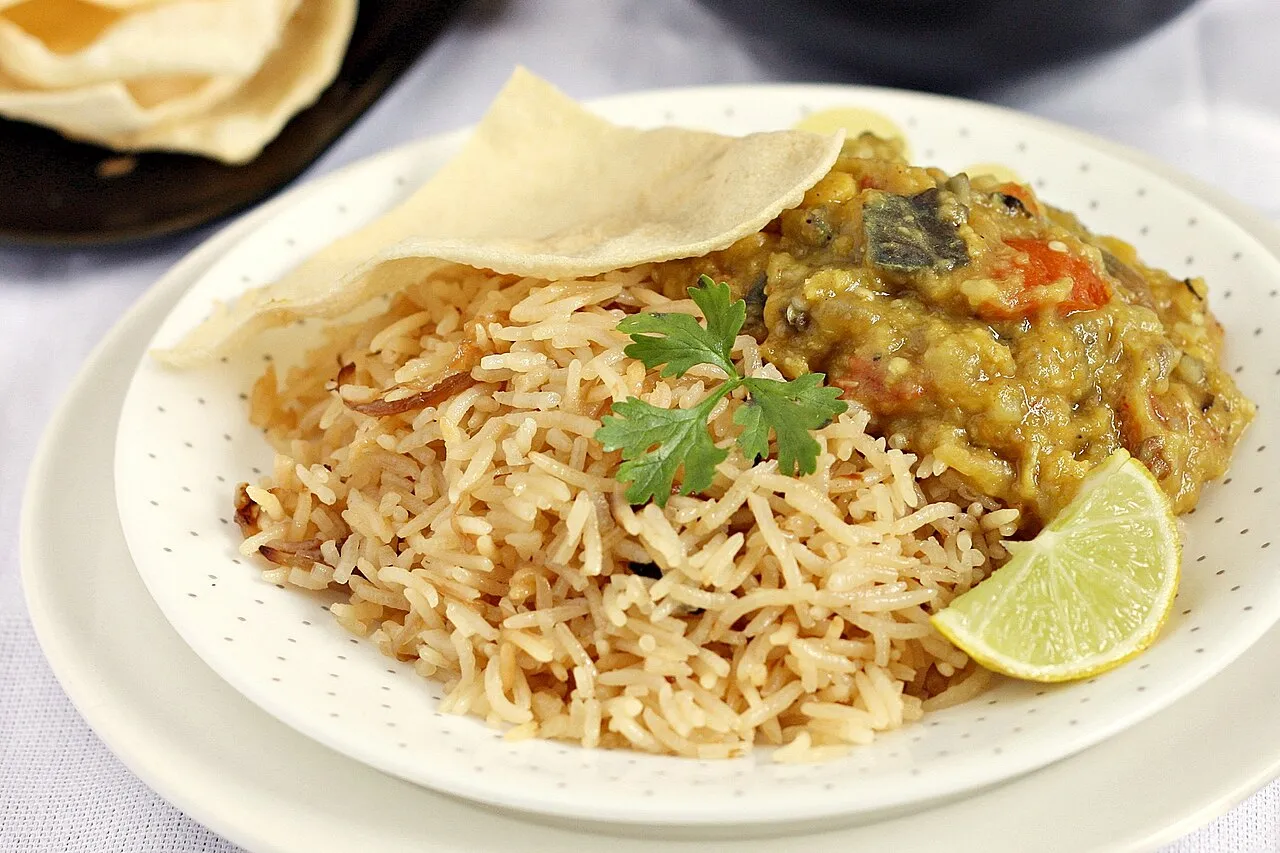
- Dhansak: lentils cooked with meat and vegetables, served with rice caramelised in jaggery, the "brown rice" of Parsi tables. Mavalvala calls it "the king of all foods Parsi".
- Patra ni machhi: fish coated in a coconut chutney, wrapped in banana leaf and steamed.
- Sali boti: mutton in a tangy tomato gravy, topped with salli.
- Jardaloo sali murghi: chicken in a gravy of apricots, jaggery and vinegar, finished with salli.
- Patio: prawns or fish in a tomato gravy, sweetened with sugarcane and soured with vinegar.
- Akuri: scrambled eggs cooked with masala, onion and tomato.
- Per eedu: literally "eggs on something", eggs cooked over vegetables or even potato chips.
- Lagan nu custard: the baked custard served at weddings.
Dhansak deserves a closer look. Bahadur cites the food historian K. T. Achaya's view that pulses took the place of the rajmah beans and spinach used in Iran, and that old versions held anywhere from three to nine dals, with fatty meat and tripe. Bahadur writes that the count has since come down to one or two dals. Our page on Dhansak covers its story and method. For the longer list, go to Classic Parsi dishes. The richest of them are rounded up in Parsi guilty-pleasure foods, and the bakery side in Nankhatai and Parsi bakers. Where to eat them in the city is covered in Parsi food in Mumbai.
When do Parsis eat which dishes?
Some dishes belong to community feasts and some to particular days. Saveur describes the evening gahambar meal as mutton pulao dar, chicken, pomfret with green chutney and sweet dried-fruit pickles, eaten off banana leaves. InHERIT, Ashoka University's heritage project, writes that Parsi associations gather for a community dinner every fortnight to a month, and that in Gujarat these gatherings are called gambhars. The way food and prayer meet at jashans and gahambars is the subject of Food, faith and community, and the beliefs behind it are in Zoroastrianism and food.
A wedding or Navjote meal follows its own order of courses, which we lay out in Parsi feast menu. The everyday joy Bawas take in eating, hosting and feeding guests is what we call Parsi bhonu culture.
Dhansak has a rule of its own. Outlook Traveller and the Parsi food writer Perzen Patel both say it is kept off the table at weddings, Navjotes and other happy occasions, because it is the dish that ends the meatless days of mourning after a death. The two differ on the count: Outlook Traveller describes three days without meat, Patel four. Saveur adds that dhansak is never eaten on Navroz. Patel disagrees on how strict this is: she calls the happy-days rule "a bit of a myth" and writes that Parsis do eat dhansak on Sundays and on happy occasions like birthdays and new years. Where families keep the rule, Patel says, they serve mutton pulao with the dal alongside, and call it masala ni dar rather than dhansak.
Practice varies between families and Agiaries; your family priest's guidance comes first.
Where are Parsi recipes written down, and is the cuisine at risk?
The best-known record is a cookbook written by a woman. The Parzor Foundation, which documents Parsi heritage, credits Zoroastrian women with protecting tradition as the community moved from Central Asia to western India. Vividha Vaani, by Meherbai Jamsetjee Wadia, first came out on 9 August 1894, according to the historian Murali Ranganathan in Scroll. It was written in Gujarati, and by its third edition it held 2,050 recipes. Parzor describes it as a two-volume book that "became a Parsi woman's heirloom cookbook". The bigger story of the women behind Parsi food is told in Parsi women and food.
The worry today is numbers. Census 2011 counted 57,264 Parsis in India, down from 69,001 in 2001, according to replies given in the Lok Sabha. We look at what is slipping away in Decline of Parsi food, at the restaurants and home chefs bringing it back in Parsi food revival, and at recipe archives and cookbooks in Preserving Parsi food heritage. Every revival raises the question of which version is the real one, which we take up in Authentic Parsi cuisine debate. For lighter versions of the classics, try Heart-healthy Parsi cooking. And when you think you know it all, take the Parsi cuisine quiz.
Frequently asked questions
What is Parsi food famous for?
Parsi food is famous for dhansak, patra ni machhi, sali boti, akuri and lagan nu custard, and for using eggs in almost everything. Its signature is tikhu-khatu-mithu, a hot, sour and sweet balance usually made with chillies, sugarcane vinegar and jaggery. Persian dried fruit and Gujarati coconut and seafood both show up on the same table.
Is Parsi cuisine the same as Persian food?
No. Parsi cuisine kept Persian tastes such as meat, dried fruit and nuts, but it grew up in Gujarat and Bombay. It took on coconut, seafood, chillies and Gujarati sweetness, and later colonial custards and sauces. Al Arabiya calls it a west coast Indian cuisine carrying flavours of ancient Persia.
Are there Parsi veg dishes?
Yes, though meat, fish and eggs dominate. The Telegraph describes koru no patio as a vegetarian patio made with red pumpkin and Kashmiri chillies. Vegetables such as spinach, brinjal and tomatoes are also cooked with eggs on top as per eedu, which suits vegetarians who eat eggs. Our page on Parsi vegetarian food lists more veg Parsi dishes.
What is Vividh Vani, the classic Parsi cookbook?
Vividh Vani, also spelt Vividha Vaani, is a Gujarati cookbook by Meherbai Jamsetjee Wadia, first published on 9 August 1894. Its third edition held 2,050 recipes. Alongside Parsi dishes it included cakes, jams and tarts, plus Goan, Bohri and Madrasi recipes, according to the historian Murali Ranganathan.
Why is dhansak not served at Parsi weddings?
Dhansak is linked with mourning. Outlook Traveller and Perzen Patel say families give up meat for three or four days after a death and return to it with dhansak, so it is kept away from weddings and Navjotes. Patel adds that many Parsis eat it on birthdays and Sundays. Practice varies; ask your family priest.


