 PalV's Kasti
On this page
Parsi food and Irani Zoroastrian food share a faith and a Persian starting point, but they come from two migrations far apart in time. Parsis settled in Gujarat centuries ago, and their cooking took in Indian spices to become the hot, sour and sweet food best known through dhansak. Irani Zoroastrians came mainly from Yazd and Kerman in the 19th and early 20th centuries, and in India their food is known mostly through Irani cafes and bakeries. Much of that cafe menu took shape in Bombay. Milky chai and buns are not Iranian specialities. A few dishes still point back to Iran: berry pulao on the cafe menu, and aush and kuku in Iranian Zoroastrian cooking.
શહેરેવર રોજ
Shehrevar Roj, Tir Mah · 1396 Y.Z.
Who are the Parsis and who are the Iranis?
Both are Zoroastrians whose families came from Iran. The difference is when they left. Parsis trace their arrival to the landing at Sanjan on the Gujarat coast, told in the Qissa-e-Sanjan. Iranis, as Sahapedia explains, are the families who came from Iran in the nineteenth and twentieth centuries, and although they share the Parsis' religion they have their own culture and social standing in India.
FEZANA's 2012 cookbook Eat, Live, Pray says the Irani Zarathushtis who opened cafes came largely from the provinces of Yazd and Kerman, fleeing persecution under the Qajar dynasty (1794 to 1925), and that Bombay Parsis helped them reach India. Sifra Lentin, Bombay History Fellow at Gateway House, adds that successive droughts in Yazd and Kerman, beginning with the Great Famine of 1870 to 1872, pushed people out, and that the migrants included Shia Muslims as well as Zoroastrians. Sahapedia also names that famine. Encyclopaedia Iranica records an Iranian Zoroastrian Anjuman founded in Bombay in 1918. Lentin notes too that census figures for Irani Zoroastrians are unavailable, because they were counted with the older Parsi community.
How does Parsi food taste different from Irani Zoroastrian food?
Parsi food is Persian memory cooked with Indian ingredients. Cookbook author Niloufer Mavalvala, writing in The Cook's Cook, says the dried fruit, nuts and sweet notes come from Persia, while ginger, garlic, chillies and spices are the Indian side. In her account most Parsi recipes start from garlic, ginger, onion and tomato, and jaggery and vinegar finish them. That balance is called tikhu-khatu-mithu (spicy, sour, sweet), and dhansak is its best-known dish. Our guide to Parsi food covers the full range.
The FEZANA book sets Iranian dishes beside Parsi ones in a few places, and the contrasts are useful.
| Occasion or dish type | Iranian Zoroastrian or Persian (as described in Eat, Live, Pray) | Parsi (same source) |
|---|---|---|
| Egg dishes | Kuku, a herb or vegetable frittata such as kuku-ye-sabzi | Per eedu (eggs on a vegetable base such as tomato, okra, potato or spinach) |
| Offering for Behram Yazad | Aujil, a lork of nuts and dried fruits, blessed and shared | Channa (roasted gram), elchi (cardamom) and sakar (rock sugar) |
| Food shared at a gahambar | Aush, a soup of herbs, legumes and noodles | Dhansak |
K. E. Eduljee writes in the FEZANA book that aush is made from chopped herbs with soaked legumes and lentils in a kashk (whey) broth, finished with reshteh noodles. He says it is the food served to the congregation at seasonal gahambars and when people gather for Pir-e-Sabz or for weddings. Because a healing manthra is recited over it, he adds, three spoons are considered enough to help the body heal. Farishta Murzban Dinshaw, in the same book, describes the ancient communal gahambar stew as the forerunner of both the Iranian aush and the Parsi dhansak served at gahambars today. A 2011 Dawn feature on the Parsi feast also lists dhansak as a frequent course at gahambars, after papeta ma gosht and chapatis.
Practice varies between families and Agiaries; your family priest's guidance comes first.
Is Irani cafe food the same as Irani Zoroastrian food?
Mostly not. Sifra Lentin points out that in Iran neither buns nor milky tea is a speciality. Iranians drink their tea reddish-black and without milk, and the traditional bread is an oblong flatbread made from barley flour. Bombay's Irani bakery breads, she writes, grew out of the Dhobi Talao neighbourhood where the first cafes opened. Rashid Irani, a former partner at Brabourne Restaurant, told her that from the 1940s to the 1960s mill workers dropped in for chai and brun-maska on their way to and from work.
The menus changed again for Indian tastes. Lentin writes that Iranian staples such as ab ghosht, a mutton soup, were too bland for Indian customers, so the cafes brought in Mughlai and Parsi food. Sayed Safar Ali Husaini, who runs Lucky Restaurant in Bandra and is a Yazdi Shia community leader, told her the cooks came from Uttar Pradesh and north India, and that the Iranians never became cooks. The FEZANA book adds that Irani cafes now serve Parsi staples such as dhansak and curry rice.
A few dishes kept the Iranian link. Gateway House names Britannia and Universal, both Irani Zoroastrian cafes in the Fort area, for their berry pulao. Eduljee calls Britannia's version an adaptation of the Iranian zereshk polo, rice with tart barberries, and NPR described chicken berry pulao as Britannia's signature dish. Bakeries also tell the story. B. Merwan and Co. on Grant Road, which Outlook Traveller says was set up in 1914 by Boman Merwan Nazarabadi, a migrant from Iran, was known for mawa cakes and bun maska until it shut in January 2026. Those cakes now sit firmly among Parsi guilty-pleasure foods.
Why do people mix up Parsi and Irani food?
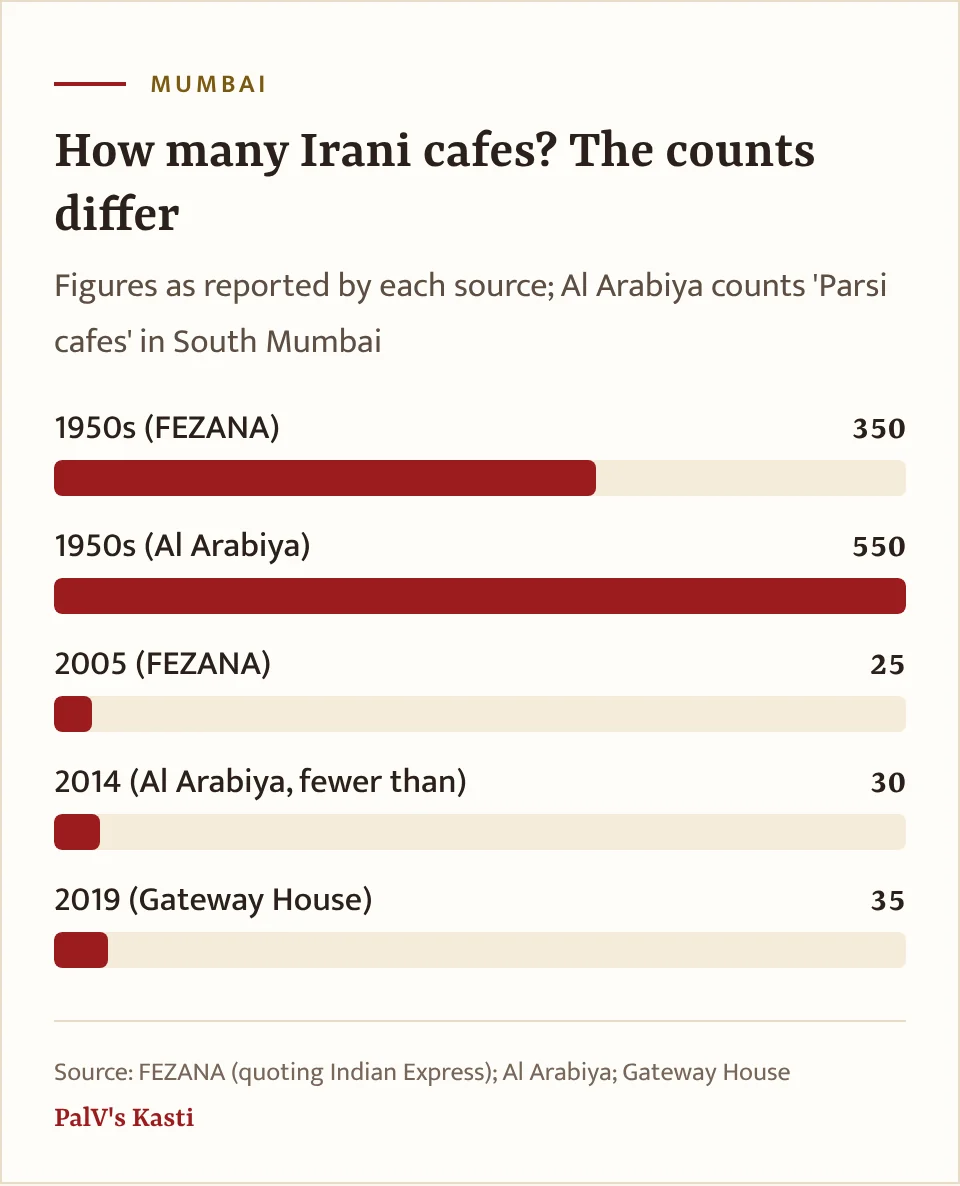
Partly because the labels themselves are used loosely. NPR's 2019 report on Britannia and Co. called it one of Mumbai's last Parsi cafes, while Gateway House lists the same cafe as Irani Zoroastrian. The cafe counts are just as unsettled. The FEZANA book, quoting an Indian Express report, gives 350 Irani cafes in the 1950s and 25 by 2005. Al Arabiya in 2014 gave about 550 Parsi cafes in South Mumbai in the 1950s and fewer than 30 by then. Gateway House, writing in 2019, put the number left at 35. The figures differ, and so do the names.

The menus also overlap. An Irani cafe that serves dhansak and curry rice looks like a Parsi restaurant to most diners. For dishes to cook at home, our collection of Parsi recipes is the place to start. Parsi food also travelled well beyond India, and our story on Parsi delicacies in Victorian London follows one of those journeys.
Is Parsi food the same as Persian food?
No, though the two are related. In the FEZANA book, Niloufer Mavalvala writes that Parsi and Persian cuisines share the same roots, that Persian food feels incomplete without a nut, a dried fruit or a berry, and that the Parsi fondness for khatu-mithu (sour and sweet) may come from there. Speaking to Al Arabiya in 2014, she said she believes dhansak goes back to a Persian khoresh, a stew of lentils, spinach, plums and meat, which became dhansak once the community moved to India.
Frequently asked questions
Are Parsis and Iranis the same community?
Both are Zoroastrians of Iranian origin, but they arrived in India at different times. Parsis descend from the much earlier settlers at Sanjan in Gujarat. Iranis came mainly from Yazd and Kerman in the 19th and early 20th centuries. Sahapedia notes they share the faith but have a distinct culture, and Gateway House says the census counted them together.
Is Irani chai actually drunk in Iran?
Not in the form Indians know it. Sifra Lentin of Gateway House notes that people in Iran drink reddish-black tea without milk, and that buns and milky tea are not Iranian specialities. The sweet milky chai and buttered bun of Bombay's Irani cafes grew up around the city's mill workers, who stopped in before and after their shifts.
Is berry pulao a Parsi or an Irani dish?
Berry pulao is an Irani cafe dish. K. E. Eduljee, in FEZANA's cookbook Eat, Live, Pray, calls Britannia's berry pulao an adaptation of the Iranian zereshk polo, rice cooked with tart barberries. Gateway House credits Britannia and Universal, both Irani Zoroastrian cafes in Mumbai's Fort area, with berry pulaos that have won renown among diners.
Is dhansak Persian or Indian?
Dhansak is Parsi, shaped in India. Niloufer Mavalvala told Al Arabiya she believes it began as a Persian khoresh of lentils, spinach, plums and meat that became dhansak after the migration. Farishta Murzban Dinshaw, in FEZANA's cookbook, writes that the old communal gahambar stew was the forerunner of both Iranian aush and the Parsi dhansak served at gahambars today.
What do Irani Zoroastrians serve at a gahambar?
According to K. E. Eduljee in FEZANA's Eat, Live, Pray, the dish usually served to the congregation is aush, a soup of chopped herbs, legumes, lentils and reshteh noodles in a whey broth. A healing manthra is recited over it before serving. The same book names dhansak as the Parsi gahambar staple. Practice varies, so ask your family priest.


