 PalV's Kasti
On this page
- Where do Zoroastrian food traditions begin?
- When did Zoroastrians reach Gujarat, and what did they have to change?
- Which parts of Parsi food are Persian, and which are Indian?
- How did the Irani migration from Yazd and Kerman change the story?
- Which Zoroastrian food customs survived the move from Iran to India?
- Is Zoroastrian food still moving?
- Frequently asked questions
Zoroastrian food was shaped by two journeys out of Iran, centuries apart. The first group, the Parsis, left after the Islamic conquest of Iran in the 7th century and settled in Gujarat, where the local ruler asked them to take up the language and dress of the land. Their cooking became a mix of Persian and Indian habits: cookbook author Niloufer Mavalvala credits nuts, dried fruit and sweets to Persia, and ginger, garlic, chillies and spices to India. The second group, the Iranis, came from the drought-hit provinces of Yazd and Kerman from the 1870s and ran many of Bombay's Irani cafes. Zoroastrians who stayed in Iran kept funding the communal gahambar feasts that Parsis also hold.
For the cuisine as a whole, see our guide to Parsi food.
શહેરેવર રોજ
Shehrevar Roj, Tir Mah · 1396 Y.Z.
Where do Zoroastrian food traditions begin?
In Iran, where food was already a marker of who you were. The historian Touraj Daryaee, writing in the journal Iranian Studies in 2012, studied late antique Zoroastrian texts in Middle Persian and Persian. He shows that these texts set the foods of Arabs and Indians against the Iranian diet, and that Zoroastrian dietary law drew a line of purity and impurity between the faithful and others.
The Oxford Companion to Food describes the Parsis as descendants of pre-Islamic Zoroastrians from the region of present-day Iran and Afghanistan. Their main migration, it says, came after Islamic armies conquered Iran in the 7th century. Dawn's Asif Noorani puts the waves of Zoroastrian migration between the 8th and the 10th centuries.
When did Zoroastrians reach Gujarat, and what did they have to change?
Nobody can give a single date. John R. Hinnells's Encyclopaedia Iranica entry on early Parsi history notes the debate and lists the years scholars have cited, from 716 CE through 785 to 936. The only account of the landing, the Qissa-i Sanjan, works in round figures. S. H. Hodivala, whose translation came out in 1920, is the scholar Iranica credits with 936, and he dates the poem's completion to 1600. Cookbook and newspaper accounts are split too: Mavalvala gives the 9th century, while a 2011 Dawn feature says the 10th.
The conditions are clearer than the date. In Hodivala's translation, the local ruler Jadi Rana told the newcomers to give up the language of their country for the speech of Hind, to dress their women like local women, to lay down their arms and to hold weddings in the evening. Iranica gives the same terms. Neither the conditions nor the priests' replies say anything about food. How the Parsi kitchen changed after settling is covered in our post on the evolution of Parsi cuisine.
Which parts of Parsi food are Persian, and which are Indian?
Parsi cooks put the split quite plainly. Niloufer Mavalvala, born in Karachi and later settled in Canada, is the author of The Art of Parsi Cooking: Reviving an Ancient Cuisine. Her version:
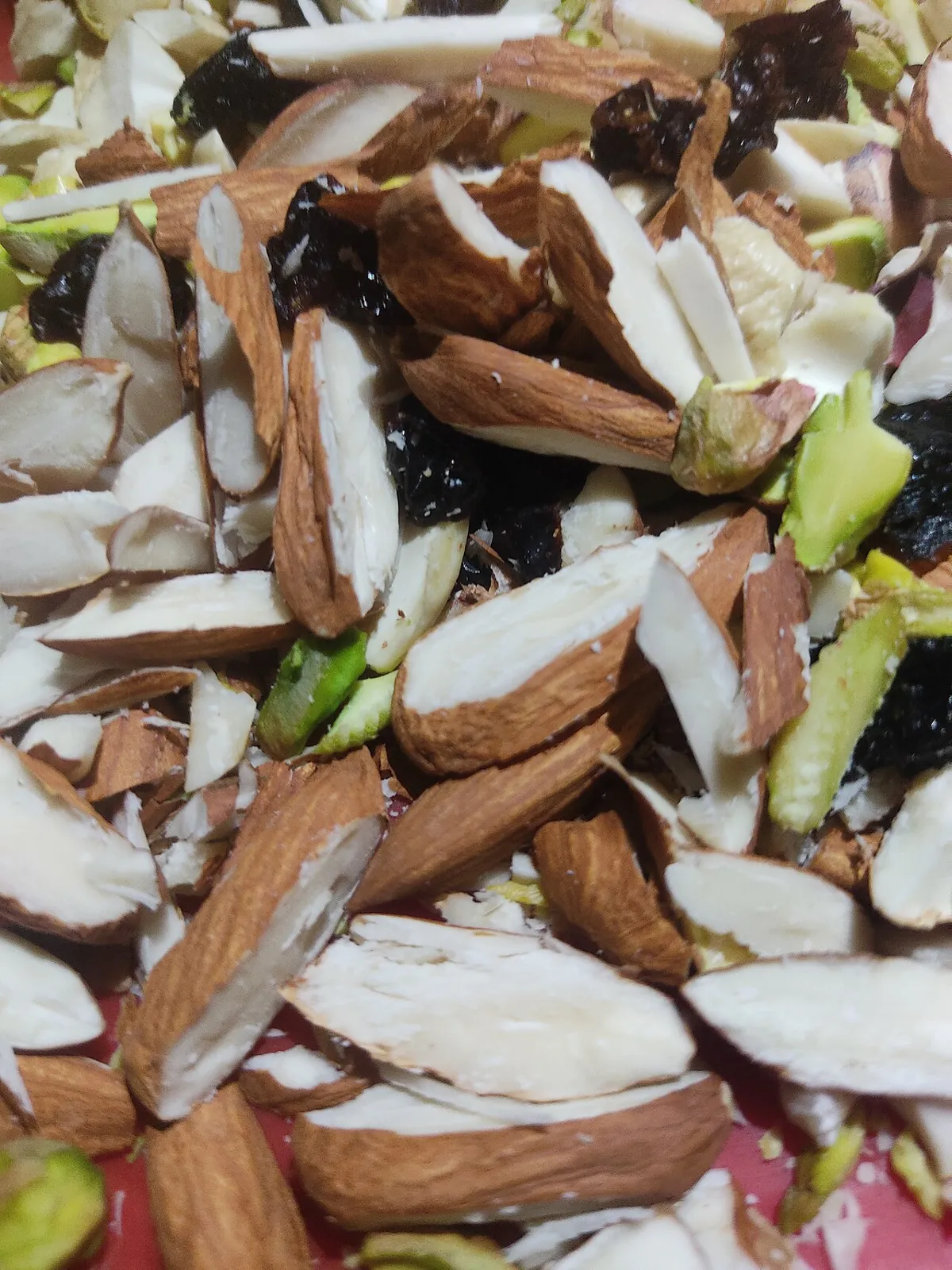
- From Persia: dishes with nuts, dried fruit, and sweets (shirini).
- From India: ginger, garlic, chillies and spices.
Farokh Talati's 2022 Bloomsbury cookbook, Parsi: From Persia to Bombay, also calls the cuisine a fusion of Persian and Indian influences. A Dawn feature from Karachi calls it "a marriage of Indian and Iranian tastes". Mavalvala names the spicy, sour and sweet balance of tikhu-khatu-mithu as central to Parsi cooking. To see the dishes themselves, go to our list of classic Parsi dishes.
How did the Irani migration from Yazd and Kerman change the story?
It added a second, much later layer. Bombay historian Sifra Lentin, writing for Gateway House in 2019, says the later Iranian Zoroastrian migrants came from the drought-hit provinces of Yazd and Kerman, pushed out by a run of droughts that began with Iran's Great Famine of 1870 to 1872. Noorani, writing in Dawn in 2016, tells of a Zoroastrian named Rustom Aspandiar Bahmani who left Yazd in the 1920s. Not everyone went to Bombay. A good number, Noorani says, settled in Karachi.
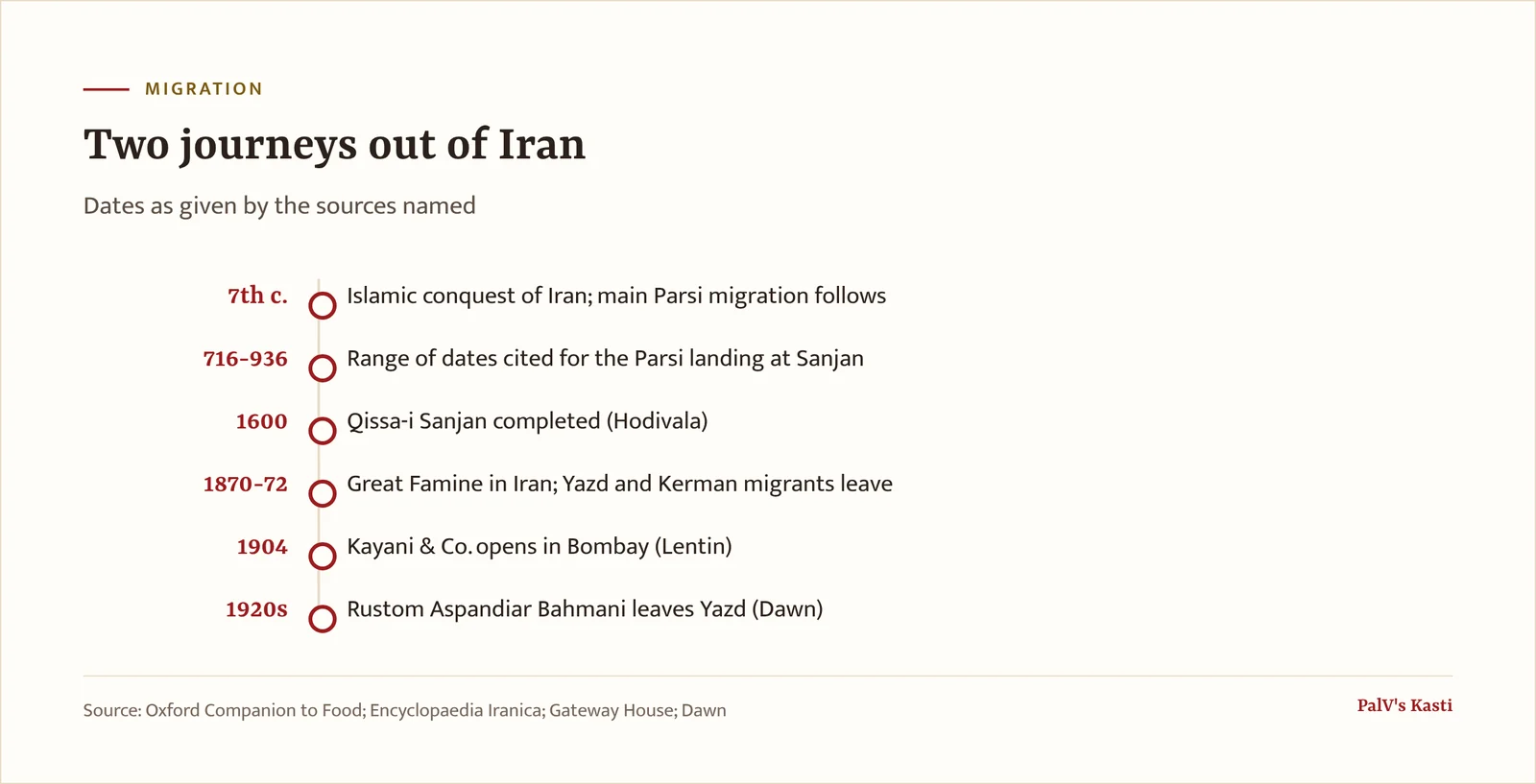
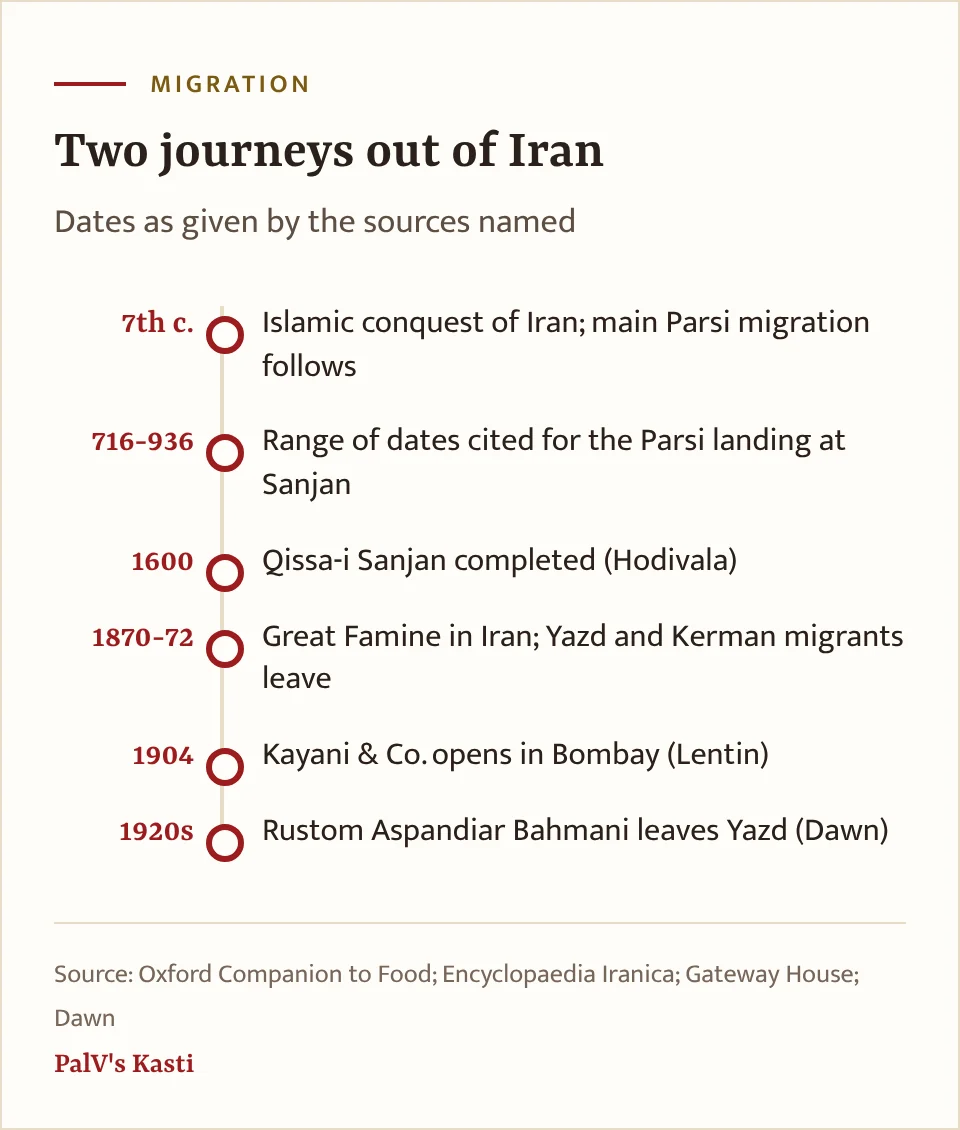
Lentin ties Bombay's Irani cafes to these migrants. She writes that Kayani & Co., possibly the oldest Irani cafe still open in the city, was set up in 1904 by Khodadad and Khodamorad Shukriye of Yazd. The menus did not simply copy Iran. Buns and milky tea were never Iranian specialities, Lentin points out: Iranians drank reddish-black tea without milk and baked an oblong naan from barley flour. Yet chai and brun-maska became what mill workers stopped in for. She also notes the berry pulao at Britannia and Universal, and NPR calls chicken berry pulao Britannia & Co.'s signature dish.
Karachi's Irani restaurants kept more Persian names on the menu. Noorani's article recalls, through regulars from the 1960s, the mahi kabab at Cafe Victoria ("mahi" is Persian for fish) and Sulemani chai, a light tea with no milk. He also describes the chullu kabab, an Iranian kabab served over buttered rice, at Cafe Subhani.
Which Zoroastrian food customs survived the move from Iran to India?
The gahambar is the clearest one. Mary Boyce's Encyclopaedia Iranica entry describes gahambars as communal banquets where consecrated food was shared and rich and poor came together. She records that Zoroastrians in Iran kept endowing gahambars through the Islamic centuries and into the 20th, and that everyone was expected to bring an offering, with a poor person free to offer a prayer instead. For India, she quotes the traveller John Ovington describing Parsis who each brought food as they could afford, which was then shared out equally. Both Boyce and a 2011 Dawn feature count six gahambars a year, and Dawn says the whole community is meant to eat the same meal, traditionally on a banana leaf.
Practice varies between families and Agiaries; your family priest's guidance comes first.
Is Zoroastrian food still moving?
Yes, and the cookbooks show it. In 2012 FEZANA, the federation of Zoroastrian associations in North America, marked its silver jubilee with Eat, Live, Pray: A Celebration of Zarathustri Culture and Cuisine. The SOAS Library described it as a culinary and cultural history with 72 recipes sent in by Zoroastrians across the diaspora. In February 2021 FEZANA announced an online talk where Iranian and Parsi Zoroastrians would compare their two cuisines and ask how the move from Iran to India may have shaped them. If you want to cook rather than read, our Parsi recipes are the place to start.
Frequently asked questions
Is Parsi food the same as Zoroastrian food?
Not exactly. Parsi food is the cooking of Zoroastrians who settled in Gujarat after the Islamic conquest of Iran, and it mixes Persian and Indian habits. In this post we use Zoroastrian food as the wider term, covering Zoroastrians who stayed in Iran and the Iranis from Yazd and Kerman who reached Bombay and Karachi from the 1870s onwards.
When did the Parsis arrive in India?
There is no agreed year. The Encyclopaedia Iranica lists dates scholars have cited, from 716 CE through 785 to 936, because the Qissa-i Sanjan, the only account of the landing, uses round figures. Iranica credits the 936 date to S. H. Hodivala, who translated the Qissa in 1920. Cookbook and newspaper writers give the 9th or 10th century.
What did Persia contribute to Parsi cuisine?
According to cookbook author Niloufer Mavalvala, dishes made with nuts, dried fruit and sweets came from Persia, while India supplied the ginger, garlic, chillies and spices. Farokh Talati's 2022 book Parsi: From Persia to Bombay also calls Parsi cuisine a fusion of Persian and Indian influences, and a Dawn feature calls it a marriage of the two.
Did the Qissa-i Sanjan set any food rules for the Parsis?
No. In S. H. Hodivala's 1920 translation, the ruler Jadi Rana asked the settlers to adopt the local language, dress their women like local women, lay down their arms and hold weddings in the evening. The Encyclopaedia Iranica lists the same terms. Neither the conditions nor the priests' replies mention food or diet.
Where did the founders of Bombay's Irani cafes come from?
Historian Sifra Lentin traces the later Iranian Zoroastrian migrants to the drought-hit provinces of Yazd and Kerman after Iran's Great Famine of 1870 to 1872. She writes that Kayani & Co., possibly the oldest Irani cafe still open in Bombay, was founded in 1904 by Khodadad and Khodamorad Shukriye of Yazd.


