 PalV's Kasti

On this page
- Where was the kitchen in an old Parsi home?
- What stoves did a traditional Parsi kitchen cook on?
- Which utensils and vessels filled a Parsi kitchen?
- How did a Parsi kitchen store grain, pickles and staples?
- What was the daily routine in a Parsi kitchen?
- Why does the Parsi kitchen stove get a birthday?
- How much of the traditional Parsi kitchen survives today?
- Frequently asked questions
A traditional Parsi kitchen, as the cooks and writers who grew up in one describe it, ran on a coal or wood sigri, a shelf of tinned copper vessels and a heavy stone for grinding masala by hand. Well-off homes, like the one cookbook writer Niloufer Ichaporia King describes, also had a cast-iron range with an oven and a kerosene stove for emergencies. Travelling tinsmiths re-tinned the copper and grains sat in large urns. Days had a rhythm: masala ground on the stone, chai at four, bhakhras made in batches. Once a year the stove itself was rested and garlanded. Every detail below is credited to the person who recorded it.
For the history and signature dishes, start with our guide to Parsi food. This post stays inside the kitchen.
અદીબેહેસત રોજ
Ardibehesht Roj, Tir Mah · 1396 Y.Z.
Where was the kitchen in an old Parsi home?
Usually at the far end. Dara M. Khodaiji, writing in Parsi Times in 2016 about a grandmother's home in the 1950s, remembers cavernous kitchens placed at the end of a long run of rooms. Perzen Patel, who runs Bawi Bride, says she too grew up with the kitchen in a far-flung corner of the house.
In well-off Bombay homes the kitchen was also staffed. Niloufer Ichaporia King, in her 2007 cookbook My Bombay Kitchen, lists a cook (the mistri), a helper (the matey) and a bearer in a starched white uniform who served at table. She presents the list as roughly what her grandmother needed to feed a family of five daughters, so read it as one prosperous family's kitchen, not every Parsi home. Who did the cooking in most homes is a story of its own, told in our post on Parsi women and food.
What stoves did a traditional Parsi kitchen cook on?
The sigri came first. Khodaiji describes coal-burning sigris built into the kitchen platform, a receptacle that held burning coal or wood. King's book describes the portable kind, a cylindrical grill about 18 inches high, used for grilling or as an extra source of heat.
Other sources of heat:
- A cast-iron range fired by wood or charcoal, with its own oven, later replaced by a gas stove (King).
- A kerosene stove kept for emergencies or when one more burner was needed (King). Khodaiji names the brands her family used: an ever-present Criterion and, at times, a Primus.
- A bumbo, a boiler that heated water for a large family (Khodaiji).
Some cooks would not give the sigri up. Khodaiji writes that some dishes, papri-ma-gosh among them, were only ever cooked on the sigri, and that the new steam cookers were met with suspicion. Baking needed a trick too. A lungri holding cake or pudding batter was covered with a tin disc, and burning embers went on top of the disc so the dish baked evenly, top and bottom.
Which utensils and vessels filled a Parsi kitchen?
Tinned copper pots and pans
Copper did most of the work. Khodaiji lists handis, tapelas, patias, lungris, kadais, cansias and fullias. King describes deep tinned copper pots with lids shaped like plates, shallow flat-lidded pans, and round dough trays called khumchas, made of tinned copper or German silver.
King notes that kalai wallas, travelling tinsmiths, came round to re-tin the pots. Khodaiji remembers copper engraved with a great-grandmother's name, going back to the nineteenth century, and Perzen Patel says her most treasured utensil is a patio tapeli, shared between her and her mother, still engraved with her grandfather's name, H N Darukhanawalla.
Griddles, frying pans and the popatji pan
King lists a cast-iron lohri or tava, a slightly curved griddle about a foot across, for chapatis, and wok-shaped karhais in cast iron, tinned copper or aluminium, anywhere from 8 to 16 inches across. A large domed aluminium steamer was kept for sandhna. Khodaiji adds the pan-o, a round vessel with four semicircular wells for frying popatjis.
The masala stone and mortars
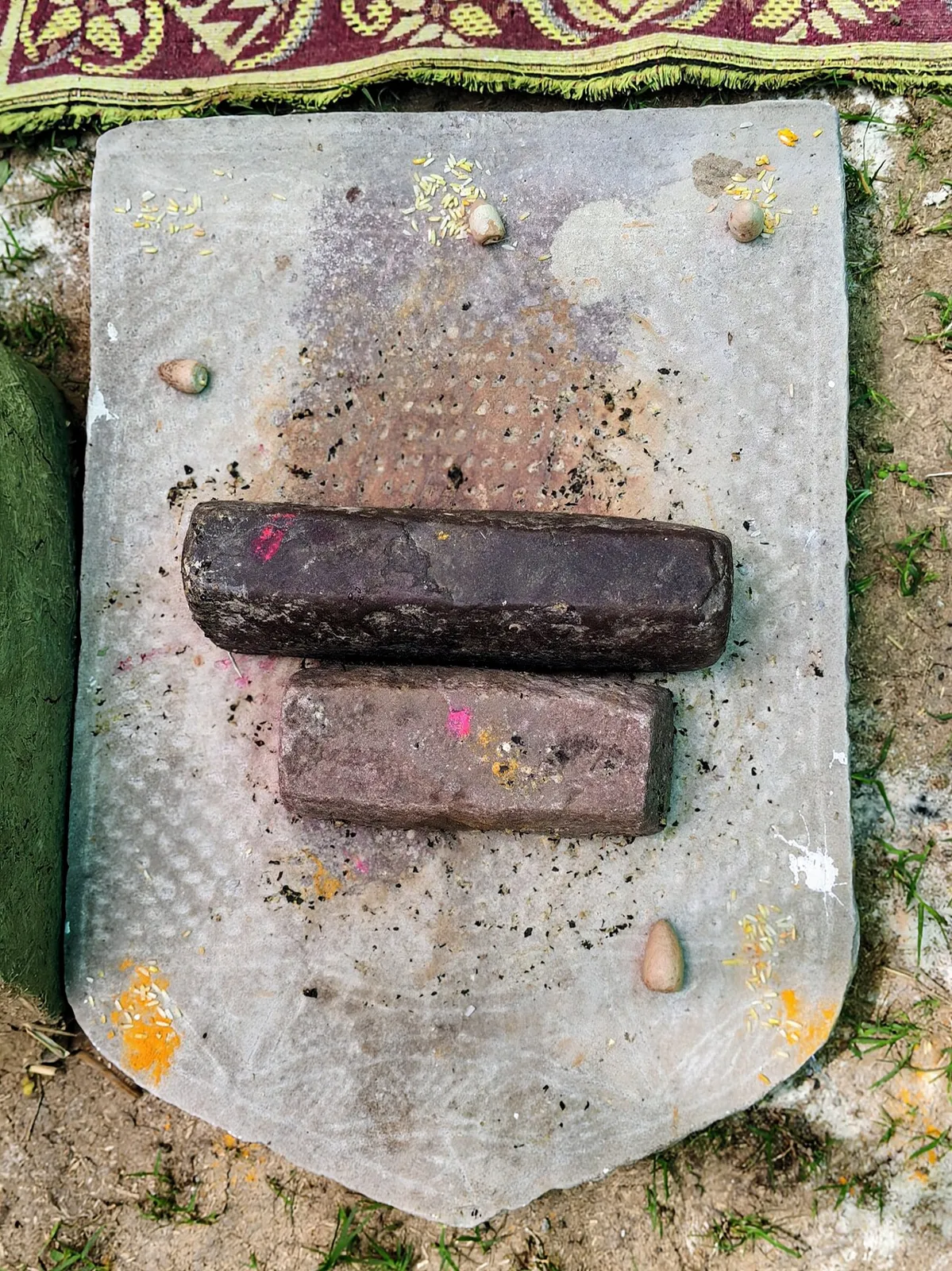
Masala began on stone. King calls it the masala no patthar, a slab with a roller, and says an itinerant worker known as the tankiwali went from house to house roughening its surface from time to time. Khodaiji uses the name piswano pattha and adds a khal-batto, a stone mortar and pestle for small quantities, along with a metal mortar for pounding dry garam masala.
Why keep grinding by hand once mixers arrived? ParsiCuisine.com, Rita Jamshed Kapadia's recipe site, gives two reasons: a stone doesn't heat the spices the way a mixie's blades do, and it crushes by friction where a blade only chops. That fresh-ground paste carries the hot, sour and sweet balance described in our post on tikhu-khatu-mithu.
How did a Parsi kitchen store grain, pickles and staples?
In big jars, mostly. King writes that grains were kept in large Chinese urns, with brass canisters and boxes holding the other staples. An icebox kept things cold until the refrigerator took its place.
Pickles had their own system. FEZANA's 2012 book Eat, Live, Pray says home pickles were made in summer, set out in the sun by day, and stored in glazed jars it calls bannies (the barni many of us know) in a dark, cool spot.
What was the daily routine in a Parsi kitchen?
Khodaiji's memories give the clearest outline of a day. Masala was ground on the stone, and many of the women of the house frowned on the mixie, sure that a good curry needed stone-ground masala. At four o'clock came chai, with simple puris, sweet or salted, and bhakhras. Khodaiji wonders whether the British or the Parsi grannies started that habit. Bhakhras were made in large quantities and served over several days. When a relative from the country brought bottles of tari, palm toddy, some went into bhakhras, sandhnas and kumas, and some was used to marinate meat for the next day's tari ma gosh.
That is one family's routine in one decade. We haven't found a source describing a typical day across many homes, so we won't invent one.
Why does the Parsi kitchen stove get a birthday?
Chulah nu varas, the birthday of the hearth fire, falls on Daepadar roj of Adar mahino, the day before Adar roj. Noshir H. Dadrawala, writing in Parsi Times in 2017 and again in 2026, describes the kitchen being cleaned, the area around the stove decorated and the stove garlanded with marigolds. His 2017 piece says the women of the household keep the day. He writes that the stove is not used from Uzirin Gah, early evening, until the next morning.
Ervad Fardoon D. Karkaria, a panthaky in Bangalore, gives a fuller account on ParsiCuisine.com. He describes the stove area wiped down with water and marked with chalk, and a prayer phrase written in a paste of kumkum and haldi. The kitchen stays closed from Uzirin Gah until Havan Gah on Adar roj, so the family eats cold food or eats out. Next morning the stove is lit again, first for tea or warm milk.
Practice varies between families and Agiaries; your family priest's guidance comes first.
How much of the traditional Parsi kitchen survives today?
Some of it, in pieces. The ParsiCuisine.com grindstone post says the sil batta can still be found in older homes, though the sil-batta katne wala who comes to roughen it is getting hard to find, and it notes that the copper utensils of the not-so-distant past have largely gone. The pieces that remain tend to be heirlooms still in use, like Perzen Patel's engraved patio tapeli. If you'd like to cook from that tradition, our collection of Parsi recipes is a good place to begin.
Frequently asked questions
What is a sigri in a Parsi kitchen?
A sigri is a coal or wood fire used for cooking. Dara M. Khodaiji, in Parsi Times, describes sigris built into the kitchen platform as a receptacle for burning fuel, while Niloufer Ichaporia King describes a portable cylindrical version. Some dishes, such as papri-ma-gosh, were cooked only on the sigri in older homes.
Why were Parsi copper vessels tinned?
Parsi copper pots were tinned, and the tin had to be renewed from time to time. Niloufer Ichaporia King writes in My Bombay Kitchen that wandering tinsmiths called kalai wallas visited Parsi homes to re-tin the copper. Dara M. Khodaiji, in Parsi Times, remembers copper engraved with a great-grandmother's name, from the nineteenth century.
What is the masala no patthar?
The masala no patthar is the flat grinding stone and roller on which Parsi cooks ground fresh masala. Niloufer Ichaporia King writes that a worker called the tankiwali came to roughen its worn surface. Dara M. Khodaiji calls it the piswano pattha. Many cooks kept using it after mixers arrived, sure a good curry needed it.
What is Chulah nu varas?
Chulah nu varas is the birthday of the hearth fire, kept on Daepadar roj of Adar mahino. According to Noshir H. Dadrawala in Parsi Times, the kitchen is cleaned, the stove is garlanded with marigolds and it is not used from Uzirin Gah until the next morning. Customs differ between families, so follow your family priest.


