 PalV's Kasti
On this page
Iranian-style pilao, called polow in Persian, starts with rice soaked in heavily salted water. It is boiled only until the grains swell, drained, and then layered in a pot over ghee and water with the other ingredients, covered and steamed on low heat. Parsi pulao is different. Its flavour comes from meat cooked down in a spiced onion and yoghurt masala, and it reaches the table with fried potatoes, fried dry fruits and a bowl of dal. Mumbai's berry pulao sits between the two: an Iranian barberry rice that an Irani cafe family adapted for Indian diners.
શહેરેવર રોજ
Shehrevar Roj, Tir Mah · 1396 Y.Z.
What is Iranian-style pilao, or polow?
Encyclopaedia Iranica's entry on rice in Persian cooking, written by Ṣoḡrā Bazargan, says that since the Safavid period Iranians have mainly eaten rice in two forms, polow and čelow, and that the difference lies mostly in what goes into the pot.
- Čelow is rice cooked on its own and served on the side of a stew (khoresh) or kebabs.
- Polow is rice layered in the pot with other ingredients, so that everything steams together.
Iranica gives palāw and pilaf as other names for polow. FEZANA's 2012 cookbook Eat, Live, Pray uses "palao" for both an Iranian barberry rice and a spiced Parsi meat rice.
How is Iranian-style pilao cooked?
The Iranica entry describes the method in four stages.
- Soak. The rice sits overnight in water with a lot of salt. Iranica adds that in earlier times rice was kept in salted water for a full week and used gradually.
- Parboil. The soaked rice goes into boiling water and comes out once the grains have grown but are not yet soft.
- Layer. The drained rice goes into a pot where ghee and water are already simmering. For a polow, the other ingredients are layered in with it.
- Steam. The lid goes on and the rice steams over low heat, a step Persian cooks call dam. Iranica gives about an hour.
What is tahdig?
Tahdig is the crisp crust that forms at the bottom of the pot. According to Iranica, a cook who wants one mixes yogurt, saffron and an egg with a little of the rice and spreads it over the ghee before the rest goes in.
What is zereshk polo, the barberry rice?
Zereshk polo is chicken, saffron and barberries layered with rice. Iranica lists it as zerešk-polow and gives a second name, morḡ-polow. Barberries (zereshk) are small, tart berries. FEZANA's cookbook says they grow widely in Iran's Khorasan province and calls Iran the world's largest producer. It also notes that the dish stays vegetarian if you leave the meat out.
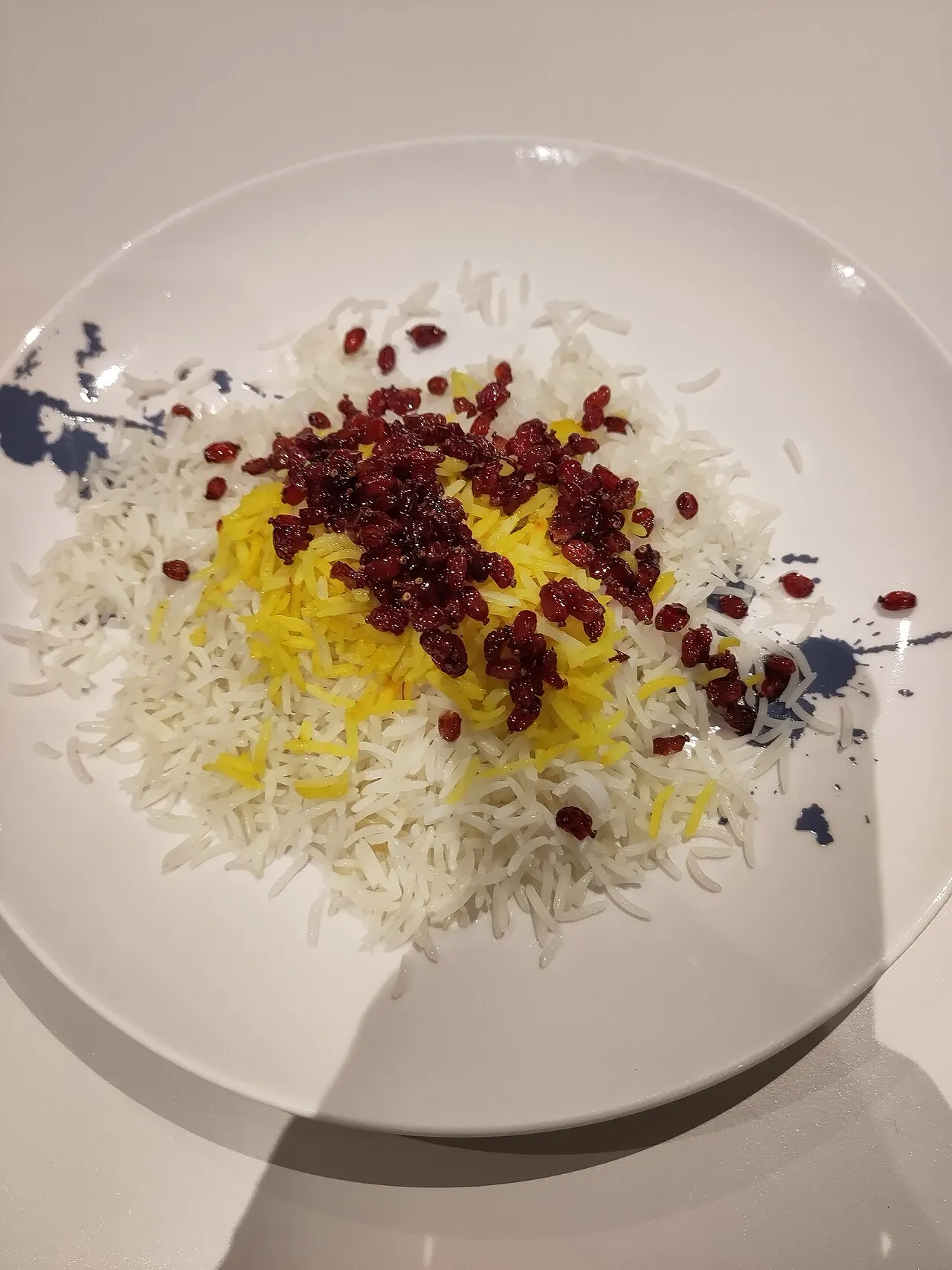
A Zarathushti home recipe for zereshk palao
This method follows Mickie R. Katgara's Zereshk Palao in FEZANA's Eat, Live, Pray: A Celebration of Zarathushti Culture and Cuisine (2012). It keeps the Iranian boil, layer and steam pattern and serves four.
- 900 g chicken, skin removed
- 2 medium onions, chopped
- 260 g (2 cups) basmati rice, soaked for two hours
- 150 g (1 cup) barberries, cleaned
- 7 g (1½ tsp) butter, divided
- 2 g (½ tsp) saffron, powdered with a pinch of salt, divided
- 10 g (2 tsp) sugar
- 1 g (¼ tsp) turmeric
- 1 g (¼ tsp) ground black pepper
- Salt and cooking oil
- Fry the onions in oil until golden. Add the turmeric, pepper and chicken and cook, stirring, for about five minutes.
- Pour in 500 ml water, salt it, and bring it to the boil. Cover and simmer until roughly 120 ml of gravy is left, then stir in a pinch of the saffron.
- Meanwhile boil the rice in a separate pot until nearly cooked. Drain it and pour lukewarm water over it so it stops cooking, since it will finish in the steam.
- Stir ¼ tsp of the saffron into 45 ml warm water, mix it through a quarter of the rice, and keep this yellow rice aside.
- Soak the barberries for 15 minutes, then drain and rinse them.
- Fry the barberries with ½ tsp butter and the sugar until they puff up. Add two pinches of saffron.
- In a large pot, melt 1 tsp butter in 60 ml water over medium heat. Layer in half the white rice, then the chicken with some of its gravy, a third of the barberries, the rest of the white rice, the yellow rice, and finally the remaining barberries.
- Push the rice in from the sides into a low mound, flatten the top a little, and dot it with the last of the butter.
- Wrap the lid in a kitchen towel, cover the pot, lower the heat and let it cook for about 30 minutes. Mix gently and serve on a large platter.
How does Parsi pulao differ from Iranian pilao?
Shabnam Minwalla, writing in Outlook Traveller, puts the change plainly: once the settlers made Gujarat home, what she calls the bland Persian pulaos picked up local spices.
In the same FEZANA cookbook, Teenaz Mahveer Javat's palao boils the rice first and sets it aside. Onions are fried golden, then come ginger-garlic paste and palao masala (the book's home blend is chilli powder, dhana-jeeru, garam masala and turmeric), then yoghurt and tomatoes, then the meat. The rice is mixed in, sprinkled with saffron, covered with sliced boiled eggs, and baked at 180°C for an hour. She serves it with masala daar or raita.
Perzen Patel, the Mumbai caterer who writes as Bawi Bride, said in a 2015 India Food Network piece that a Parsi pulao's main flavour comes from the stock and gravy the meat is cooked in. She also counts deep-fried potato quarters on top and a generous scatter of fried cashews, almonds and raisins among its marks.
| Point of difference | Iranian-style polow | Parsi pulao |
|---|---|---|
| Rice | Soaked in salted water, parboiled, drained, then steamed over ghee and water | Boiled separately, then mixed with the cooked meat |
| Main flavour | Saffron, fat, and what is layered in (chicken, barberries) | Meat cooked in an onion, ginger-garlic, spice, yoghurt and tomato masala |
| Finish | Optional tahdig crust at the base of the pot | Fried potatoes, fried dry fruits, boiled eggs, saffron |
| Eaten with | Polow is a dish in itself; plain čelow goes with stews or kebabs | Dal, kachumber or raita |
Why is Parsi pulao served with dal?
Patel writes that pulaos such as berry pulao are usually paired with dhansak dal made without the meat, with kachumber on the side, because the dal adds moisture and another kick of spice. FEZANA's wedding menu lists "palao with masala ni daar" as the rice course. Urvaksh Hoyvoy of Parsi da Dhabha, speaking to PTI in 2017, called palav daar "our variation of the moghlai biryani". We think that's the right comparison. A Parsi pulao has more in common with a biryani than with a saffron polow from Iran.
Where does Mumbai's berry pulao fit in?
Britannia & Co. at Ballard Pier opened in 1923 under Rashid Kohinoor, an immigrant from Iran, according to both The Tribune and the South China Morning Post. In a 2023 Tribune interview, his grandson Afshin Kohinoor said the restaurant first served continental food and that his mother, Bacha Kohinoor, later introduced the Iranian berry pulao, zereshk polo. In Iran, he said, the dish is served dry with meat, so she created a gravy for Indian diners. FEZANA's cookbook likewise calls Britannia's berry palao an adaptation of the Iranian zereshk polo.
For more home dishes, our Parsi recipes guide is the place to start, and the wider story of the cuisine is in our piece on Parsi food. Two more dishes from the same series are Parsi crumb chops and Parsi falooda.
Frequently asked questions
What is the difference between polo and pulao?
Polo, or polow, is the Persian rice dish in which salted, soaked and parboiled rice is layered with other ingredients and steamed over ghee. Encyclopaedia Iranica gives palāw and pilaf as other names for it. Parsi pulao builds its flavour from meat cooked in a spiced masala, adds fried potatoes and dry fruits, and comes with dal.
What is zereshk polo?
Zereshk polo is an Iranian rice dish of chicken, saffron and barberries, also known as morgh polow. In Mickie R. Katgara's recipe in FEZANA's cookbook, the tart barberries are fried with butter and sugar and layered with the rice and chicken. The same book notes that the dish stays vegetarian if the chicken is left out.
Is berry pulao Iranian?
Berry pulao comes from the Iranian zereshk polo, but the Mumbai dish is an adaptation. Afshin Kohinoor of Britannia & Co. told The Tribune that his mother, Bacha Kohinoor, introduced it and added a gravy, because in Iran it is served dry with meat. FEZANA's cookbook also calls Britannia's version an adaptation.
What is tahdig?
Tahdig is the crisp rice crust that forms at the bottom of a Persian pot of polow. Encyclopaedia Iranica describes how a cook makes one: yogurt, saffron and an egg are mixed with a little of the rice, and the mixture is spread over the ghee in the pot before the rest of the rice goes in.
What do Parsis serve with pulao?
Parsis serve pulao with dal. FEZANA's wedding menu pairs palao with masala ni daar, and Perzen Patel writes that pulaos such as berry pulao usually come with dhansak dal made without meat, plus kachumber. FEZANA's palao recipe suggests masala daar or raita, and Patel adds that Parsi prawn pulao goes well with a simple raita.


