 PalV's Kasti
On this page
- What do Parsis eat for breakfast?
- What is akuri (akoori), and how is it different from bhurji?
- What is a Parsi pora?
- What is sali par eedu, and which other per eedu dishes are eaten at br…
- Which meat dishes turn up at a big Parsi breakfast?
- What sweet dishes are eaten at breakfast, including on Navroz morning?
- Where can you eat a Parsi breakfast in Mumbai?
- Frequently asked questions
Start with akuri, the soft Parsi scrambled egg with onion, green chilli, tomato and coriander. Then try a pora (the Parsi omelette), and one of the per eedu dishes where eggs are set over salli, okra, banana or tomato. If you want the full spread, add kheema, cutlets and a bowl of sweet ravo. On Navroz morning the table turns sweet: malai pao, ravo with fried nuts, sev and mithu dahi. Below we go through each dish, what it is and who describes it, so you know what you are ordering or cooking.
અસપંદામેદ રોજ
Asfandarmad Roj, Tir Mah · 1396 Y.Z.
What do Parsis eat for breakfast?
Not every Parsi morning is a feast. Shabnam Minwalla, who is half Parsi, grew up on toast, butter and strawberry jam. She met only a pale version of the full spread, at relatives' tables in Hyderabad and on holidays at old-style Parsi hotels. In Outlook Traveller in 2021 she recalled her father's account of growing up in a joint family outside Hyderabad, where kheema was eaten every day along with aleti paleti, and plain eggs were only for the sick. His list for a proper morning also ran to bheja (brain) cutlets, gurda-kaleji and akoori.
Eggs sit at the centre of it. Minwalla describes a community convinced that almost any dish improves with an egg on it. The list below follows that: mostly egg dishes, with meat and sweets on either side.
What is akuri (akoori), and how is it different from bhurji?
Akuri is Parsi scrambled egg. Minwalla gives the basic version as eggs scrambled with onion, green chillies, tomato, garlic and kothmir, with an eggier taste and a creamier texture than an ordinary bhurji. Cookery writer Durri Bhalla, in The Telegraph, calls it a very popular Parsi breakfast dish and a creamier take on scrambled eggs.
The method is short. In the recipe Zavare Tengra contributed to FEZANA's Eat, Live, Pray (2012), onions are softened in butter, then chilli, coriander, tomato, ginger and turmeric go in for about three minutes before the beaten eggs are stirred through until they reach the texture you like. It is served at once.
Bharuchi akuri and other versions
Here the sources disagree. Minwalla describes Bharoochi akoori as made with fried potato slices and a startling amount of ghee (600 grams for eight eggs), and names a separate mava ni akoori made with nuts and raisins. Tengra's note in the FEZANA book instead calls the sweeter version, where fried almonds, charoli, cashews, pistachios and raisins replace the spices, Bharuchi akoori. Ask whoever is cooking which one they mean. Minwalla also mentions akuri made with dried Bombay duck, mutton or ripe mango.
What is a Parsi pora?
A pora (also spelt poro) is the Parsi omelette, and it is meant to be flatter than a fluffy Western one. Nari Dastur's recipe in the FEZANA book whisks two whole eggs per pora without separating white and yolk, which Dastur says would make it fluffier, with onion, green chilli and coriander, adds tomato, ginger-garlic or turmeric if you like, and browns each side for three to four minutes in a shallow pan. Dastur suggests serving it with warm crusty bread, cheese and jam for breakfast, or rolling it in a rotli for a picnic.
Minwalla calls the plain pora an unexciting omelette until it is stuffed with prawns, chopped brain or de-boned Bombay duck. The pora also has a famous eater in former Tata Steel chairman Russi Mody. A Food52 article says he ate a 16-egg poro for breakfast, while Minwalla, in a 2018 Outlook Traveller piece, writes of his 18-egg-omelette breakfasts. We can't tell you which number is right.
What is sali par eedu, and which other per eedu dishes are eaten at breakfast?
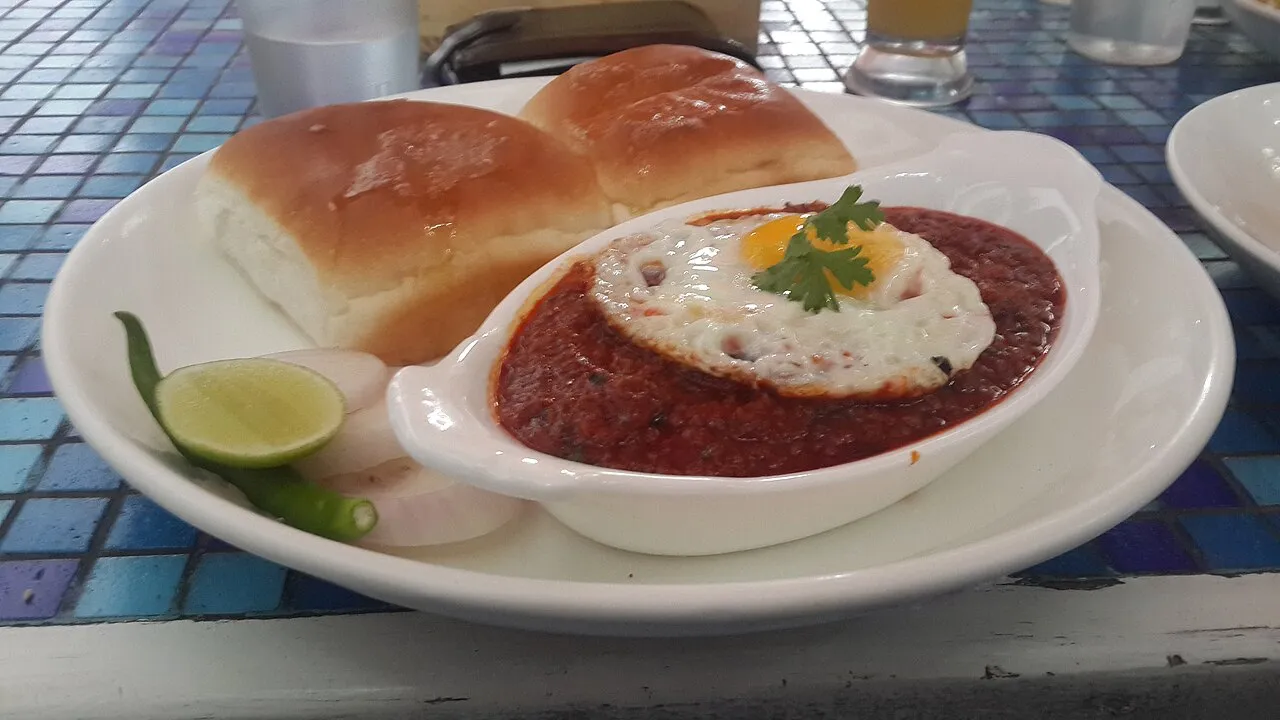
Par eedu (also written per eedu or par eeda) means, in Meher Mirza's translation in SAVEUR, "egg cooked over something". Food52 says that something can be anything from potato chips to okra. Salli par eedu sets eggs over salli, the potato wafer sticks that Durri Bhalla also lists in jardaloo salli boti. Minwalla names bhindi par eedu (okra), kera par eedu (banana) and tamater par eedu (tomato), where the base is covered with egg and cooked over low heat. She adds that many Parsis say it is the only way they can digest their vegetables.
We have separate posts on per eedu as a whole and on the okra, tomato and kheema versions, each with a named recipe, so we won't repeat the methods here.
Which meat dishes turn up at a big Parsi breakfast?
- Kheema, spiced mince. Minwalla remembers wanting it topped with chopped onion and a squeeze of lime.
- Kheema ghotala, kheema scrambled with egg and masalas into something springy and spicy.
- Aleti paleti: chicken heart, liver and gizzard, chopped and fried with ginger-garlic paste.
- Gurda-kaleji, goat kidney, liver and lungs, which Minwalla says were given a slug of toddy.
- Bheja cutlets, frilly brain cutlets.
Minwalla's fullest description of the spread is of the old Majestic Hotel in Udvada, where breakfast brought akoori, kheema, gurda-kaleji and cutlets, then crisp-fried boi machhi and sweet ravo. She notes that the hotel has since shut, so this is a memory, not a booking tip.
What sweet dishes are eaten at breakfast, including on Navroz morning?
Sweet ravo is a semolina custard, and Minwalla calls it a perfect breakfast treat. She met it at her Hyderabad relatives' homes alongside homemade pumpkin and mango murambo, and again at Udvada. That Udvada morning began with doodh na puff: milk left out overnight in the garden and then whipped until frothy.
For Navroz, Meher Mirza describes her own family's morning in SAVEUR. It is malai pao (the layer of cream off heavy milk, eaten with white bakery bread), ravo with butter-fried raisins, pistachios, almonds and charoli, sev scented with cardamom and nutmeg, or mithu dahi, lightly sweetened yoghurt. She calls them sweet omens for the year ahead. That is one family's table, and yours may look different.
One more, if you can find it: topli nu paneer, the small soft cheese that carries the mark of the wicker basket it sets in. In an essay in the FEZANA book signed N.I.K., the writer looks back on Bombay mornings of eating far too many of them with soft or crusty pao and gooseberry jam from the Women's India Trust.
Where can you eat a Parsi breakfast in Mumbai?
We have not found a reliable, current list. The one recent report we could check is from the Free Press Journal, dated December 2025: it said Mumbai's Ripon Club changed its menu daily, with akuri on toast on Mondays and salli par edu on Tuesdays. The paper called the club an exclusive preserve of Parsis, and its reporter was taken there by a colleague. We have not confirmed the club's menu, access rules or status since that report, so check before you plan a visit. Minwalla also noted in 2021 that the Parsi breakfast had become the subject of pop-ups, blogs and special menus.
If you want to cook beyond breakfast, our guide to Parsi recipes is the place to start, and our overview of Parsi food explains how the cuisine came together. For something to eat alongside, read about gharab nu achaar, the fish roe pickle, and for the colder months, see our piece on Parsi winter foods.
Frequently asked questions
What is the most famous Parsi breakfast dish?
Akuri turns up in most of the accounts we read. It is eggs scrambled with onion, green chilli, tomato and coriander, creamier and eggier than an ordinary bhurji. Durri Bhalla calls it a very popular Parsi breakfast dish, and a December 2025 Free Press Journal report found it on toast at Mumbai's Ripon Club on Mondays.
What does par eedu mean?
Par eedu, also written per eedu or par eeda, means "egg cooked over something", in Meher Mirza's translation. The base is covered with egg and cooked over low heat. Bases named in the sources include salli (potato wafer sticks), okra, banana and tomato, and Food52 says the base can be anything from potato chips to okra.
Is a Parsi pora the same as a masala omelette?
It is close. A pora is a thin omelette with onion, green chilli and coriander, and sometimes tomato, ginger-garlic or turmeric. Nari Dastur's FEZANA recipe whisks whole eggs without separating them, so it comes out less fluffy. Shabnam Minwalla says the plain version is unexciting and proves its Parsi roots with stuffings such as prawns, brain or de-boned Bombay duck.
What do Parsis eat on Navroz morning?
It differs between families. Meher Mirza, writing in SAVEUR, describes her own Navroz morning as sweet: malai pao with white bakery bread, ravo with butter-fried nuts and raisins, sev fragrant with cardamom and nutmeg, or mithu dahi. She treats these sweets as good omens for the year ahead.
Is ravo a breakfast dish?
Yes. Ravo, a sweet semolina custard, appears at Parsi breakfasts in both Shabnam Minwalla's and Meher Mirza's accounts. Minwalla ate it at relatives' homes in Hyderabad and at a hotel breakfast in Udvada. Mirza serves it on Navroz morning, finished with butter-fried raisins, pistachios, almonds and charoli.


