 PalV's Kasti
On this page
Parsi berry pulao is the barberry rice made famous by Britannia & Co., the Irani cafe at Ballard Estate in Mumbai's Fort area. It began as the Iranian zereshk polo, saffron rice studded with small, sour red barberries. In Mumbai it picked up a spiced tomato gravy with chicken, and fried onions and cashews on top. Britannia has never handed out its recipe, so home cooks work from published versions. The one we follow here is Madhur Jaffrey's vegetarian berry pulav from Curry Easy Vegetarian. You soak the basmati and a saffron milk for three hours, brown sliced onion with the berries and sugar, parboil the rice with whole spices, then layer everything with butter and bake it covered for half an hour. It serves four to six.
શહેરેવર રોજ
Shehrevar Roj, Tir Mah · 1396 Y.Z.
What is Parsi berry pulao?
Berry pulao (also written berry palao, berry pulav or berry pilaf) is layered rice with dried barberries, usually served with chicken. FEZANA's 2012 cookbook Eat, Live, Pray calls Britannia's berry palao an adaptation of the Iranian zereshk polo: zereshk is the barberry, polo the cooked rice.
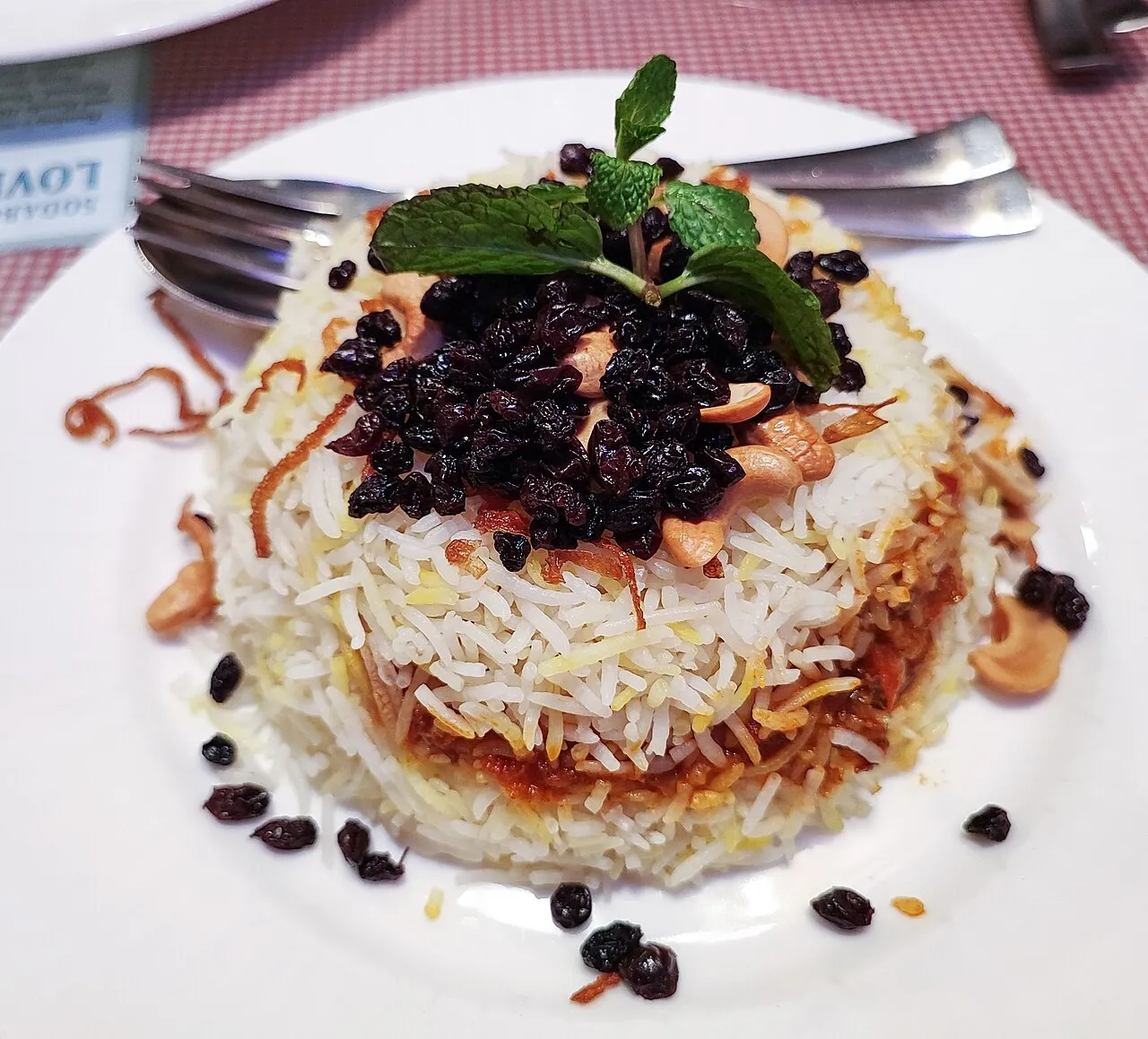
At Britannia the plate is richer than the Iranian original. NPR in 2019 described chunks of chicken in a tomato sauce mixed into the rice and finished with sour barberries, and The Better India added fried shallots, cashews and caramelised onions to the toppings. Jaffrey sums up the final taste as sweet and sour.
Is berry pulao Parsi or Irani?
Both, depending on which side of the family you look at. Britannia was founded in 1923 by Rashid Kohinoor, a Zoroastrian from Iran. The Tribune names his home province as Yazd. The dish itself came later and is credited to a woman of the family, though accounts differ on who she was and when:
- The Tribune (2023) and NPR (2019) credit Boman Kohinoor's wife and name her Bacha. The Better India (2019) spells it Bachan and says she worked as a legal adviser in Iran for several years before retiring to Mumbai.
- Her son Afshin Kohinoor told Deccan Herald that his mother, "a Parsi lady", brought in the Iranian dishes in 1982. Madhur Jaffrey also writes that Boman married a Parsi.
- BBC Travel (2023) gives the same year, August 1982, but presents the story as legend and names Bachan as the wife of Rashid Kohinoor rather than of his son.
So the rice is Iranian at root, and the gravy and spices that make it "Parsi berry pulao" came from a Parsi cook in an Irani cafe. Our Britannia & Co. history covers the restaurant and the family in full.
How is it different from Iranian zereshk polo?
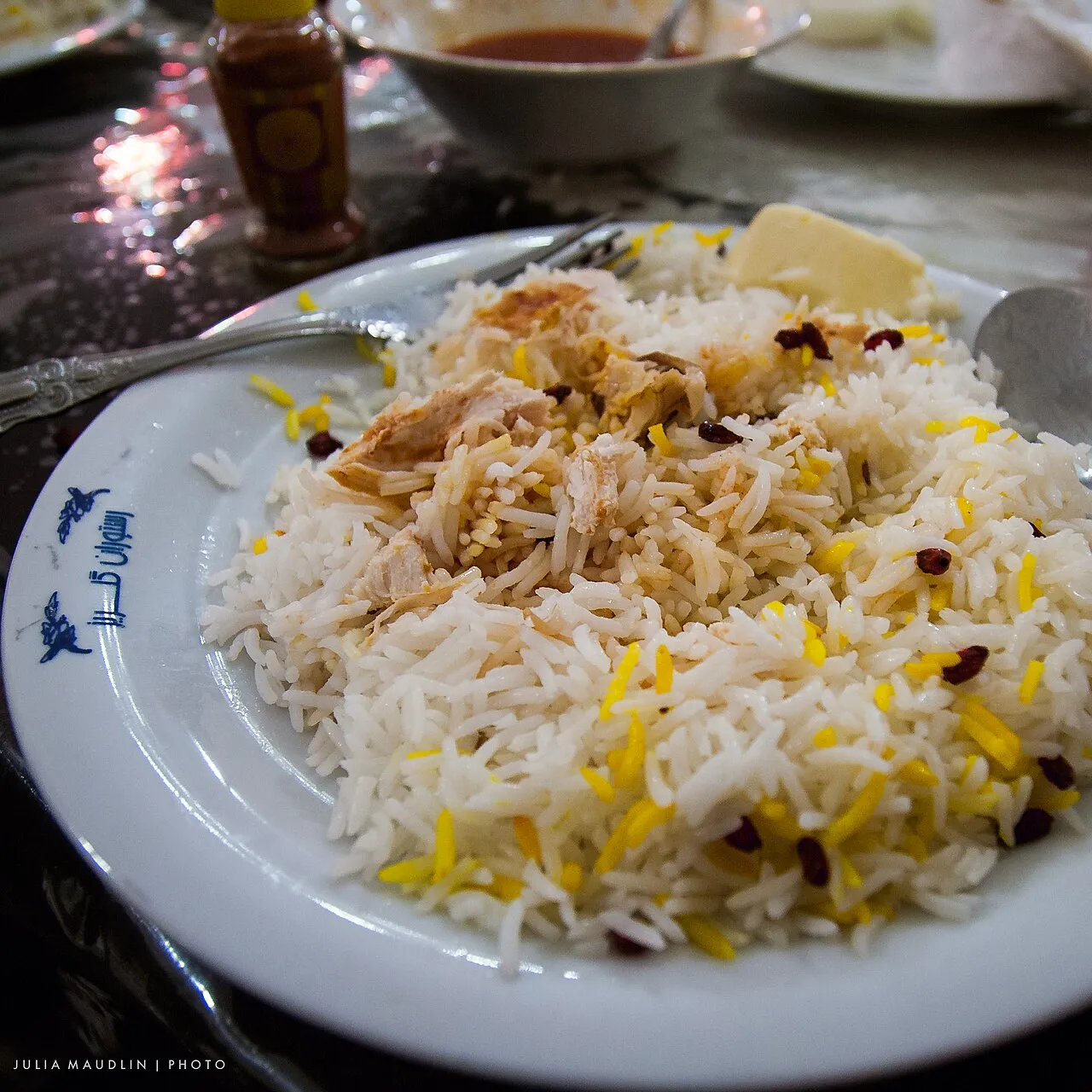
The gravy. The Tribune reports that zereshk polo is eaten dry with meat in Iran, and that Bacha Kohinoor created a gravy because Indian diners would not want rice without one. The Better India says she added more spices as well. The Iranian way of cooking it is on our Zereshk palau page.
Which berries go into berry pulao, and where do you buy them?
The berry is the barberry, zereshk in Persian. FEZANA's cookbook describes its flavour as slightly tart and notes that it grows widely in Iran's Khorasan province, which it says makes Iran the world's largest producer. Britannia buys its berries from Iran, according to The Tribune, The Better India and Afshin Kohinoor himself.
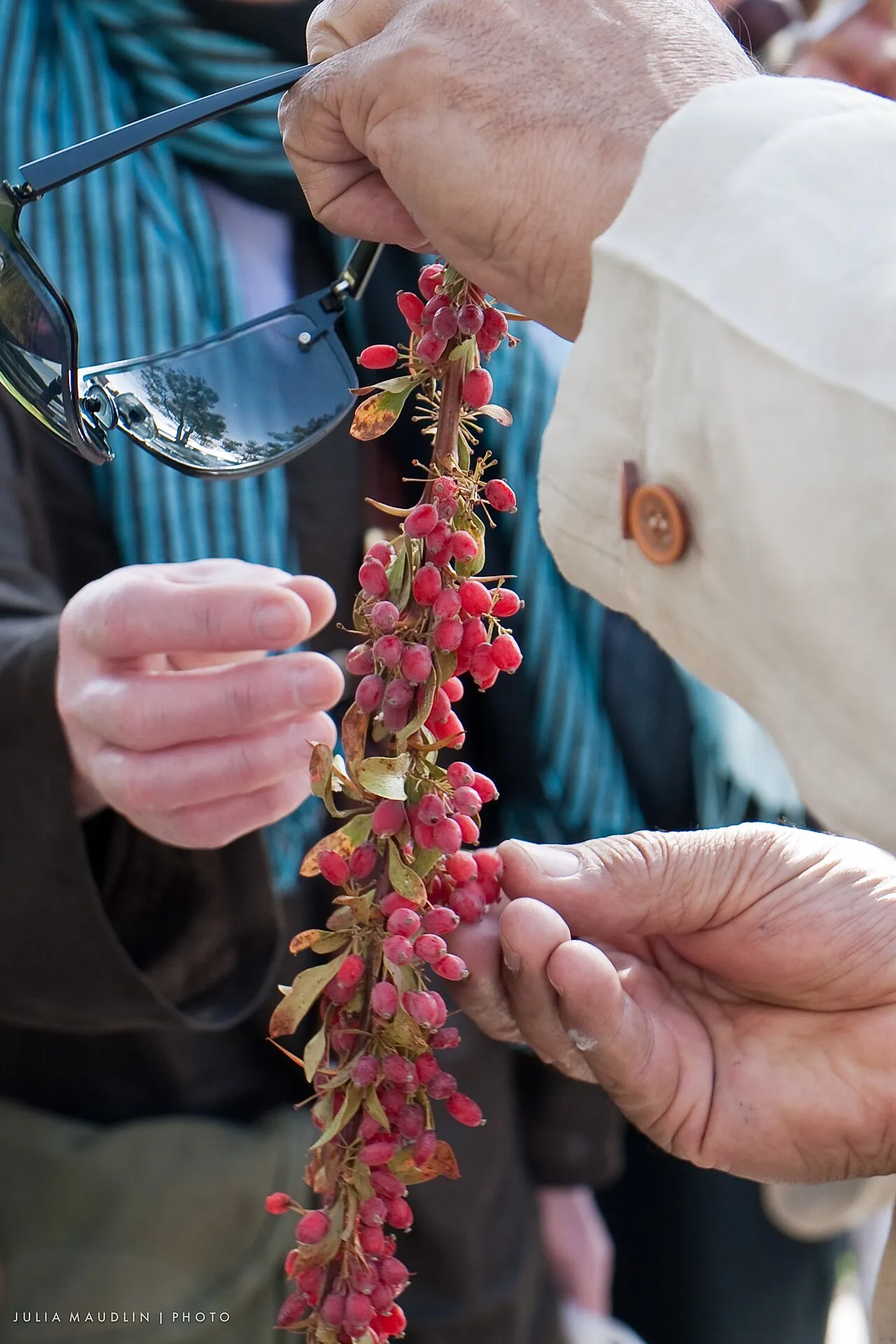
For home cooking, Jaffrey says Indian and Persian grocers stock barberries and that dried cranberries will do if you cannot find them. Dishoom made the same swap in its published homage to the Britannia dish, saying barberries are tricky to find.
How do you cook berry pulao at home?
This method follows Madhur Jaffrey's Berry Pilaf (Berry Pulav) recipe in Curry Easy Vegetarian, written here in our own words. Jaffrey writes that when she asked Boman Kohinoor for the cafe's recipe, he joked that he would hand it over in exchange for the formula for Coca-Cola, so she created her own meatless version of the dish. It serves four to six.
Ingredients
- 475 ml (measured by volume) good basmati rice
- 1 tsp saffron threads
- 3 tbsp sugar, split into 1 tbsp and 2 tbsp
- 3 tbsp milk, very hot
- About 30 g dried barberries (dried cranberries if you cannot find them)
- 3 tbsp peanut or olive oil
- 1 large onion, halved lengthways and sliced into thin half-rings
- 1½ tbsp salt
- 5 cardamom pods, a 4 cm piece of cinnamon, 1 bay leaf and 3 cloves
- 3 tbsp melted butter
Method
- Rinse the rice in a few changes of water, cover it well with fresh water and leave it to soak for 3 hours.
- At the same time, pound the saffron with 1 tbsp of the sugar to a powder, stir it into the hot milk and leave that for 3 hours too.
- Rinse the berries, soak them for 20 minutes, then drain and pat them dry.
- Heat the oil in a frying pan over medium-high heat and fry the onion for about 5 minutes until it begins to colour. Lower the heat to medium-low and keep cooking until it turns reddish-brown. Stir in the berries and the other 2 tbsp sugar, then take the pan off the heat.
- Heat the oven to 160°C (gas mark 3).
- Set roughly 2.5 litres of water on a fierce boil with the salt and whole spices. Drain the rice, add it and boil for roughly 5½ minutes, until three-quarters done with a thin hard core left in each grain. Drain.
- Brush an ovenproof pan with 1 tbsp butter. Spread in half the rice, then another 1 tbsp butter, half the saffron milk and half the onion and berries with some of their oil.
- Add the rest of the rice and top it with the last of the butter, saffron milk and onion-berry mix.
- Seal with foil and a lid and bake for 30 minutes. Let it stand, unopened, for 10 minutes, then toss gently and serve.
Serving it, and adding meat
Jaffrey suggests serving her pulav with aubergine, spinach or paneer dishes. Her version leaves out the chicken and meatballs that Britannia adds. If you want a chicken berry pulao, Dishoom's published homage takes a different route: it cooks marinated raw chicken under the parboiled rice in the kacchi style from Hyderabad, with butter, cream, saffron water and cranberries on top, then bakes the sealed pot. Treat that as a separate recipe rather than mixing the two.
Where can you eat berry pulao in Mumbai?
Britannia & Co. is the name every source ties to the dish, and The Tribune's centenary report in 2023 described it serving both meat and vegetarian versions. Writing for Gateway House in July 2019, its Bombay History Fellow Sifra Lentin noted that Universal, another Irani Zoroastrian restaurant in Fort, had more recently begun serving berry pulao as well. Hours and menus change, so check with the restaurant before you go.
Frequently asked questions
What is Parsi berry pulao made of?
At Britannia & Co. in Mumbai it is basmati rice with chicken in a spiced tomato gravy, topped with tart barberries, fried onions and cashews. Madhur Jaffrey's home version keeps the rice, saffron milk, barberries and browned onions but leaves out the meat, using whole spices, sugar and butter to round out the sweet and sour flavour.
Is berry pulao Parsi or Irani?
It starts from the Iranian zereshk polo, and Britannia & Co., an Irani cafe founded in 1923, says it pioneered the dish in India. Afshin Kohinoor credits his mother, whom he describes as a Parsi lady, with adding the dish and its gravy in 1982. Accounts spell her name Bacha or Bachan, and BBC Travel calls the story legend.
How far ahead should I start making berry pulao?
Start about four hours before you want to eat. Madhur Jaffrey's recipe soaks the rice and the saffron milk for three hours each, side by side. After that, the berries soak for 20 minutes, the rice boils for about five and a half minutes, the pot bakes for 30 minutes and rests for 10.
Can I use cranberries instead of barberries?
Yes. Madhur Jaffrey lists dried cranberries as the stand-in when barberries are not available, and Dishoom uses cranberries in its own homage to the Britannia dish. Barberries remain the berry of the original Iranian zereshk polo, and Jaffrey notes that Indian and Persian grocers sell them, so look there before you swap.
Where can I eat berry pulao in Mumbai?
Britannia & Co. at Ballard Estate in Fort is the restaurant most linked with the dish, and in 2023 The Tribune reported it serving meat and vegetarian versions. Gateway House noted in 2019 that Universal, another Irani Zoroastrian restaurant in Fort, had more recently added berry pulao. Check timings with the restaurant before visiting.


