 PalV's Kasti
On this page
- Who founded Britannia & Co., and when?
- Why is it called Britannia?
- Who was Boman Kohinoor?
- How did the Britannia menu change after independence?
- What are Britannia & Co.'s signature dishes?
- What is inside the restaurant?
- Who runs Britannia & Co. today?
- Where is Britannia & Co., and when is it open?
- Frequently asked questions
Britannia & Co. is an Irani restaurant at Ballard Estate in Mumbai's Fort area, opened in 1923 by Rashid Kohinoor, a Zoroastrian from Yazd in Iran. Family members say the British name was chosen to win a licence from a colonial official. The menu began as plain continental food for European diners and turned to spicier Indian and Iranian dishes after independence. Its best-known plate is chicken berry pulao, a gravy-rich take on the Iranian zereshk polo that the family credits to Bacha Kohinoor, wife of Rashid's son Boman. Boman ran the restaurant for some eighty years and died in September 2019, aged 97. The restaurant marked its centenary in 2023 under his son Afshin and granddaughter Diana.
શહેરેવર રોજ
Shehrevar Roj, Tir Mah · 1396 Y.Z.
Who founded Britannia & Co., and when?
Rashid Kohinoor opened the restaurant in 1923. The Tribune's centenary feature describes him as a businessman from the province of Yazd, and The Better India calls him an immigrant Zoroastrian. That puts the Kohinoors among the Irani families. In a 2007 interview Boman described the Iranis as coming to Bombay later than the Parsis, and said his family left Yazd for a better life after the villages there ran short of water. The Better India gives a different reason, saying Rashid's ancestors left Iran to escape religious persecution.
The year carries a family detail. Rashid's son Boman was born in 1923 too, so the man and the restaurant were the same age. Boman said as much in that 2007 interview, recorded for the Irani Chai, Mumbai oral history project. In the same interview he said his grandfather had run an earlier place, Kohinoor Restaurant, near the Bombay GPO, from around 1890 or 1895. That date rests on his memory alone.
Britannia is one of many cafes that Irani migrants opened across the city. For the wider story of those cafes, see our guide to the Irani cafes of Mumbai.
Why is it called Britannia?
The family gives two versions of one story, and both tie the name to getting permission to trade under British rule. Afshin Kohinoor, Boman's son, told The Tribune in 2023 that a British municipal officer promised his grandfather a licence within a day if the business carried a British name. Boman himself told NPR in 2019 that his father chose the name to please the local commissioner, who was giving out leases at the time. Neither account has been confirmed from municipal records, so read it as the family's own explanation.
Who was Boman Kohinoor?
Boman Rashid Kohinoor was the face of Britannia for most of its first century. According to The Better India, he took charge at 16, after his father died in an accident in 1939. He told NPR in 2019 that habit had brought him to the restaurant every day for eighty years, and he spent lunch hours going from table to table chatting with diners.

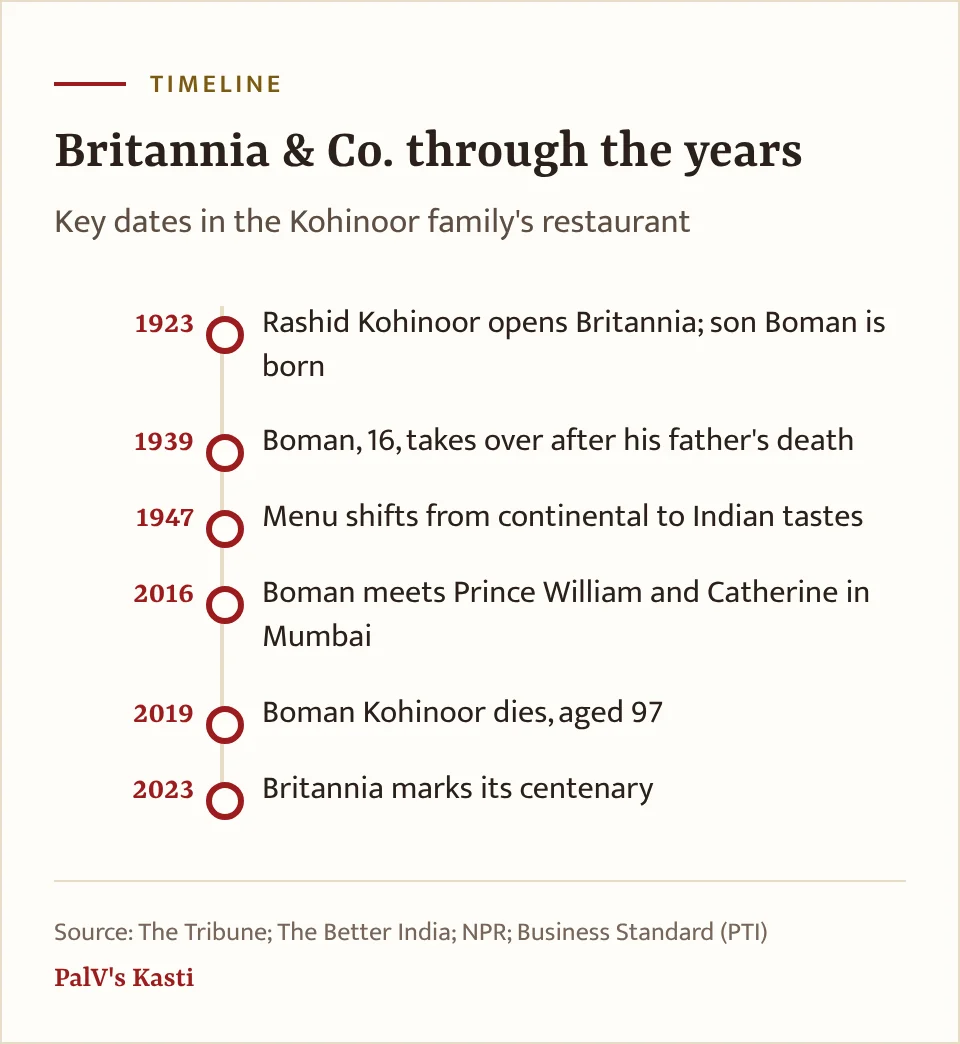
He was also famous for his devotion to the British royal family. He wrote to Queen Elizabeth II over the years and received a reply from Windsor Castle. He was the star of a 2016 social media campaign to meet Prince William and Catherine, and when the couple visited Mumbai that year they invited him to meet them at the Taj Mahal Palace hotel. Business Standard (PTI) and the Deccan Chronicle (AFP) both reported his death on 25 September 2019 at the Parsee General Hospital, aged 97.
The building lived through other history in his time. The Tribune's centenary feature says the British took over the premises to store ammunition during the Second World War. We found no second source for that, so read it as that paper's account.
How did the Britannia menu change after independence?
In 2007 Boman described the early menu as continental and bland, cooked for Europeans who did not eat spicy food. He listed beef steak, chops and fish and chips as dishes that had since left the menu. After 1947 the cooking moved toward Indian tastes, with masala, pulao, biryani and gravy dishes. NPR's 2019 report says the same: lighter European food at the start, then Iranian comfort food added after independence.
The person the family credits with the dishes people now queue for is Boman's wife. The Tribune spells her name Bacha and The Better India spells it Bachan. The Better India says she worked as a legal adviser in Iran for several years and brought in her recipes after she retired and came back to Mumbai. Both say the berry pulao was her doing, and NPR adds that most of today's menu still follows her recipes, which the family keeps private.
What are Britannia & Co.'s signature dishes?
- Chicken berry pulao. NPR calls it the signature dish. In Iran, zereshk polo is a dry rice served with meat, and Afshin told The Tribune that his mother added a gravy because Indian diners would not want rice without one. The barberries are imported from Iran. Our page on berry pulao covers the dish itself.
- Salli boti. Mutton in a red-brown gravy, topped with crisp potato straws.
- Dhansak. Meat cooked into lentils and vegetables, served with brown rice.
- Caramel custard to finish. Outlook Traveller's 2025 guide suggests a Pallonji's raspberry soda alongside.
The Better India's 2019 list of Bachan's additions also includes patra ni machhi. The Tribune's centenary piece names Persian sweets as the house desserts, among them a pistachio and rosewater baklava and gaz, the Iranian nougat. Menus change, so ask on the day.
What is inside the restaurant?
Much of the room is old. The Better India and The Tribune both report that the bentwood chairs were imported from Poland in Rashid's time and are still in use. On the walls, NPR and The Better India both describe a portrait of Queen Elizabeth II hanging next to a painting of Gandhi, with pictures of Zarathushtra in white robes nearby. The Deccan Chronicle mentions a large cardboard cut-out of Prince William and Catherine.
The black cockerel in the Britannia logo has a story too. The Better India, quoting The Hindu, says it was a tribute to a pet that belonged to Bachan Kohinoor.
Who runs Britannia & Co. today?
The Kohinoor family still runs it. When the restaurant turned 100 in 2023, The Tribune described Afshin Kohinoor as the third generation and Chef Diana, Boman's granddaughter, as the fourth. NPR's 2019 report also names Romin, another of Boman's sons, who had worked the cash counter for four decades, and says Diana was keeping the books at the time. The two reports differ on one point: The Tribune calls Diana Afshin's daughter, and NPR calls her Romin's.
In 2019 The Better India, citing The Hindu, reported that the restaurant's 99-year lease was due to run out in 2023. We could not find a published account of how the lease was settled. The restaurant was still listed as open in November 2025.
Where is Britannia & Co., and when is it open?
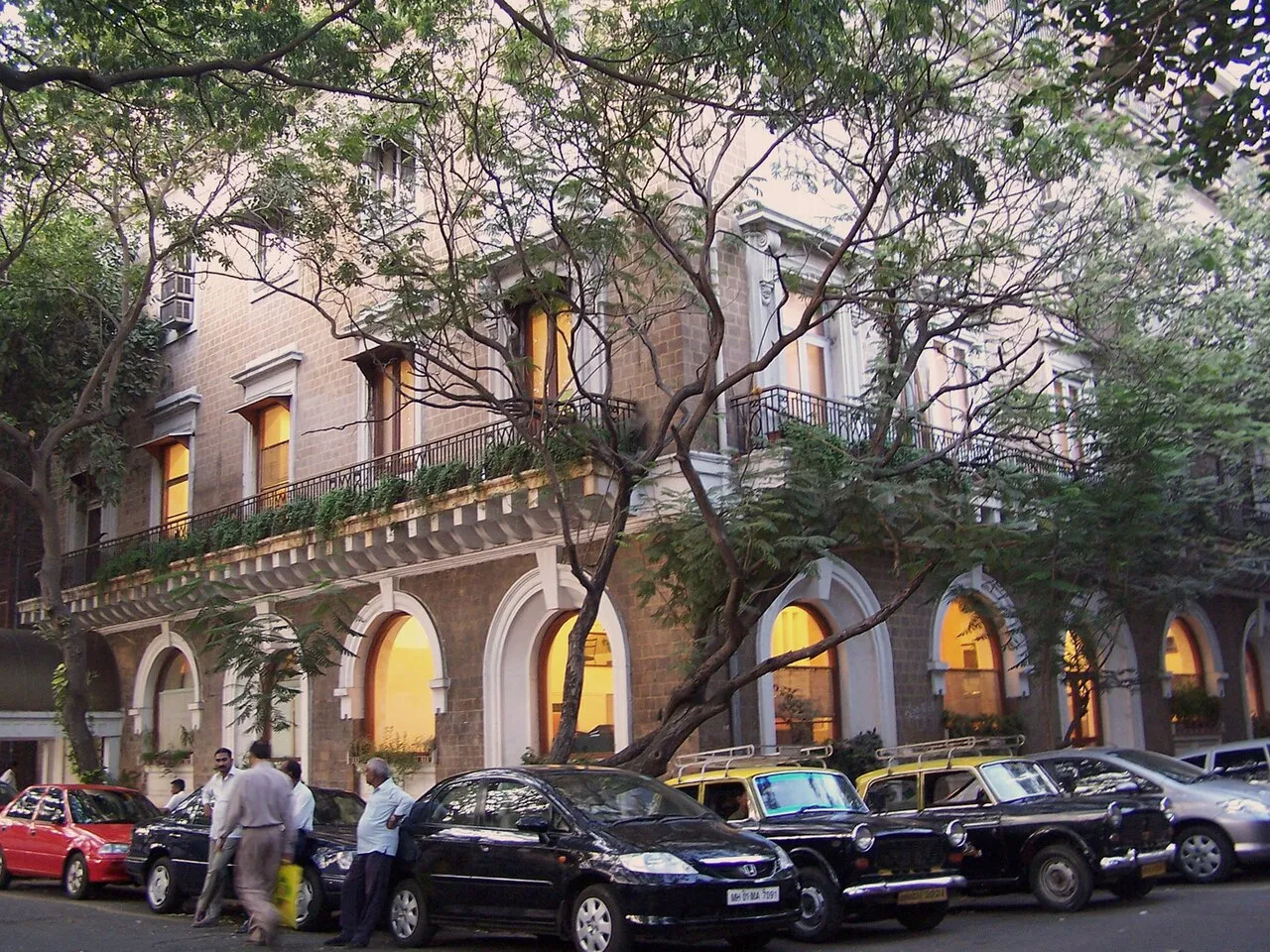
Britannia is at Wakefield House, opposite the New Customs House, Ballard Estate, Fort, Mumbai 400001. Outlook Traveller's November 2025 guide gives its hours as Monday to Saturday, 11:30 am to 4 pm, which matches what The Better India printed in 2019, when it also said the restaurant stays shut on Sundays. It is a lunch place, so plan a midday visit and check the hours before you travel, because they have not been confirmed for 2026.
Frequently asked questions
Who founded Britannia & Co. in Mumbai?
Rashid Kohinoor, a Zoroastrian from Yazd in Iran, opened Britannia & Co. at Ballard Estate in 1923. His son Boman, born the same year, took over as a teenager and ran it until his death in 2019. Boman's son Afshin and granddaughter Diana carried the family restaurant into its centenary year.
Why is the restaurant named Britannia?
According to the Kohinoor family, Rashid Kohinoor picked a British name to get permission to trade. Afshin Kohinoor says an official promised a licence within a day for a British name, while Boman Kohinoor said his father wanted to please the commissioner handing out leases. No official record of this has been published.
What is Britannia & Co. famous for?
Britannia is best known for chicken berry pulao, a gravy-rich version of the Iranian zereshk polo topped with barberries brought from Iran. Diners also come for salli boti, dhansak, caramel custard and Pallonji's raspberry soda, and for the old room, with its Polish bentwood chairs and a portrait of Queen Elizabeth II on the wall.
Is Britannia & Co. open on Sunday?
No. Published listings say Britannia & Co. is closed on Sundays. Outlook Traveller's November 2025 guide gives its hours as Monday to Saturday, 11:30 am to 4 pm, so it serves lunch only. Opening times have not been confirmed for 2026, so call or check a recent listing before you go to Ballard Estate.
Who was Boman Kohinoor of Britannia?
Boman Rashid Kohinoor was the son of Britannia's founder and ran the restaurant for about eight decades. Known for greeting diners at every table and for his love of the British royals, he met Prince William and Catherine in Mumbai in 2016. He died at the Parsee General Hospital on 25 September 2019, aged 97.


