 PalV's Kasti
On this page
- What is a Bombay Irani cafe?
- Who were the Iranis who opened Mumbai's cafes?
- How did Irani cafes become part of Bombay's history?
- What do Irani cafes serve?
- How many Irani cafes were there in Mumbai, and how many are left?
- Which are the oldest Irani cafes in South Mumbai?
- Why are Irani cafes closing?
- Frequently asked questions
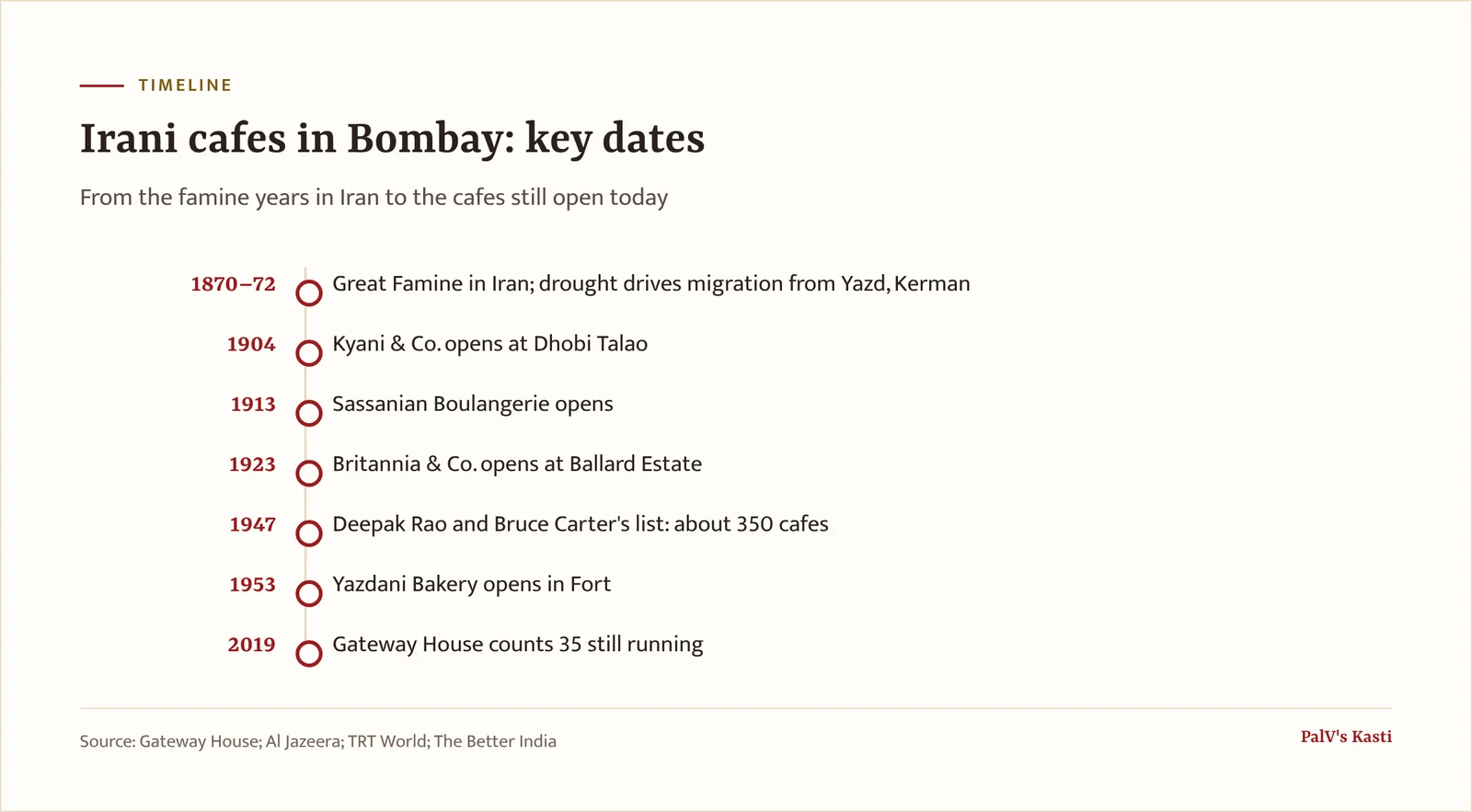
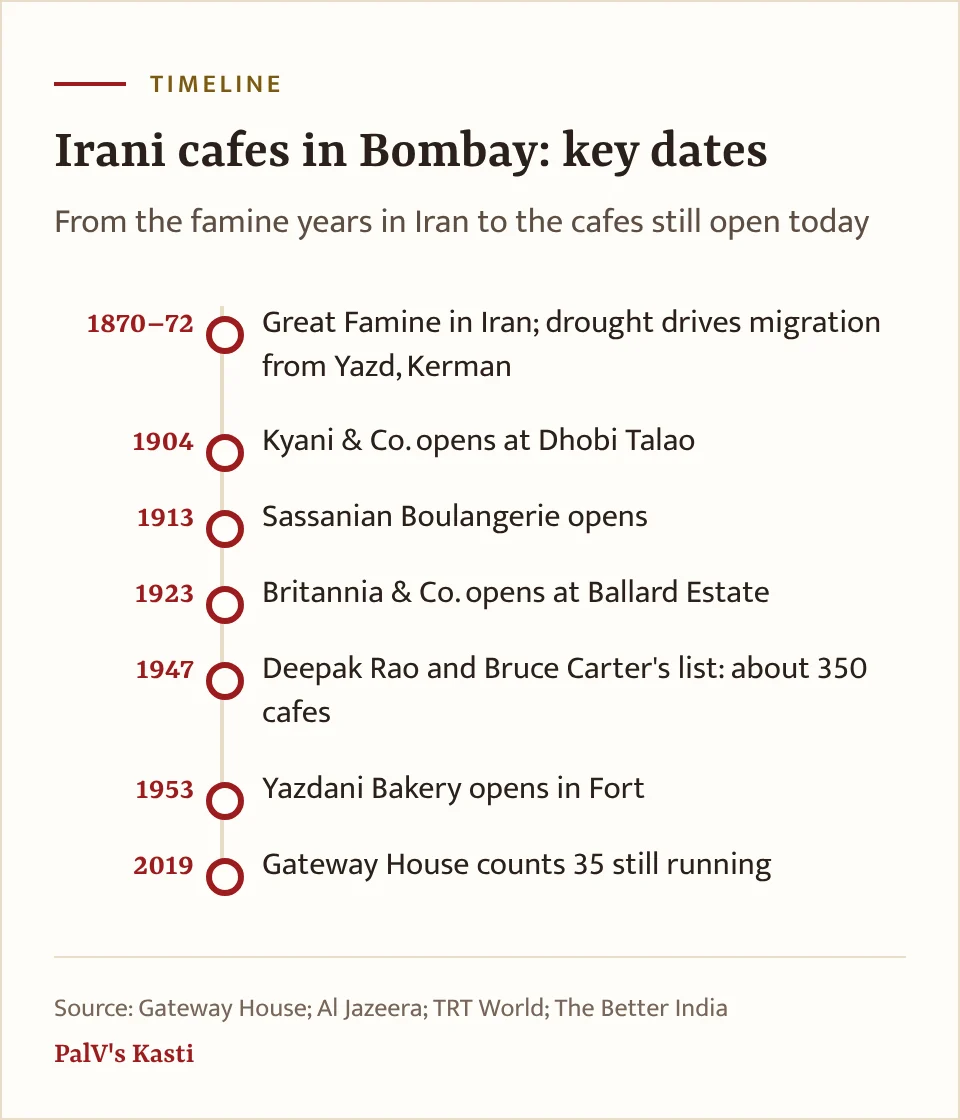
An Irani cafe in Mumbai is a no-frills tea room and bakery opened by migrants from Iran, most of them Zoroastrians from Yazd and Kerman, along with a smaller number of Shia Muslims. The big wave came in the late 19th and early 20th centuries. The cafes sold cheap sweet milky tea and buttered bread to the mill hands and clerks of a fast-growing port city, and they set up on street corners all over Bombay. A list compiled for 1947 counted about 350 of them. Published counts, the latest from 2019, put the survivors at 25 to 35, among them Kyani & Co. (1904) and Britannia & Co. (1923).
અદીબેહેસત રોજ
Ardibehesht Roj, Tir Mah · 1396 Y.Z.
What is a Bombay Irani cafe?
A Bombay Irani cafe, also called an Irani restaurant or an Irani chai shop, is a family-run eating house started by an Iranian immigrant, very often on the ground floor of a corner building. The menu is short. Chai, bun maska, brun pav, eggs and a few cooked dishes are the core of it, and many cafes also ran a bakery counter and sold small household goods. Sifra Lentin, writing for Gateway House in 2019, describes the early cafes as "cafés-cum-provision stores" where toiletries, over-the-counter medicines and detergent could be bought along with tea.
The look is easy to recognise. Gateway House and TRT World both describe bentwood chairs, marble-topped tables, chequered floors and big wall mirrors, and TRT World and Al Jazeera mention the high ceilings. How that room worked, from the cash counter to the famous house rules, is a story of its own, and we cover it in our piece on Irani cafe culture.
Are Irani cafes the same as Parsi cafes?
Not quite. The Zoroastrian Iranis share their faith with the Parsis, but they came to India from Iran much later, in the 19th and 20th centuries, while the Parsis were already an established community in Bombay. Gateway House points out that census takers counted Irani Zoroastrians together with "the older Parsi community", so there is no separate census figure for them. And not every Irani cafe owner was Zoroastrian, since Shia Iranian families ran some of them too.
Who were the Iranis who opened Mumbai's cafes?
Most were Zoroastrians from the dry Iranian provinces of Yazd and Kerman. Both Gateway House and Sahapedia's essay on the cafes name those two regions as the main source of the Bombay Iranis, and Gateway House adds that Shia families from the same area took the same road. The Encyclopaedia Iranica entry on Bombay's Persian communities, written by the historian John R. Hinnells, puts it plainly: the Zoroastrians who came to India "became famous for their tea shops".
Why they left is told a little differently by different writers. Gateway House links the first big wave to droughts that began with Iran's Great Famine of 1870 to 1872. Sahapedia's essay says the Zoroastrians were escaping persecution and that it was mainly the non-Zoroastrian Iranis who were fleeing that famine. A TRT World feature by Kalpana Sunder names both famine and persecution. Iranica adds that as conditions eased under the later Qajar kings and the Pahlavis, more and more Irani Zoroastrians travelled to India.
The tea shops themselves began earlier than the mass migration. Gateway House calls a Zoroastrian named Khodadad the first Irani cafe owner and places his tea shop in Dhobi Talao in the early 19th century, and Iranica also credits a Khodadad, son of Mehrabab, with starting the Iranian tea shops in that century. His story, and the families who followed him, are in our article on who started Irani cafes.
How did Irani cafes become part of Bombay's history?
They fed the working city. As Bombay's cotton mills multiplied in the 19th century, a new labour class grew up, and Sahapedia's essay describes that class as the core market for cafes that sold tea, bread and biscuits very cheaply. Food anthropologist Kurush Dalal, quoted by TRT World, says the regulars included mill workers and white-collar staff alike. According to Gateway House, cafes opened in large numbers in mill districts like Lower Parel, Worli and Lalbaug to catch workers whose first shift began at 6 am.
Location helped. All three of Gateway House, Sahapedia and TRT World say corner premises were thought unlucky at the time and so came cheap, which suited newcomers short of money. Gateway House pins the belief on Hindu merchants and TRT World links it to Vastu. That is why so many cafes still sit where two roads meet, and the full explanation is in our piece on Irani cafes on street corners.
The cafes also changed what Bombay ate. Gateway House notes that buns and milky tea are not Iranian specialities at all, since tea in Iran is drunk dark and without milk, and that the Irani bakery breads grew out of Dhobi Talao, where Goan Christian bakers were already at work. Sifra Lentin quotes film-maker Dr Mansoor Showghi Yezdi as saying the Goans "took the Iranians under their wing". Gateway House lists kheema pav, omelettes, Mughlai dishes and Parsi food among later additions to the menu, and TRT World mentions dhansak.
What do Irani cafes serve?
The two things every Irani cafe is known for are sweet milky tea and bread with butter. Gateway House lists crusty brun, sweet buns and soft pav, all served buttered, as the basic fare, and Al Jazeera's 2014 photo essay describes the same pairing of sweet milk tea and bun maska. You can read how the tea is brewed and what milk goes into it in our guide to Irani cafe chai, and the bread has its own page on bun maska.
Some cafes went further. Gateway House names Britannia and Universal in the Fort area as known for berry pulao, and Sarvi at Nagpada for Iranian naan and kebabs. For a dish-by-dish guide to the menu, see what to eat at an Irani cafe.
How many Irani cafes were there in Mumbai, and how many are left?
Nobody has an official count, and the published figures do not agree. They all point the same way, though: from a few hundred at the peak to a few dozen now.
| Source | At the peak | Still running |
|---|---|---|
| Gateway House (2019) | About 350, from a list of cafes in 1947 | 35 |
| Deccan Herald (quoting Rafique Baghdadi) | 400 | About 30 |
| TRT World | As many as 400 in the early 1960s | "A handful" |
| Al Jazeera (2014) | Not given | No more than 25 |
Gateway House says the 1947 list of 350 cafes was compiled by Deepak Rao, author of a history of the Mumbai police, with Bruce Carter, and that most of the cafes on it were Zoroastrian-run, with about 15% run by Shias.
Which are the oldest Irani cafes in South Mumbai?
Most of the surviving old cafes are in South Mumbai, around Dhobi Talao, Marine Lines, Fort and Ballard Estate. Kyani & Co. at Dhobi Talao opened in 1904. Al Jazeera calls it the oldest Irani cafe still operating, and Gateway House, a little more cautiously, "possibly the oldest". Sassanian Boulangerie dates from 1913 and Yazdani Bakery in Fort from 1953, according to Al Jazeera and TRT World, while Al Jazeera and The Better India both date Britannia & Co. at Ballard Estate to 1923.
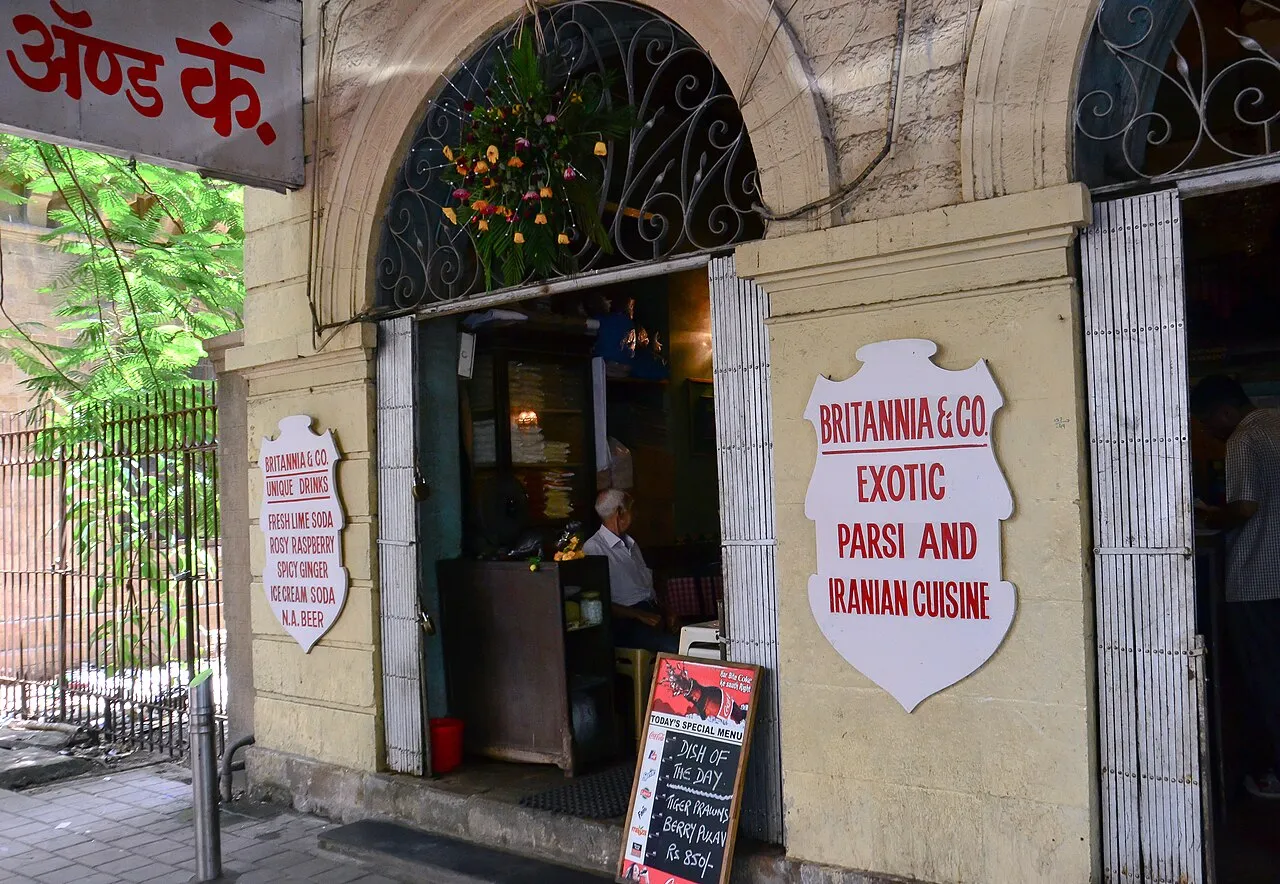
We go through the founding dates and the families behind them in our page on the oldest Irani cafes in Mumbai, and our list of famous Irani cafes in Mumbai covers the ones you can still walk into today. Britannia, with its berry pulao, has a page of its own on Britannia & Co. history.
Why are Irani cafes closing?
Gateway House, Sahapedia and the Deccan Herald give overlapping answers: rising costs, valuable South Mumbai property, newer competition and younger family members who don't want to take the business on. The full story, cafe by cafe, is in our piece on the decline of Irani cafes.
Frequently asked questions
Where is the original Irani cafe in Mumbai?
Gateway House says the first Irani cafe owner was a Zoroastrian named Khodadad, who opened a tea shop in Dhobi Talao in the early 19th century. Of the cafes still running, Kyani & Co., opened in 1904 at Dhobi Talao, is called the oldest by Al Jazeera and "possibly the oldest" by Gateway House.
Who opened the Irani cafes in Mumbai?
Irani cafes were started by immigrants from Iran, mostly Zoroastrians from Yazd and Kerman, with a smaller number of Shia Muslim owners. Gateway House says about 15% of the cafes on a 1947 list were Shia-run. Their earliest regulars were mill workers and office clerks, and Sahapedia describes Bombay's new labour class as the cafes' core market.
How many Irani cafes are left in Mumbai?
Published estimates range from about 25 to 35. Al Jazeera put the number at no more than 25 in 2014, the Deccan Herald at about 30, and Gateway House at 35 in 2019. At their peak there were between 350 and 400, depending on the source, so roughly one in ten, or fewer, has survived.
What is Irani chai?
Irani chai is the sweet, milky tea served in Mumbai's Irani cafes, usually with bun maska or brun pav. Despite the name, it is not how tea is drunk in Iran. Gateway House notes that buns and milky tea are not Iranian specialities, and that people in Iran drink their tea reddish-black and without milk.


