 PalV's Kasti
On this page
The Irani cafes of Bombay were started by Iranian migrants, most of them Zoroastrians from the provinces of Yazd and Kerman, along with Shia Muslim Iranians. They came in the late nineteenth and early twentieth centuries. The jizya poll tax on Zoroastrians pushed them out, and so did years of drought that began with the Great Famine of 1870-72. Most arrived with very little money. Some worked first in Parsi homes, and many went on to open small tea shops selling chai and bread to the city's workers. No single founder can be named with certainty. Gateway House credits one Zoroastrian, Khodadad Oshtori, with the first Irani tea shop at Dhobi Talao, while TRT World writes that there are no records of how the cafes began.
This post looks only at the people behind the cafes. For the wider story of the cafes themselves, start with our guide to the Irani cafes of Mumbai.
અદીબેહેસત રોજ
Ardibehesht Roj, Tir Mah · 1396 Y.Z.
Who were the Iranis who started the cafes?
In Bombay, Irani is the name for the Iranians who came in the nineteenth and twentieth centuries, as distinct from the Parsis, whose ancestors settled in Gujarat much earlier. Sahapedia dates the Parsi arrival from the tenth century onward, and Encyclopaedia Iranica describes the nineteenth-century emigrants from Yazd and Kerman as following the example of those tenth-century Zoroastrians.
Both Sahapedia and Bombay historian Sifra Lentin, writing for Gateway House in 2019, place the home of most Bombay Iranis in the same pocket of central Iran: Yazd and Kerman. They were not all Zoroastrian. Gateway House, TRT World and the Deccan Herald all describe the cafe founders as a mix of Zoroastrian and Shia Muslim Iranians, and Lentin says the later arrivals of both faiths came from Yazd and Kerman. Sahapedia adds that the newcomers spoke Dari, a Persian dialect.
Why did Zoroastrians leave Yazd and Kerman for Bombay?
The jizya and the help from Bombay
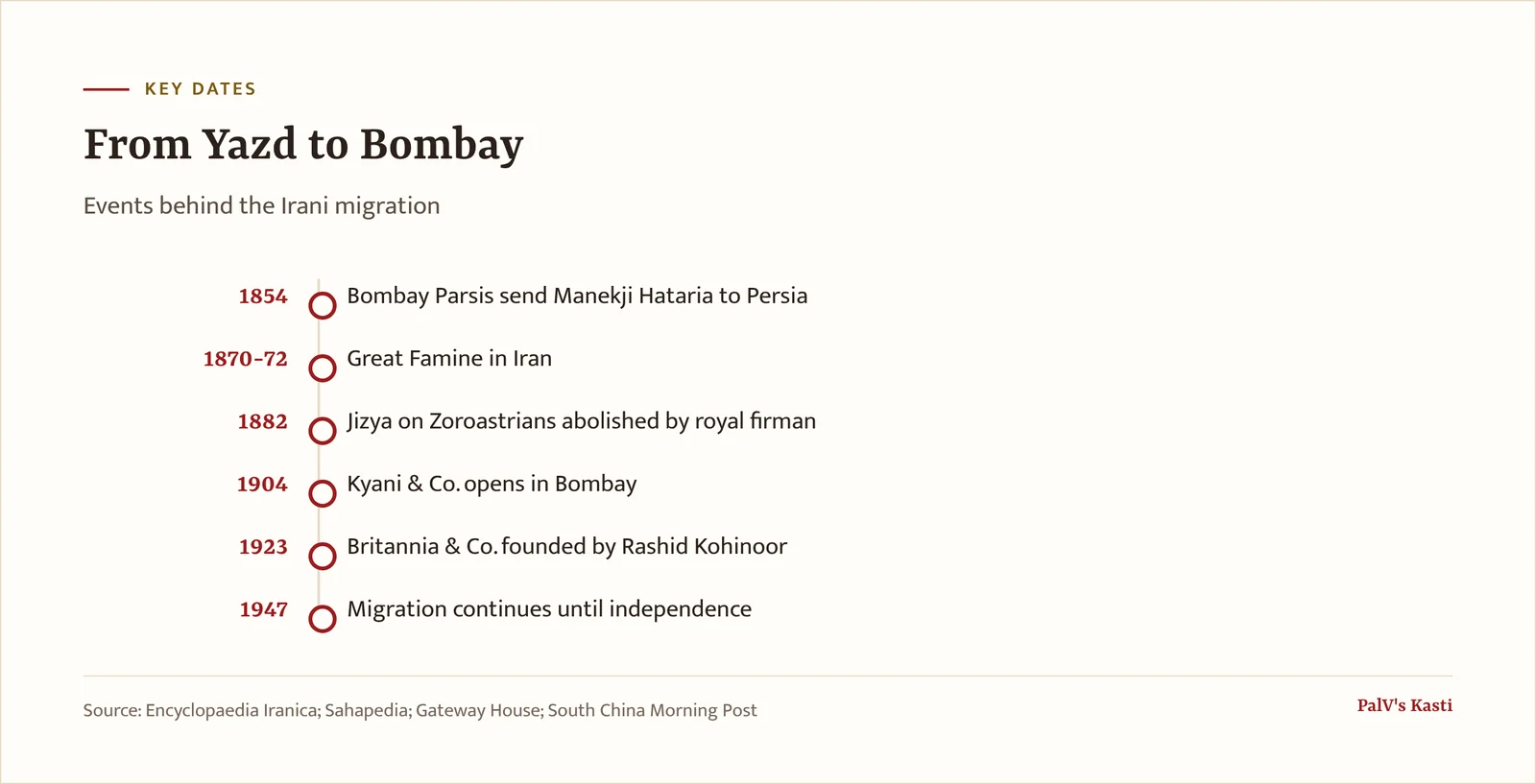
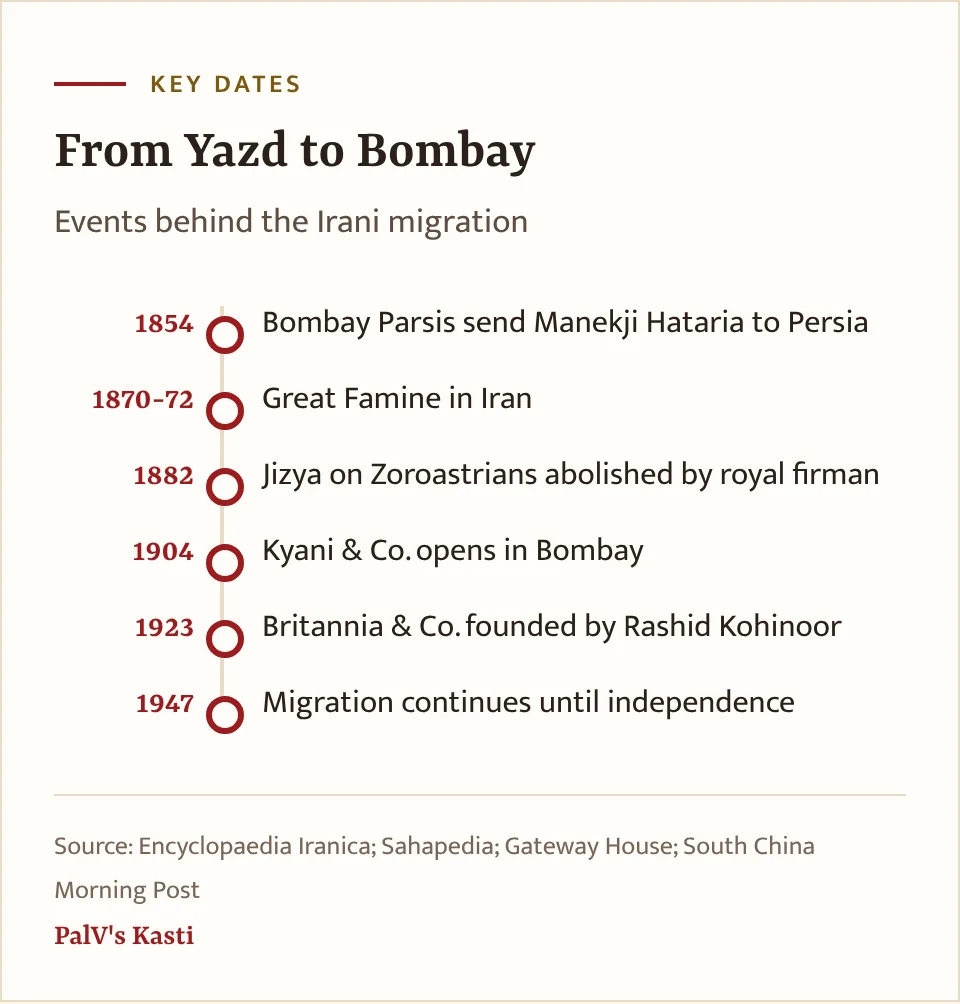
Encyclopaedia Iranica calls the jizya poll tax the heaviest of the burdens on Iran's Zoroastrians. Those who could not pay were pushed to convert or go into hiding, and the Zoroastrian council of Kerman wrote that the choice was death or emigration. In 1854, Bombay Parsi reformists sent Manekji Limji Hataria to Persia for their Society for the Amelioration of the Condition of Zoroastrians in Persia, and both Iranica and historian Monica Ringer say ending the tax was part of his brief. The jizya was abolished by a royal firman of Naser al-Din Shah in 1882, though Iranica notes that local enforcement of this and later decrees was often weak. According to Iranica's entry on Hataria, he also urged Zoroastrians struggling to make a living to move to Bombay, where Parsi merchants and entrepreneurs had jobs to offer.
Drought and the famine of 1870-72
Lentin describes Yazd and Kerman as drought-hit provinces, with a run of dry years beginning with the Great Famine of 1870-72 that ruined farmland and sent people abroad. Sahapedia also points to that famine. Iranica records one Zoroastrian village, Hasanabad, where a water shortage led twenty families to emigrate to India. Business Standard, in a 2019 feature on Yazdi families in Mumbai, adds a worsening economy under Qajar rule and a wish to escape two years of military conscription. Sahapedia says this movement carried on until Indian independence in 1947. Many came overland through Baluchistan, Sindh and Gujarat, and some by the Arabian Sea.
How did the first Irani tea shops begin?
Money was the first problem. Business Standard reports that in most cases a family sent one son, who either set up or worked at a small eating house serving tea and buttered buns, a trade that needed little education or capital. Sahapedia also notes how little capital the Iranis brought, and that Yazd was already famous for its confectionery.
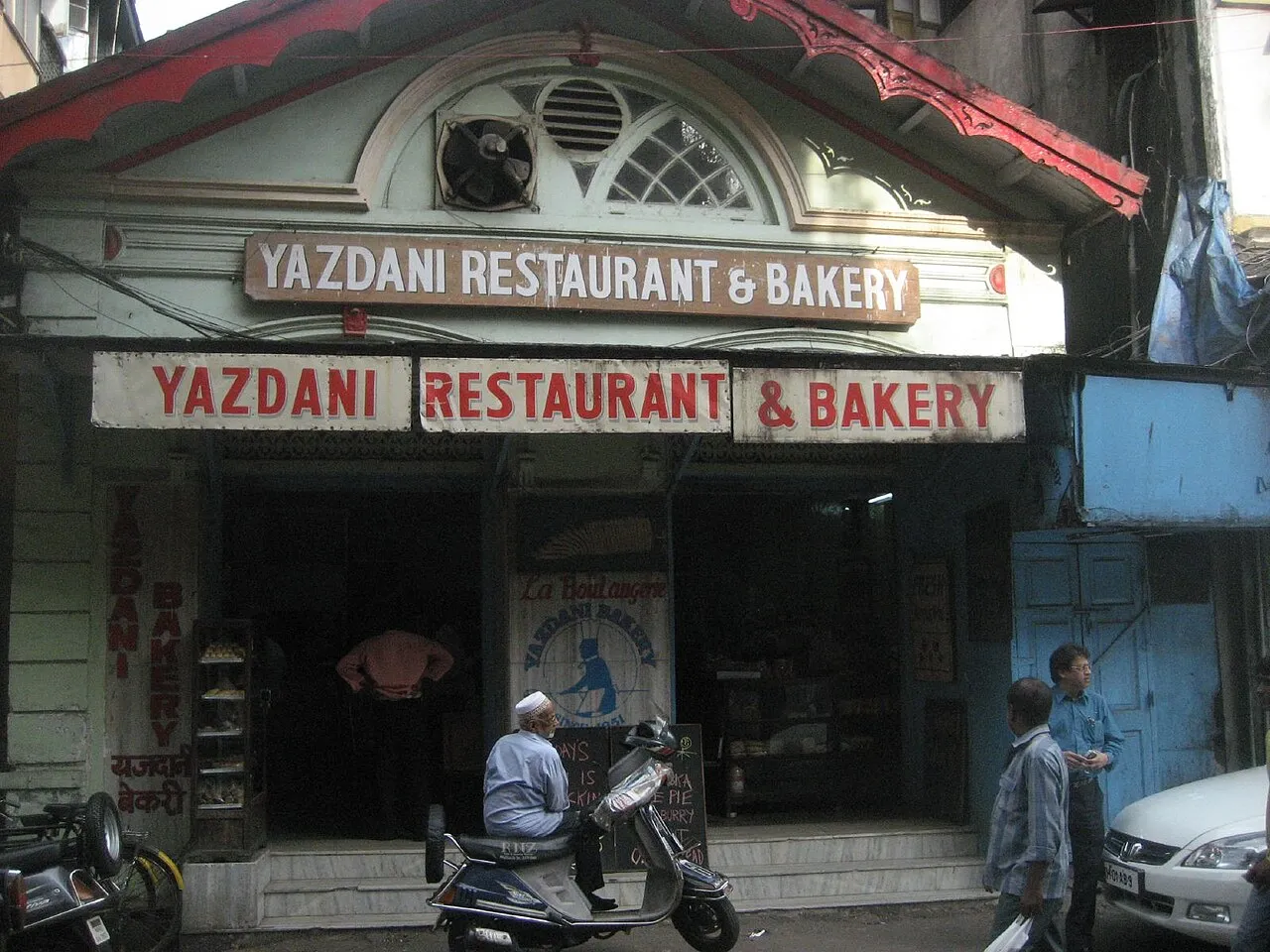
The Parsi household was often the first step. Gateway House says Khodadad Oshtori worked as a domestic servant in a Parsi home before he opened the first Irani tea shop at Dhobi Talao. TRT World tells a looser version: Iranians working in Parsi homes would gather in the evenings, the person serving their tea began charging a small amount for it, and the idea of a cafe followed. TRT World is also plain that there are no records of how the cafes actually started.
The customers were working men. Sahapedia says the cafes sold biscuits, bread and tea very cheaply to factory, railway and dock workers, and Lentin names mill and factory hands as the main trade. The sweet, milky drink these shops became known for is covered in our post on Irani cafe chai.
Which Irani cafe founders are named in the record?
Only a handful of founders' names appear in published accounts.
- Kyani & Co. opened in 1904, according to both Gateway House and the South China Morning Post. Gateway House names its founders as Khodadad and Khodamorad Shukriye of Yazd.
- Britannia & Co. opened in 1923, and the South China Morning Post credits Rashid Kohinoor with founding it.
- Mansoor Showghi Yezdi, who runs Cafe Irani Chaii, told the South China Morning Post that his grandfather walked from Yazd to India in 1890 to escape famine. Business Standard adds that the grandfather sold chai from a samovar around Apollo Bunder through his teens before starting his own establishments.
- Haji Gholam Ali arrived in 1909. Business Standard says that, unlike most of his compatriots, he brought enough money to set up his own teahouse and sweets business.
For opening years of the cafes that still trade, see our list of the oldest Irani cafes in Mumbai.
Were all Irani cafes and Irani restaurants run by Zoroastrians?
No. Zoroastrians ran most of them, but not all. Lentin puts the number of Irani cafes in late nineteenth-century Bombay at about 350 and estimates that roughly 15 per cent were run by Shias. She also notes that the first Iranians to settle in Bombay were Shia merchants from Shiraz, Bushire and Isfahan, in the early nineteenth century, well before the Yazdi and Kermani wave. The Deccan Herald likewise credits both Zoroastrian and Muslim Iranis with building the restaurant trade in Mumbai, Pune and Hyderabad.
On paper, the line between Irani and Parsi was blurred. Gateway House notes that Irani Zoroastrians were counted along with the Parsis in census figures, so their early numbers are hard to pin down. Business Standard cites Sunil Kavadi's book Nakyavarcha Irani for the view that Yazdi Zoroastrians learnt from Parsis that Bombay was a land of promise, and the same article says Muslim Iranis soon followed. The South China Morning Post notes that many of these immigrants became chaiwalas, or tea sellers, in the late 1800s and early 1900s. Our page on Irani chai covers the drink itself.
Frequently asked questions
Who started the Irani cafes in Mumbai?
Iranian migrants started them in the late nineteenth and early twentieth centuries. Most were Zoroastrians from Yazd and Kerman in central Iran, joined by Shia Muslim Iranians. Some worked first as domestic servants in Parsi homes, then opened small tea shops selling chai and bread. No single founder is documented, and sources disagree on who came first.
What is the difference between Iranis and Parsis?
Both groups came from Iran, but centuries apart. Parsi ancestors settled in Gujarat from around the tenth century. Iranis came mainly from Yazd and Kerman in the nineteenth and twentieth centuries, and spoke Dari, a Persian dialect, when they arrived. Most Iranis were Zoroastrian, though some were Shia Muslims. Census figures counted Irani Zoroastrians together with Parsis.
Why did Iranians migrate to Bombay?
Zoroastrians in Iran paid the jizya poll tax until it was abolished in 1882, and Yazd and Kerman suffered years of drought, starting with the Great Famine of 1870-72. Bombay offered work, often with Parsi merchants and employers. Business Standard also mentions a weakening economy under Qajar rule and the wish to avoid two years of military conscription.
Who opened the first Irani cafe in Bombay?
Sources disagree. Gateway House names Khodadad Oshtori, a Zoroastrian who had worked as a domestic servant in a Parsi household, as the man who opened the first Irani tea shop at Dhobi Talao. TRT World says there are no records of how the cafes began. Among cafes still trading, Kyani & Co. is reported to have opened in 1904.
Were Irani cafes started only by Zoroastrians?
No. Zoroastrians ran most of them, but Shia Muslim Iranians from Yazd and Kerman ran cafes and restaurants too. Historian Sifra Lentin estimates that about 15 per cent of the roughly 350 Irani cafes in late nineteenth-century Bombay were Shia-run. Shia merchants from Shiraz, Bushire and Isfahan had settled in Bombay even earlier.


