 PalV's Kasti

On this page
Dhansak is a Parsi dish that took shape in Gujarat after Zoroastrians from Iran settled there. No early document records who first cooked it. Writers on Parsi food link it to the Iranian khoresh, a meat stew, which in India met local dals, vegetables and spices. By the late nineteenth century it was widely popular in Bombay and Karachi. Sona Bahadur notes that Meherbai Wadia's Gujarati cookbook Vividh Vani, whose first edition Scroll dates to 1894, gives three recipes for it. Since then the dish has grown simpler: fewer dals, no tripe, pressure cookers instead of wood and coal fires. It has also found a second life on British curry-house menus.
અદીબેહેસત રોજ
Ardibehesht Roj, Tir Mah · 1396 Y.Z.
Where did dhansak originate?
Dhansak originated in the Parsi kitchens of Gujarat, but its roots are usually traced further back, to Iran. Anahita Dhondy, writing in the Deccan Chronicle in 2015, says the dish goes back to the Iranian khoresh and that the older version was a mutton stew cooked with spinach and plums. Bisma Tirmizi, writing in Dawn in 2014, also ties dhansak to the khoresh.
The food historian K.T. Achaya, as quoted by Sona Bahadur in her book An Invitation to Feast (Aleph), made a similar point from the Indian side: once in India, the cooks would have swapped the Iranian rajma and spinach for pulses.
Treat any neat origin story with care. Outlook Traveller and Homegrown both say dhansak's exact origins are hard to establish. We agree: the Iranian link is a fair reading of the dish, not a documented line from one recipe to another.
When did the Parsis bring their cooking to Gujarat?
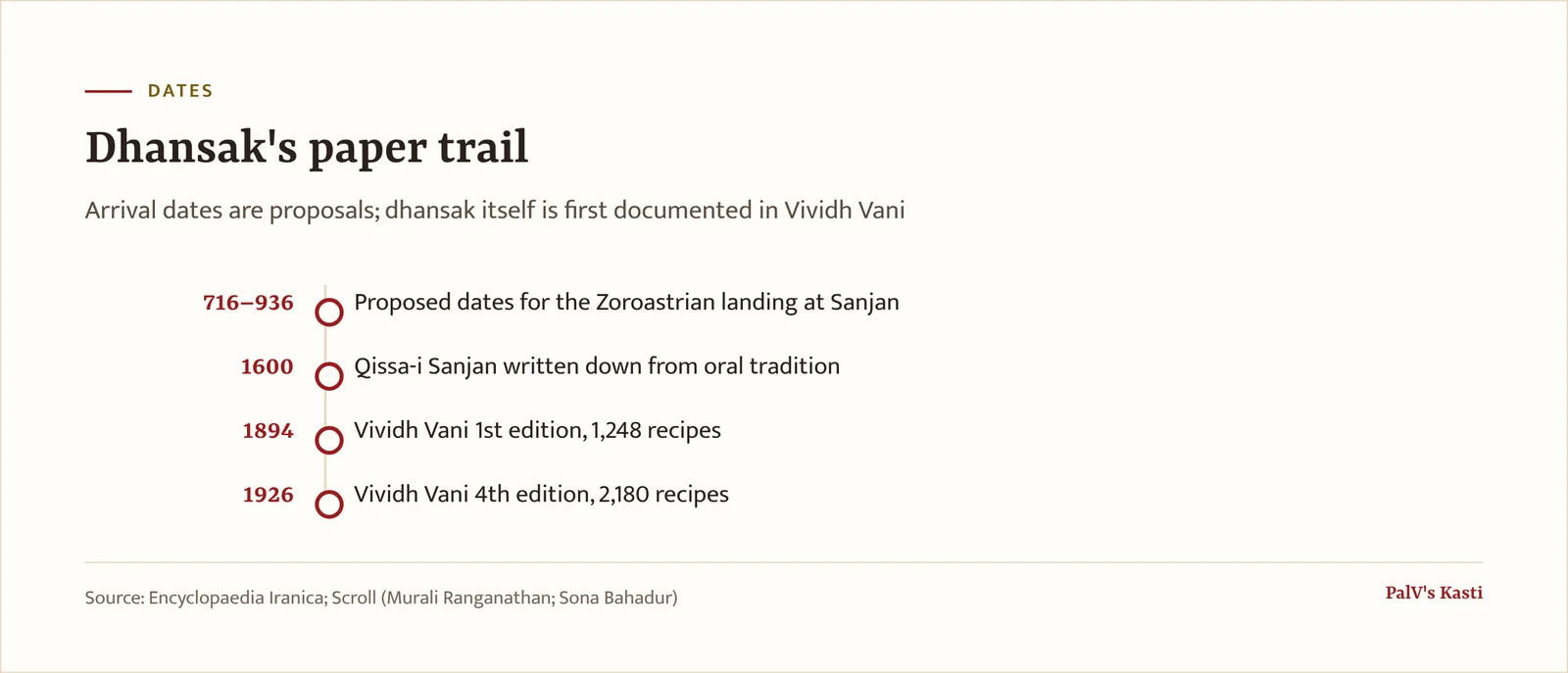
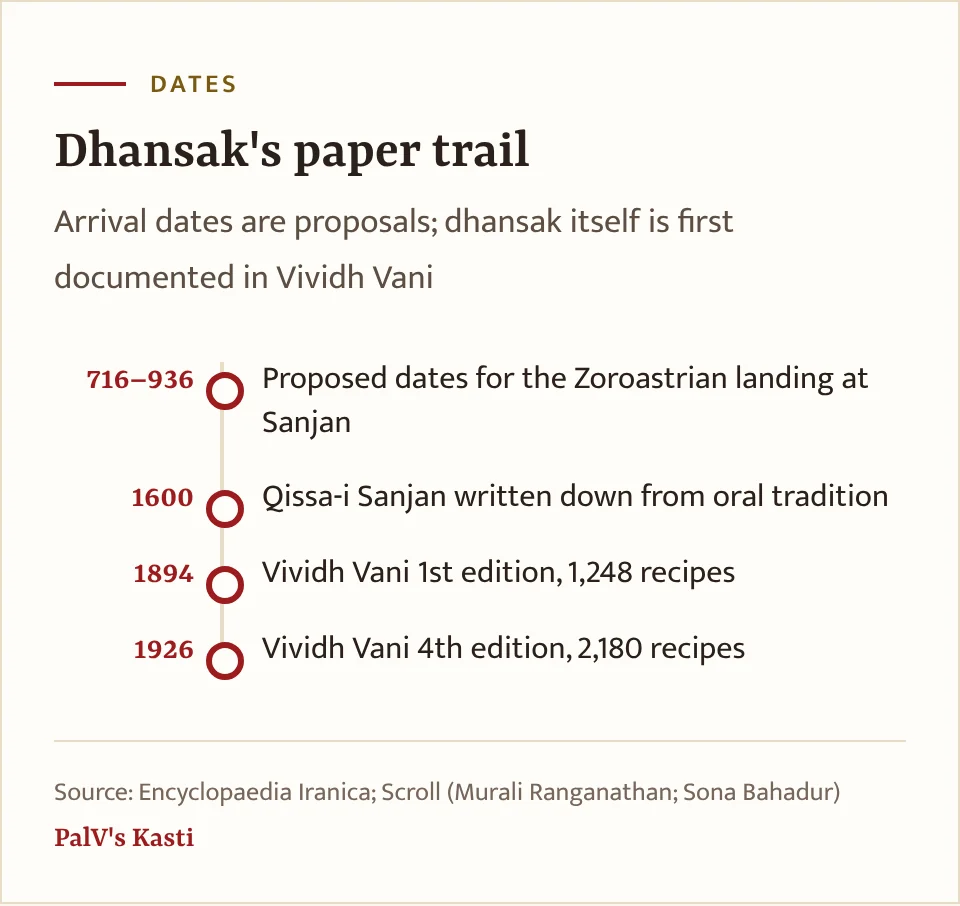
The date of the Zoroastrian landing at Sanjan in Gujarat is itself disputed. Encyclopaedia Iranica lists the dates scholars have proposed: 716, 775, the 780s, 785 and 936 CE. Sona Bahadur's account places it in the eighth century.
The main account of that landing, the Qissa-i Sanjan, was written down in 1600 from oral tradition, says Iranica. In it, the local ruler asks the newcomers to use the local language and the women to wear local dress. None of the conditions Iranica lists concerns food. Sona Bahadur suggests the settlers soon took to the Gujarati love of food that is sweet, tangy and spicy at once, and that dhansak grew out of that meeting. Our guide to Parsi food covers the wider mix.
What does the name dhan-sak mean?
The name splits into two Gujarati words, and the second half is not in dispute: sak (shaak) means vegetables. The first half is read two ways. Outlook Traveller connects dhan with grain or rice. Pat Chapman, quoted in Dawn, and Anahita Dhondy both read dhan as wealth, with Dhondy adding "gold". Both readings are in print, and we found no early source that settles which one the first cooks meant.
What was dhansak like in the nineteenth century?
The best written evidence for early dhansak is Vividh Vani, a Gujarati cookbook by Meherbai Jamshedji Wadia. Its first edition came out on 9 August 1894 with 1,248 recipes, writes Murali Ranganathan in Scroll, and the fourth, in 1926, ran to 2,180. Sona Bahadur notes that the book gives three different dhansak recipes, and that chicken or mutton can be used.
Older dhansak was heavier work. Achaya, again as quoted by Bahadur, wrote of at least three dals and as many as nine, with fatty meat, tripe and vegetables. Bahadur says it was cooked over a wood fire with masalas ground at home. Dhondy writes that the dal was traditionally cooked over coal, which gave it a smoky taste.
The same period made dhansak common. Dawn and Homegrown both say the dish became widely popular in the late nineteenth century, as Bombay and Karachi grew quickly into industrial cities.
How has dhansak changed over time?
Dhansak has become quicker and lighter since the wood-fire days. In Bahadur's words, the nine dals came down to one or two, tripe went, and home-ground masala gave way to the blender and the pressure cooker. Dhondy adds that health-conscious Parsis have moved from ghee to refined oil, though she says mutton tastes better in ghee.
The dal count shows the change best, and no two sources agree:
| Source | Dals in dhansak |
|---|---|
| K.T. Achaya, quoted by Sona Bahadur (older dish) | At least 3, up to 9 |
| Pat Chapman, quoted in Dawn | Up to 4 |
| Lizzie Collingham, quoted in Dawn | 4 |
| Anahita Dhondy's recipe, Deccan Chronicle | 3 (toor, chana, masoor) |
| Perzen Patel's recipe | 3 (toor, moong, masoor) |
| Sona Bahadur on the modern dish | 1 or 2 |
Chicken is not a recent swap: Bahadur notes that Vividh Vani already allowed chicken or mutton. Zavera Shahuna of Chennai told The News Minute in 2016 that plain vegetarian or chicken dhansak has become acceptable, though the taste is not the same. For the dish as it is served today, start with our Dhansak guide.
How did dhansak reach British curry houses?
Homegrown writes that the dish moved into Anglo-Indian homes and then onto the menus of British-Indian restaurants, and Lizzie Collingham, quoted in Dawn, also calls it a standard item on those menus. Perzen Patel says dhansak is very popular at UK curry houses, where it is often made with pineapple, pomegranate or tamarind, ingredients a Parsi cook would find odd. In Dawn, Bisma Tirmizi notes that as chefs from the subcontinent gave old dish names new meanings, dhansak came to stand for a slightly sweet lentil curry.
The Parsi original, as Dhondy describes it, is a thick, spicy dal with mutton, eaten with brown rice. What the Bombay columnist Behram Contractor wrote about the dish is a story of its own, told in Busybee on dhansak.
Frequently asked questions
Is dhansak Persian or Indian?
Dhansak is an Indian Parsi dish with Iranian roots. Writers such as Anahita Dhondy and Bisma Tirmizi link it to the Iranian khoresh stew, while its dals, vegetables and spice balance come from Gujarat. No early text records its invention, so the Iranian link is a reading of the dish rather than a documented fact.
How old is dhansak?
Nobody can give dhansak an exact age. One firm written record is Meherbai Wadia's Gujarati cookbook Vividh Vani, whose first edition Scroll dates to 9 August 1894, and which according to Sona Bahadur includes three dhansak recipes. Dawn and Homegrown both say the dish became widely popular in the late nineteenth century.
How many dals were used in the original dhansak?
Food historian K.T. Achaya, quoted by Sona Bahadur, wrote that older dhansak used at least three dals and up to nine, along with fatty meat, tripe and vegetables. Modern recipes usually use fewer. Anahita Dhondy and Perzen Patel each use three dals, and Bahadur says the number has generally come down to one or two.
Is British curry-house dhansak the same as Parsi dhansak?
No. Curry-house dhansak is a different dish from the Parsi one. Perzen Patel notes that UK restaurants often add pineapple, pomegranate or tamarind, which Parsis would find unusual, and Dawn says that as chefs gave dish names new meanings, dhansak came to stand for a slightly sweet lentil curry. Parsi dhansak is meat cooked into dal, eaten with brown rice.


