PalV's Kasti
On this page
- When was the Delhi Parsi Anjuman founded?
- Where did Delhi's Parsis gather before the Anjuman had its own buildin…
- What does the Delhi Parsi Anjuman run at Delhi Gate?
- Can travellers stay at the Delhi Parsi Dharamshala?
- Who runs the Delhi Parsi Anjuman, and how many members does it have?
- How did the Delhi Parsi Anjuman mark 100 years?
- What was the 2019 Delhi High Court case about the fire temple?
- Frequently asked questions
The Delhi Parsi Anjuman (DPA) is the community body of Parsi Zoroastrians in the capital. It was formed in 1925, when Delhi had about 40 Parsis according to the Anjuman's website, and it marked its centenary in 2025. From its compound at Delhi Gate on Bahadur Shah Zafar Marg it runs the Kaikhusuru Palonji Katrak Dar-e-Mehr, the only fire temple in North India by its own account and that of Parsi Times, along with a 44-room dharamshala for travellers and its community halls. A Board of Trustees elected by the members manages it.
અસપંદામેદ રોજ
Asfandarmad Roj, Tir Mah · 1396 Y.Z.
When was the Delhi Parsi Anjuman founded?
The Delhi Parsi Anjuman was founded in 1925. Both the community's own website, delhiparsis.com, and a December 2025 Parsi Times report on the centenary give that year. According to delhiparsis.com, Delhi's Parsi population at the time was about 40 people.
Parsis were in Delhi well before the Anjuman existed. The story of those early families, from the Mughal court to New Delhi's building years, belongs to our page on the Parsis of Delhi. This page stays with the institution itself.
Where did Delhi's Parsis gather before the Anjuman had its own buildings?
For years the Delhi Parsi Anjuman borrowed space. Writing in The Wire in 2016, Shernaz Italia recalled that the Modi brothers let the Anjuman use their cinema hall, the Plaza, free of charge twice a year for community celebrations. Navjotes and weddings were held at Hormuzji Sethna's house at 19 Alipore Road. That arrangement lasted, she wrote, until the community was given additional land at Delhi Gate in 1947.
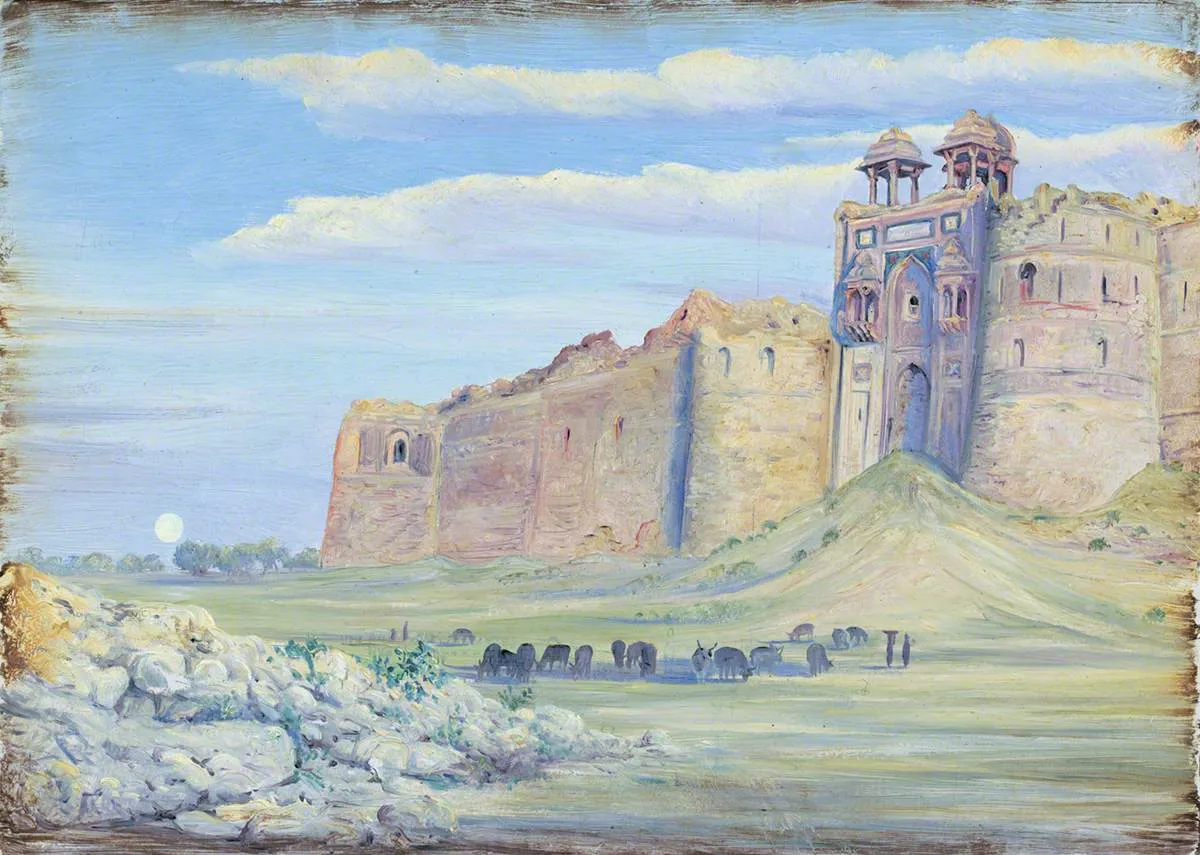
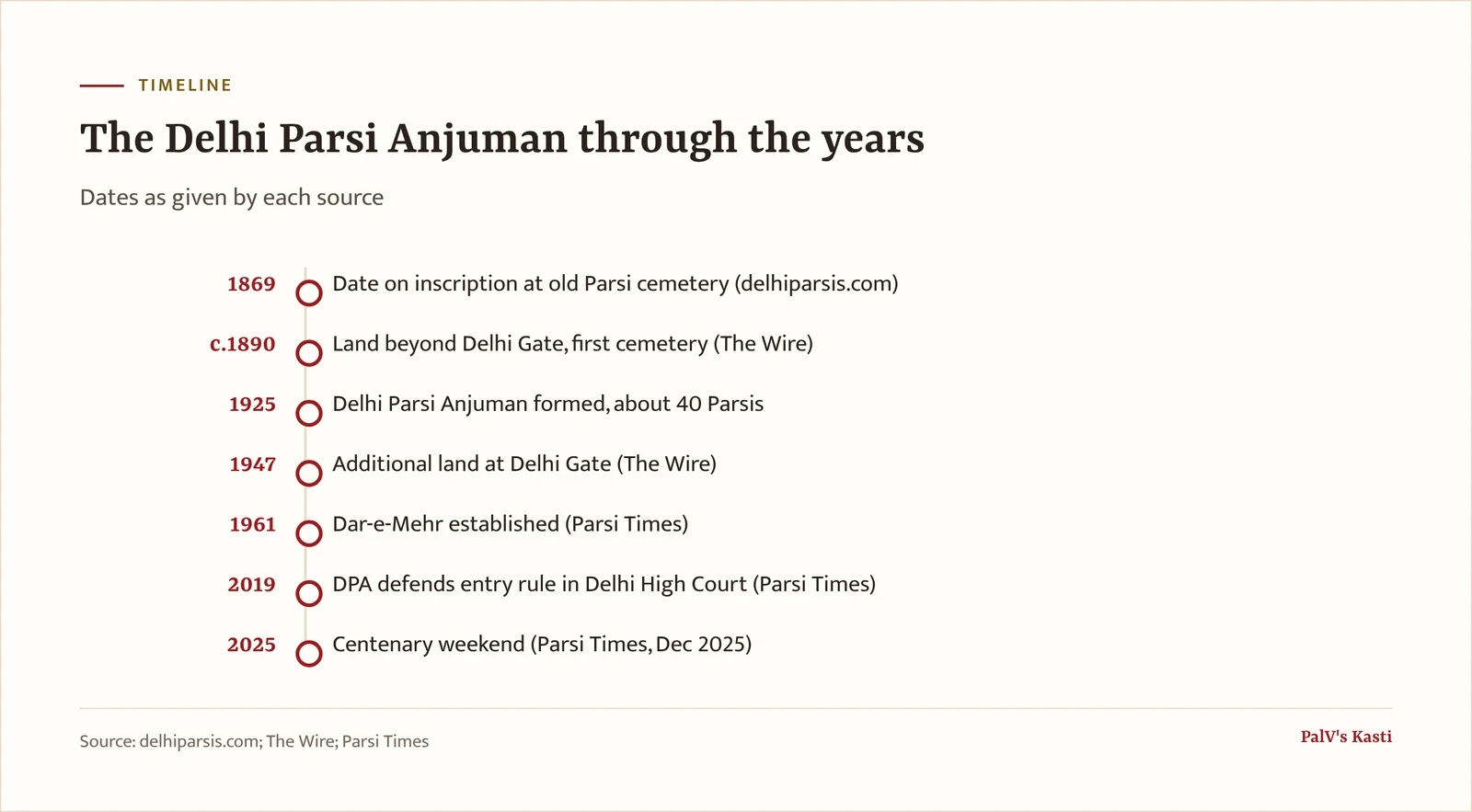
Delhi Gate was not new ground. The same article says Parsis were given land just beyond Delhi Gate, outside the Walled City, around 1890, and that the first Parsi cemetery was laid out there, with prayer meetings held beside the graves. The sources don't quite agree on the date, though. Delhiparsis.com points to an inscription at the old Parsi cemetery dated 1869 as the earliest physical evidence of Parsis in the region, two decades before The Wire's "around 1890". Both are on record, and we haven't found a document that settles it.
What does the Delhi Parsi Anjuman run at Delhi Gate?
The Anjuman's premises are at Delhi Gate, Bahadur Shah Zafar Marg, New Delhi 110 002. Delhiparsis.com and the 2025 Parsi Times report between them list a fire temple, a dharamshala and community halls.
The Dar-e-Mehr
The Kaikhusuru Palonji Katrak Dar-e-Meher (also written Dar-e-Mehr) is the community's fire temple. Delhiparsis.com calls it the only one of its kind in North India, and Parsi Times describes it the same way. Parsi Times gives 1961 as the year it was established. We cover its rituals and visiting customs separately in our page on the Delhi Parsi fire temple.
The dharamshala
The Anjuman's rest house appears as the Mehgusi Parsi Dharamshala on one page of delhiparsis.com and the Mengusi Parsi Dharamshala on another. Same building, two spellings.
The halls
The Bhiwandiwalla Community Hall holds a collection of books on Zoroastrian history and culture, according to delhiparsis.com. Parsi Times lists a banquet hall in the Delhi Gate complex, along with the renovated Katgara Hall, donated by the Katgara family and formally opened during the centenary weekend.
Can travellers stay at the Delhi Parsi Dharamshala?
Yes. The dharamshala takes room bookings. Its page on delhiparsis.com, last updated in July 2026, lists 44 rooms: 16 Deluxe AC, 6 Semi-Deluxe and 16 Standard. That adds up to 38, so the page's own breakdown leaves six rooms unaccounted for. Bookings go through the online link on that page or the phone number +91 11 2323 8615.
The page doesn't spell out who is eligible to stay. It mentions special rates for large groups, students and working professionals on long stays, and it says Parsi food is served at breakfast, lunch and dinner, with a table-booking link to Rustom's, ITO. The page also notes that both main railway stations, Connaught Place, the High Court, the Supreme Court and Pragati Maidan are close by. Before you travel, call to confirm rates and any rules for guests.
Who runs the Delhi Parsi Anjuman, and how many members does it have?
A Board of Trustees runs the Delhi Parsi Anjuman, and DPA members elect it, according to delhiparsis.com. The president at the time of the centenary was Adil S. Nargolwala, as reported by Parsi Times.
The two published figures measure different things. Delhiparsis.com puts the membership at about 750 Parsis across the National Capital Region. At the centenary, Nargolwala put the number of Parsis in Delhi at about 500, Parsi Times reported.
The Anjuman's work isn't only religious. In August 2016, Parsi Times reported, its Social Centre Committee organised a Navroz evening at which the ghazal singer Penaz Masani handed out scholarships to students from pre-nursery to master's level, and members set up stalls to promote their own enterprises.
How did the Delhi Parsi Anjuman mark 100 years?
Parsi Times reported in December 2025 that the Delhi Parsi Anjuman had marked its centenary over a weekend at its premises on Bahadur Shah Zafar Marg. The report says the DPA describes itself as the "cultural, social and spiritual anchor" of Delhi's Parsi community, and lists these events across the two days:
- Saturday: the building was lit up and Justice Jamshed Burjor Pardiwala was felicitated. There were musical performances, a photo exhibition on Parsi history in Delhi and a Parsi dinner from Surat caterers.
- Sunday: a Jashan at the Dar-e-Mehr led by Vada Dasturji Khurshed Dastoor, then a talk by Justice Rohinton Fali Nariman and the formal opening of the renovated Katgara Hall. A centenary edition of Dipanjali, the Anjuman's in-house journal, was released the same day.
What was the 2019 Delhi High Court case about the fire temple?
In 2019 the Delhi Parsi Anjuman defended the fire temple's Zoroastrians-only entry rule before the Delhi High Court. Parsi Times reported in April 2019, citing The Indian Express, that a public interest litigation had been filed before a bench headed by Chief Justice Rajendra Menon. The petitioner alleged discrimination because Hindus, Muslims and Sikhs were barred from the temple's sanctum and no notice said that only Zoroastrians could enter.
In its affidavit, as quoted by Parsi Times, the DPA argued that people outside the community have no legal right to insist on using its facilities, the fire temple included. The Anjuman called the petition "not maintainable" and said the fire temple is privately funded and endowed for Parsi Zoroastrians. It added that the restriction has nothing to do with caste, colour or race and exists to protect the sacred fires. The court asked the DPA, the Centre, the state government and the police to respond. The April 2019 report recorded no ruling, and we haven't found a later one.
Practice varies between families and Agiaries; your family priest's guidance comes first.
Frequently asked questions
When was the Delhi Parsi Anjuman founded?
The Delhi Parsi Anjuman was founded in 1925, a date given by both delhiparsis.com and Parsi Times. Delhi had about 40 Parsis then, according to delhiparsis.com. Parsi Times reported in December 2025 that the Anjuman had marked its centenary over a weekend at its premises on Bahadur Shah Zafar Marg.
Where is the Delhi Parsi Anjuman?
The Delhi Parsi Anjuman is at Delhi Gate, Bahadur Shah Zafar Marg, New Delhi 110 002. Parsi Times lists the Dar-e-Mehr, a dharamshala, a banquet hall and the renovated Katgara Hall on these premises. According to the dharamshala's page, Connaught Place, the High Court and both main railway stations are close by.
Is there a Parsi fire temple in Delhi?
Yes. The Kaikhusuru Palonji Katrak Dar-e-Meher at Delhi Gate is run by the Delhi Parsi Anjuman. Delhiparsis.com and Parsi Times both describe it as the only Zoroastrian fire temple in North India, and Parsi Times dates it to 1961. In 2019 the DPA defended its Zoroastrians-only entry rule before the Delhi High Court.
Can travellers stay at the Parsi dharamshala in Delhi?
Yes. The Mengusi (or Mehgusi) Parsi Dharamshala at Delhi Gate lists 44 rooms on delhiparsis.com, in Deluxe AC, Semi-Deluxe and Standard categories. You can book online or on +91 11 2323 8615. The page mentions special rates for groups, students and long-stay professionals but doesn't state eligibility, so call first.
How many Parsis live in Delhi today?
At its centenary in 2025, DPA President Adil S. Nargolwala put Delhi's Parsi population at about 500, Parsi Times reported. Delhiparsis.com gives a separate figure of around 750 members across the National Capital Region. The two numbers come from different sources and cover different areas.