PalV's Kasti
On this page
- Who are the Zoroastrians of South Gujarat?
- How many Parsis live in Gujarat today?
- Why did rural Parsi families in South Gujarat become poor?
- What does the WZO Trust do in South Gujarat villages?
- Who are the "tribal Parsis" of the Vansda and Dang villages?
- How do the Zoroastrians of South Gujarat live today?
- Frequently asked questions
The Zoroastrians of South Gujarat are the Parsi families of the coastal belt from Bharuch and Surat down through Navsari and Valsad to Udvada and Sanjan, the area of the community's old priestly districts. Census 2011 counted 9,727 Parsi/Zoroastrian people in all of Gujarat, and in 2001 nearly four in five of the state's Parsis lived in Surat, Navsari, Valsad, Bharuch and the Dangs (our calculation). Today most live in towns. A smaller village population, spread across more than 200 villages, still farms, keeps dairy cattle or runs small shops, and many of those families have been supported since 1991 by the World Zoroastrian Organisation Trust.
અસપંદામેદ રોજ
Asfandarmad Roj, Tir Mah · 1396 Y.Z.
Who are the Zoroastrians of South Gujarat?
They belong to the Parsi settlements of the Gujarat coast. Encyclopaedia Iranica describes how that coast was divided into five panthaks, districts each placed in the religious care of particular priestly families: Sanjan (between the Pardi and Dahanu rivers, now based at Udwada), Navsari, Godavra (from Variav to the Narmada near Broach), Bharuch (from Ankleshwar to Cambay) and Cambay itself. Most of that map lies in what we now call South Gujarat.
Within that map, Navsari rose to what Iranica calls "a position of religious pre-eminence", and Surat later overtook Broach as the community's main commercial base. The Iranshah fire was moved to Udvada in 1742, a year given both by Iranica and by Outlook Traveller, which cites the Imperial Gazetteer. For the longer story of the first of those towns, read our page on Navsari Parsi history.
The numbers were once large. Iranica gives the 1881 census figures as 12,593 Parsis in Surat, 8,118 in Navsari and 3,042 in Broach.
How did rural Parsis earn a living?
Two livelihoods come up again and again. Iranica records that most Parsis in Gujarat had made their living from toddy production, and quotes John Ovington, a 17th-century traveller who reached Bombay in 1689, calling them "the principal Men at the loom in all the country". Shernaz Cama, founder of Parzor, put it more bluntly to ThePrint in 2023: most rural Parsis had toddy shops, and "toddy was their safety net".
How many Parsis live in Gujarat today?
Census 2011 recorded 9,727 people under the label "Parsi/Zorastrian" in Gujarat: 4,902 men and 4,825 women. Of them, 8,374 lived in urban areas and 1,353 in rural areas. That was about 17% of India's 57,264 Parsis (our calculation).
Ten years earlier, Census 2001 counted 11,594 in the state, so the number fell by 1,867, or about 16%, in a decade (our calculation). The rural count fell faster, from 1,869 to 1,353. We were able to open the 2001 table district by district. We could not open district-level Parsi figures for 2011, so the table below uses 2001.
| District (Census 2001) | Parsi/Zoroastrian total | Of whom rural |
|---|---|---|
| Surat | 4,117 | 677 |
| Navsari | 3,204 | 384 |
| Valsad | 1,308 | 505 |
| Bharuch | 397 | 133 |
| The Dangs | 89 | 89 |
| Gujarat (all districts) | 11,594 | 1,869 |
Those five districts held 9,115 of Gujarat's 11,594 Parsis in 2001. They also held 1,788 of the state's 1,869 rural Parsis, which means almost every village Parsi in Gujarat lived in the south (our calculation). Every Parsi counted in the Dangs lived in a village.
Why did rural Parsi families in South Gujarat become poor?
Dinshaw Tamboly, chairman of the World Zoroastrian Organisation Trust (WZOT), wrote in Parsi Times in March 2020 that the poverty of village families set in between 1947 and 1952 for three reasons outside their control:
- The Tillers Act, under which large areas of farmland passed to the labourers who worked it, leaving the owners with little.
- Prohibition in Gujarat, which made the toddy plantations useless.
- The State Transport Act. It nationalised the buses that Zoroastrians had run between villages.
ThePrint, reporting in 2023, cites Shernaz Cama for a different date: in her account, the large-scale migration followed prohibition in the 1960s. "When toddy was banned, no compensation was given," she said. The same report lists policies of the late 1950s and early 1960s that also hurt Parsis: the Land to the Tiller Act, the Land Ceiling Act and the state takeover of banks and transport. It also quotes Cama saying that land ceiling "really hurt the Parsis". The two accounts name overlapping causes and give different dates.
Migration made it worse. Iranica notes that the young, active men left for Bombay, so the villages they left behind came to consist more and more of the elderly and the disabled.
What did the Bhaya survey of rural Zoroastrians find?
The Bhaya survey is the community study behind most later work. Dr Cashmera P. Bhaya identified 687 poor Zoroastrian families living in 209 villages, many far below the poverty line of the day, an annual family income of about Rs 15,000. It was a sample survey, not a census. The sources differ on its date. Tamboly's 2020 article says it was conducted in 1987. The WZO Trusts' 2025 brochure says the World Zoroastrian Organisation, London, commissioned it for 1984/1985 and that Dr Bhaya submitted her report in 1988, and a 2025 Parsi Times report also says the report was presented to WZO in 1988.
In 2025 Dr Bhaya published the full work as a 642-page book, A Sociological Survey of Rural Parsis in South-Gujarat. According to Parsi Times, it includes the original report and her thesis on the Parsis of Choriyasi taluka, and copies are held at the First Dastoor Meherjirana Library in Navsari, the K R Cama Library, the Parzor archives and the F D Alpaiwalla Museum Library. The village side of this story has its own page: Parsis in rural Gujarat.
What does the WZO Trust do in South Gujarat villages?
The WZO Trust was set up in Bombay in 1991, on the basis of the Bhaya report, to rehabilitate poor village Zoroastrians. Tamboly's stated rule was no doles. Families received farm inputs as interest-free support and repaid them in token amounts from their higher incomes. According to Tamboly, farmers were trained at the Tata Marginal Farm Management Institute by faculty of South Gujarat Agricultural University and Forest Department officials. Families with enough land moved into cash crops such as sugarcane. Those without it were helped to start poultry farms, dairies, flour mills and grocery shops.
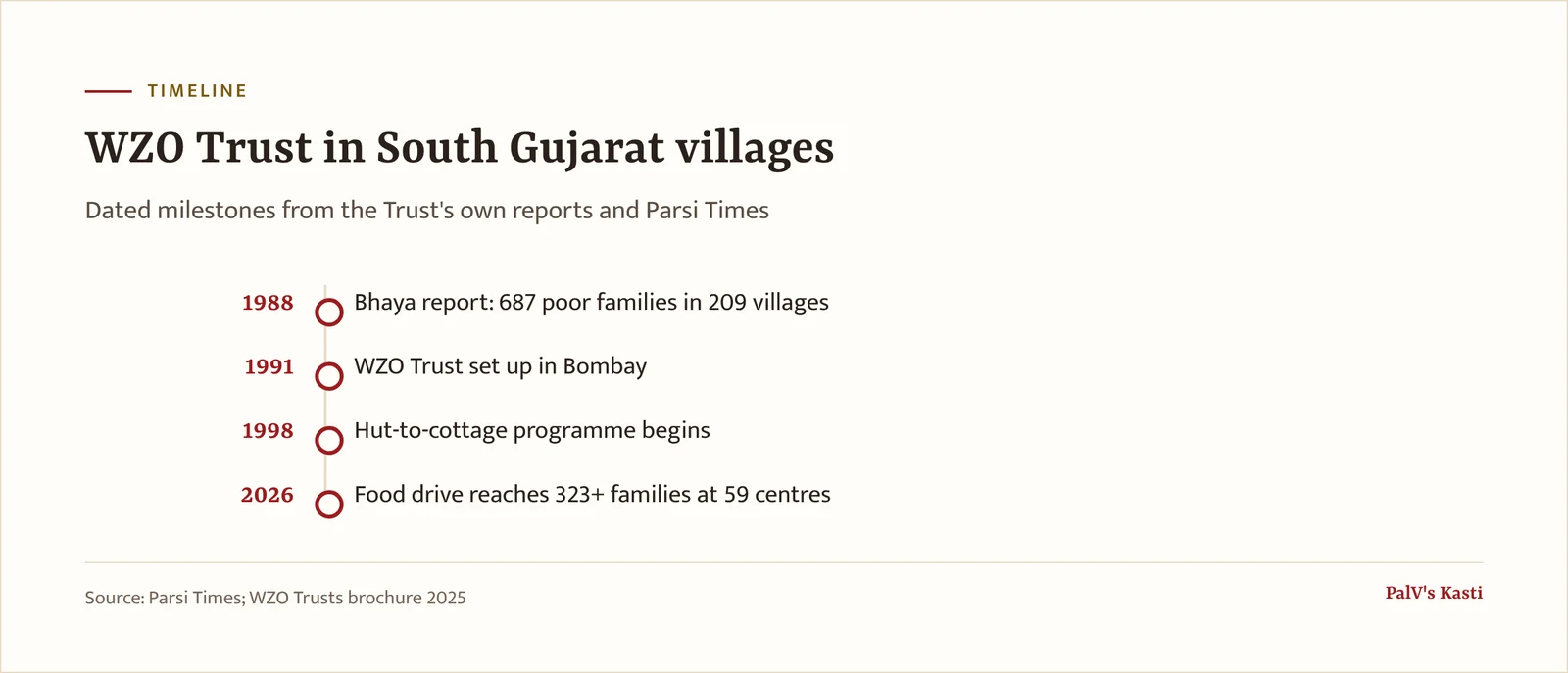
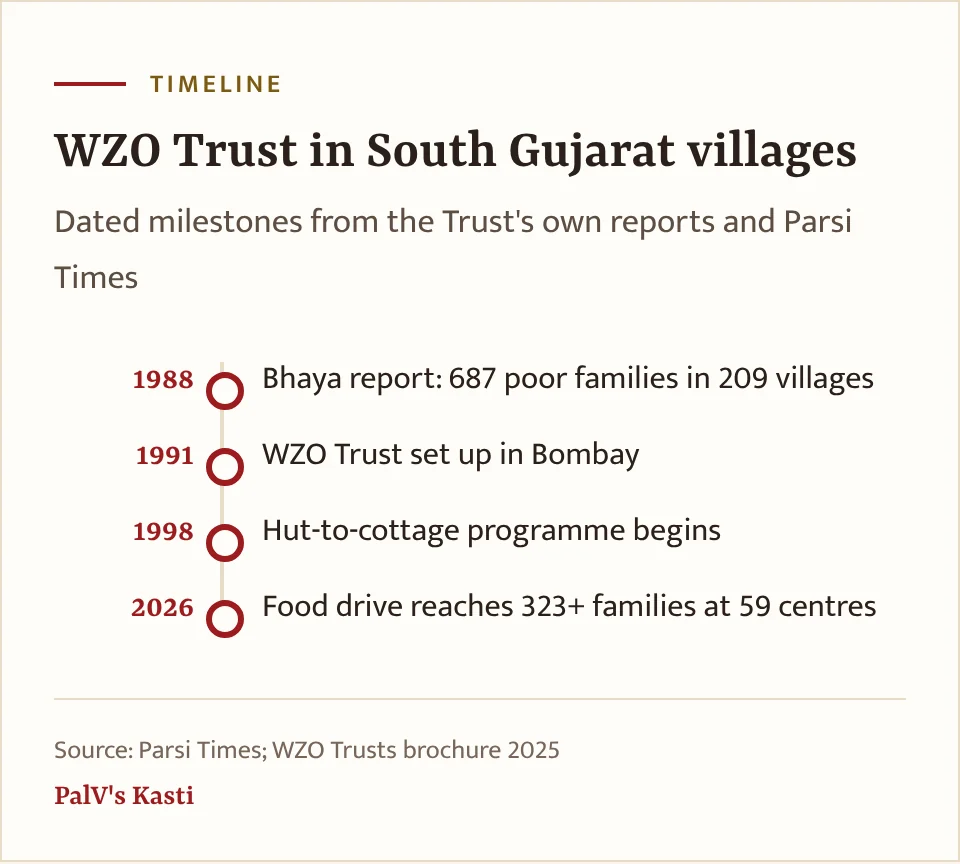
Housing came later. In 1998 the Trust began replacing huts with brick cottages, because most of the families it served lived in huts. The count has grown with each report, so it helps to read the figures with their dates:
| Reported by | Families rehabilitated | Huts replaced by cottages |
|---|---|---|
| Dinshaw Tamboly, Parsi Times, March 2020 | 498 families in 202 villages | 290 |
| ThePrint, October 2023 | not given | 334 houses, "primarily in Gujarat" |
| WZO Trusts brochure, 2025 (farm figures to March 2025) | 524 farmer families in 215 villages | 342 |
The 2025 brochure puts the farm programme's spending at Rs 7.29 crore since 1991 and the cost of one cottage at Rs 7 lakh. It also lists interest-free self-employment support, since 1995, for 1,265 Zoroastrians in 131 rural and urban locations, and two senior citizens' centres in Navsari, opened in January 1998 and December 2005.
The annual food-grain drive
The Trust also runs an annual food-grain drive. In February 2019, Parsi Times reported, it reached 285 families in 55 South Gujarat villages, with each kit valued at Rs 6,500. In January and February 2026 the drive reached more than 323 families at 59 centres on five routes, covering Navsari district, the Vansda and Dharampur talukas, Dadra and Nagar Haveli, and parts of Palghar taluka in Maharashtra. Each 2026 kit, worth about Rs 9,000, was packed to last a family nearly four months.
Who are the "tribal Parsis" of the Vansda and Dang villages?
This is the most sensitive part of the South Gujarat story, and we report it only as the sources tell it. ThePrint reported in October 2023 that around 200 Parsi families live in the forested parts of Dang, Valsad and Navsari districts, and describes them as descendants of children born outside marriage to Parsi landlords of the pre-Independence years.
In June 1942, according to the same report, two reformers, Burjorji Bharucha and Dastur Framroze Bode, performed the Navjote of 77 people aged between seven and 60 in the then princely state of Vansda. Berjis Desai, writing in Parsiana and quoted by ThePrint, argued that these children had been kept out of the faith although, under the law as he read it, a child with a Parsi father and a non-Parsi mother counted as a Parsi Zoroastrian. The reaction was fierce. ThePrint, drawing on Desai, says nearly all Parsi anjumans and panchayats denounced the Navjotes and 20,000 Parsis wrote to the Bombay Parsi Punchayet asking for a Samast Anjuman to condemn them, which never took place. We could not trace the opponents' own statements from 1942, so we do not paraphrase their reasons here.
The families who became Parsis that year, and their descendants, stayed in the community. In 2023 Dinshaw Tamboly, then president of WZO, told ThePrint that these families had never been fully accepted and were "looked down upon by affluent and orthodox families". A member of the Vansda Parsi punchayet told the same reporter that no priest is willing to live in the remote villages and that, with no Tower of Silence nearby, they bury their dead.
Practice varies between families and Agiaries; your family priest's guidance comes first.
How do the Zoroastrians of South Gujarat live today?
In the towns, the picture is one of fewer people in very old houses. ThePrint reported in September 2023 that Udvada had no more than 50 permanent residents, most of them senior citizens living alone near the Atash Behram. In Navsari, the same report says, about a hundred years ago one resident in three was a Parsi. It found the Jeejeebhoy and Tata ancestral houses restored as small museums and free INTACH heritage walks taking visitors past them, the town's historic library and the Atash Behram.
In the villages, life is farming, dairy and small trade. Tamboly wrote in 2020 that the Trust also pays for village children to board at schools in Mumbai, Pune and elsewhere, and funds medical treatment. ThePrint found in 2023 that the Dosibai Kotwal Parsi Orphanage in Navsari was being run as a boys' hostel because there were no orphans left, housing boys from rural Gujarat and Maharashtra with WZO support. A young lawyer from Dang told the reporter that for a Navjote or any other ceremony needing a priest, families travel to Navsari city, bring the priest to the village and take him back.
Frequently asked questions
How many Parsis live in Gujarat?
Census 2011 counted 9,727 Parsi/Zoroastrian people in Gujarat, 8,374 of them in towns and 1,353 in villages. That was down from 11,594 in Census 2001. In 2001, Surat district had the most Parsis in the state with 4,117, followed by Navsari district with 3,204.
Which South Gujarat towns are Parsi centres?
Navsari, Surat, Udvada and Bharuch are the historic centres. Navsari became the community's religious centre, Surat its main commercial base, and Udvada has housed the Iranshah fire since 1742. Valsad district, which includes Udvada, had 1,308 Parsis in Census 2001, and Bharuch district had 397.
Why did rural Parsis in Gujarat become poor?
Dinshaw Tamboly of the WZO Trust names three changes between 1947 and 1952: the Tillers Act, which passed farmland to labourers, prohibition, which ended the toddy trade, and the State Transport Act, which nationalised village buses. Shernaz Cama, quoted by ThePrint in 2023, dates the large migration to prohibition in the 1960s and says land-ceiling laws also hurt Parsis.
What does the WZO Trust do in Gujarat villages?
The World Zoroastrian Organisation Trust, set up in 1991, gives poor village families farm inputs, dairy or poultry units and small-business support, repaid in token amounts. Its 2025 brochure reports 524 farmer families helped in 215 villages and 342 huts rebuilt as brick cottages. It also runs a yearly food-grain drive.
Who were the Vansda Navjotes of 1942?
In June 1942 Burjorji Bharucha and Dastur Framroze Bode performed the Navjote of 77 people, aged seven to 60, in the princely state of Vansda. ThePrint describes them as children of Parsi landlords' relationships outside marriage. It reports that most anjumans denounced the ceremony, but those initiated were never excommunicated.