 PalV's Kasti
On this page
- How were Parsi funerals carried out before these changes?
- When did the vultures disappear from Doongerwadi?
- What did the BPP try once the vultures were gone?
- Were any of the Towers taken out of use?
- How has the Worli prayer hall changed Parsi funerals?
- What changed during the COVID-19 pandemic?
- Where do things stand in 2026?
- Frequently asked questions
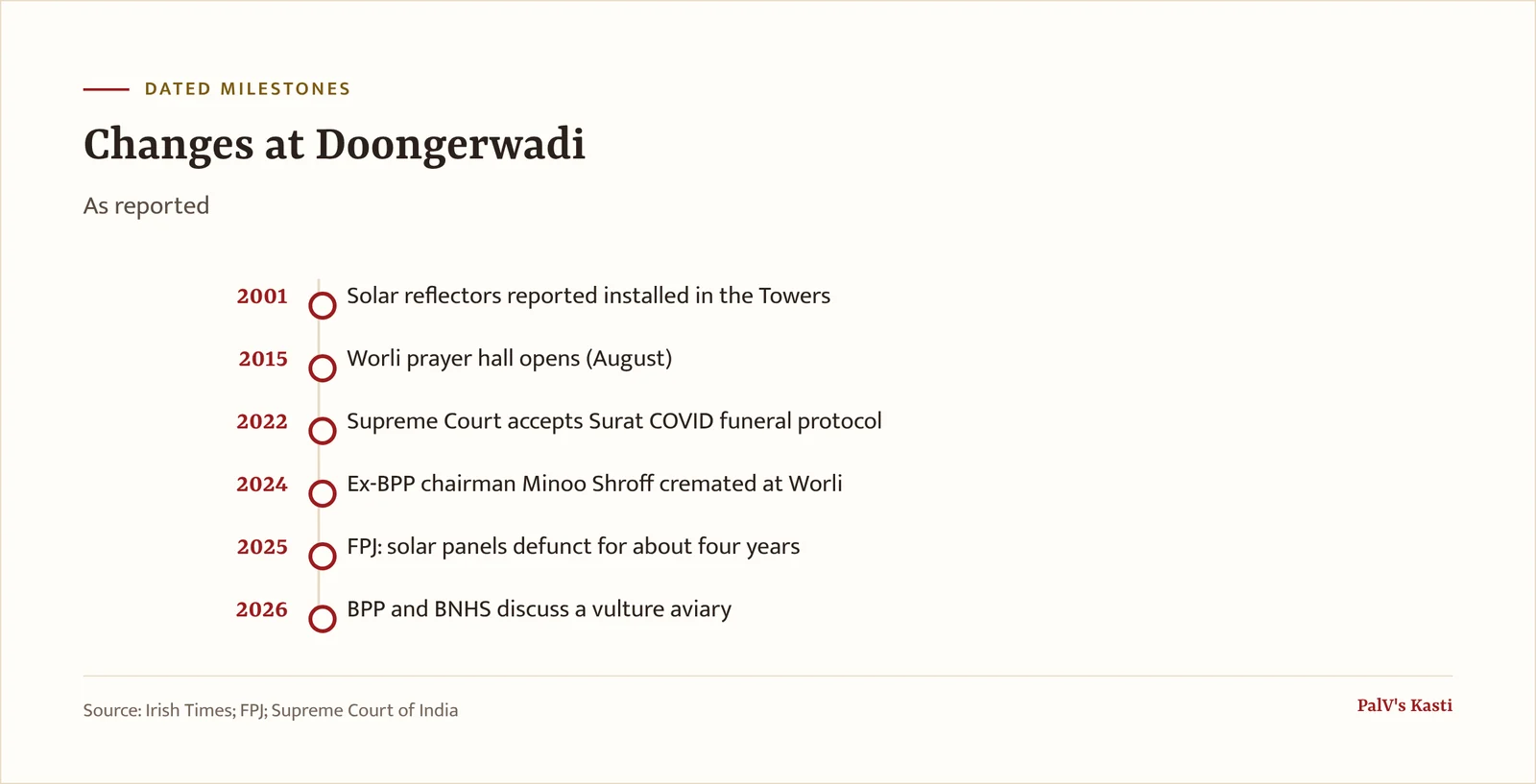
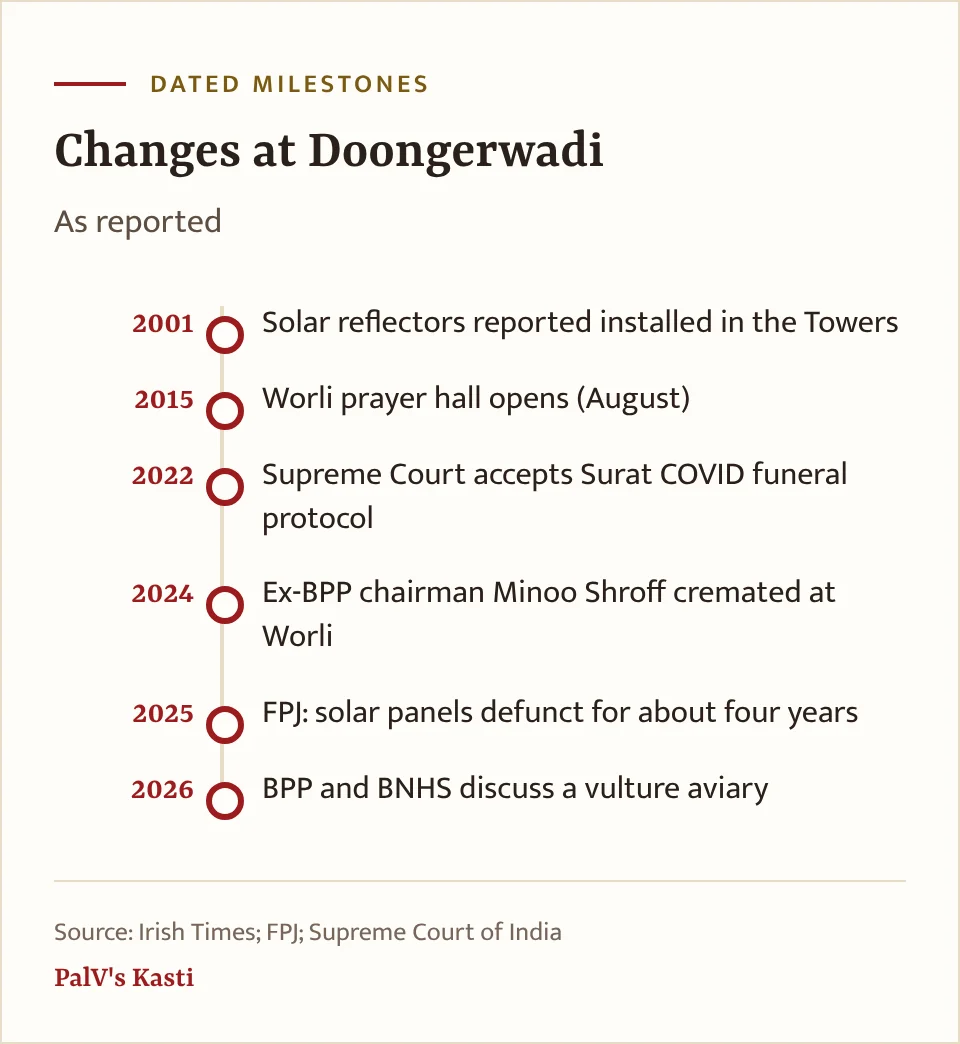
Dokhmenashini at Mumbai's Doongerwadi has changed a great deal in recent decades. The walking funeral gave way to the hearse van. The vultures that once did the work had gone by the 1980s or 1990s, depending on the source. The Bombay Parsi Punchayet (BPP) tried flowers, a herbal mixture and, by 2001, solar reflectors, and some Towers stopped being used. In August 2015 a prayer hall opened at the Worli crematorium, giving cremated Parsis a place for their prayers, and estimates of the share of Mumbai Parsi funerals that are cremations, put at 7–8% before the hall, now range from just over 10% to 15–20%. COVID-19 brought its own rules. As of August 2026, the BPP was still discussing a vulture aviary. Here is each change, with who reported it and when.
શહેરેવર રોજ
Shehrevar Roj, Tir Mah · 1396 Y.Z.
How were Parsi funerals carried out before these changes?
A description quoted in J.J. Modi's 1922 book on Parsi ceremonies says that every Parsi, rich or poor, had a walking funeral: the body carried on an iron bier by the corpse bearers, with mourners in white following in pairs. Mary Boyce, in Encyclopaedia Iranica, writes that these walking funerals, called paydast, went on well into the twentieth century, from the house door to the dakhmas on Doongerwadi hill, until traffic and crowds ended the custom. Today the BPP's own website asks families for the full address so that its hearse van can be sent to collect the deceased.
The structure of a dakhma and the reasons behind it are explained in our Tower of Silence guide.
When did the vultures disappear from Doongerwadi?
Sources give different decades. Speaking to Al Jazeera in April 2015, Asad Rahmani, then Director of the Bombay Natural History Society (BNHS), said the vultures had gone from the Tower of Silence 30 to 35 years earlier, which points to the early 1980s. The 99% Invisible podcast (2024) reported that the khandia Aspi Gadiali began to notice fewer birds at their usual perch in the early '80s. The Free Press Journal (January 2024) puts the last time vultures were seen there in significant numbers in the 1990s.
Why India's vultures collapsed is covered in Vultures and the Tower of Silence.
What did the BPP try once the vultures were gone?
99% Invisible describes a run of experiments agreed by the Panchayat, drawing on Dinshaw Tamboly, who at the time was the BPP member in charge of dokhmenashini. First came kewra flowers; Tamboly explained that the flowers, kept in water in earthen pots outside the walls, gave off a strong scent that masked the smell. Then came a mixture of herbs and chemicals meant to speed up decomposition. He said it did speed things up, but left the area inside the Tower sludgy.
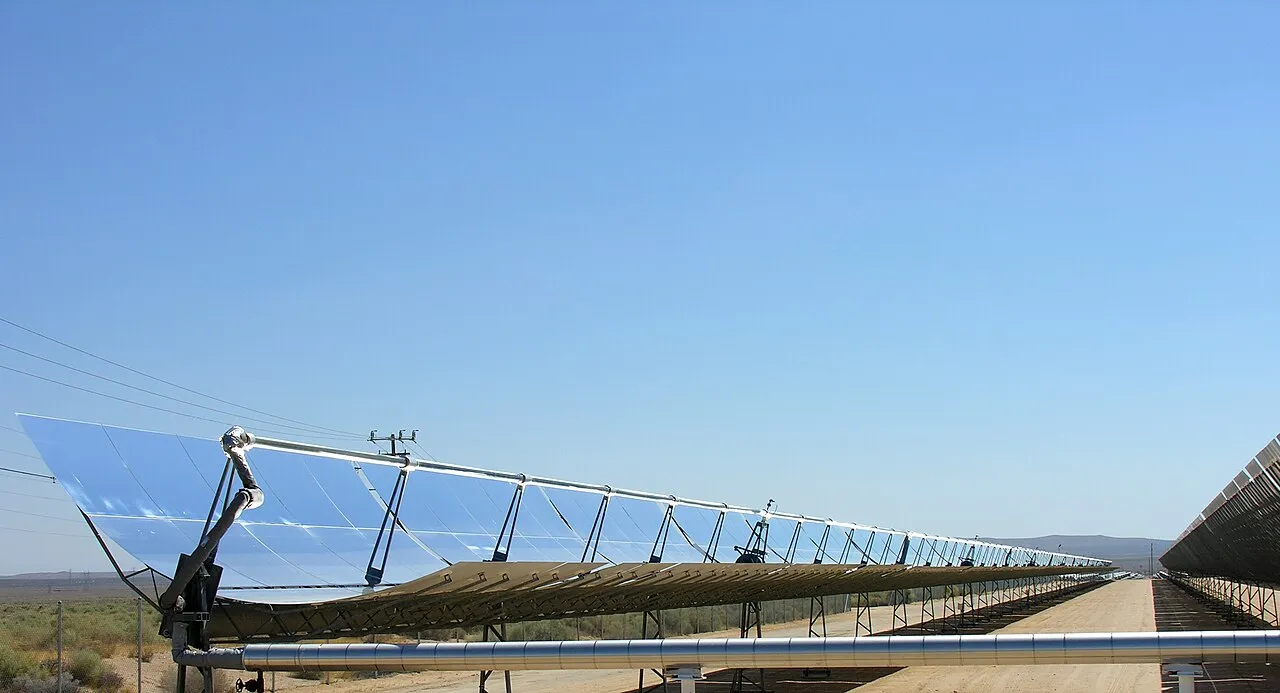
Solar reflectors followed. The Irish Times reported on 23 July 2001 that Bombay's Parsis had installed them in the Towers and that several Parsis said they were working. The BPP's website, in an undated passage, still lists 12 solar units, four each at the Anjuman, Sethna and Bisni dokhmas. But by February 2025, the Free Press Journal reported, the panels had been out of action for about four years, and Parsis were asking the BPP to restore them.
Other ideas never got past discussion. 99% Invisible lists gasification, promession and flesh-eating insects, and says no one could agree on any of them. Composting is discussed separately in our post on the Human composting debate.
Were any of the Towers taken out of use?
Yes, though reports differ on how many. NPR reported in 2012 that one Tower had been closed because the new high-rise buildings around the forest could see into it. 99% Invisible reported in 2024 that Tamboly had found two of the five Towers could be seen from apartment windows, and that those two were taken out of use.
The BPP's website, read in November 2026, gives differing accounts on the same page. One passage says Doongerwadi has five dokhmas, all operational. Another says three are constantly functional (the Anjuman, Sethna and Bisni dokhmas), that the Banaji dokhma is not in use but would soon be made functional, and that there is also a Modi dokhma, used for Parsi women who married non-Parsis but kept the Zoroastrian faith until death and wished to be placed in the Towers.
How has the Worli prayer hall changed Parsi funerals?
Some Parsis were cremated before the hall existed, but, Tamboly told the Free Press Journal in April 2024, there were no facilities for the prayers that follow. He said the high priests did not favour cremation and would not allow prayers at the Doongerwadi prayer halls for those who were cremated, so his group had no choice but to set up a hall of their own. It opened in August 2015 at the BMC's Worli crematorium, with a founding grant of Rs 1.5 crore from the A H Wadia Trust (FPJ, January 2024). In October 2024 the same paper reported that the Tower of Silence management had barred families who chose cremation from using its prayer halls for the four days of after-death rituals.
Figures from the Prayer Hall, as reported by the Free Press Journal in January 2024:
- Cremations at the hall: 33 in 2015, 90 in 2019 and 66 in 2020.
- Before the hall, an estimated 7–8% of Mumbai Parsi funerals were cremations.
- The Prayer Hall Trust now estimates that 15–20% of funerals take place at crematoriums.
Not everyone reads the numbers the same way. Jehangir Patel, editor of Parsiana, told the paper in April 2024 that just over 10% of funerals were done in non-traditional ways, and that there was still reluctance to choose cremation.
Some well-known Parsis have been cremated at Worli: Cyrus Mistry in 2022, former BPP chairman Minoo Shroff in April 2024 and Ratan Tata in October 2024, the Free Press Journal reported. Tamboly said Shroff's could be the first time a BPP trustee had been cremated. On the priests' side, Boyce noted in 1993 that Bombay's orthopractic priests decline to perform the funeral rites once a body has been cremated. The religious arguments on both sides are set out in Dokhmenashini vs cremation.
Practice varies between families and Agiaries; your family priest's guidance comes first.
What changed during the COVID-19 pandemic?
In Mumbai, the bodies of those who died of COVID-19 were not allowed into the dakhmas, according to Framroze Mirza, the priest in charge at the Worli Prayer Hall, and Jehangir Patel (FPJ, January 2024). Both said cremations rose during the pandemic as a result.
In Gujarat the question went to court. The Surat Parsi Panchayat Board challenged the government's rules for disposing of COVID-19 victims, and the Gujarat High Court dismissed its petition on 23 July 2021. On appeal, the Supreme Court (Justices D.Y. Chandrachud and Surya Kant, Civil Appeal 1067 of 2022, 4 February 2022) accepted a protocol agreed by both sides and set the High Court judgment aside. Under it, only professional corpse bearers in protective kit handle the body, relatives and the two priests reciting the Geh Sarna keep at least 10 feet away, and dokhma No. 3 is kept for COVID-19 victims alone, with a metal bird net to be fitted over it.
Where do things stand in 2026?
Bringing the vultures back is still under discussion. In August 2026 BPP chairman Viraf Mehta told the Free Press Journal that the BPP was talking to the BNHS about an aviary at Doongerwadi and already had a donor willing to pay for it, but that protecting the birds from diclofenac remained the challenge.
How far the system has changed is itself argued over. Tamboly, recalling what he saw as a trustee, told 99% Invisible that the system had collapsed. Ervad Dr Ramiyar Karanjia, in his published questions and answers on death and dokhmenashini, takes a different view: of its four principles, only exposure to birds of prey has weakened in roughly the last two decades, while the other three still work, so dokhmenashini remains effective.
Practice varies between families and Agiaries; your family priest's guidance comes first.
Frequently asked questions
Are the Towers of Silence at Doongerwadi still in use?
Yes. The Bombay Parsi Punchayet's website, read in November 2026, says three dokhmas at Doongerwadi are constantly functional and that the Banaji dokhma will soon be brought back into use. Another passage on the same page says all five are operational, so the exact number in use is not clear from the BPP's own text.
When were solar panels installed at the Tower of Silence?
The Irish Times reported in July 2001 that Mumbai's Parsis had installed solar reflectors in the Towers of Silence to help in the absence of vultures. In February 2025 the Free Press Journal reported that the panels had been non-functional for about four years and that community members were asking the BPP to restore them.
How many Parsis in Mumbai now choose cremation?
Estimates differ. The Prayer Hall Trust put it at 15–20% of funerals in January 2024, up from about 7–8% before the Worli hall opened, according to the Free Press Journal. Parsiana editor Jehangir Patel told the same paper in April 2024 that just over 10% of funerals were done in non-traditional ways.
Could Parsis who died of COVID-19 be placed in the dakhma?
In Mumbai, according to accounts in the Free Press Journal (2024), they were not allowed into the dakhmas. In Surat, the Supreme Court's order of 4 February 2022 accepted an agreed protocol that kept dokhma No. 3 only for COVID-19 victims, with handling by professional corpse bearers, distance rules and a bird net.


