 PalV's Kasti
On this page
- Is there a Tower of Silence in the UK?
- Where are Zoroastrians buried in England?
- What do British Zoroastrians do with their dead today?
- Why can't a Tower of Silence be built in Britain?
- Has anyone proposed a Tower of Silence in England?
- Why do some Zoroastrians argue for dokhmenashini wherever they live?
- Frequently asked questions
There is no Tower of Silence in the UK, and we found no formal proposal to build one. A 2018 survey for Historic England gives the reason plainly: England has no vultures and the sun is often not out, so many Zoroastrians there are cremated or buried at Brookwood Cemetery in Surrey. Whether dokhmenashini could legally be practised in Britain has never been tested in an English court as far as we can find. The nearest case, brought by a Hindu man named Davender Ghai, was about open-air cremation. The argument for dokhmenashini anywhere comes from the religious case for it, set out by priests such as Ervad Dr Ramiyar Karanjia, while Kersey H. Antia, writing for Zoroastrians in North America, has accepted other methods as the lesser evil where exposure is not possible.
અસપંદામેદ રોજ
Asfandarmad Roj, Tir Mah · 1396 Y.Z.
Is there a Tower of Silence in the UK?
No. Professor Emma Tomalin of the University of Leeds, in her June 2018 survey of Zoroastrian buildings in England for Historic England, states that the country has no Tower of Silence. She describes the traditional dakhma as a circular, roofless structure in which the body is dried by the sun and eaten by vultures, and notes that neither condition holds in England. The BBC's Religions guide, last updated in October 2009, says that in western countries exposure is either impractical or illegal, so Zoroastrians there usually choose cremation.
For how a dakhma is built and used in India, see our guide to the Tower of Silence.
Where are Zoroastrians buried in England?
At Brookwood Cemetery, near Woking. Historic England's survey dates the community's burial ground there to 1862, when Parsis could not be buried in Christian graveyards and sailing ships took too long to carry a body home to Bombay. Sarah Stewart of SOAS, writing in The Middle East in London in September 2010, says Parsis were coming to England to study and work by the 1860s, and that money was raised for a plot of 2,500 square yards, planted with trees and given a sagri, or chapel, for funeral services.
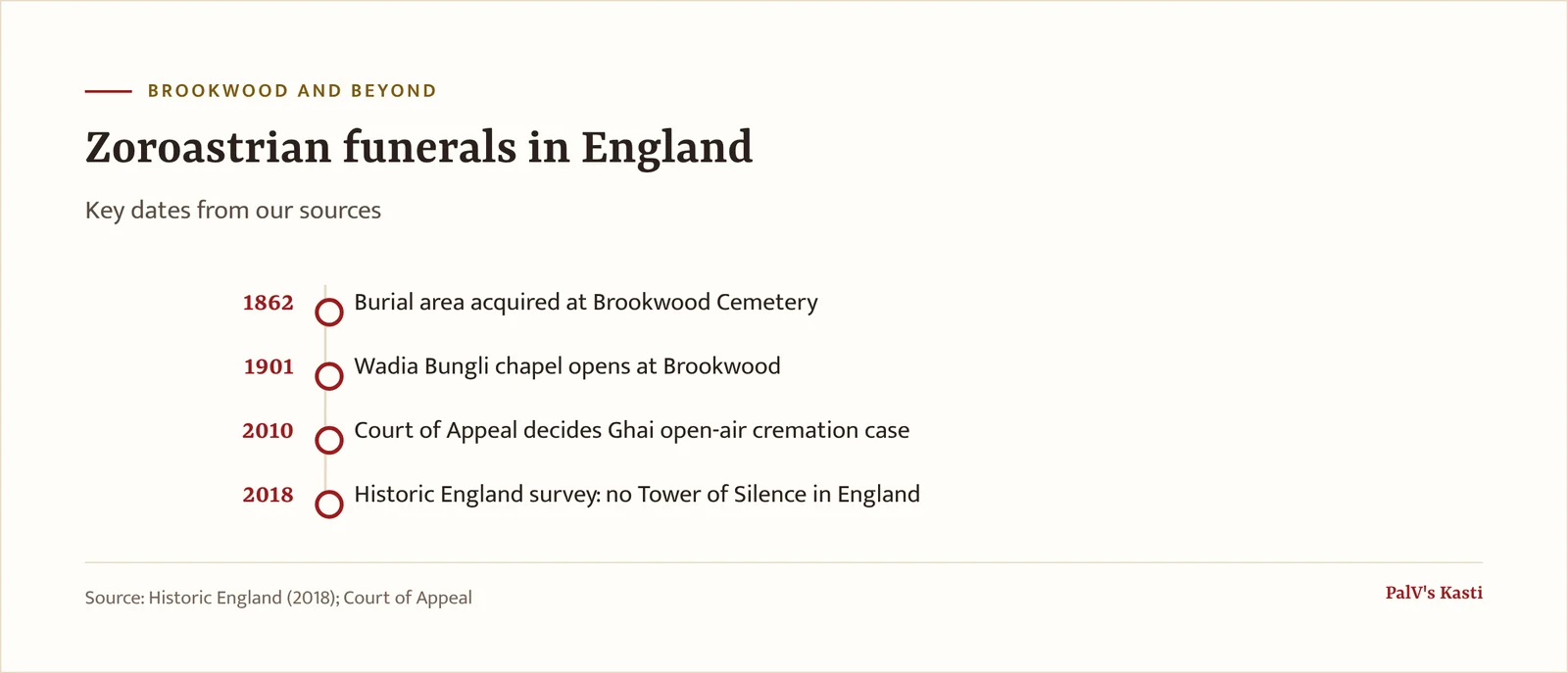
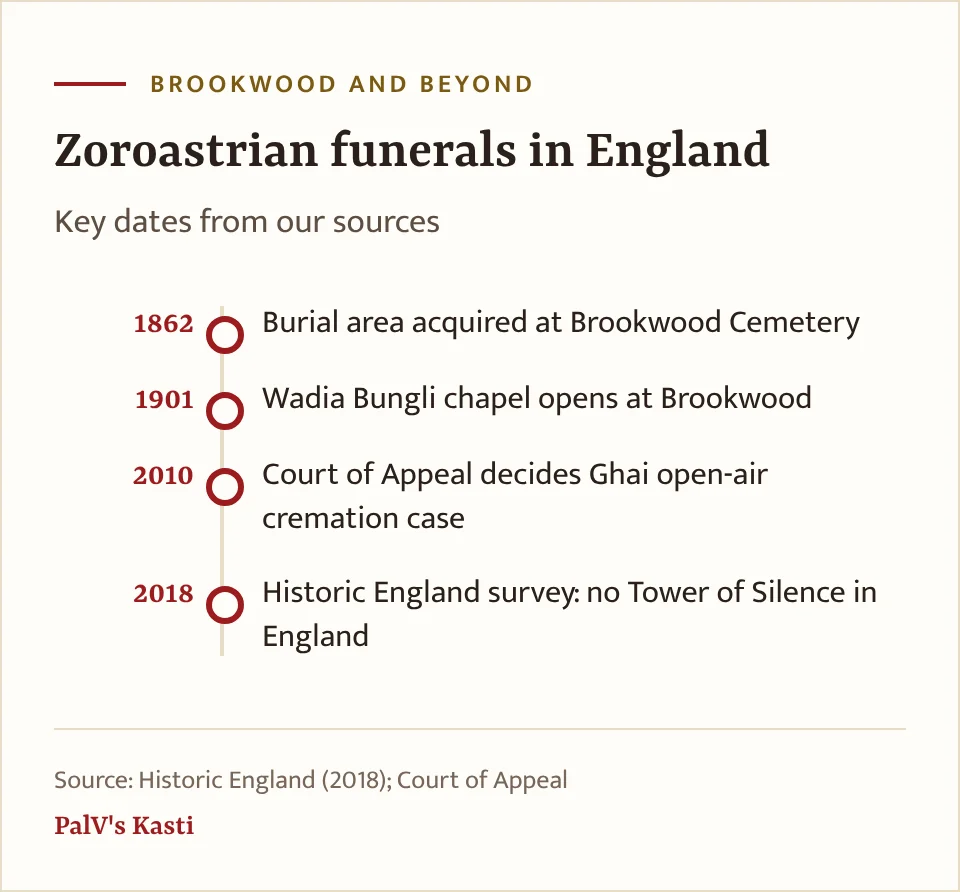
A new bungli for prayer and purification rites opened at the cemetery in 1901, after Sir George Birdwood redesigned the ground, according to the Historic England report. It became known as the Wadia Bungli, and last rites for Parsi and Irani Zoroastrians were held there. The ground is best known for the mausoleum of Nowroji Nusserwanji Wadia and three Tata family mausolea. Jamsetji Tata died in Germany and was brought to Brookwood.
What do British Zoroastrians do with their dead today?
They cremate or bury. Historic England's 2018 report says many Zoroastrians in England are cremated or buried at Brookwood, and that after-death ceremonies, not funerals, are held at the Zoroastrian Centre. Mary Boyce, writing in Encyclopaedia Iranica in 1993, says Zoroastrians in other lands use general undertakers and public crematoriums, with the religious rites usually said at home or at the community's place of worship.
The choice between the two is an old one in Britain. Stewart records that when space at Brookwood ran short in the early 1900s, the community debated whether to take up cremation. Those in favour argued that modern crematoria were more efficient and, being enclosed, less offensive to religious feeling. For burials today, she notes, wooden coffins are commonly used.
Why can't a Tower of Silence be built in Britain?
The reasons given in our sources are practical. Historic England points to the lack of vultures and of strong sun. The BBC guide does not name a law. We found no UK statute or court ruling that deals directly with exposing a body, so we can't tell you whether a dakhma would be lawful there.
What did the Ghai case decide?
The closest English case is R (Ghai) v Newcastle City Council and others [2010] EWCA Civ 59, decided by the Court of Appeal on 10 February 2010. Davender Ghai, a Hindu, wanted an open-air pyre. The Cremation Act 1902 requires cremation to take place in a "building", and the court read that word in its natural, fairly wide sense: a relatively permanent and substantial structure. A building with large openings that let sunlight fall directly on the body could qualify, so his wishes could be met under the Act. The case concerned cremation by fire. It did not deal with exposure.
Has anyone proposed a Tower of Silence in England?
Only in jest, as far as we can find. Writer Farrukh Dhondy, in a column for DNA written while the Ghai case was before the courts, pictured fellow Parsis petitioning for Towers of Silence in England. He then argued against it. Citing a figure of 95 per cent for Indian vulture species lost to the painkiller diclofenac, he wrote that many British Parsis would have taken the drug, so their bodies would do Britain's vultures no favours. He said he would appear in court to denounce any such petition. The petitioners in the column are imagined. It is not a record of any actual proposal. We found no statement on dokhmenashini in Britain from the Zoroastrian Trust Funds of Europe.
Why do some Zoroastrians argue for dokhmenashini wherever they live?
Because, in the traditional view, it is the method the religion prescribes. Ervad Dr Ramiyar Karanjia writes in his published questions and answers that the texts set four criteria: an elevated place, as far from habitation as possible, with the body exposed to carrion birds and to the rays of the sun. He calls dokhmenashini the most ecological way of disposing of the body and says burning, burying or placing in water each pollute some element of nature. He also writes that choosing other modes, by choice or by necessity, slows the soul's progress.
Kersey H. Antia starts from the same principle but reaches a different practical answer. Writing in the FEZANA Journal (Winter 2005) about the choices open to Zoroastrians in North America, he says that dokhmenashini is the only way to avoid polluting any element, so every other method means choosing the lesser of the evils. Where modern laws do not allow a body to be exposed to the sun, he sees cremation as the next alternative, with burial for places that have no crematorium. He has suggested that each association keep a small garden plot where the ashes of all its dead could lie together, which he finds reminiscent of dokhmenashini.
For the rites that follow a death, whatever the method, see our guide to Parsi death rituals. Body composting as an alternative to dokhmenashini is a separate question, which we do not take up here.
Practice varies between families and Agiaries; your family priest's guidance comes first.
Frequently asked questions
Is there a Tower of Silence in the UK?
No. Historic England's 2018 survey of Zoroastrian buildings states that England has no Tower of Silence, because there are no vultures and the sun is often not shining. Zoroastrians in England are instead cremated or buried, many at Brookwood Cemetery near Woking, where the community has had its own burial ground since 1862.
Where are Zoroastrians buried in England?
Mainly at Brookwood Cemetery in Surrey. Historic England dates the Zoroastrian burial area there to 1862 and its chapel, the Wadia Bungli, to 1901. The ground holds the mausoleum of Nowroji Nusserwanji Wadia and three Tata family mausolea. Jamsetji Tata, who died in Germany, was brought there.
What do British Zoroastrians do with their dead?
Most choose cremation or burial. Historic England reports that many are cremated or buried at Brookwood, with after-death ceremonies held at the Zoroastrian Centre. Mary Boyce wrote in Encyclopaedia Iranica that Zoroastrians abroad use ordinary undertakers and public crematoriums, with prayers said at home or at the community's place of worship.
Why can't a Tower of Silence be built in Britain?
Historic England gives practical reasons: no vultures and too little strong sun. The BBC's Religions guide says exposure is impractical or illegal in western countries. We found no UK law or ruling on exposure itself, and the 2010 Ghai case in the Court of Appeal dealt with open-air cremation, not with leaving a body exposed.
Is cremation acceptable for Zoroastrians abroad?
Views differ. Ervad Dr Ramiyar Karanjia writes that dokhmenashini is the prescribed method and that other modes slow the soul's progress. Kersey H. Antia, writing in the FEZANA Journal in 2005, called every other method a lesser evil and saw cremation as the next choice where exposure is not allowed. Ask your family priest.
This is general information, not legal advice; for a specific case, speak to a lawyer.


