 PalV's Kasti
On this page
- Where is the soul during the first three days after death?
- Who protects the soul in those three days?
- Do the family's prayers change what happens to the soul?
- What happens to the soul on the third day?
- Why are four Baj performed before the fourth dawn?
- What is the Chinvat bridge, and what happens at the fourth dawn?
- Which rites mark the fourth day, the Chahrum?
- Frequently asked questions
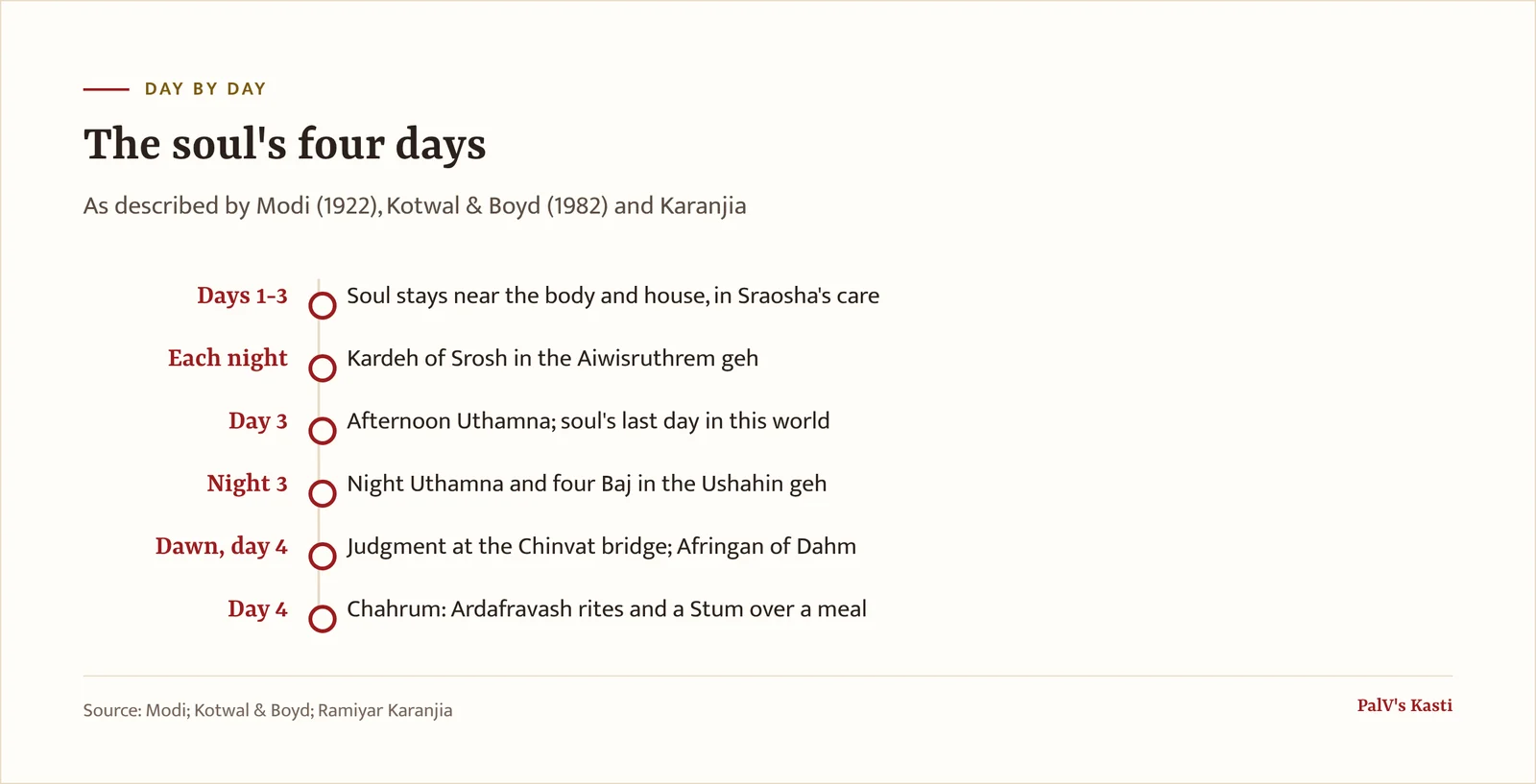
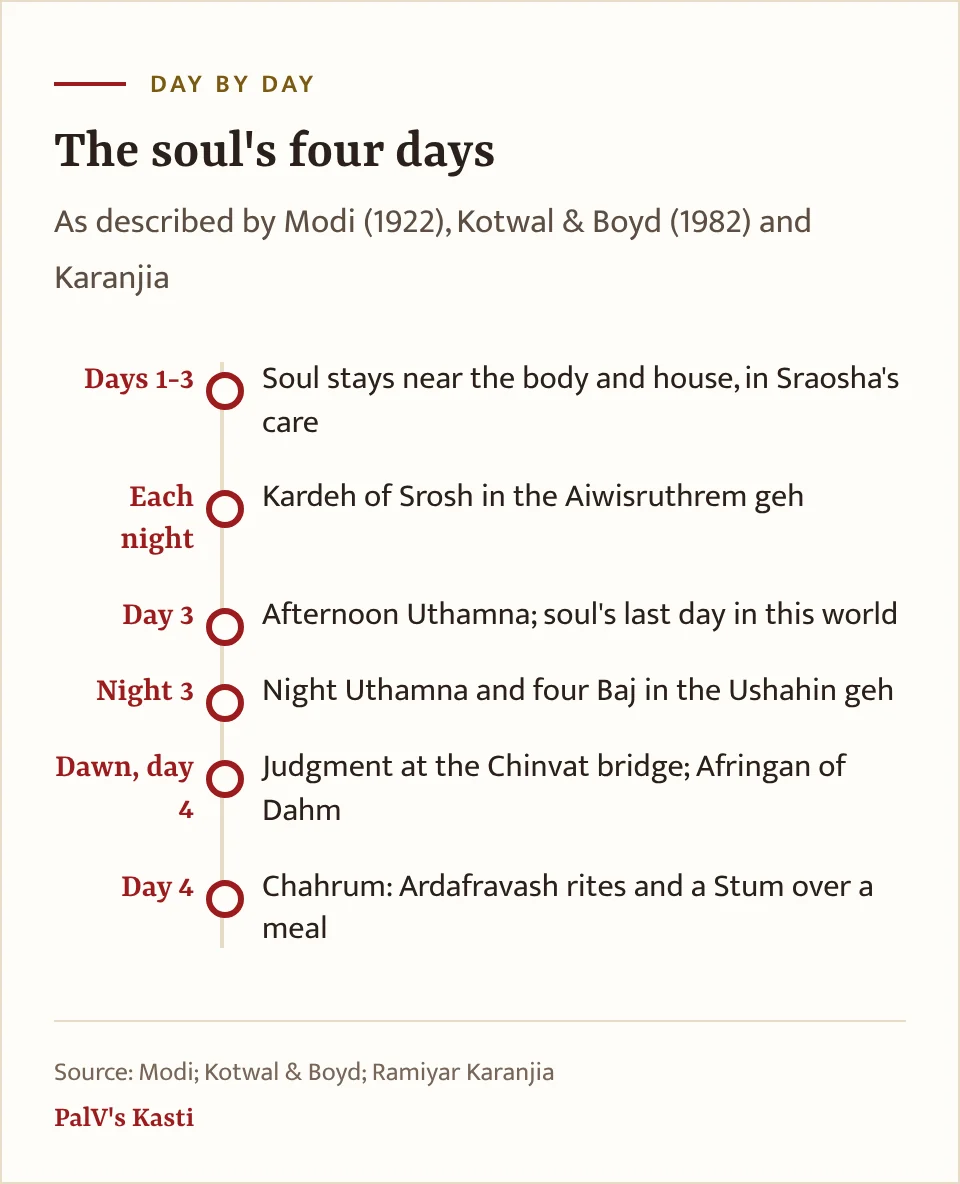
In Zoroastrian teaching, the soul of a person who has died stays in this world for three days and three nights, close to the body and the house, under the protection of Sraosha (Srosh Yazad). At dawn after the third night it leaves for the Chinvat bridge, where its deeds are judged. The rites of these four days follow that journey. Prayers to Srosh fill the first three days, the Uthamna marks the third, four Baj ceremonies are performed before the fourth dawn, and the Afringan of Dahm Yazad opens the fourth day, the Chahrum.
We follow that journey through three priestly sources: Ervad Dr. Jivanji Jamshedji Modi (1922), the catechism of Dastur Erachji Meherjirana translated by Dastur Firoze Kotwal and James Boyd (1982), and Ervad Dr. Ramiyar Karanjia. The geh-by-geh prayer schedule is in our guide to After-death prayers.
અસપંદામેદ રોજ
Asfandarmad Roj, Tir Mah · 1396 Y.Z.
Where is the soul during the first three days after death?
Near its old home. The catechism translated by Kotwal and Boyd answers the question directly: the soul remains in the house where the person died and around the place where the body is kept. It quotes the Vishtasp Nask, "The soul remains around the head."
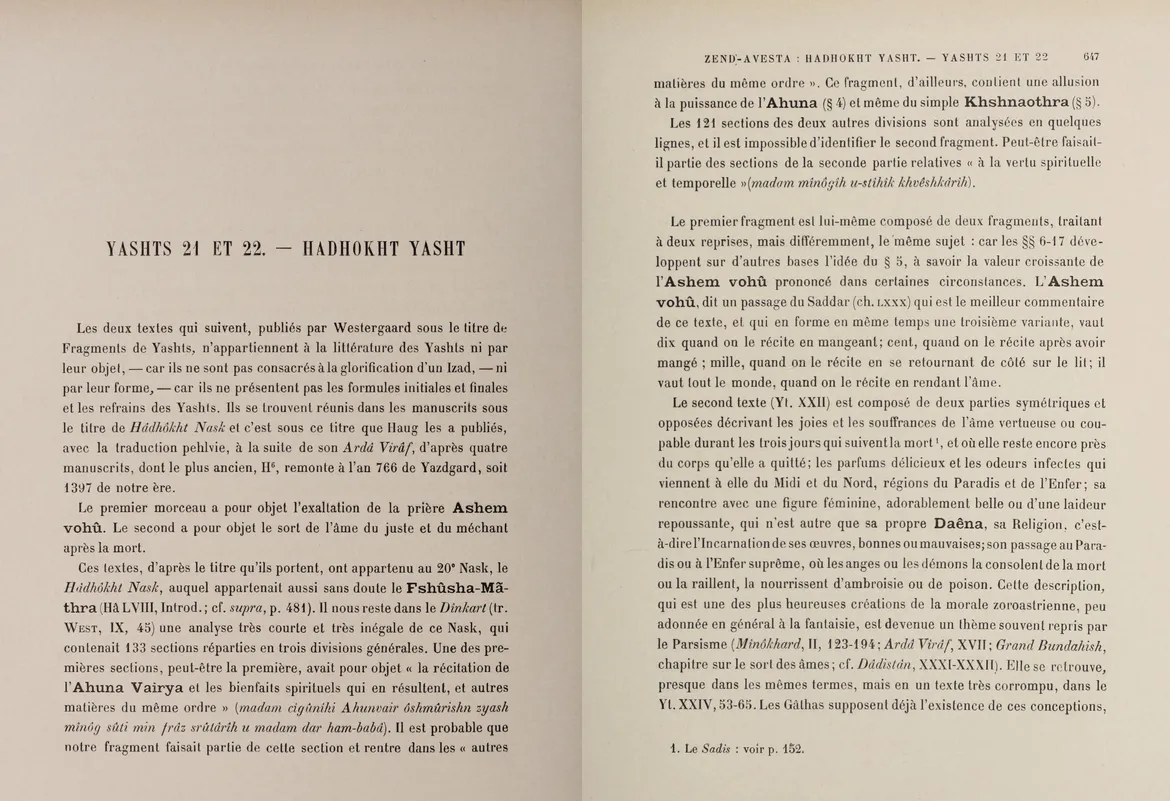
Modi takes the same teaching from the Hadokht Nask, where Zarathushtra asks Ahura Mazda where a righteous soul dwells on the first, second and third nights after death. The answer is that it stays at the place of the body, chanting the Ushtavaiti Gatha. A wicked soul, in Modi's reading of the same text, also stays three nights, but spends them recalling its wrongs and asking where it should go.
Karanjia, and Dastur Kersey Antia in his 2005 funeral guide for the FEZANA Journal, give the same span of three days and nights.
Why three? Modi calls it a sacred number because it recalls the faith's three main precepts. Three days after death, he writes, a good soul moves towards paradise in three steps of good thoughts, good words and good deeds (humata, hukhta, hvarshta), and he quotes the Hadokht Nask for them. A wicked soul moves towards hell in the three opposite steps.
Practice varies between families and Agiaries; your family priest's guidance comes first.
Who protects the soul in those three days?
Sraosha. Modi calls him the guardian angel appointed to guide souls in life and after death. Because the soul is in his care for those three days, Modi writes, the ceremonies of the first three days are performed with his Khshnuman (dedication). He quotes the Pahlavi Shayast ne Shayast: the ceremonial of Srosh is needed in all three days, because Srosh can save the soul from the demons through that time.
The catechism is stricter still. It says that in these three days no ceremony is required except those in honour of Srosh. Kotwal and Boyd add that Srosh watches over the world with special care after sunset, which is why an Afringan of Srosh is performed in the Aiwisruthrem geh. Karanjia names this rite the Kardeh of Srosh or Sarosh nu Patru, done by two priests in that geh during the first three days.
Karanjia records a Baj of Srosh in every geh at an Agiary or Atash Behram until the Chahrum. The funeral usually falls inside these days, and our guide on How to attend a Paydast covers the procession, where mourners walk in pairs joined by a cloth, the Paivand.
Why are a lamp, water and flowers kept where the person died?
The catechism says the fravashis (holy spirits of the departed) come gladly wherever there are water and flowers, and the soul stays nearby for three days, so both are kept there with an oil lamp. The fire, it adds, protects the soul from bad spirits. Antia's guide asks families to keep the divo burning at least until the Chahrum is over.
Practice varies between families and Agiaries; your family priest's guidance comes first.
Do the family's prayers change what happens to the soul?
The catechism says relatives should do the bandagi (daily prayers) of the five gehs on the soul's behalf during the three days, because the dead person can no longer do them. In doing so they fulfil his duty and earn merit for him, merit that "will reach him at the Chinwad bridge".
Karanjia, answering a question he dates 13 January 2013, sees it differently. The prayers comfort the soul, he wrote, because a good deed is done for it and it feels remembered. But they "do not add merit to the soul", and its place is decided by its own deeds alone. For the family, he adds elsewhere, the rites are a soothing balm.
Practice varies between families and Agiaries; your family priest's guidance comes first.
What happens to the soul on the third day?
Karanjia calls the third day the soul's last day in this world. Family and friends gather for the afternoon Uthamna in the Uziran geh, and a second Uthamna follows late in the Ushahin geh, before dawn. Kotwal and Boyd explain the difference in terms of the journey: at the afternoon Uthamna the soul is still in the house, while by the dawn one it has already started to move on. They advised families to hold both.
Practice varies between families and Agiaries; your family priest's guidance comes first.
Why are four Baj performed before the fourth dawn?
Each Baj (also called Baj-dharna or Dron) honours a divine being who has a part in the soul's crossing. Karanjia says the four are done one after another in an Agiary, in the Ushahin geh of the third night, and that they help the soul through the Chinvat bridge and its judgment. Modi and Karanjia list them in the same order. The catechism names the same four but places Srosh before Ardafravash.
| Baj in honour of | Why, according to the sources |
|---|---|
| Rashnu and Ashtad | They help Meher in the judgment. The catechism says they take account of the soul's deeds. |
| Ram (Vayu, the good air) | Modi writes that the righteous soul rises to the higher regions through the rarefied air. The catechism adds that the good air keeps the bad air from harming it. |
| Ardafravash | The fravashis of all the departed, whose company the soul is about to join (Modi). |
| Srosh | The guardian who has guided the soul since death (Modi). |
With the Baj of Ardafravash a suit of white clothes, the Siyav, is consecrated. Karanjia records the same step, and Modi adds that the clothes usually go to a priest or to the poor.
Practice varies between families and Agiaries; your family priest's guidance comes first.
What is the Chinvat bridge, and what happens at the fourth dawn?
The Chinvat bridge (Chinwad Pul) joins this world to the next. Karanjia calls it allegorical, "the Bridge of Separation". Modi quotes the Vendidad (19.29): it is a road for the wicked and the righteous alike, and there the soul must account for its deeds.
At the dawn after the third night, Meher (Mihr Davar, the Judge) weighs the soul's life, helped by Rashnu and Ashtad. Modi gives the rule, and Antia's guide names the same judges:
- If the good deeds outweigh the bad, even by a particle, the soul crosses to paradise.
- If they are exactly equal, it goes to Hameshta-gehan. The catechism describes this place (hamistagan, "the place of the mixed") as lying between the earth and the star station.
- If the bad outweigh the good, it falls to hell.
Karanjia adds the picture of the bridge itself as a beam, broad on one side and sharp on the other. For the righteous it stays broad. He also describes the Daena, the soul's own record of actions, coming to meet it after the judgment: as a beautiful woman who leads a righteous soul across, or as an ugly hag who drags the wicked down. Modi describes the same figure of a fair or a misshapen woman as the soul's picture of its past deeds.
On the far side, the catechism and Karanjia agree, Vohuman (Bahman Ameshaspand) welcomes the righteous soul from a golden throne. Karanjia ends his account further ahead still: at frashokereti, the renovation at the end of time, every soul passes through a final judgment.
Practice varies between families and Agiaries; your family priest's guidance comes first.
Which rites mark the fourth day, the Chahrum?
Chahrum (Cheharum in Modi) simply means "the fourth". The day opens with the Afringan of Dahm Yazad, which Karanjia says is recited only in the first four days' rites for someone who has died. The catechism gives the reason: Dahm Yazad is the custodian of the souls of the righteous, and at the end of this Afringan blessings (afrins) are said for the soul and the living for the first time.
In the Havan geh a Yasna, Baj and Afringan follow in honour of Ardafravash. At lunch time, about 11 am in the catechism's reckoning, a Stum is said over a meal, which the catechism asks families to give to deserving or poor people so that their good wishes reach God for the soul. Modi adds that meat, avoided for three days, is allowed again from the fourth.
The Chahrum is the first of the remembrance days. The tenth day, the thirtieth and the first anniversary follow, as Modi lists them. For how the four days fit into the whole sequence from deathbed to dakhma, see our guide to Parsi death rituals, and for the dakhma itself, the Tower of Silence.
Practice varies between families and Agiaries; your family priest's guidance comes first.
Frequently asked questions
Where is the soul for the first three days after death?
According to the catechism translated by Kotwal and Boyd, the soul stays in the house where the person died and near the place where the body is kept. Modi cites the Hadokht Nask for the same teaching. Karanjia writes that it remains in this world for three days and nights in Sraosha's care.
What is the Chinvat bridge?
The Chinvat or Chinwad bridge is where the soul is judged at dawn on the fourth day. Karanjia describes it as an allegorical bridge between the material and spiritual worlds. Meher, helped by Rashnu and Ashtad, weighs the soul's deeds. The righteous cross to paradise, and the wicked fall to hell below it.
What happens on the fourth day, the Chahrum?
The day begins with the Afringan of Dahm Yazad, guardian of the souls of the righteous. A Yasna, Baj and Afringan for Ardafravash follow in the Havan geh, then a Stum at about 11 am over a meal meant for deserving or poor people. Modi notes that meat, avoided for three days, is allowed again from the fourth.
Why are four Baj performed at the end of the third night?
The four Baj honour Rashnu and Ashtad, who help Meher judge the soul, Ram, the good air through which it rises, Ardafravash, the spirits of all the departed, and Srosh, its guardian since death. Karanjia says they are done in an Agiary in the Ushahin geh of the third night.


