 PalV's Kasti
On this page
Pune's Irani cafes were opened by families who came from Iran in the 19th and 20th centuries, many of them settling in Poona after first landing in Bombay. Café Goodluck on Fergusson College Road, founded in 1935 by Hussain Ali Yakshi, is the one most often named as the city's oldest. The Citizen dates Café Diamond Queen in Camp to the same year. Café Yezdan at Sharbatwala Chowk followed in 1964, and Vohuman Café on Sassoon Road was long run by Hormaz Irani. What ties them together is breakfast: a soft bun or a crisp broon spread thick with butter, dipped into a glass of milky Irani chai.
શહેરેવર રોજ
Shehrevar Roj, Tir Mah · 1396 Y.Z.
Who started Pune's Irani cafes, and why Pune?
The founders were Iranis, a later wave of migrants from Iran and a community distinct from the Parsis, who had arrived centuries earlier. FEZANA's cookbook Eat, Live, Pray (2012) describes Irani Zarathushtis from Yazd and Kerman escaping persecution under Iran's Qajar rulers, helped across by the Parsis of Bombay. Their first homes were often the Parsi colonies of the Fort district, and from there they moved on to Pune and Hyderabad. The Citizen, writing about Pune's cafes in 2018, also puts the Iranis' arrival in the 19th and 20th centuries and links it to Qajar-era persecution.
Pune was not a random stop. Sifra Lentin of Gateway House writes that the newcomers were drawn to British India, Bombay and Poona above all, as Iranian Zoroastrians had already settled in both cities. She quotes the filmmaker Dr Mansoor Showghi Yezdi, whose grandfather walked from Khairabad in Yazd with a group that thinned out across the subcontinent before reaching Bombay, Poona and finally Hyderabad. The same article quotes Deepak Rao, author of Mumbai Police: 150 Years, saying he had seen circulars from around 1895 welcoming Iranis to British India.
Not every Irani cafe owner was Zoroastrian. Gateway House notes that the later migrants from Yazd and Kerman included Shia Muslims as well, and both groups made their living through cafes. In 2014 DNA reported that Pune's Irani cafes were a mix of Muslim-owned places and ones DNA called Parsi-owned, with the Muslim-owned ones far more numerous. For how the cafes began in Bombay, see our guide to the Irani cafes of Mumbai, and for the wider community story in this city, our page on Parsi and Irani Pune.
Which is the oldest Irani cafe in Pune?
Café Goodluck usually gets the title. Outlook Traveller (2025) and The Citizen (2018) both give 1935 as its founding year and Hussain Ali Yakshi as its founder. There is one wrinkle. Slurrp reported in 2022 that papers found by the present owner, Kasim Yakshi, point to the place possibly dating from 1924. Slurrp did not reproduce those papers, so 1935 remains the year the cafe is known by.
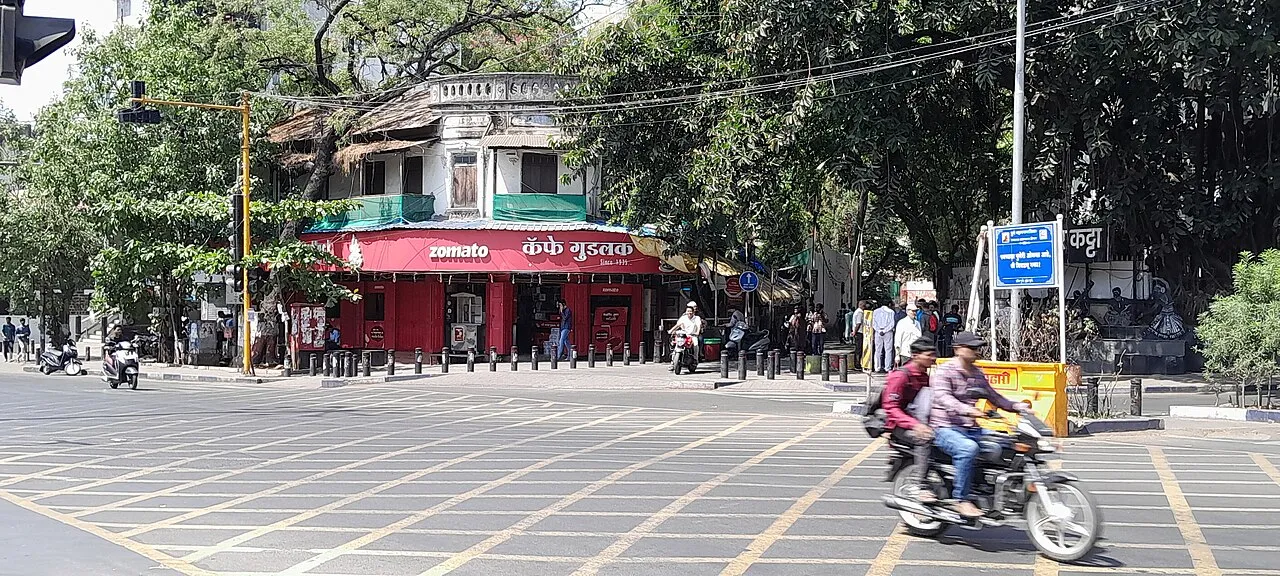
Both Outlook Traveller and Slurrp tell the founder's story the same way. His family left Iran after a famine. He trained in Afghanistan and Pakistan, worked in Delhi, then in Mumbai, and finally came to Pune. Slurrp adds the reason for the last move: Mumbai's humidity troubled his breathing, and he was told to find a drier city. It also says the premises had earlier been a cycle repair shop.
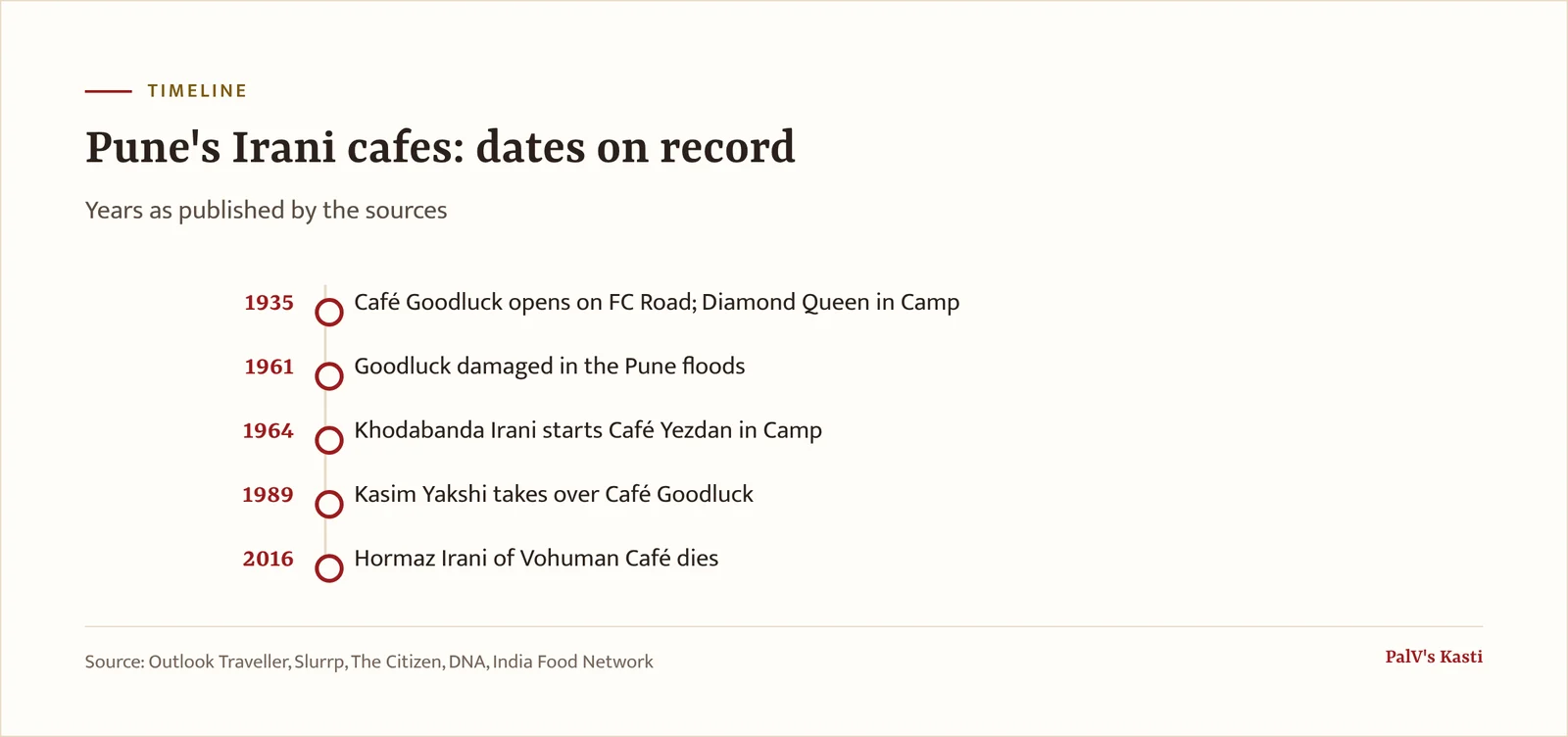
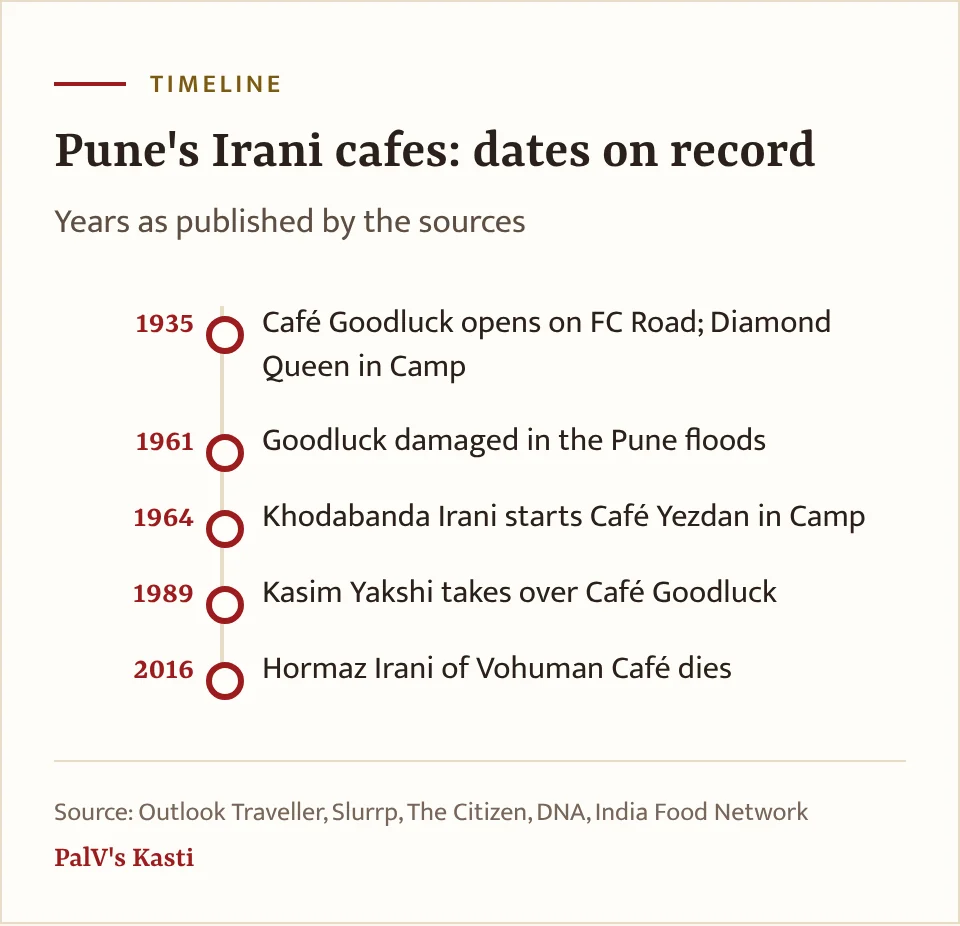
The first menu was short. Tea and bun maska, plus a few snacks. Eggs, chicken and mutton came later, and Slurrp notes the cafe became known for serving meat in a largely vegetarian part of the city. Outlook Traveller records that the cafe was damaged in the Pune floods of 1961. After Hussain Ali Yakshi died in 1989, his brother Kasim took charge. The old wooden chairs have since given way to plastic ones, which both publications mention.
Which other old Irani cafes does Pune still have?
The Citizen's 2018 breakfast round-up named Vohuman Café, Café Diamond Queen, Café Goodluck, Kohinoor Restaurant and Café Yezdan among the city's Parsi-Irani cafes. Here is what the published record says about each.
| Cafe | Area | Year given | What it is known for |
|---|---|---|---|
| Café Goodluck | Fergusson College Road, Deccan | 1935 | Bun maska, bun omelette, egg bhurji |
| Café Diamond Queen | Camp | 1935 | Keema pav, the first dish to sell out each morning |
| Café Yezdan | Sharbatwala Chowk, Camp | 1964 | Bun maska chai and broon |
| Vohuman Café | Sassoon Road | Not published (called 39 years old in 2016) | Cheese omelette, bun maska |
| Kohinoor Restaurant | Not stated | Not published | Opening at 4 am |
Café Yezdan
DNA's 2014 profile says Café Yezdan was started in 1964 by Khodabanda Irani after he left Iran, and that his grandson Shapoor Irani was running it. DNA called it one of the very few "Parsi-owned" Irani cafes left in Pune, using that word for a Zoroastrian-owned cafe. Shapoor told the paper the cafe had no in-house bakery: buns came from Persian Bakery and broons from Imperial Bakery, while everything else was cooked on the premises.
Vohuman Café
Vohuman Café on Sassoon Road was run by Hormaz Irani, whom regulars remembered as a lively Bawa uncle. In November 2016 India Food Network reported that he had died after a prolonged illness, and described the cafe as 39 years old at the time. Its cheese omelette is the dish both India Food Network and The Citizen single out, The Citizen recommending it as a double.
Kohinoor Restaurant and Café Diamond Queen
The Citizen noted that while most of these cafes open around 6 am, Kohinoor opens at 4 am, and a notice by its cash counter asks customers not to linger once they have eaten. At Café Diamond Queen in Camp, which the same report dates to 1935, keema pav was the dish most likely to run out first.
What is bun maska chai, and what makes Irani chai different?
Bun maska is a soft, faintly sweet bun loaded with butter (maska). Its partner on the counter is the broon, sometimes spelt brun, a lighter bread with a crisp crust that gets the same buttering. At Café Yezdan, DNA's reporter was told that the broons sell out quickly.
The chai is the real draw. As The Citizen describes it, the tea and sugar are steeped in a closed vessel, on dum, so the tea steams rather than boils. It is then poured into a glass and topped up with milk that has been kept simmering gently in a separate pot. The Citizen calls the result creamy and rich, a long way from ordinary tea. Regulars dunk the bun straight into it.
Beyond the bread and tea, the Pune menus lean on eggs: cheese omelette, egg bhurji and egg fry. Goodluck's menu adds keema pav, keema samosas and bheja masala, and The Citizen recommends the caramel custard. The Citizen also mentions small plates of lightly sweetened malai, eaten at the end of breakfast.
What does a Pune Irani cafe look like inside?
The Citizen's 2018 description fits most of them. Small marble-topped tables, wooden chairs, mirrors along the walls, and the owner at the cash counter, happy to talk. Many take only cash. In Pune, a good number sit in the old Camp area. The writer Asif Noorani, in Dawn, observed that Irani restaurants in Karachi, Mumbai and Pune almost always stand on street corners, open on two sides.
Not every cafe keeps the full set. Kyoto Journal's essay on Café Yezdan describes bentwood chairs and glass jars of biscuits and rusks on the counter, but notes that Yezdan lacks the black marble round tables seen elsewhere. At Goodluck, the plastic chairs replaced the wooden ones long ago.
Frequently asked questions
Which is the oldest Irani cafe in Pune?
Café Goodluck on Fergusson College Road is usually called Pune's oldest Irani cafe. Outlook Traveller and The Citizen both date it to 1935 and name Hussain Ali Yakshi as founder. Slurrp reported in 2022 that the owner had found papers suggesting 1924, but the report did not reproduce them. The Citizen dates Café Diamond Queen to 1935 as well.
Is Café Goodluck in Pune still open?
Yes, as of Outlook Traveller's June 2025 feature, which listed Café Goodluck near Goodluck Chowk on Fergusson College Road as open every day from 8 am to 10:30 pm. The cafe has been run by Kasim Yakshi since his brother, the founder Hussain Ali Yakshi, died in 1989. Check current timings before you go.
What is broon maska?
Broon maska, also spelt brun maska, is a broon (a light bread, crisp on the outside) spread generously with butter. It is served with Irani chai in Pune's Irani cafes as an alternative to the softer, slightly sweet bun maska. Café Yezdan in Camp has bought its broons from Imperial Bakery, according to DNA.
Are Irani cafes Parsi?
Not exactly. Irani cafes were founded by Iranis, who came from Iran in the 19th and 20th centuries, long after the Parsis. Some Iranis were Zoroastrian, as the Parsis are, and the two communities are close and have intermarried. Others were Shia Muslims. DNA reported in 2014 that most of Pune's Irani cafes were Muslim-owned.
Where are most Irani cafes in Pune?
Many are in the old Camp area, The Citizen reported. Café Diamond Queen is there, and DNA placed Café Yezdan at Sharbatwala Chowk in Camp. Others are spread across the city: Café Goodluck is on Fergusson College Road in Deccan, and Vohuman Café is on Sassoon Road. Most open early, around 6 am, and many accept only cash.


