 PalV's Kasti
On this page
- What is Jam-e-Jamshed, and what does the name mean?
- When was Jam-e-Jamshed founded, and who started it?
- Is Jam-e-Jamshed older than Bombay Samachar?
- How did Jam-e-Jamshed go from weekly to daily and back?
- Who edited Jam-e-Jamshed?
- Where did Jam-e-Jamshed stand on community debates?
- Who runs Jam-e-Jamshed now, and is it in Gujarati or English?
- Frequently asked questions
Jam-e-Jamshed is a Mumbai newspaper written mainly for Parsis, first published in 1832 and, in the latest reports we could find (2016), a weekly in Gujarati and English. Its first issue was a weekly dated 12 March 1832, according to a 2016 history in The HOOT. The HOOT and Deccan Herald both describe it as the second-oldest newspaper in Asia, after Bombay Samachar, which began in 1822. So the "oldest Parsi newspaper" label needs care. Bombay Samachar is older, and Parsi Times credits it to another Marzban, Mobed Furdoonji Marzban. What Jam-e-Jamshed holds is a narrower title: Parsi Times, writing in 2016, called it "the community's oldest" weekly. According to The HOOT, it became a daily in 1853, ran into money trouble in the 1960s, and carried on as a weekly when the daily closed.
અસપંદામેદ રોજ
Asfandarmad Roj, Tir Mah · 1396 Y.Z.
What is Jam-e-Jamshed, and what does the name mean?
Jam-e-Jamshed (often shortened to JJ, and sometimes spelt Jame Jamshed) is a community newspaper that Mumbai's Parsis have read since 1832. The HOOT explains the name: in Persian it points to the goblet of Shah Jamshid, a cup in which, The HOOT says, the past, present and future could be seen.
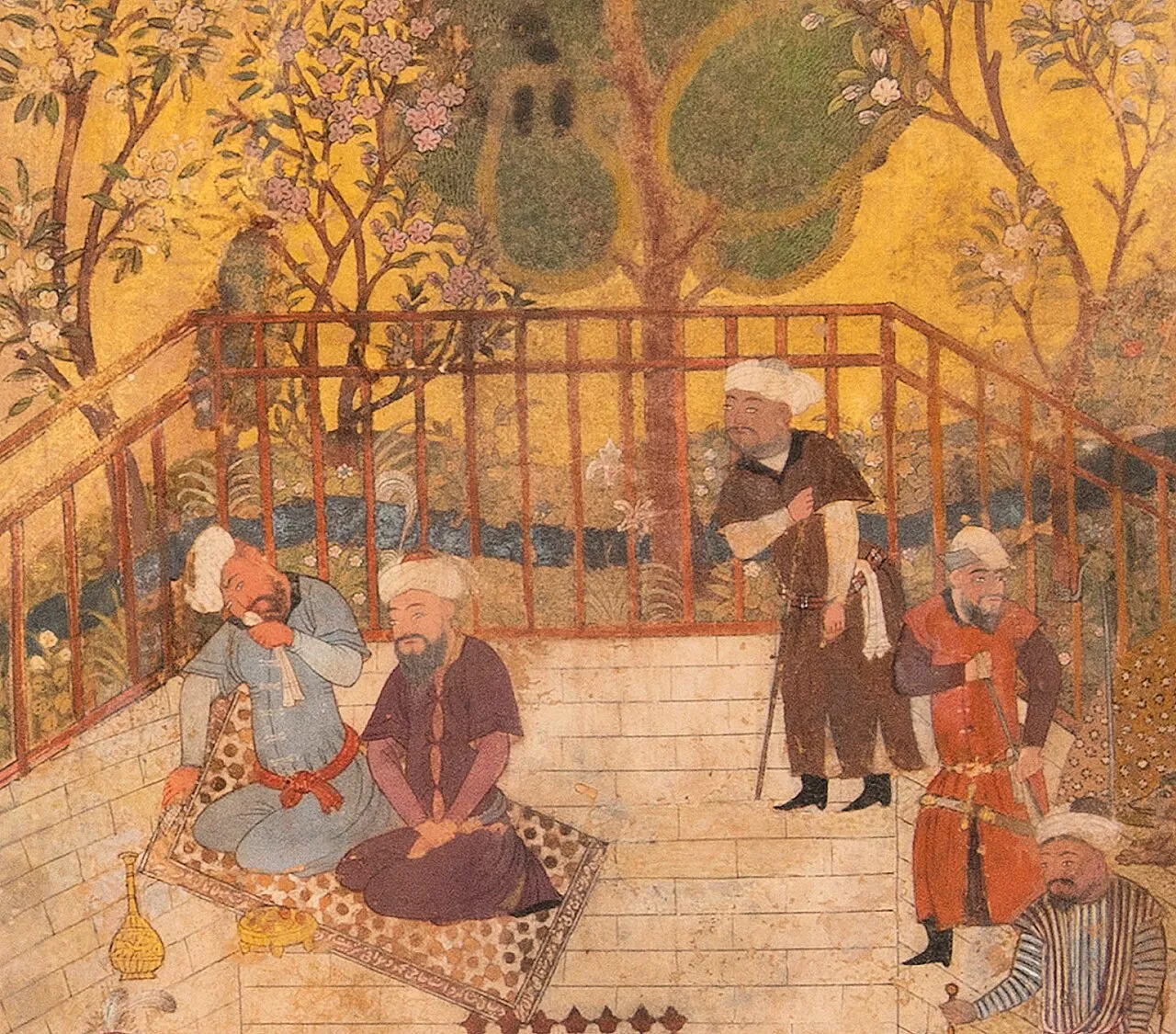
Parsis were never its only readers. Both The HOOT and a Deccan Herald interview with the paper's editor say that it grew up with Bombay's trade, and that Bohras and other trading communities read it alongside Parsis.
When was Jam-e-Jamshed founded, and who started it?
Every source we checked puts the first issue in 1832. The founder is less settled, and the sources give two answers.
- Pestonji Maneckji Motivala. In a two-part 2025 Parsi Times series, Adil J. Govadia writes that Seth Pestonji Maneckji Motivala opened a Gujarati printing press called Jam-e-Jamshed in 1829 and launched a weekly paper of the same name in 1832.
- The Marzban family. The HOOT (2016) and Deccan Herald both credit the start of the paper to the Marzbans, an influential Parsi family of Bombay.
We have not found a primary record that settles it. The Govadia series, which names Motivala as founder, also lists three generations of Marzbans as the paper's editors (see below).
Is Jam-e-Jamshed older than Bombay Samachar?
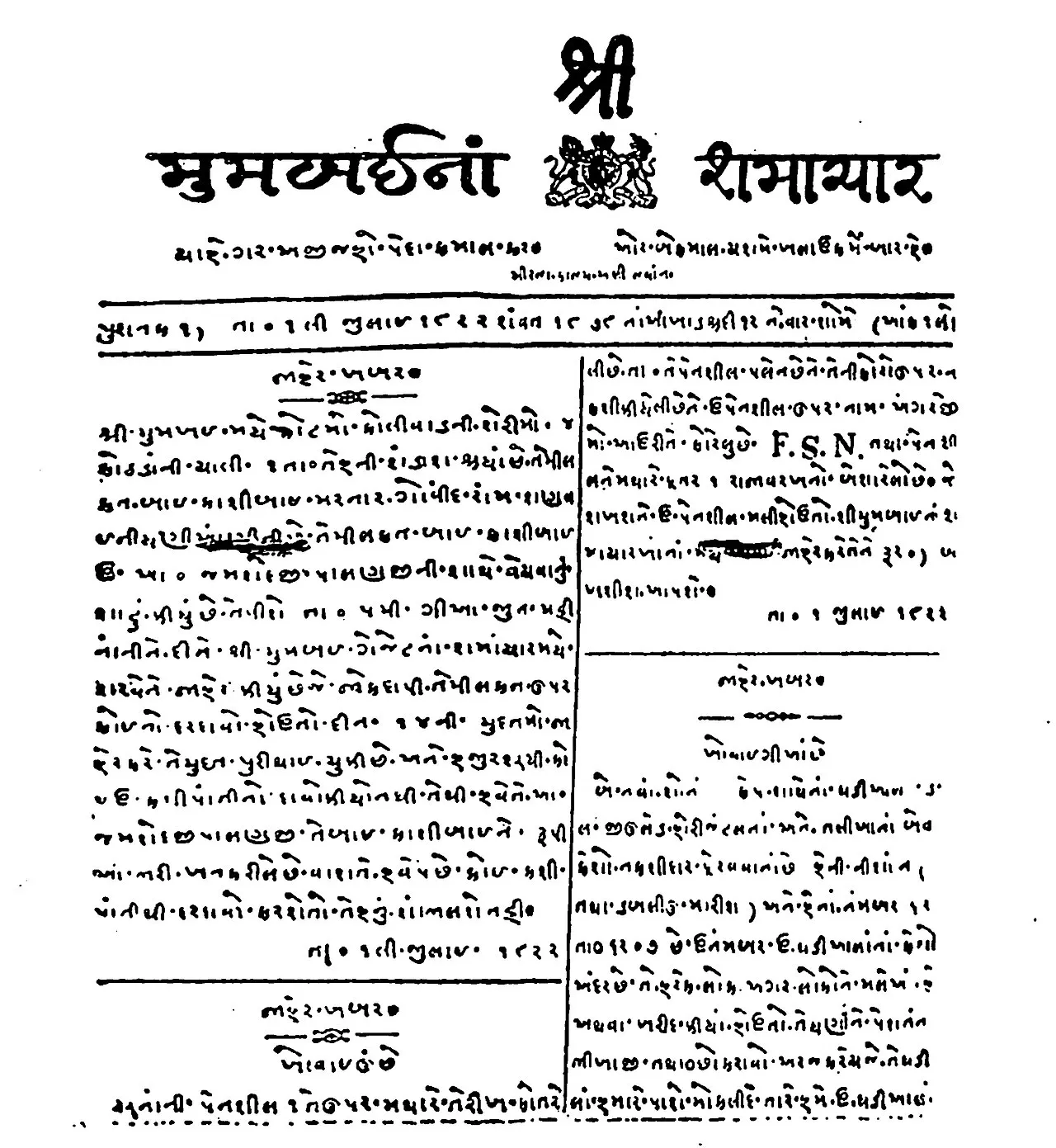
No. Govadia's Parsi Times series dates Bombay Samachar to 1822 and credits it to Mobed Furdoonji Marzban (1787-1847), whom it describes as a Persian scholar. That puts Bombay Samachar almost ten years ahead of Jam-e-Jamshed. Deccan Herald and The HOOT agree on the order: Bombay Samachar first, Jam-e-Jamshed second. We tell that older paper's story in our post on Bombay Samachar.
How did Jam-e-Jamshed go from weekly to daily and back?
The HOOT gives the outline. Jam-e-Jamshed came out weekly, published from a red brick building the paper owned at Ballard Pier, by the Mumbai docks. In 1853 it became a daily. In the early twentieth century it reported on India's freedom struggle (Deccan Herald also mentions this).
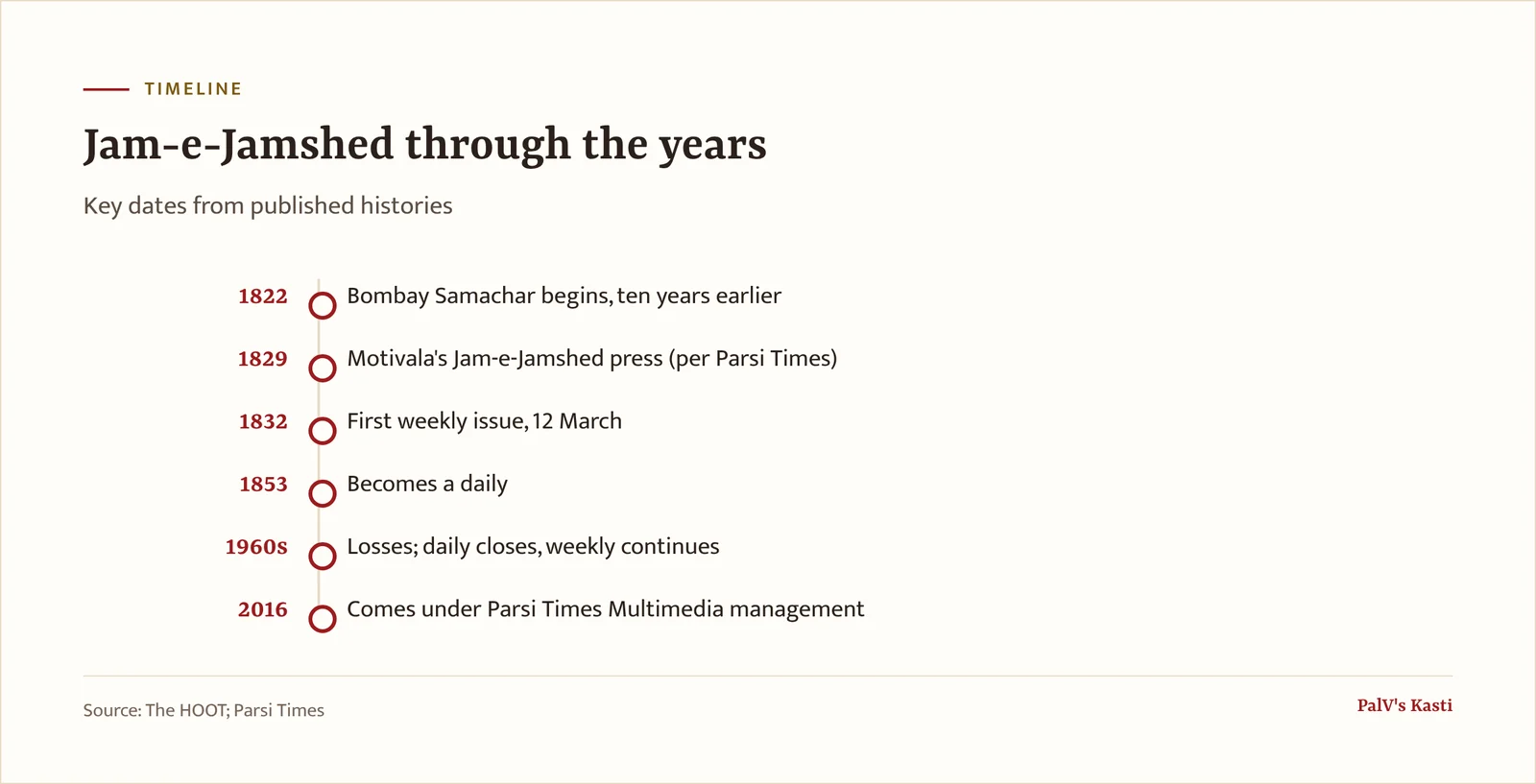
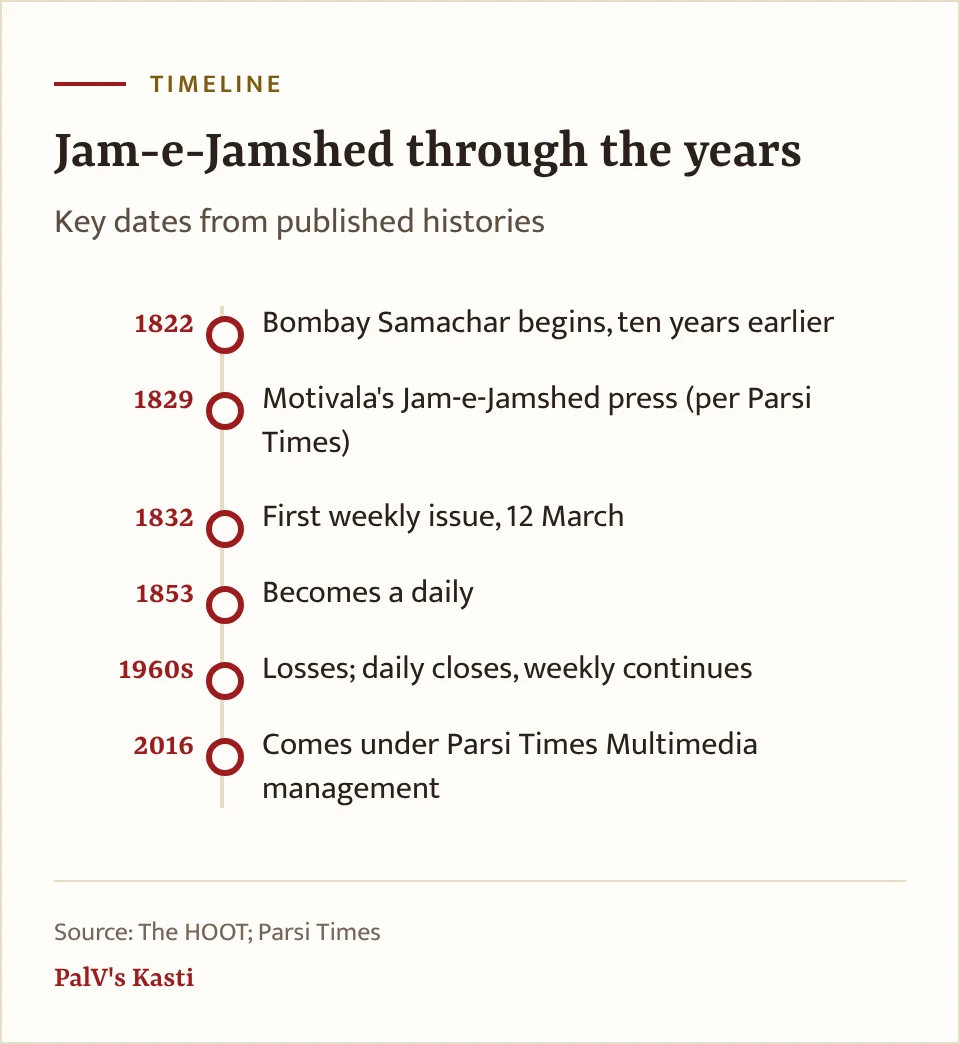
Money trouble came in the 1960s. According to The HOOT, Nanabhai Beheramji tried to save the paper by taking it over in all but name and steering it back to an orthodox line. The daily still shut, and Jam-e-Jamshed carried on as a weekly, the form it still had in 2016. Deccan Herald also says the paper later moved out of the Ballard Pier building.
Who edited Jam-e-Jamshed?
Govadia names Seth Jehangir Byramji Marzban (1848-1928) as editor. After 1928 the job went to his son, Seth Pirojshah Marzban, who wrote under the pen-name "Pijam". The family's work in journalism then passed to Pirojshah's sons, Ardeshir (Adi) and Rustomji Marzban.
The HOOT adds Fram Bulsara, who was joint editor during the 1940s to 1960s. In 2016 The HOOT named the editor as Shernaaz Engineer, who had earlier worked at the Afternoon Despatch & Courier.
Where did Jam-e-Jamshed stand on community debates?
The HOOT describes an orthodox paper that stood against the reform wave of the late nineteenth and early twentieth centuries. It says Jam-e-Jamshed opposed conversion, mixed marriages and what The HOOT calls "mixed Navjote". Between the 1940s and the 1960s, under Fram Bulsara, it tried out reformist ideas, and The HOOT reports that this met strong orthodox opposition.
Shernaaz Engineer gave her own account of the paper in her Deccan Herald interview. She said the clergy had never influenced its editorial policy. In the same interview she spoke about the community's shrinking numbers, how women who marry outside the community are treated, and the choice some Parsis now make of cremation, which she said the clergy still frown upon. We report these positions as the sources record them, and take no side.
Practice varies between families and Agiaries; your family priest's guidance comes first.
Who runs Jam-e-Jamshed now, and is it in Gujarati or English?
The most recent reports we could find on how the paper is run date from 2016. That July, Parsi Times reported that Jam-e-Jamshed and Parsi Times had come under "the sole management of Parsi Times Multimedia Pvt. Ltd.", with a common board of directors. Parsi Times said the reason was commercial: two papers serving a limited audience would gain from economies of scale. It added that each weekly would keep its own identity, with no overlapping content. The report named no owners or directors.
Language has changed too. The paper began in Gujarati. The HOOT (2016) describes a weekly in Gujarati and English, with more English than before, and Engineer told Deccan Herald that she had flipped the old page balance so that English took the larger share. Some readers criticised the change, she said. Copies were also posted to readers in Australia, the UK and Canada, according to that interview.
We found no 2025 or 2026 source on who edits or owns the paper today. Treat the details in this section as accurate for 2016. Jam-e-Jamshed is one strand of a longer story, which our post on Parsi journalism in India follows. For a community magazine of a different kind, see our post on Parsiana magazine.
Frequently asked questions
When was Jam-e-Jamshed founded?
Jam-e-Jamshed was founded in Bombay in 1832. A 2016 history in The HOOT dates its first issue, a weekly, to 12 March 1832, and Parsi Times also gives 1832 as the year it began. By our calculation, 2026 marks 194 years since that first issue. The HOOT and Deccan Herald describe it as Asia's second-oldest newspaper, after Bombay Samachar.
Who founded Jam-e-Jamshed?
Sources differ. A 2025 Parsi Times series by Adil J. Govadia credits Seth Pestonji Maneckji Motivala, who opened the Jam-e-Jamshed press in 1829 and launched the weekly in 1832. The HOOT and Deccan Herald credit the Marzban family, who edited the paper for generations. We found no primary record that settles which account is right.
Is Jam-e-Jamshed the oldest Parsi newspaper?
Not strictly. Bombay Samachar, which Parsi Times says Mobed Furdoonji Marzban started in 1822, is about ten years older. Deccan Herald calls Bombay Samachar the oldest newspaper in Asia and Jam-e-Jamshed the second oldest. In 2016 Parsi Times described Jam-e-Jamshed more narrowly, as the community's oldest weekly newspaper.
Was Jam-e-Jamshed ever a daily newspaper?
Yes. According to The HOOT, Jam-e-Jamshed started as a weekly in 1832 and became a daily in 1853. Its finances worsened in the 1960s. A rescue attempt by Nanabhai Beheramji failed to turn things around, the daily closed, and the paper went back to coming out once a week, which it still did in 2016.
Is Jam-e-Jamshed published in Gujarati or English?
Both. It began as a Gujarati paper. In 2016 The HOOT described a weekly in Gujarati and English with more English than before, and editor Shernaaz Engineer told Deccan Herald she had reversed the old page balance in favour of English. We found no newer source on its current language mix.


