PalV's Kasti
On this page
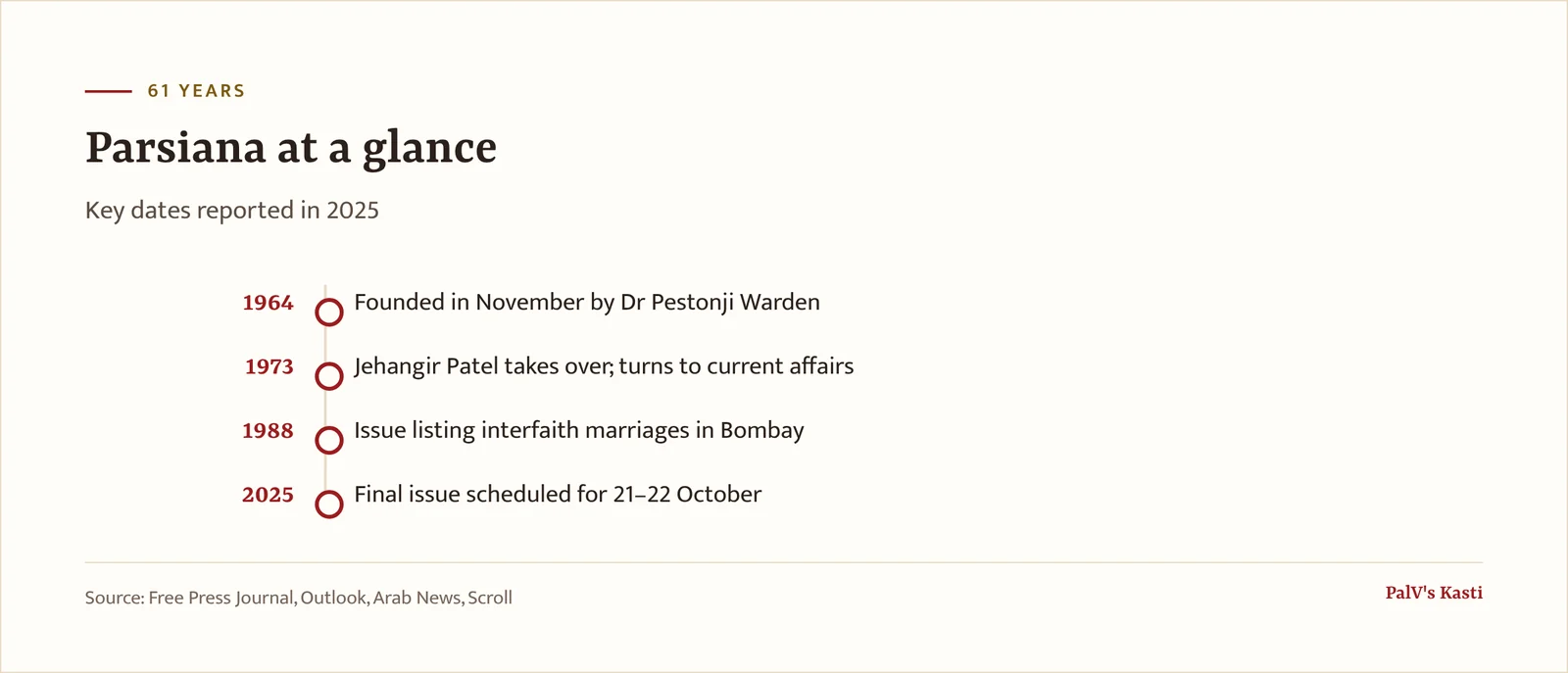
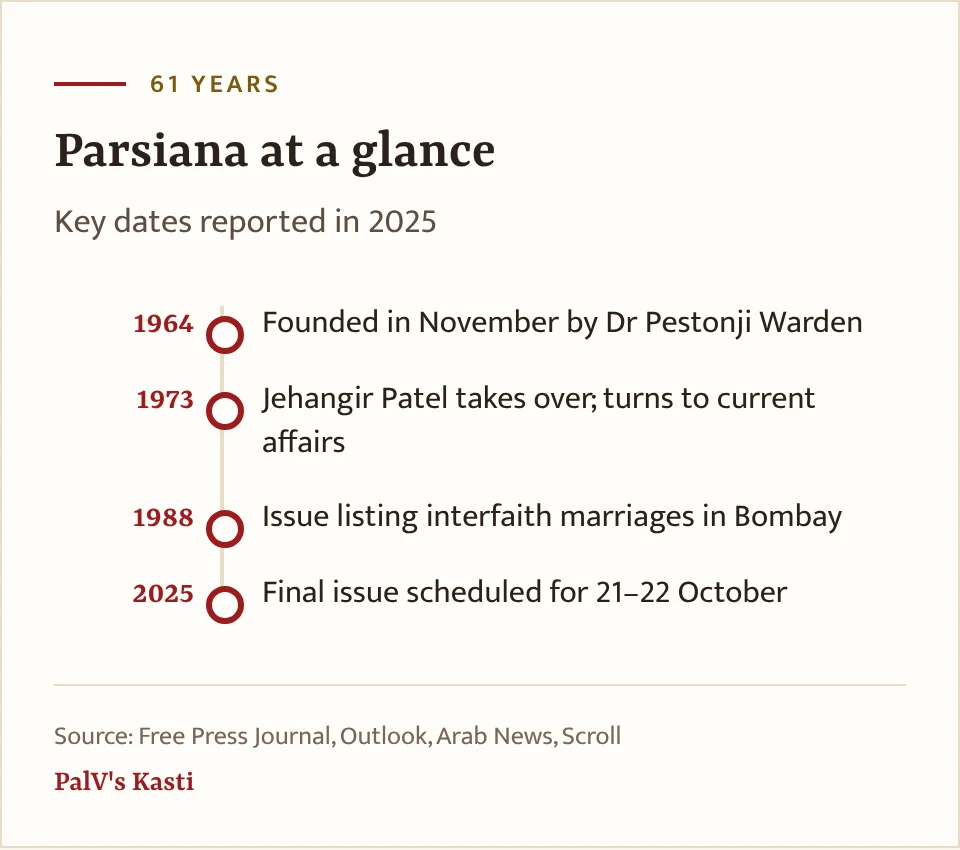
Parsiana was a Parsi community magazine published between November 1964 and October 2025, about 61 years by our count. Dr Pestonji Warden, a physician, founded it. In 1973 his young relative, the journalist Jehangir Patel, took it over and moved it from religion and history to current affairs. It matters because for five decades it reported Parsi affairs from the inside and took open positions on divisive questions, such as the rights of Parsi women who married outside the faith. Those positions put it at odds with orthodox Parsi establishments, the Free Press Journal reported. When it announced its closure in 2025, Scroll, Outlook, the Free Press Journal and Arab News all covered the story, and Scroll called it a loss for Indian journalism as well as for Parsis.
અસપંદામેદ રોજ
Asfandarmad Roj, Tir Mah · 1396 Y.Z.
What was Parsiana magazine?
Parsiana was a magazine for Parsis and Zoroastrians. The Free Press Journal reported in July 2025 that it started as a monthly, then became a bimonthly and finally a fortnightly. Outlook tells the same story and adds that it began as a small cyclostyled bulletin. Scroll, in a piece by the historian Dinyar Patel, calls it semi-monthly, which means the same as fortnightly.
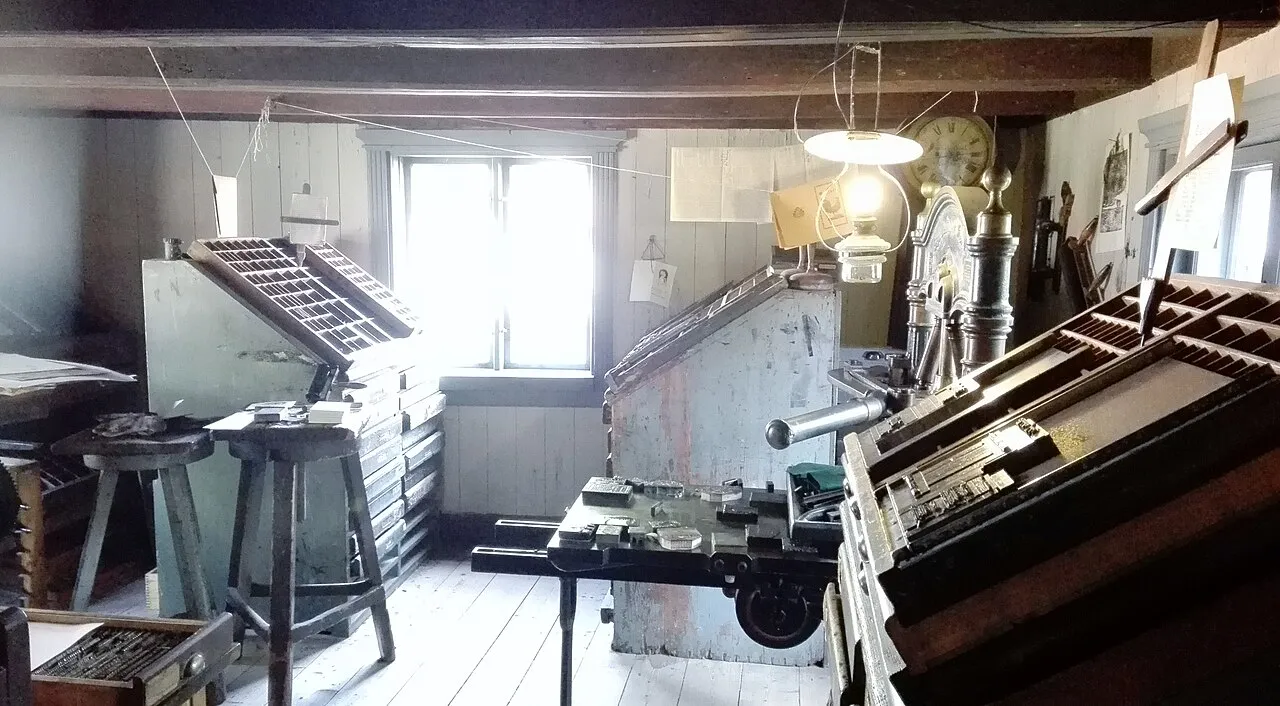
The staff stayed small. Arab News put the team at 15 members in 2025, and the Free Press Journal gave a figure of around 15, counting journalists, designers and advertising staff.
Who founded Parsiana, and when?
All four reports name Pestonji Warden as the founder. The Free Press Journal gives the month as November 1964. Arab News calls him a Parsi doctor and entrepreneur; Outlook describes him as a physician and sandalwood trader who wanted to document a community going through change.
According to Outlook, Warden launched the bulletin in defiance of disputes he was having with the Bombay Parsi Panchayat. For its first nine years, Arab News says, the magazine dealt mostly with religious, historical and academic subjects. Scroll adds that Warden's issues carried scholarly writing on Zoroastrianism and, now and then, translations of religious texts.
How did Jehangir Patel change Parsiana after 1973?
In 1973 Warden, by then ageing, sold the magazine to Jehangir Patel, whom the Free Press Journal describes as a young relative. Outlook reports that Patel paid one rupee for it. Both the Free Press Journal and Arab News say Patel had studied at Yale and worked at the San Francisco Examiner and the Hartford Times in the United States before he came back to India.
Arab News says the focus moved to current affairs once Patel took charge. Dinyar Patel writes in Scroll that the new editor's first cover story was on rising divorce rates among Parsis. Scroll also describes how the magazine was made in those years. It was printed by letterpress, galley proofs were put together by hand, and paper was so short that it had to be bought on the black market. The print run grew to 3,000 copies.
Scroll reports that the cartoonist Mario Miranda drew cover art, one cover showing a Gahambar feast, and that the magazine hired Manjula Padmanabhan, then a young artist, to draw cartoons of community life.
What issues did Parsiana cover?
The reports below describe the magazine's own positions. We set them out as reported.
- Intermarried women. Scroll names the denial of community and religious rights to intermarried women as one of the contested issues it took on. The Free Press Journal says it backed equal religious rights for Parsi women.
- Entry to fire temples. Outlook reports that it supported women's right to enter fire temples.
- A 1988 issue that listed interfaith marriages in Bombay. Outlook calls it among the magazine's most debated issues and says it caused outrage in orthodox circles.
- National events that touched Parsi lives. Scroll mentions the 1992 to 1993 Bombay riots and the 2008 attacks on Mumbai. Scroll and Outlook both say that when it reported on the Ram temple consecration at Ayodhya in early 2024, it reminded readers of the thousands killed in the violence after the Babri Masjid demolition.
- The Emergency. Scroll says Patel used satire against the government in its pages, and in 1977 called the Emergency "independent India's darkest chapter".
According to the Free Press Journal, these editorials put Parsiana at loggerheads with the orthodox Parsi establishment. This page reports the magazine's stance as the press described it and does not take a side in the underlying debates.
Why did Parsiana close in October 2025?
Outlook, writing in October 2025, says an editorial that August made the closure official, and gives the reasons as fewer subscribers, higher costs and no younger generation to take over. The Free Press Journal, in July 2025, listed ageing staff, the lack of trainees and changing reading habits.
Patel's own explanation was about people. "Dissemination of news is not a problem, finding journalists is," he told the Free Press Journal, adding that very few young people wanted a job he called "niche and unattractive". He also said the same would happen to other community institutions because "there are not many young people". To Arab News he said it was very difficult to find new people to work with them, even non-Parsis.
The final issue was scheduled for October 2025, and the reports differ on the day: the Free Press Journal and Arab News gave 21 October, Outlook 22 October. Arab News reported that it would carry a story on the clocks in Zoroastrian fire temples and how they are looked after. Outlook mentions boxes of old issues waiting to be digitised.
Why does Parsiana matter to the community?
Outlook describes Warden as setting out to document a community in flux, and for about 61 years (our count) the magazine did that with Parsi editors writing about Parsi affairs. It began in a dispute with the Bombay Parsi Panchayat and, by Outlook's account, went on to print issues such as the 1988 marriage list that angered orthodox readers. Dinyar Patel's Scroll essay treats its closure as a loss for Indian journalism, not only for Parsis.
For a much older Parsi paper, read our page on the Jam-e-Jamshed newspaper. For the wider story of Parsi editors and publishers, see our guide to Parsi journalism in India.
Frequently asked questions
Who founded Parsiana magazine?
Dr Pestonji Warden founded Parsiana in November 1964. Arab News describes him as a Parsi doctor and entrepreneur, and Outlook as a physician and sandalwood trader. Outlook reports that it began as a small cyclostyled monthly bulletin, started while he was in dispute with the Bombay Parsi Panchayat. In 1973 he sold it to his young relative Jehangir Patel.
When did Parsiana close, and why?
Parsiana's final issue was scheduled for October 2025, after about 61 years; reports give 21 or 22 October. Outlook says an August editorial cited fewer subscribers, higher costs and no younger generation to take over. Editor Jehangir Patel told the Free Press Journal that very few young people wanted a job he called niche and unattractive.
Who was Jehangir Patel?
Jehangir Patel ran Parsiana from 1973 until it closed in 2025. The Free Press Journal says he studied political science at Yale and trained at the San Francisco Examiner and the Hartford Times before returning to India. Outlook reports that he bought the magazine for one rupee, and Arab News says he turned it towards current affairs.
How often was Parsiana published?
Parsiana started as a monthly, according to the Free Press Journal and Outlook. The Free Press Journal says it then became a bimonthly and finally a fortnightly, the form it kept until it closed. Scroll calls it semi-monthly, which means the same as fortnightly. Scroll also reports that its print run grew to 3,000 copies under Jehangir Patel.
What topics did Parsiana write about?
Under Pestonji Warden, Parsiana carried religious, historical and scholarly writing on Zoroastrianism. After 1973 it turned to current affairs, including rights for intermarried Parsi women, women's entry to fire temples and a 1988 list of interfaith marriages in Bombay. Scroll says it also covered national events affecting Parsis, such as the 1992 to 1993 riots and the 2008 Mumbai attacks.