PalV's Kasti
On this page
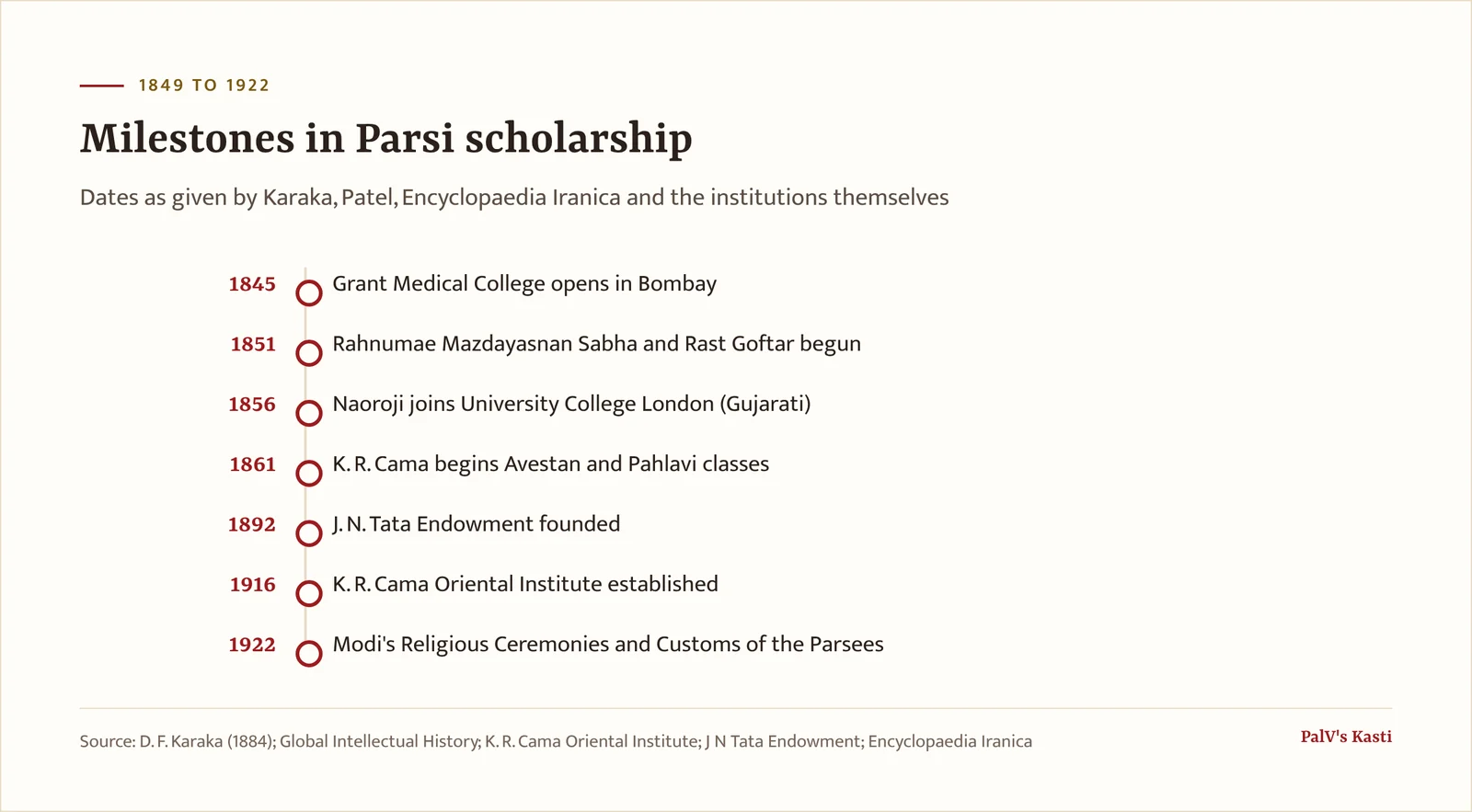
Three Parsi names stand out in the academic life of 19th and early 20th century western India. Dadabhai Naoroji became the first Indian named a professor at Bombay's Elphinstone Institution. K. R. Cama brought European methods of studying Avestan and Pahlavi home to Bombay and started classes in those languages in 1861. Sir Jivanji Jamshedji Modi, a priest and scholar, led the K. R. Cama Oriental Institute and wrote the standard English account of Parsi rituals. Around them stood the institutions where this work happened: Elphinstone, the Grant Medical College, the K. R. Cama Oriental Institute (founded in 1916, by its own account) and the J. N. Tata Endowment of 1892. For the schools themselves, see our overview of Parsis and education.
અસપંદામેદ રોજ
Asfandarmad Roj, Tir Mah · 1396 Y.Z.
Who was the first Indian professor at Elphinstone College?
That was Dadabhai Naoroji. D. F. Karaka's History of the Parsis (1884) reprints the Board of Education's report confirming him as Professor of Mathematics and Natural Philosophy at what was then called the Elphinstone Institution. The Board said he had already been doing the job well for nearly two years, and it called his appointment the first nomination of a native of India to a professorship there. The report linked the post back to a public meeting of August 1827, when people of western India agreed to fund professorships in Mountstuart Elphinstone's name and hoped Indians would one day hold them.
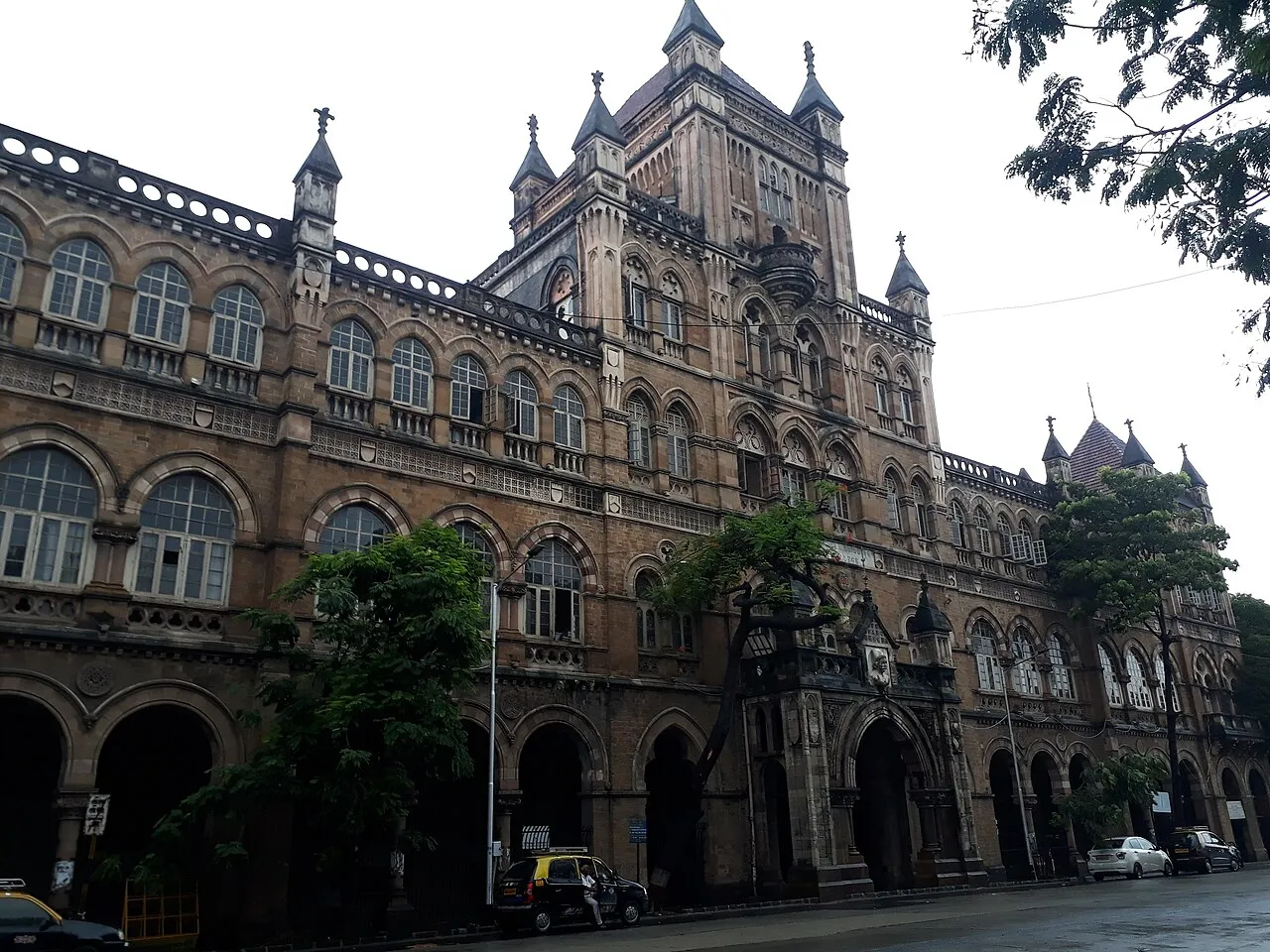
The historian Dinyar Patel, writing in Global Intellectual History (2017), adds the wider picture. Naoroji's results at Elphinstone College had impressed Erskine Perry, Chief Justice of the Bombay Supreme Court. In 1851 Naoroji and one of his Elphinstone teachers, Navrozji Fardunji, organised the first meeting of the Rahnumae Mazdayasnan Sabha (Navrozji as president, Naoroji as secretary) and later that year helped launch the Gujarati reform paper Rast Goftar. Naoroji left for England in mid-1855 to help set up Cama and Company, and in 1856, Patel writes, he joined University College London as a professor of Gujarati.
Who was K. R. Cama?
Kharshedji Rustamji Cama was born on 11 November 1831 and died on 20 August 1909, according to Encyclopaedia Iranica. Patel gives the same years. Iranica says he finished at the Elphinstone School in 1849 and joined a relative's trading firm in Calcutta. In 1855 he went to London with Naoroji on the Cama and Company venture.
Instead of staying in business, Cama turned to scholarship. Both Patel and Iranica name his European teachers as Friedrich Spiegel at Erlangen, and Julius Oppert and Julius von Mohl in Paris. Patel dates his move away from commerce to 1859.
What did Cama start in Bombay?
Iranica records that after returning to India he began classes in Avestan and then Pahlavi in February 1861, with S. D. Bharucha as the first teacher. Among the early pupils it names T. D. Anklesaria, K. E. Kanga and E. K. Antia. In 1864 he founded a society for research on the Zoroastrian religion, and from 1866 he published the journal Zarthoshti Abhyas, which ran to twelve volumes. Patel also places Cama alongside Naoroji as a colleague at the Rast Goftar and the Rahnumae Mazdayasnan Sabha.
The K. R. Cama Oriental Institute
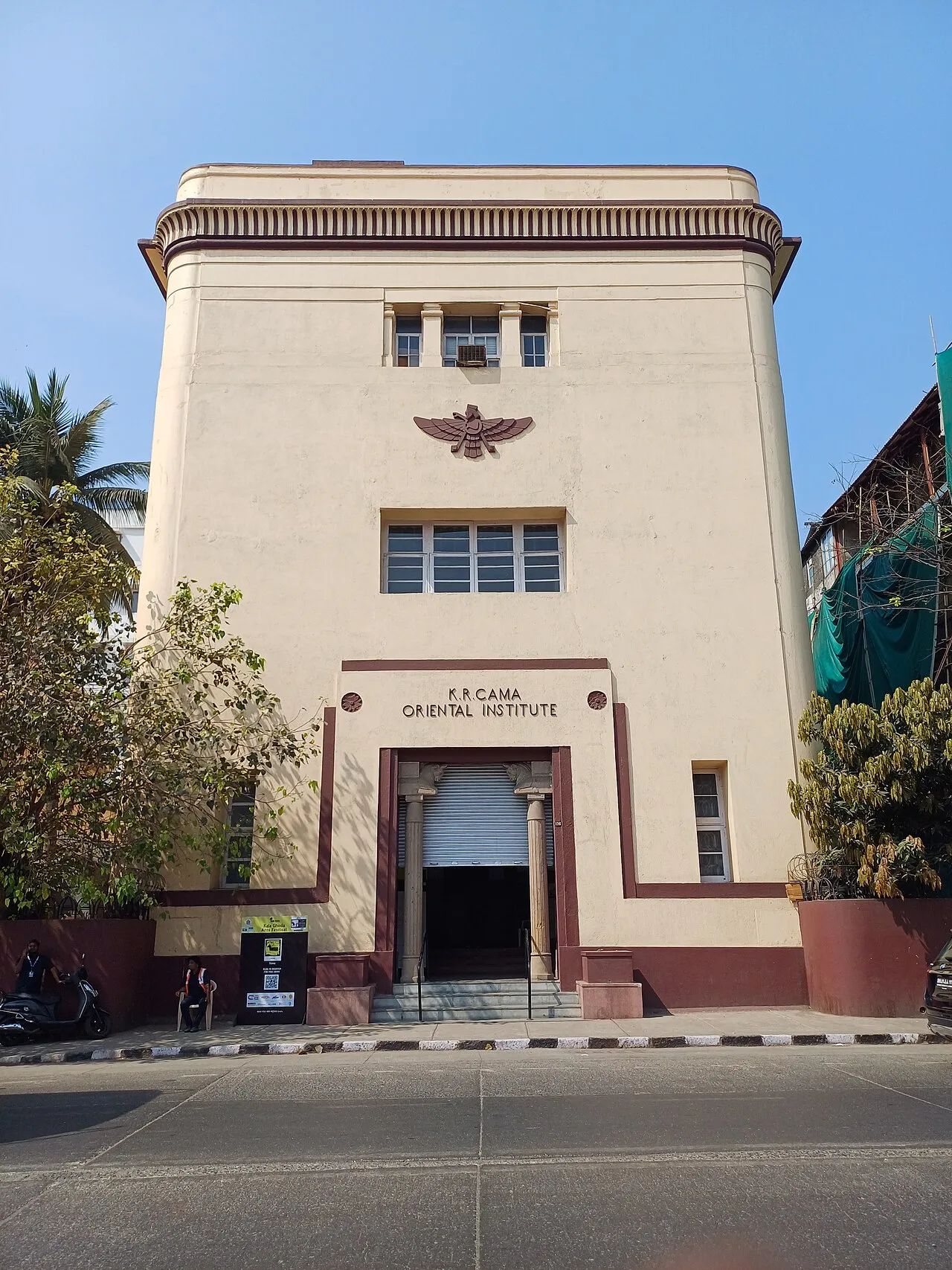
The Institute says it was established in 1916 with money collected from the citizens of Bombay, to keep Cama's memory alive. Its website today describes a library used by scholars from many countries, an annual journal, research fellowships for senior and junior scholars, and regular courses in world religions. Among its national seminars it lists one in 2004 on the life and work of Sir J. J. Modi, and one in 2009 on what Parsis contributed to education in western India during the 19th and 20th centuries.
Who was Sir Jivanji Jamshedji Modi?
Jivanji Jamshedji Modi lived from 1854 to 1933. The authority record in the Deutsche Biographie gives the same years and Bombay as his place of death. The Encyclopaedia Iranica entry by Michael Stausberg and Ramiyar P. Karanjia describes him as a Parsi priest, scholar, public servant and community activist. Iranica says that in 1871 he took over from his father as the Colaba Agiary's head priest (the Seth Jejeebhoy Dadabhoy Agiary), serving formally until 1910, that he took his B.A. from Bombay University in 1876, and that in 1882 he joined the Mulla Feroze and Sir Jamsetji madressas, two Parsi institutions for teaching Indo-Iranian languages.
His academic roles, as Iranica lists them:
- K. R. Cama Oriental Institute: President 1919 to 1921, Secretary 1921 to 1931, and editor of its journal 1922 to 1931.
- Anthropological Society of Bombay: member from 1886, later its Secretary and then its President.
- Bombay Branch of the Royal Asiatic Society: member from 1888.
- Honorary doctorates from Heidelberg (1912) and Bombay University (1930), the title Shams-ul-Ulama (1893) and a knighthood in 1930.
His best-known book, The Religious Ceremonies and Customs of the Parsees (1922, second edition 1937), is described by Iranica as still the only full survey in English of the rituals Parsis perform. Iranica also records that he served as Secretary of the Bombay Parsi Panchayat from shortly after 1893 until 1930. Patel notes that Naoroji, by then in England, kept up a correspondence with Cama, Modi and other Bombay scholars, passing ideas and contacts between them and European orientalists.
Which Parsis led schools and medical teaching in 19th-century Bombay?
Karaka, writing in 1884, gives a snapshot of Parsi teachers at work. Dosabhai Nasarvanji Wadia, M.A., a former Senior Fellow of Elphinstone College, had run the Sir Jamsetjee Jejeebhoy Parsi Benevolent Institution since 1 February 1873, and its four Bombay boys' schools then had about 1,100 pupils on their rolls. Jamshedji Ardeshir Dalal had served as Vice-Principal of the Elphinstone High School. The Fort High School and the Fort Proprietary School, with about 650 and 550 Parsi boys, were led by Parsi head-masters with mostly Parsi staff.
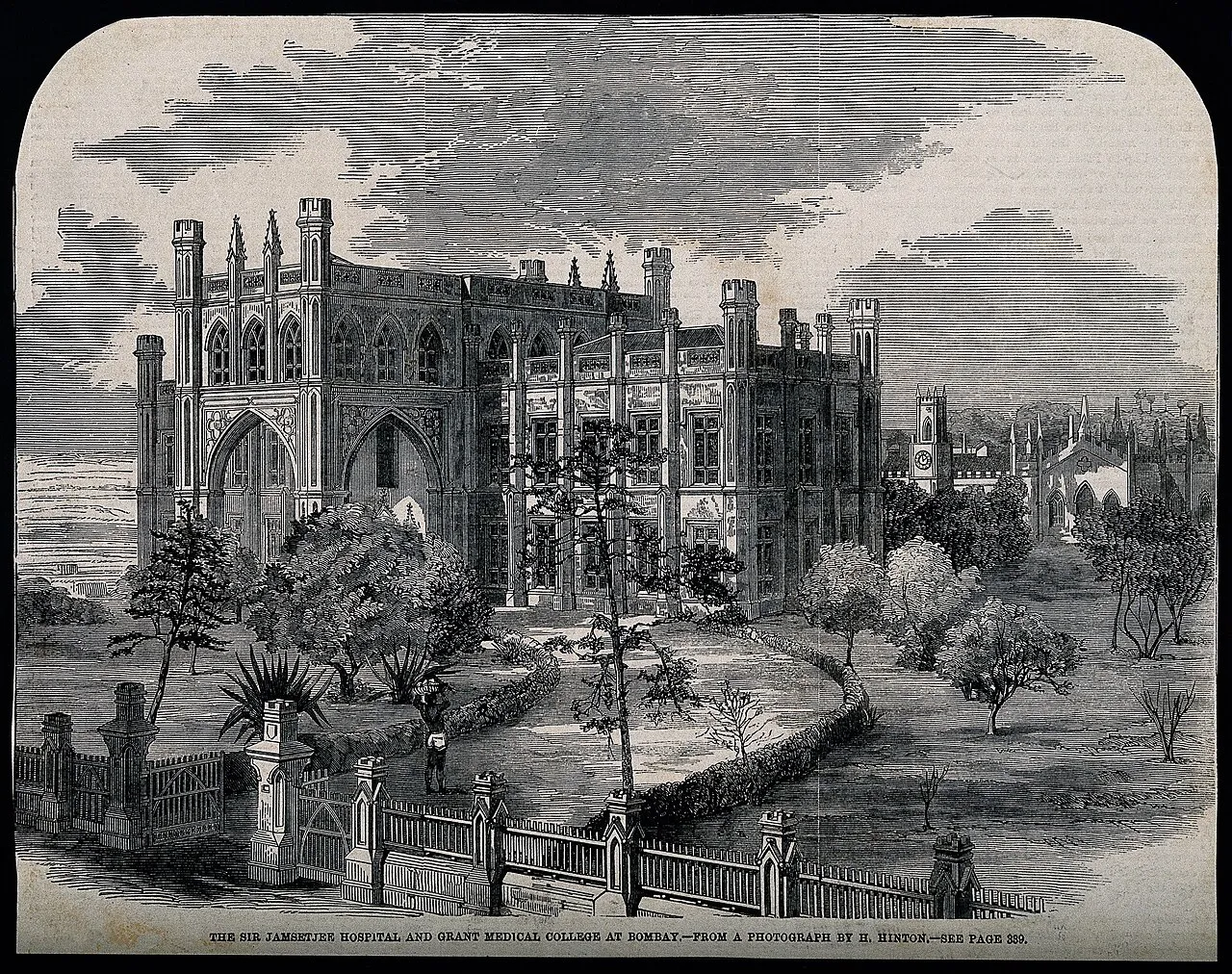
Medicine followed the same pattern. The Grant Medical College opened in 1845, and by Karaka's count fourteen Parsis had entered the Indian Medical Service through the London examination. He reports that Dhanjisha Naorozji Parakh had just been appointed to the chair of midwifery at Grant Medical College, and he describes this as the first time an Indian had received such a distinction. He also notes that of the ten girls then receiving medical training alongside male students, four were Parsi.
Outside teaching, Karaka mentions two other firsts. Pherozeshah Mehta was one of the first men from western India to go to England to qualify for the bar, and Mancherji Pestanji Kharegat took first place in the 1884 final examination for the covenanted civil service. Parsi students were also well represented at the mission colleges, Noshir H. Dadrawala wrote in Parsi Times in 2019, naming Wilson College and St Xavier's.
Who was the first J. N. Tata scholar?
Jamsetji Tata set up the J. N. Tata Endowment in 1892 to give loan scholarships for higher study abroad. The Endowment says it has since supported more than 5,700 Indian students, and it names Dr Freany K. Cama as its first scholar, who went to Edinburgh and Dublin to study gynaecology and midwifery. Parsi Times spells her name Freny K. R. Cama, says she was lent Rs 10,000, and says she came back as one of India's pioneering gynaecologists.
Parsi scholars also taught beyond Bombay. Ardeshir Cowasjee, writing in Dawn in 2009, remembered Dasturji Maneckji Nusserwanji Dhalla (born in Surat in 1875, died in Karachi in 1956, by Cowasjee's account) as his teacher of ancient history and Zoroastrianism at the Soparivala Parsi High School in Karachi, Pakistan.
Frequently asked questions
Who was the first Indian professor at Elphinstone College?
Dadabhai Naoroji. The Board of Education confirmed him as Professor of Mathematics and Natural Philosophy at the Elphinstone Institution, calling it the first nomination of an Indian to a professorship there. D. F. Karaka reprinted the Board's report in his 1884 History of the Parsis. Naoroji later taught Gujarati at University College London, according to historian Dinyar Patel.
Who was K. R. Cama?
Kharshedji Rustamji Cama (1831 to 1909) was a Bombay Parsi who studied Avestan and Pahlavi in Europe under Friedrich Spiegel, Julius Oppert and Julius von Mohl. From February 1861 he ran classes in these languages in Bombay, Encyclopaedia Iranica records. The K. R. Cama Oriental Institute, established in 1916 according to its website, carries his name.
Who was Sir Jivanji Jamshedji Modi?
Sir Jivanji Jamshedji Modi (1854 to 1933) was a Parsi priest and scholar. Encyclopaedia Iranica records that he headed the K. R. Cama Oriental Institute as President and later Secretary, edited its journal, led the Anthropological Society of Bombay, wrote The Religious Ceremonies and Customs of the Parsees (1922) and was knighted in 1930.
When was the K. R. Cama Oriental Institute founded?
The Institute says it was established in 1916, funded by money collected from the citizens of Bombay to honour K. R. Cama, who died in 1909. Its website describes a library for scholars, an annual journal, research fellowships and courses in world religions. In 2009 it held a national seminar on Parsi contributions to education in western India.
Who was the first J. N. Tata scholar?
The J. N. Tata Endowment, founded by Jamsetji Tata in 1892, names Dr Freany K. Cama as its first scholar. She went to Edinburgh and Dublin to study gynaecology and midwifery. Parsi Times, which spells her name Freny K. R. Cama, reports that she was lent Rs 10,000 and returned as one of India's pioneering gynaecologists.