PalV's Kasti
On this page
- Where is the BVS Parsi High School?
- How did the school begin in 1859?
- Who was Bai Virbaiji, and why does the school carry her name?
- How did the school grow between 1875 and 1947?
- When did BVS start admitting non-Parsi students?
- How has the school marked 150 years and more?
- What is BVS Parsi High School like today?
- Frequently asked questions
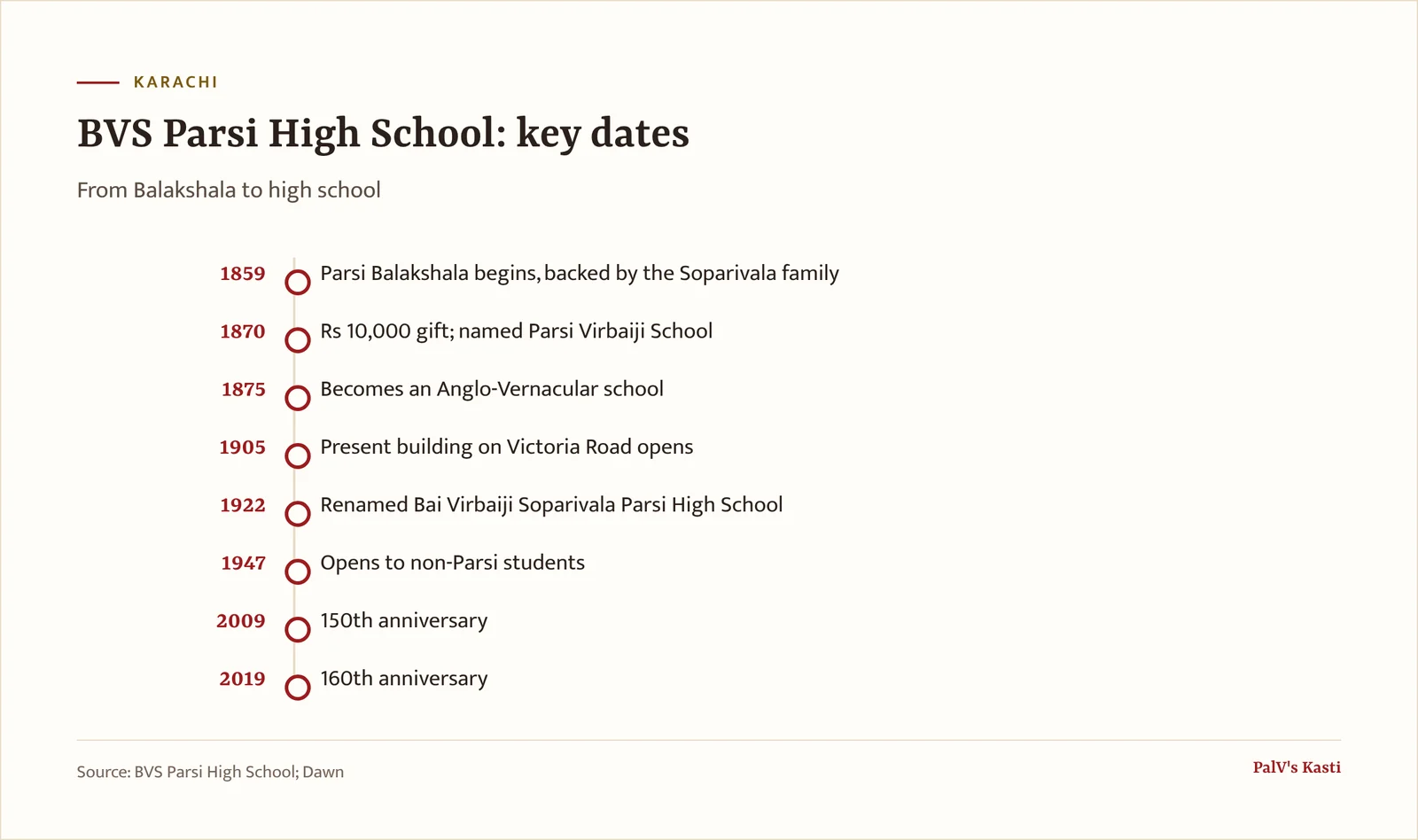
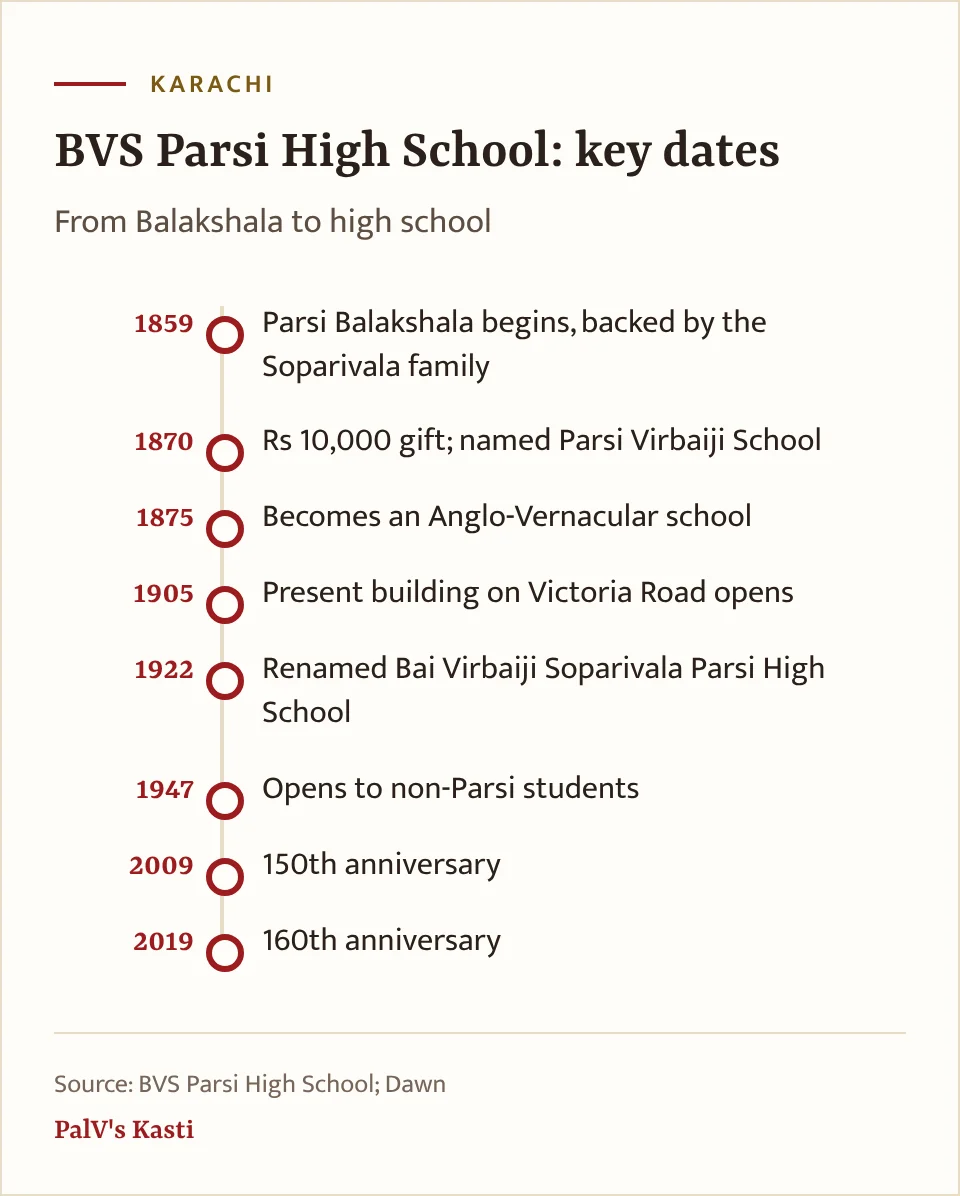
Bai Virbaiji Soparivala Parsi High School, known as BVS, is a Parsi school in Karachi, Pakistan, not in India. It began in 1859 as a small Parsi Balakshala run with the support of Seth Shapurji Hormusji Soparivala and his family. After his wife Bai Virbaiji died in 1869, Seth Shapurji gave Rs 10,000 in 1870 on the condition that the school carry her name. It moved into its stone building in Saddar in 1905, took its full present name in 1922, and opened its doors to non-Parsi children in 1947 at the request of Mohammad Ali Jinnah. Dawn reported its 150th anniversary in 2009 and its 160th in 2019, when it also reported that most of its students were Muslim. The Parsi name, the founders' story and the old motto remain.
અસપંદામેદ રોજ
Asfandarmad Roj, Tir Mah · 1396 Y.Z.
Where is the BVS Parsi High School?
The school stands on Main Abdullah Haroon Road in Saddar, Karachi. When its present building went up in 1904 and 1905, the school's own history calls the street Victoria Road, while Dawn places the same building on Abdullah Haroon Road, the name the road carries now.
So BVS belongs to the Karachi Parsi story, and it has stayed in the same city through Partition and after. For the wider picture of Parsi schooling in Bombay and Gujarat, see our piece on Parsis and education.
How did the school begin in 1859?
Both the school and Dawn date the beginning to 1859. It was not a grand institution at first. The school's history describes a small Parsi Balakshala, a children's school, kept in the home of a community member, Dadabhoy Palonji Paymaster. The Soparivala family were its patrons from the start.
Numbers grew and the house became too small. The school's account says the Balakshala stayed a vernacular school until 1875, with all lessons in Gujarati. Children learnt arithmetic, writing, history and geography, and some needlework was taught too. In 1875 it became an Anglo-Vernacular institution, so English entered the classroom.
Who was Bai Virbaiji, and why does the school carry her name?
Bai Virbaiji was the wife of Seth Shapurji Hormusji Soparivala. She died in 1869. In May 1870 her husband, already the school's biggest donor, gave Rs 10,000 on one condition: that the school be named after her. Dawn's 2019 report and the school's own history agree on the year of her death, the sum and the condition.
The first name was the Parsi Virbaiji School. According to the school, the Commissioner of Sindh, Sir William Merewether, performed the opening ceremony on 24 September 1870, with Jamshedji Framji Master as headmaster. The school's own website spells the name Virbaiji. You may also see it written Virbaijee; both refer to the same school.
How did the school grow between 1875 and 1947?
The 1905 building
The building that still houses the school dates from 1905, a year that the school, Dawn and The Dawood Foundation all give. The school says Seth Khurshedji Soparivala, the founder's eldest son, laid the foundation stone on 10 October 1904 and opened the finished building himself on 24 March 1905. The Dawood Foundation, a Karachi charity, credits the design to Moses Somake and notes the carved pilasters, Corinthian capitals and arched doorway. It also says a floor was added in 1923 in the same Gizri stone. The school's history puts the second storey in the 1920 to 1946 period, so the exact year of that floor rests on The Dawood Foundation alone.
The Pithawalla years and the 1922 renaming
Dr Maneck Pithawalla led the school from 1920 until he retired in 1946, according to the Dawn columnist Ardeshir Cowasjee, who joined BVS as a pupil in 1931. The school's history covers the same years and calls the period momentous, though it spells his name Pithwalla. Under him the school moved up from middle school to high school. On 25 July 1922, the school says, it was renamed Bai Virbaiji Soparivala Parsi High School. Between 1923 and 1946 it sent out 292 matriculates, by the school's count.
The school credits him with its motto too. The school's website writes it as "Towards That Best Light". Cowasjee, writing from memory in Dawn in 2009, quoted it as "Towards the Best Light".
Donors and the Bhojan Fund
Other Karachi Parsi families kept adding to the campus. The school lists the Golwalla Dining Hall (1932), the Limbuvala classrooms and drawing hall (1935 to 1937), the Dadabhoy Mama workshop building (1946) and a playing field on Sangster Road secured in 1940 through the Fakirjee Cowasjee family. In 1919 a trust fund from the Cowasjee and Virbaiji Variawa family began paying to feed and clothe poor Parsi students. The school's history says this "Bhojan Fund" still does that work.
Cowasjee also remembered one of his teachers, Dastur Dr Maneckji Nusserwanji Dhalla, who served as high priest for the Parsis of Sindh, Punjab, Balochistan and the North-West Frontier and taught ancient history and Zoroastrianism at BVS. Cowasjee wrote that Dhalla, born in Surat in 1875, died in Karachi in 1956.
When did BVS start admitting non-Parsi students?
In 1947, after Partition. The school's history and two Dawn articles all say the school admitted non-Parsis for the first time at the request of Mohammad Ali Jinnah, with Behram Rustomji as principal. The Dawood Foundation's page also records the request from Jinnah. Cowasjee wrote that Rustomji, an old boy of the school, became principal in 1946 and served for 19 years.
The change was large and fast. Deena Mistri, whom the school lists as a later principal, told The Dawood Foundation that five years on the school had more than 600 students and had become a public school. By 2019, Dawn reported, Muslim students were the majority.
How has the school marked 150 years and more?
Counting from 1859, the 150th year fell in 2009, and Dawn carried Cowasjee's column on the sesquicentenary that May. Ten years later Dawn reported the 160th anniversary, marked with prayers and a Milad, with children of different faiths holding their own morning prayers. The principal at the time, Kermin Parakh, told Dawn that although the children follow different religions, they share one purpose.
One date does not line up. The school's own history says the centenary was celebrated on 23 May 1958, a year earlier than 1859 plus one hundred would give. We have not found a source that explains the gap, so we give both. The school's history also records a golden jubilee in 1909.
What is BVS Parsi High School like today?
Here we rely on the school's own website. It says BVS introduced the Aga Khan University Examination Board (matric) and Cambridge (CAIE) streams in 2010, with the first students sitting both in 2012. It has two libraries, primary and secondary, each with over 10,000 books and periodicals. Pupils are split into four houses: Soparivala, Lancelot, Quaid-e-Azam and Rezashah. The founding family's name lives on in the first.
The school's newsletter for August to December 2025 is signed by Mrs Mehernaz Bharucha as principal. It reports that Pakistan won the World Youth Scrabble Championship in Kuala Lumpur in 2025 with BVS pupils in the side, one of them taking the under-16 world title. It also records Hindu pupils visiting temples during Navratri and celebrating Diwali at school.
Frequently asked questions
Is BVS Parsi High School in India?
No. Bai Virbaiji Soparivala Parsi High School is in Karachi, Pakistan, on Main Abdullah Haroon Road in Saddar. It was founded in 1859, long before Partition, and has carried on in the same city since 1947, still under its Parsi name. It is part of the history of the Karachi Parsi community, not of Parsi schooling in India.
Who founded the Soparivala Parsi High School?
The school and Dawn credit Seth Shapurji Hormusji Soparivala and his family. It started in 1859 as a small Parsi Balakshala in the home of Dadabhoy Palonji Paymaster. In 1870 Seth Shapurji gave Rs 10,000 on the condition that the school be named after his late wife, Bai Virbaiji, who had died in 1869.
What is the motto of BVS Parsi High School?
The school's website gives the motto as "Towards That Best Light" and credits it to its principal Dr Pithwalla, whom Dawn names as Dr Maneck Pithawalla, head from 1920 to 1946. The columnist Ardeshir Cowasjee, a former pupil, quoted it in Dawn in 2009 as "Towards the Best Light".
When did BVS admit non-Parsi students?
In 1947. The school's history, Dawn and The Dawood Foundation all say BVS first opened to non-Parsis after Partition at the request of Mohammad Ali Jinnah, under Principal Behram Rustomji. Deena Mistri, a later principal, told The Dawood Foundation that within five years it had over 600 students. Dawn reported a Muslim majority by 2019.
Is BVS still a Parsi school?
It keeps its Parsi name, founders' story and motto, and one of its four houses is named Soparivala. But it has admitted children of all communities since 1947, and Dawn reported in 2019 that Muslim students are now the majority. Its 2025 newsletter describes Hindu pupils marking Navratri and Diwali.