PalV's Kasti
On this page
- How did modern schooling for Parsis begin in Bombay?
- Which was the first Parsi school in Bombay?
- Who started girls' education among the Parsis?
- Which Parsi schools in Mumbai did families and educators found?
- How did Parsi philanthropy fund higher education?
- Why did many Parsi schools lose ground later?
- Frequently asked questions
Parsis built their schools in Bombay in the 19th century, first by using the new government-backed schools and then by founding and paying for their own. The Bombay Native Education Society began work in 1820. According to D. F. Karaka's History of the Parsis (1884), Sir Jamsetjee Jejeebhoy set aside Rs 3,00,000 in 1842 for the Parsi poor and the education of their children, and the boys' schools of his institution opened on 17 October 1849. Karaka dates the first four Parsi girls' schools, started by volunteers, to 22 October 1849, with 44 pupils. In 1857 Parsis formed their own Parsi Girls' School Association, and in 1892 Jamsetji Tata started the J. N. Tata Endowment for study abroad. This post walks through that history, the Parsi schools in Mumbai that families founded, and where the story went next.
અસપંદામેદ રોજ
Asfandarmad Roj, Tir Mah · 1396 Y.Z.
How did modern schooling for Parsis begin in Bombay?
For generations, ordinary Parsi schooling was in Gujarati and went little further than reading, writing and arithmetic. That is how Dosabhai Framji Karaka, whose History of the Parsis appeared in 1884, describes it. He writes that the first English lessons came at the start of the 19th century from two or three small schools run in Bombay by Eurasians and former soldiers. Parsi boys made up most of their pupils.
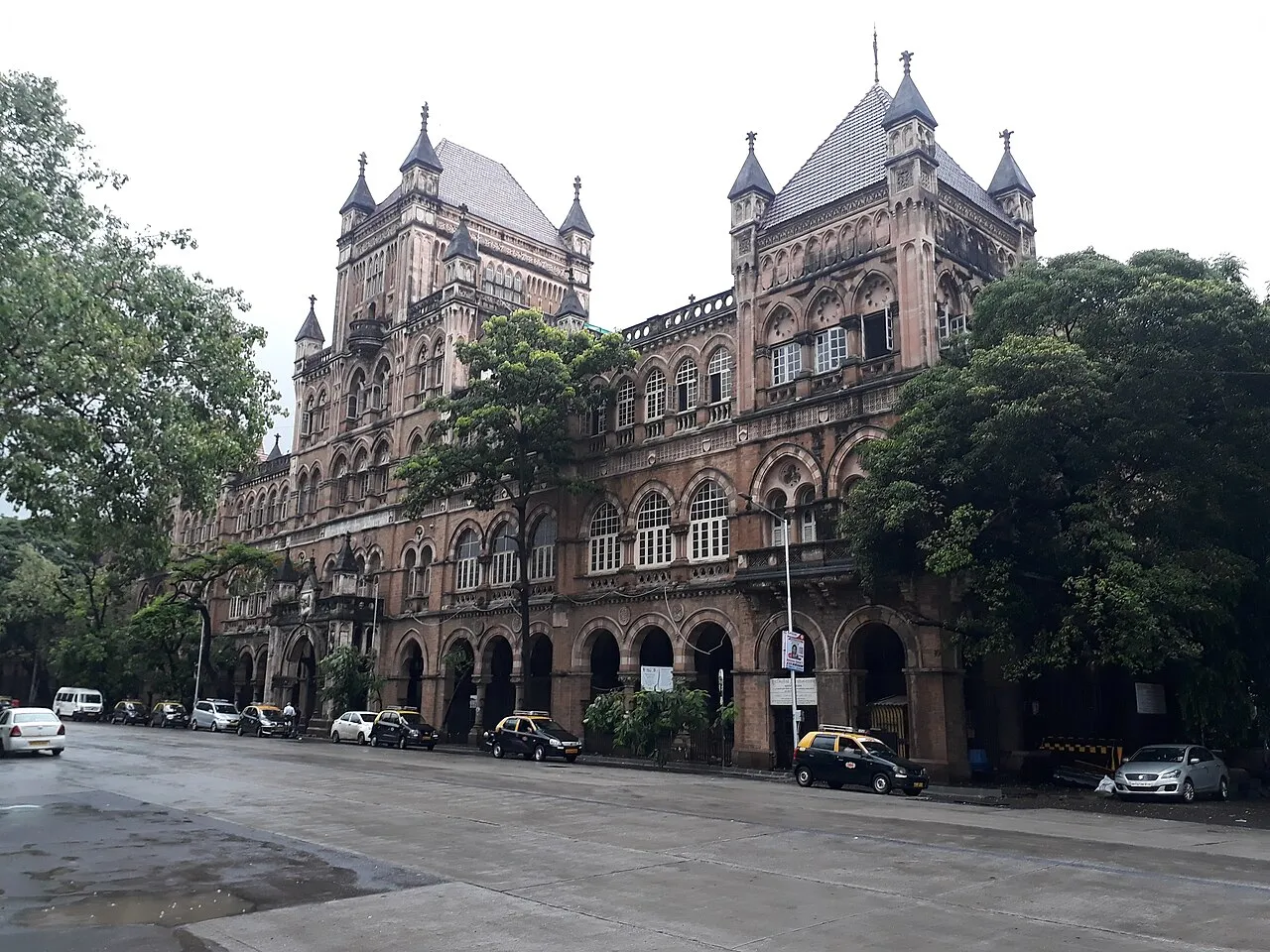
The bigger change came in 1820, when the Bombay Native Education Society was set up under Governor Mountstuart Elphinstone. Karaka and the Parsi Times writer Noshir H. Dadrawala both name it as the starting point. When Elphinstone retired, a public meeting held in August 1827 in the Society's library resolved to found professorships in his name. Indian subscribers, Parsis prominent among them, raised Rs 2,15,000 for these "Elphinstone Professorships", and Karaka traces the college that carries Elphinstone's name to that fund. By his own day, he wrote, most Parsis in high government posts or otherwise distinguished in public life were Elphinstonians.
Karaka also notes who used the new schools first. It was not the rich. Middle-class and poorer Parsi families sent their sons, while wealthier households preferred private schools. Dadrawala makes the same point in his 2019 series, and adds that in 1849 Bombay still had nine private English schools that some well-off families preferred.
Which was the first Parsi school in Bombay?
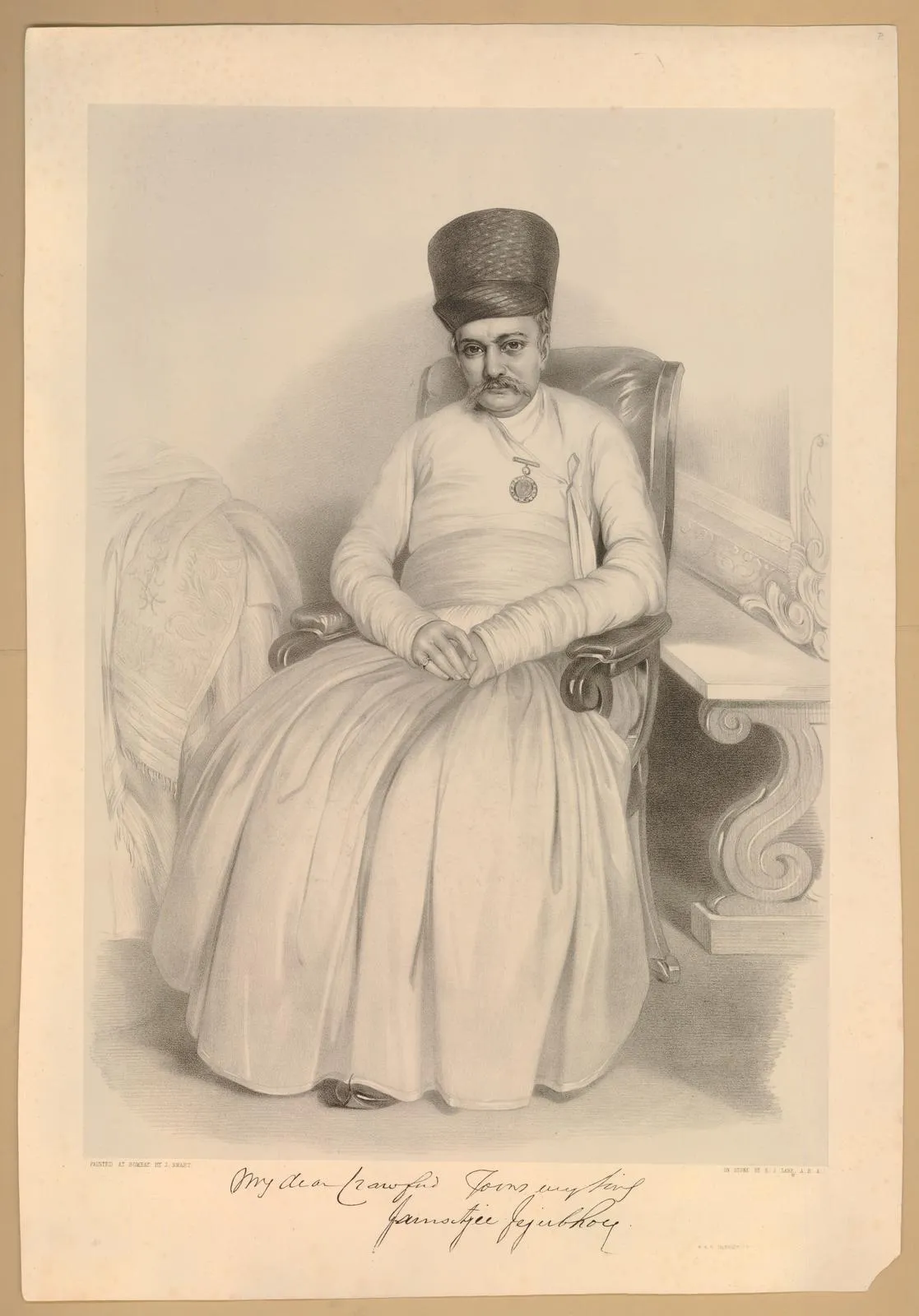
Dadrawala names the Sir Jamsetjee Jejeebhoy Parsi Benevolent Institution as Bombay's first Parsi school and the foundation of "an independent Parsi educational system". Karaka traces its roots to 1842, the year Jejeebhoy was knighted. In reply to the community's congratulations, he announced a fund of Rs 3,00,000 for the Parsi poor of Bombay, Surat and nearby places, and for "the education of their children". Karaka records that the Government of India took on the trusteeship.
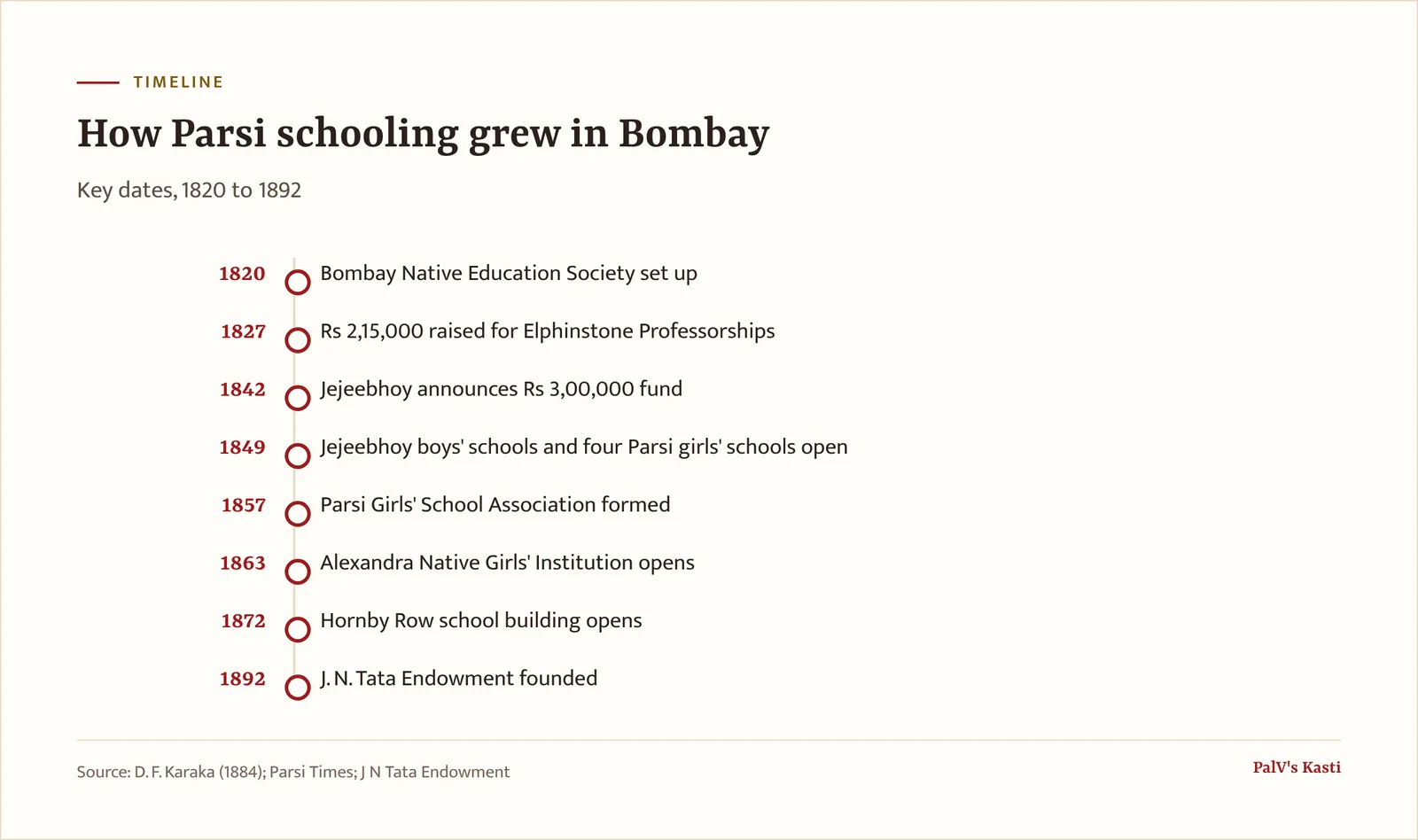
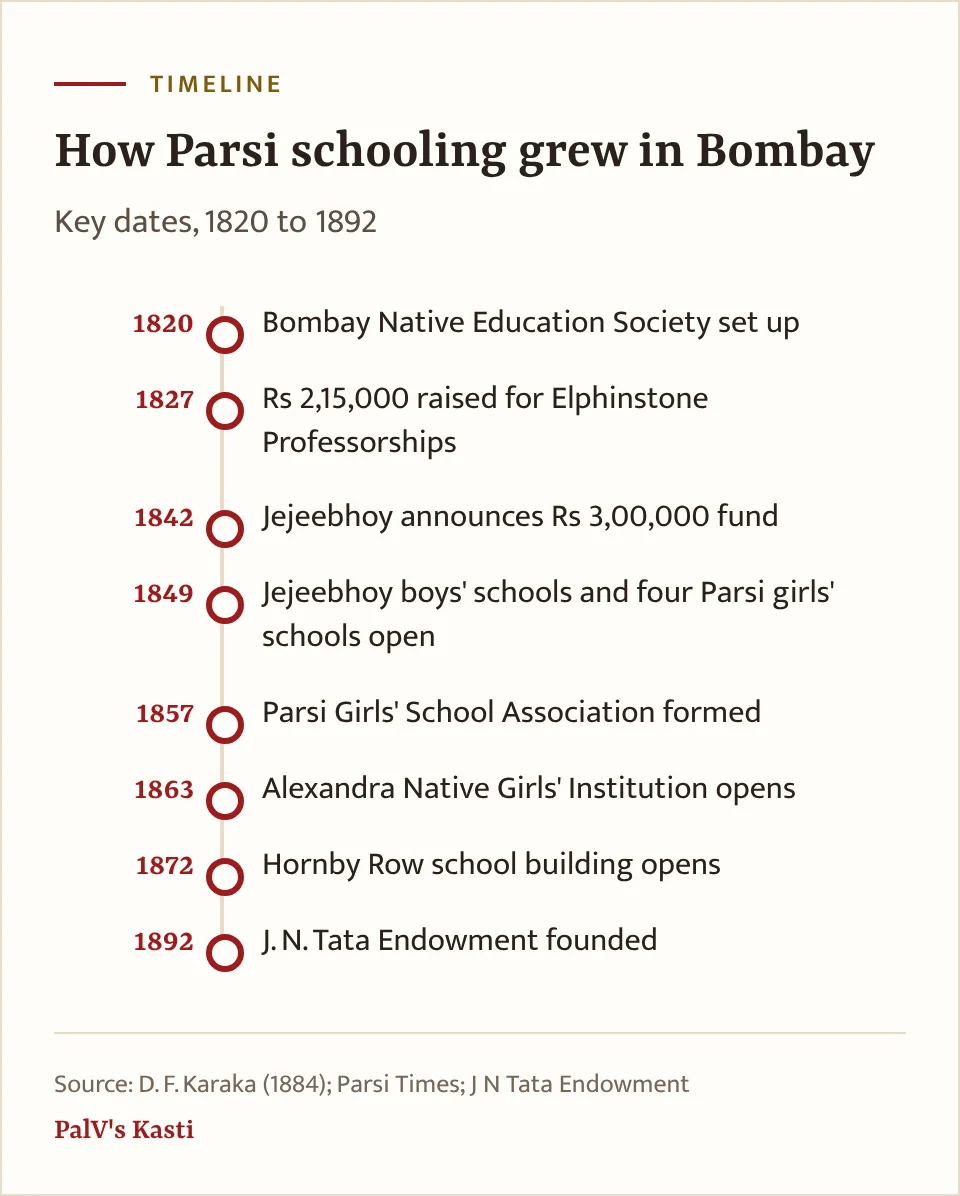
According to Karaka, the income was split into 400 shares. Of those, 180 went to schools in Bombay and 70 to schools in Gujarat, with the remaining 150 shares for poor, aged and disabled Parsis, funerals and the marriages of poor girls. The boys' schools in Bombay first opened on 17 October 1849.
By 1884 the institution ran four boys' schools and three girls' schools in Bombay, plus fifteen small schools across Gujarat. Karaka counts about 1,100 boys and 900 girls in the city and more than 1,000 children outside it, so close to 3,000 poor Parsi children were taught free. Three of the boys' schools and one girls' school shared a three-storey building in Hornby Row. Its foundation stone was laid on 21 February 1871 and it opened on 20 November 1872. A Parsi architect designed it, at a cost of Rs 3,46,825.
Gujarat followed. Dadrawala writes that Navsari's first school was endowed by Jejeebhoy in 1853, with a second opened there by Sir Cowasji Jehangir a year later, in 1854.
Who started girls' education among the Parsis?
Young men from Elphinstone did. The Students' Literary and Scientific Society, made up of Elphinstone professors, masters and students according to Karaka, and led by Dadabhai Naoroji according to Dadrawala, decided to open schools for girls with no money at all. Members volunteered as teachers and lent rooms in their own homes. Classes ran from seven to ten in the morning so the teachers could still go to work. Karaka records that four Parsi girls' schools opened this way on 22 October 1849, and 44 pupils came on the first day. Dadrawala dates the Society to 1848 and also gives 44 pupils in four Parsi classes.
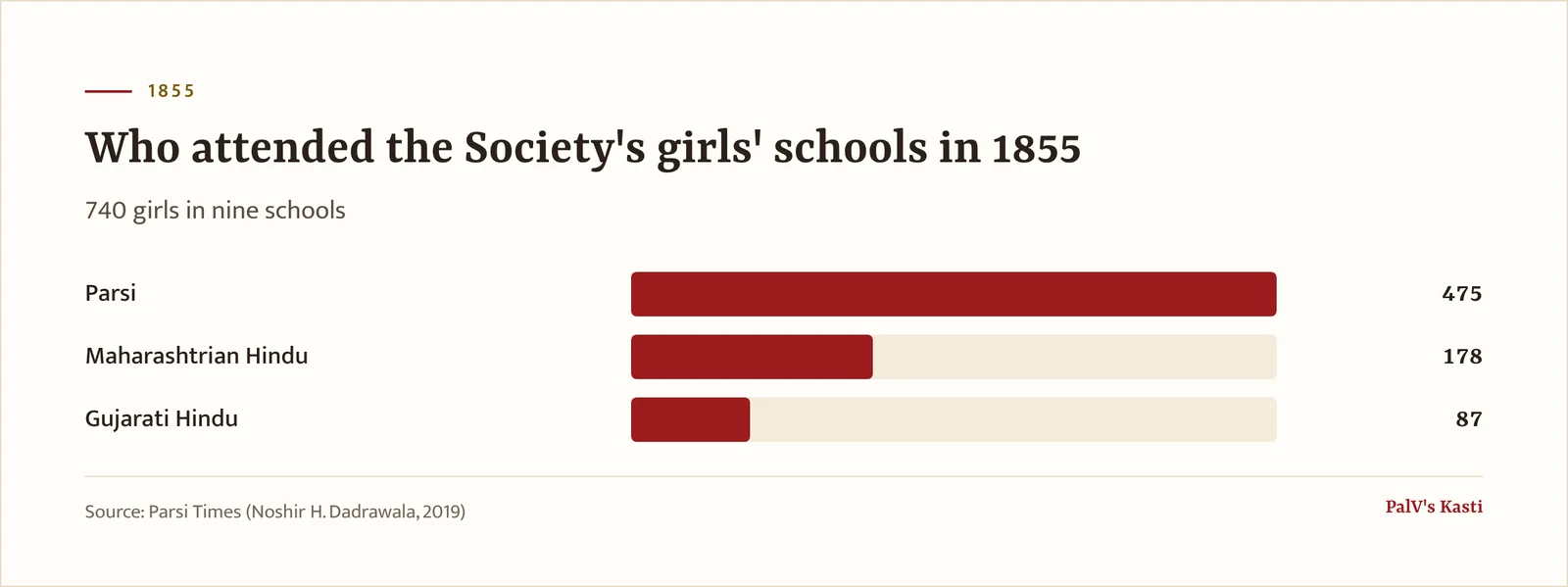
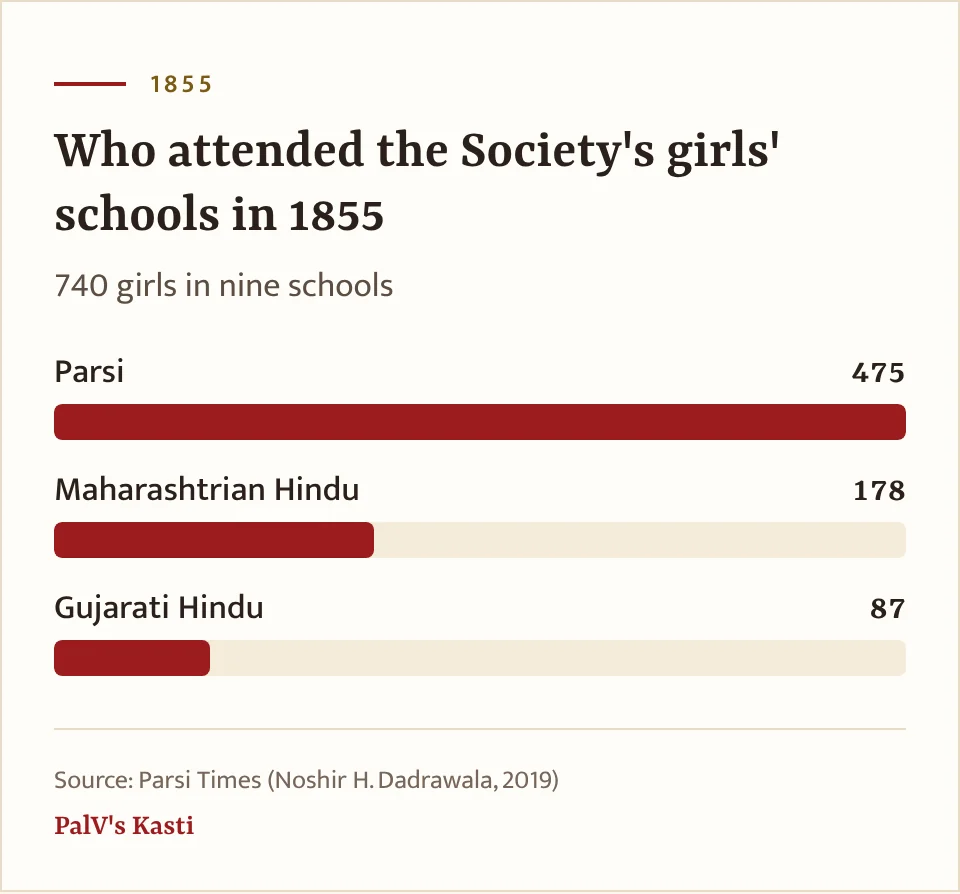
The idea spread quickly. Dadrawala gives the Society's figures for 1855: its nine girls' schools had 740 pupils, of whom 475 were Parsi, 178 Maharashtrian Hindu and 87 Gujarati Hindu. Dr Reid, the Society's English chairman, used the Parsi example to urge others on, saying that over 1,200 Parsi daughters were now being taught "whereas 10 years ago there were not perhaps 20".
The Parsi Girls' School Association, 1857
In 1857 the community took over the Parsi girls' schools from the Students' Society and formed the Parsi Girls' School Association to run them. Karaka records that Rs 15,000 was subscribed within a few days. Dadrawala describes Parsis after this point holding something close to a monopoly in girls' schooling in the city.
English for girls: the Alexandra Institution and Girton
The early girls' schools taught in Gujarati. English came with Manockjee Cursetjee (Karaka spells him Manakji Kharshedji Shroff), a former judge of Bombay's Court of Small Causes. In 1863 he opened an English school for Indian girls and named it the Alexandra Native Girls' Institution, after the Princess of Wales. Dadrawala calls it the first school in Bombay to teach Indian girls in English. He also credits Bachoobai Moos with the Girton High School for girls, founded in 1888, and notes that Jejeebhoy had his only daughter, Pirojbai, taught English, one of the first Parsi women to learn it.
Which Parsi schools in Mumbai did families and educators found?
Beyond the charity schools, educated Parsis opened their own high schools. Karaka names the Fort High School, with 650 Parsi boys on its roll in 1884, and the Fort Proprietary School, with 550. Both had Parsi head-masters and mostly Parsi staff, and both sent a large number of pupils through the Bombay University matriculation each year.
Family names followed. In his 2019 Parsi Times series, Dadrawala lists the J. B. Petit School and the Bai Avabai Petit School for Girls at Bandra among the Petit family's gifts, alongside a boys' orphanage in Poona (1888). He also credits the Godrej family with the Udayachal School, and the Patuck family with a run of institutions from an Industrial School in 1934 to a College of Commerce and Management in 2001.
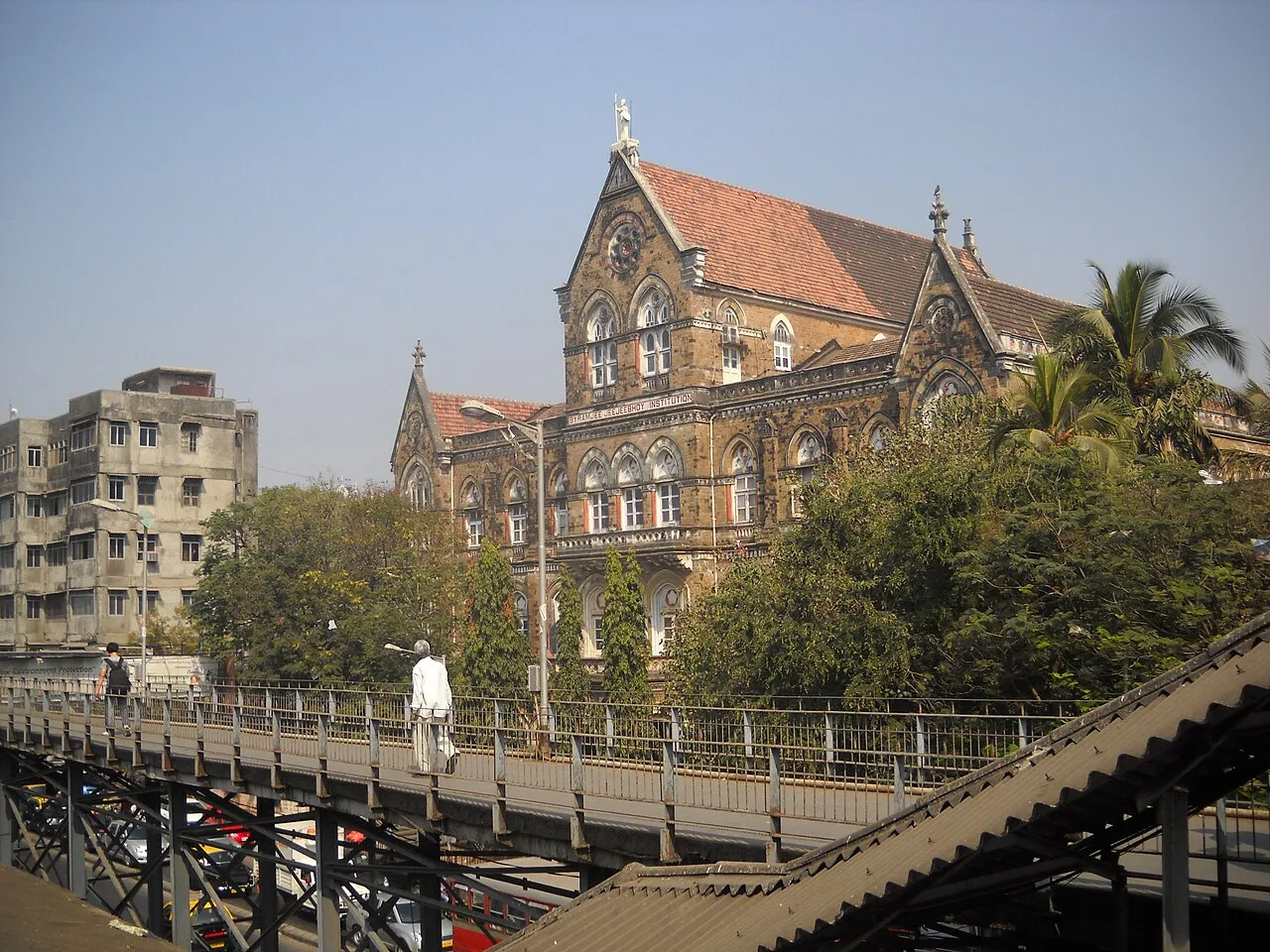
One building tells the story well. The Byramjee Jeejeebhoy Parsee Charitable Institution (BJPCI), opposite Charni Road station, was established in 1890 and formally inaugurated in September 1891, according to a Parsi Times report of 25 November 2023. Its Gothic Revival building was designed by Khan Bahadur Muncherji C. Murzban. The same report says it won an Urban Heritage Award in 1993 and has since been restored in phases by conservation architect Vikas Dilawari, with the latest work supported by the Virtusa Foundation.
For admissions, fees or timings at any of these Parsi schools in Mumbai today, ask the school directly. We have kept this page to history.
How did Parsi philanthropy fund higher education?
Once the schools were full, the next step was college and beyond. Karaka writes that more than a thousand Parsis had passed the matriculation examination between the founding of Bombay University in 1857 and 1884, and that Grant Medical College, opened in 1845, had trained a very large number of Parsi doctors. The people behind those numbers, from the first Indian professor at Elphinstone to early doctors and scholars, are covered in our post on Parsi contributions to academia.
In 1892 Jamsetji Nusserwanjee Tata started the J. N. Tata Endowment, which gives loan scholarships for higher study overseas. Its own website says it has supported more than 5,700 Indian students. The first name in its register was Freny K. Cama, who went to Edinburgh and Dublin to study gynaecology and midwifery. Dadrawala adds that she was loaned Rs 10,000 and came back as one of India's early gynaecologists.
Dadrawala opens his series with literacy. Citing the Census of India, he writes that 71% of Bombay's Parsis were literate in 1911, and that in 1901 25.8% of Parsis knew English, against 20.9% of Indian Christians. He describes Parsis today as having virtually full literacy. We have not checked these figures against the census tables ourselves.
Dadrawala also points to two later Tata trusts, founded in 1918 by Sir Ratan Tata and in 1932 by Sir Dorabji Tata, as open to every community at a time when most charities served only their own. Training for trades is a separate thread, which we follow in our post on the Sir Ratan Tata Industrial Institute.
Why did many Parsi schools lose ground later?
Dadrawala is frank about it. He writes that the Parsi school system was built "with élan and enormous expenditure" in the second half of the 19th century and put the community ahead of every other in India. Later, in his view, other communities caught up and Parsi schools fell behind because they lacked flexibility and the will to modernise. Well-off Parsi families moved their children to private Jesuit schools, and many Parsi schools came to serve mainly poorer families.
That is one writer's reading, not a census. It sits alongside something Karaka noticed in 1884: the new schools were first taken up by middle-class and poorer Parsis, and the Jejeebhoy schools were set up for the poor from the start. Parsi community schools also opened outside Bombay, including in Karachi, now in Pakistan, where the Soparivala Parsi High School has its own long history.
Frequently asked questions
Which was the first Parsi school in Bombay?
Parsi Times writer Noshir H. Dadrawala names the Sir Jamsetjee Jejeebhoy Parsi Benevolent Institution as Bombay's first Parsi school. Karaka's 1884 history says Jejeebhoy announced its Rs 3,00,000 fund in 1842 and its boys' schools opened on 17 October 1849. By 1884 it taught close to 3,000 poor Parsi children free.
Who started girls' education among Parsis?
The Students' Literary and Scientific Society, a group of Elphinstone teachers and students that Dadrawala says was led by Dadabhai Naoroji, opened four Parsi girls' schools on 22 October 1849, according to Karaka. Volunteers taught 44 girls in their homes, seven to ten each morning. In 1857 the community took the schools over through the Parsi Girls' School Association.
What role did Elphinstone College play in Parsi education?
Elphinstone grew from Rs 2,15,000 that Indians, Parsis prominent among them, raised after an August 1827 meeting to honour Governor Mountstuart Elphinstone with professorships. Its students later started Bombay's first Parsi girls' schools in 1849. Karaka wrote in 1884 that most Parsis in high government posts were Elphinstonians.
What was the Parsi Girls' School Association?
The Parsi Girls' School Association was formed in 1857 when Parsis took over the girls' schools that the Students' Literary and Scientific Society had been running since 1849. Karaka records that Rs 15,000 was subscribed within a few days. The Association then ran these Parsi schools for girls in Bombay with its own committee.
Are Parsis the most literate community in India?
Parsi Times writer Noshir H. Dadrawala, citing the Census of India, says 71% of Bombay's Parsis were literate in 1911, and that in 1901 25.8% of Parsis knew English, against 20.9% of Indian Christians. He describes Parsis today as virtually fully literate. We have not checked these figures against the census tables ourselves.
What scholarships did Parsis found for higher education?
The best known is the J. N. Tata Endowment, started by Jamsetji Tata in 1892 to give loan scholarships for study abroad. Its website says more than 5,700 Indian students have received them. Its first scholar was Freny K. Cama, who studied gynaecology and midwifery in Edinburgh and Dublin and became a pioneering gynaecologist.