PalV's Kasti
On this page
- How did the J. N. Petit Library begin?
- Who was J. N. Petit, and why is the library named after him?
- When was the J. N. Petit Institute building built?
- What heritage awards has the building won?
- How did Metro-3 construction affect the J. N. Petit Library?
- What books and rare items does the library hold?
- Can anyone join the J. N. Petit Library?
- Who runs the J. N. Petit Institute today?
- Frequently asked questions
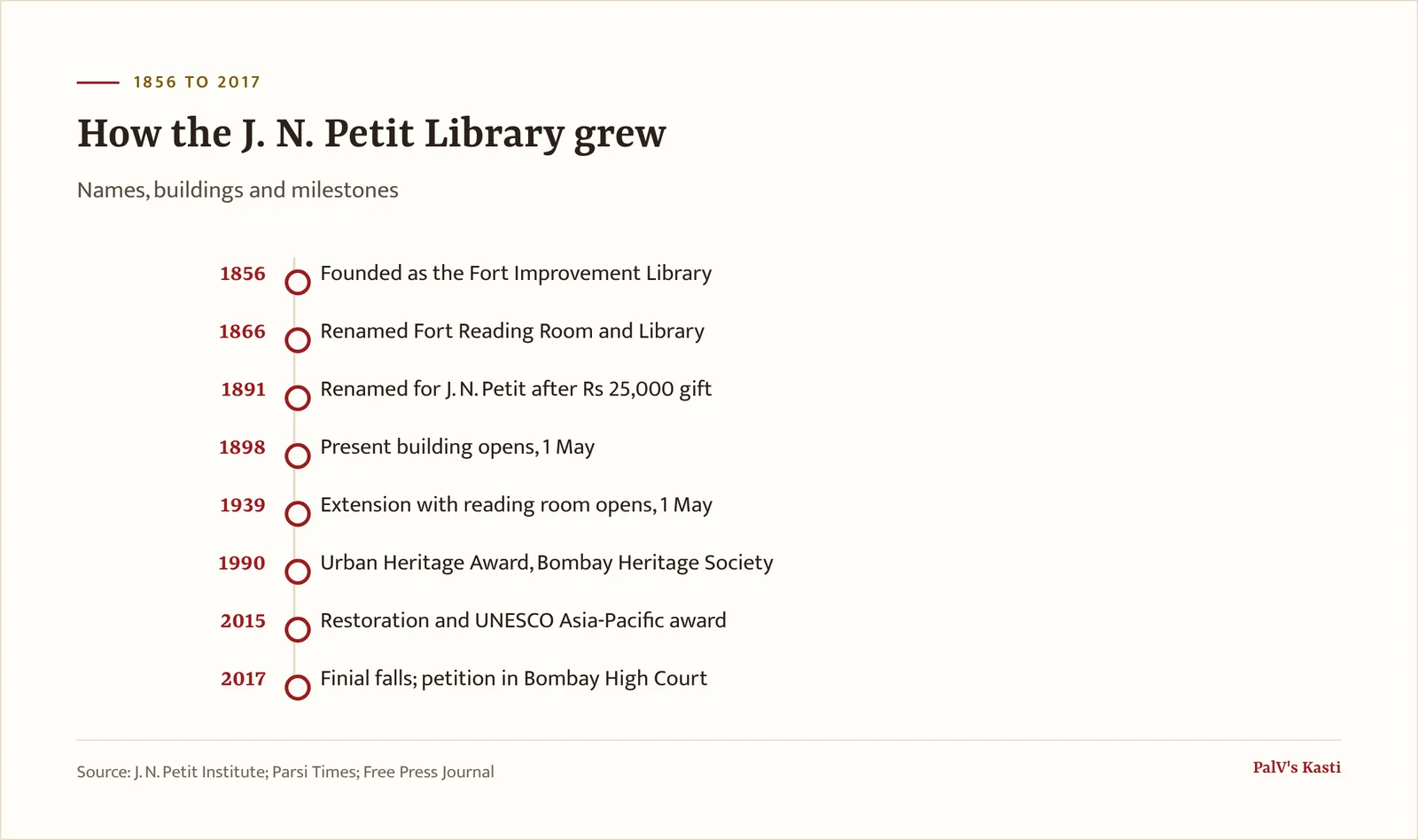
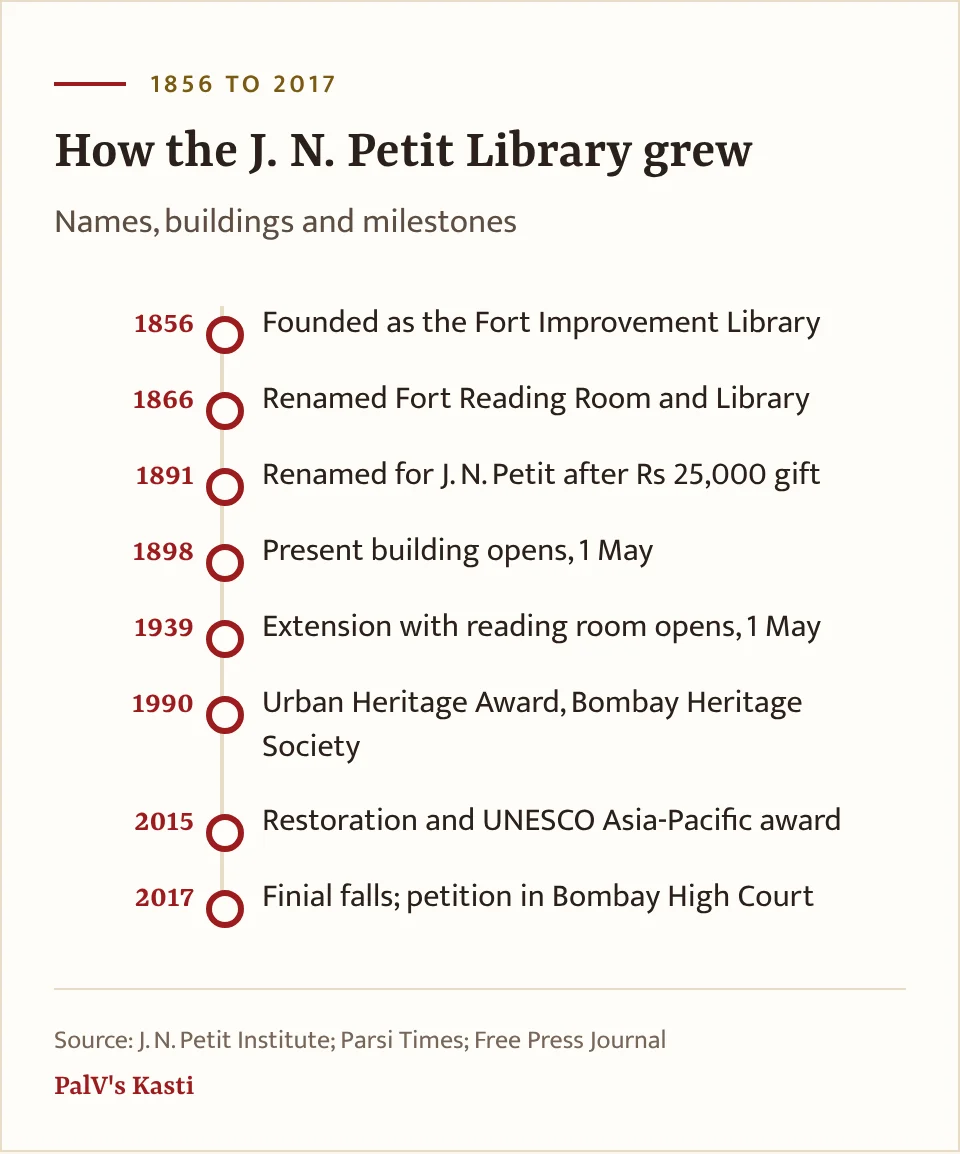
The J. N. Petit Library in Mumbai's Fort began in 1856 as a small students' club called the Fort Improvement Library. It became the Fort Reading Room and Library in 1866 and took the Petit name in 1891, when Nesserwanjee Manockji Petit gave Rs 25,000 in memory of his only son, Jamsetjee Nesserwanjee Petit. His mother, Bai Dinbai Petit, then paid for the Neo-Gothic building that opened on 1 May 1898. An extension with the present reading room followed in 1939. The Institute says the building won the Bombay Heritage Society's Urban Heritage Award for 1990, and Parsi Times and the Free Press Journal report a UNESCO Asia-Pacific award after its 2015 restoration. According to its website, it still lends books and runs a reading room today.
અસપંદામેદ રોજ
Asfandarmad Roj, Tir Mah · 1396 Y.Z.
How did the J. N. Petit Library begin?
The library started in 1856 with roughly twelve young men from Elphinstone College who lived in the Fort area of Bombay. The Institute's own history describes them as Elphinstone students; a 2014 DNA feature by Meher Mirza adds that they were Parsi students. They called their venture the Fort Improvement Library.
By 1866 the club had grown. According to the Institute, it was renamed the Fort Reading Room and Library that year and had about 250 members.
Who was J. N. Petit, and why is the library named after him?
Jamsetjee Nesserwanjee Petit was the only son of Nesserwanjee Manockji Petit. The Institute records that he was a life member of the library and one of its directors for many years, and that he took a keen interest in how it was run.
After his death, his father donated Rs 25,000 in 1891 so that the library would keep his son's memory alive. The library was renamed The J. N. Petit Fort Reading Room and Library. It still had no home of its own. The Institute says it rented a large first-floor hall in a house on Churchgate Street.
When was the J. N. Petit Institute building built?
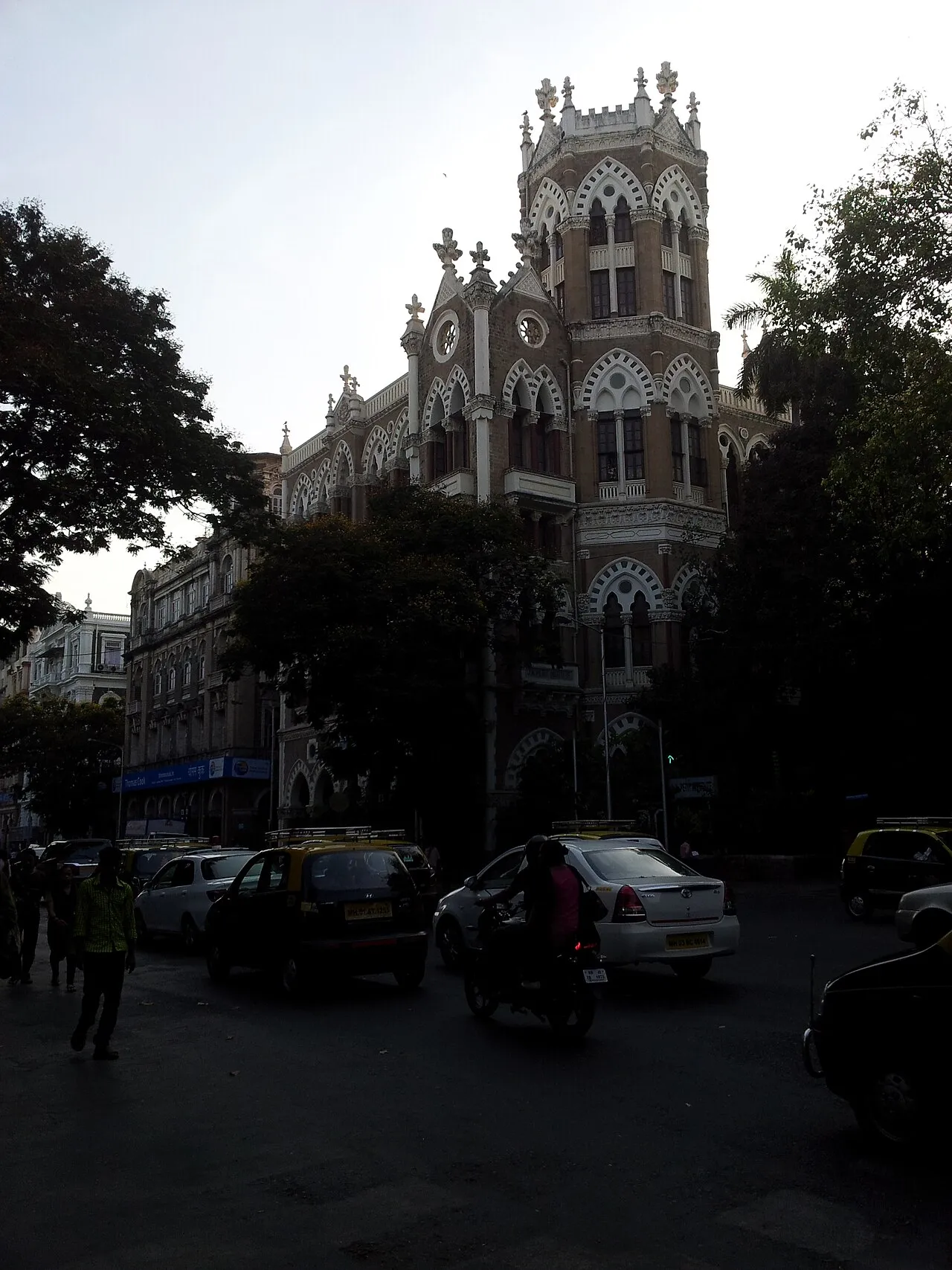
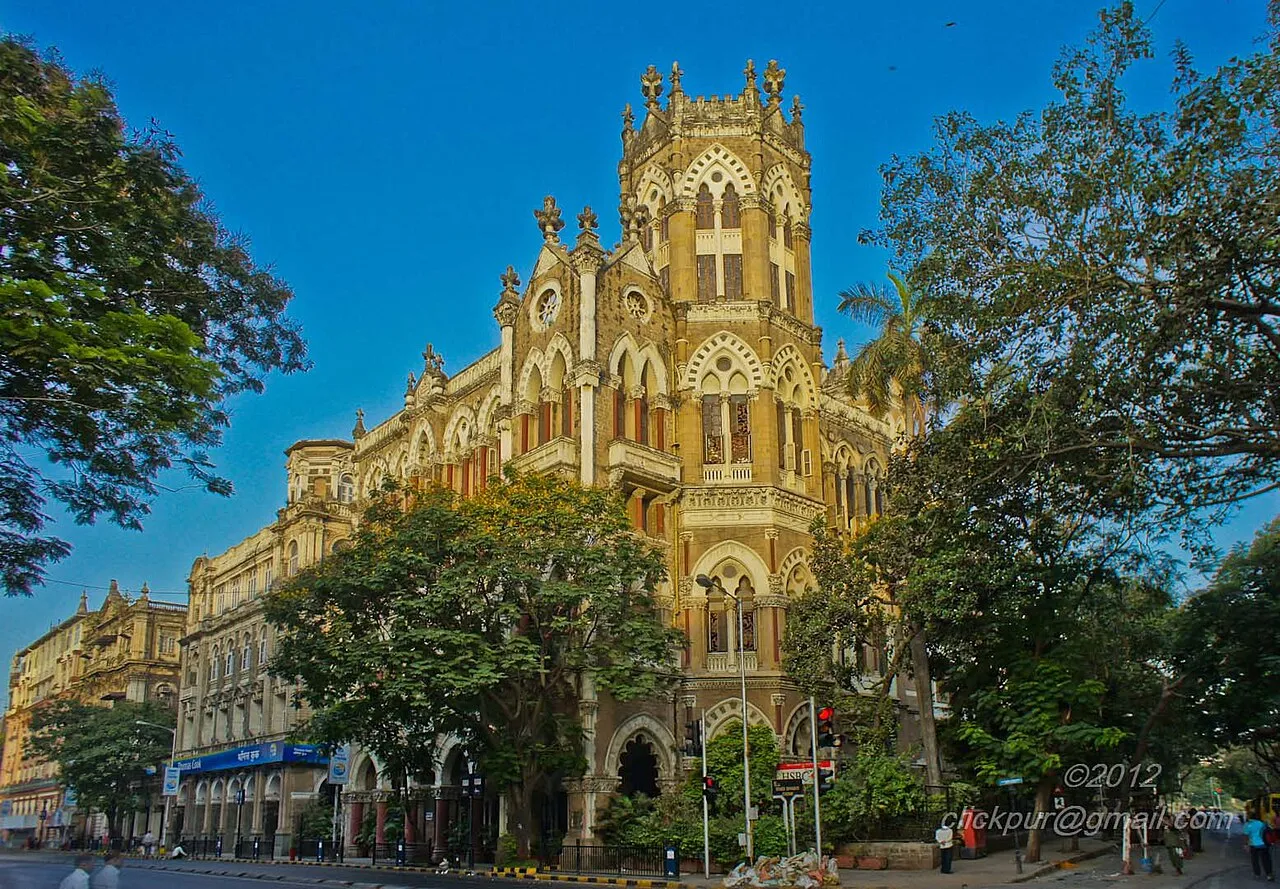
Around 1895 Bai Dinbai Nesserwanjee Petit, J. N. Petit's mother, gave about Rs 2.5 lakh for a building in her son's memory. The DNA feature notes that the Churchgate hall had become too cramped. The Institute says the new building, two storeys with one mezzanine floor, opened on 1 May 1898. DNA also dates its completion to 1898.
DNA, drawing on Sharada Dwivedi and Rahul Mehrotra's book Fort Walks, says the building honoured three men in her family: her son, her husband and her son-in-law. None of the three lived to see it finished.
The rest of the family gave too. The Institute lists these gifts:
- new furniture for the whole library from Bai Avanbai Framji Petit, J. N. Petit's sister;
- Rs 10,000 from Sir Dinshaw Manockjee Petit, 1st Baronet, to start a Book Purchase Fund;
- J. N. Petit's own private library of more than 500 volumes, some of them rare and costly, given by Bai Dinbai.
There is more on the family in our post on Sir Dinshaw Petit.
Work on an extension began in 1938. On 1 May 1939, 41 years to the day after the first opening, Sir Dinshaw Manockjee Petit, 3rd Baronet, then President of the Managing Committee, opened the enlarged premises to members. The Institute's home page says this extension included the reading room.
What heritage awards has the building won?
The Institute says the Bombay Heritage Society gave the building its Urban Heritage Award for 1990.
Parsi Times reported in September 2017 that the library had been fully restored in 2015 and had won a UNESCO award. The Free Press Journal, in August 2019, put the award in 2015 and called it a UNESCO Asia-Pacific award for preserving the Neo-Gothic building. Parsi Times also describes it as a Grade II A heritage building in the Neo-Gothic Revival style.
How did Metro-3 construction affect the J. N. Petit Library?
Work on Mumbai Metro Line 3 (Colaba to Bandra to SEEPZ) ran right past the library. Parsi Times reporter Delaveen Tarapore wrote in September 2017 that a carved limestone finial, 119 years old, fell from the building on 25 August 2017 and was destroyed. The Institute blamed vibration from the metro work. According to the report, the vibration recorded at the Institute as of 6 September 2017 was 20 mm/sec, against a permissible limit of 5 mm/sec for a heritage structure. The Institute was also unhappy that the metro corporation wanted part of the library garden for an entry and exit point with a lift.
The Institute filed a petition in the Bombay High Court on 8 September 2017. Santosh Patil, site manager for the metro work on D. N. Road, gave Parsi Times a different account. He said the finial stood on the inner lane, Maharshi Dadhichi Marg, away from the work, and fell because its iron anchor had rusted and gave way in rain and strong wind. He added that the corporation's own monitoring device recorded vibration well below the acceptable limit. Parsi Times reported that at a first hearing on 14 September 2017, Chief Justice Manjula Chellur and Justice Nitin Jamdar asked for security for the structure and discussed sharing the monitoring data with the Institute daily. We could not find a source for how the case finally ended.
The disruption lasted. In August 2019 the Free Press Journal quoted staff member Percy Wadia, who said footfall had fallen by half since barricades went up near the entrance. He said many of the members who stayed away were senior citizens. Some regular readers now wanted their issued books collected from home, and the library had begun sending staff to do it.
What books and rare items does the library hold?
Published counts differ. The Institute's website gives a main collection of over 100,000 books on all subjects, from old classics to new fiction and non-fiction, plus some special collections. Parsi Times in 2017 reported more than one lakh books, 2,400 of them rare, and 12 manuscripts. The Free Press Journal in 2019 gave about 90,000 books.
A few holdings get special mention. DNA wrote of a very valuable copy of Ferdowsi's Shah Nama. The Free Press Journal reported books dating from around 1660, old Zoroastrian scripts, and religious books in Sanskrit, Persian and Gujarati, and said researchers from India and abroad come to use the older material.
Readers looking for old Zoroastrian manuscripts may also want our post on the K. R. Cama Oriental Institute, whose own website lists the preservation of its ancient manuscripts among its activities.
Can anyone join the J. N. Petit Library?
According to the Institute's website, viewed in November 2026, membership is open to adults living in Mumbai, but an existing member who has known the applicant for at least two years must propose them. The page shows these fees, which may not be up to date:
| Class | Fee shown on the website |
|---|---|
| Life member | Rs 10,000 once, plus Rs 500 admission fee |
| First class | Rs 500 for two quarters |
| Senior citizen | Rs 360 for two quarters |
| Family (two adults, up to three children) | Set by the Managing Committee |
| Researcher or visitor | Rs 50 per day |
The website says members may borrow three books and three periodicals at a time. Books go out for 14 days and late returns cost Re 1 a day. The catalogue runs on SLIM software. The reading room on the second floor covers about 7,000 sq ft and seats around 300. The site lists it as open every day of the year from 7 a.m. to 8.30 p.m. Its stained-glass windows carry portraits of the Petit family, a detail both the Institute and the Free Press Journal mention. Check timings and fees with the library before you visit.
Who runs the J. N. Petit Institute today?
The Institute's website describes a Board of Trustees at the top. Under it, a Managing Committee of 12 runs the Institute's affairs: four trustees, among them the President, Vice President and Treasurer, and eight committee members, among them an Honorary Secretary. An Administrator handles daily work. Separate committees choose new books and magazines and weed out old or damaged items.
Frequently asked questions
When was the J. N. Petit Library founded?
The library was founded in 1856 by about a dozen Elphinstone College students living in Bombay's Fort, under the name Fort Improvement Library. It became the Fort Reading Room and Library in 1866 and took the J. N. Petit name in 1891. Its present building opened on 1 May 1898.
Where is the J. N. Petit Library?
The J. N. Petit Library is in the Fort area of south Mumbai. A 2014 DNA feature places it at a corner of D. N. Road, and a 2017 Parsi Times report puts one side on Maharshi Dadhichi Marg, an inner lane. Before 1898 it worked from a rented first-floor hall on Churchgate Street, according to the Institute's own history.
How much does J. N. Petit Library membership cost?
According to the Institute's website in November 2026, life membership is Rs 10,000 plus a Rs 500 admission fee. First-class membership is Rs 500 for two quarters, and senior citizens pay Rs 360. Day visitors and researchers pay Rs 50 a day. Applicants must be Mumbai adults proposed by an existing member.
What rare books does the J. N. Petit Library have?
Parsi Times reported in 2017 that about 2,400 of its books are rare and that it holds 12 manuscripts. DNA singled out a precious copy of Ferdowsi's Shah Nama. The Free Press Journal mentioned books from around 1660 and religious works in Sanskrit, Persian and Gujarati, along with old Zoroastrian scripts.
Has the J. N. Petit Institute building won heritage awards?
Yes, two. The Institute says the Bombay Heritage Society gave the building its Urban Heritage Award for 1990. Parsi Times reported a full restoration in 2015, and the Free Press Journal reported that the library received a UNESCO Asia-Pacific award that year for preserving its Neo-Gothic building.