 PalV's Kasti
On this page
Few people want to become khandias, the pall-bearers at Mumbai's Doongerwadi. Khandias told Open magazine in 2015 that finding anyone willing to take the job is hard, that most recruits come from outside Mumbai, and that their work grew heavier once solar reflectors replaced the vultures. They also spoke of social distance and of wages that had not risen in three years. Pay disputes were reported in 2015, 2018 and 2023. The published response is limited: in 2015 the Bombay Parsi Punchayet (BPP) was recruiting needy Parsis from rural areas, community volunteers stepped in during a one-day mass leave in 2018, and the 2023 dispute went to the Industrial Court. We found no published BPP recruitment scheme or new pay settlement from 2024 to 2026.
અસપંદામેદ રોજ
Asfandarmad Roj, Tir Mah · 1396 Y.Z.
Why is it hard to find new khandias?
No published headcount measures the decline, so this rests on what khandias and the BPP have said on record. In Lhendup G. Bhutia's July 2015 report for Open, the khandias said that most of them came from places other than Mumbai because few people will do the job. Each time more workers are needed, they said, the BPP sends staff to rural areas to look for Parsis in need who might accept it.
Social distance is part of the picture, and accounts of it differ. Open described khandias as the "untouchables" of a community without castes, and one khandia told the magazine that he had kept the details of his work from some of his relatives. Reviewing a novel about khandias for Outlook, Bakhtiar K. Dadabhoy took a different view: he wrote that there are no restrictions today on eating with khandias, and that their low standing now has less to do with ritual pollution than with poverty and anonymity. Who khandias are and the rules of purity they keep are covered in our main page on Khandias (corpse bearers).
How has the work changed since the vultures disappeared?
The khandias Open spoke to in 2015 described a job that had become harder. Large solar reflectors had been installed to dry out the remains, and because each reflector covers only a small area, they said, they had to move a single body several times a day. As of November 2026, the BPP's Doongerwadi page lists 12 "solars", four each at the Anjuman, Sethna and Bisni dokhmas, run by a separate team of engineers and solar operators. The khandias also told Open that they must enter the dokhma's central pit to clear it twice a year. Our page on the Tower of Silence explains how the dokhma is meant to work.
How much are khandias paid?
The BPP does not publish khandias' salaries, and the figures on record are scattered and dated. In 2015 khandias told Open that each of them was paid Rs 9,000 for each twice-yearly pit clearing. Pervez Wadia, described as the senior-most khandia, said the wage increase that usually came every few years had not come for three years. Dadabhoy's Outlook review states that khandias employed by the BPP in Mumbai earn about Rs 20,000 a month. Outlook's website dates that review to February 2022, and the review does not say which year the figure refers to.
Did the khandias go on strike?
Three disputes over pay have been reported.
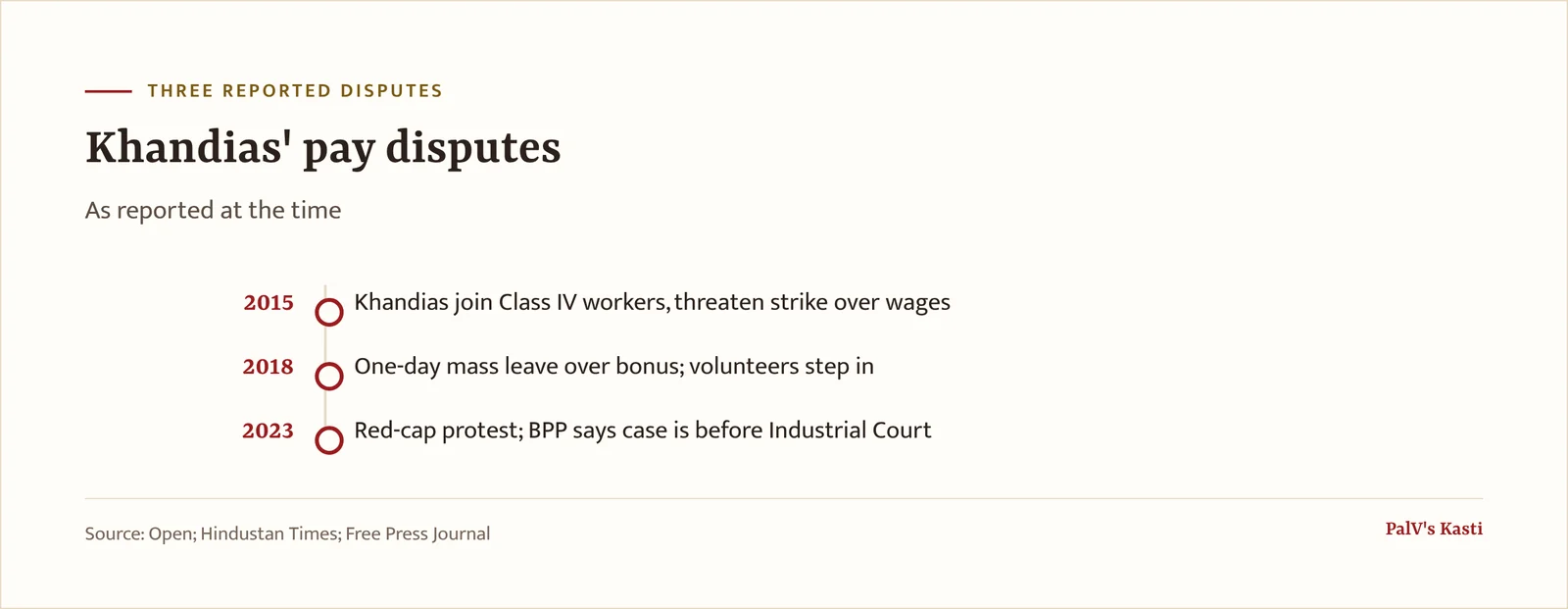
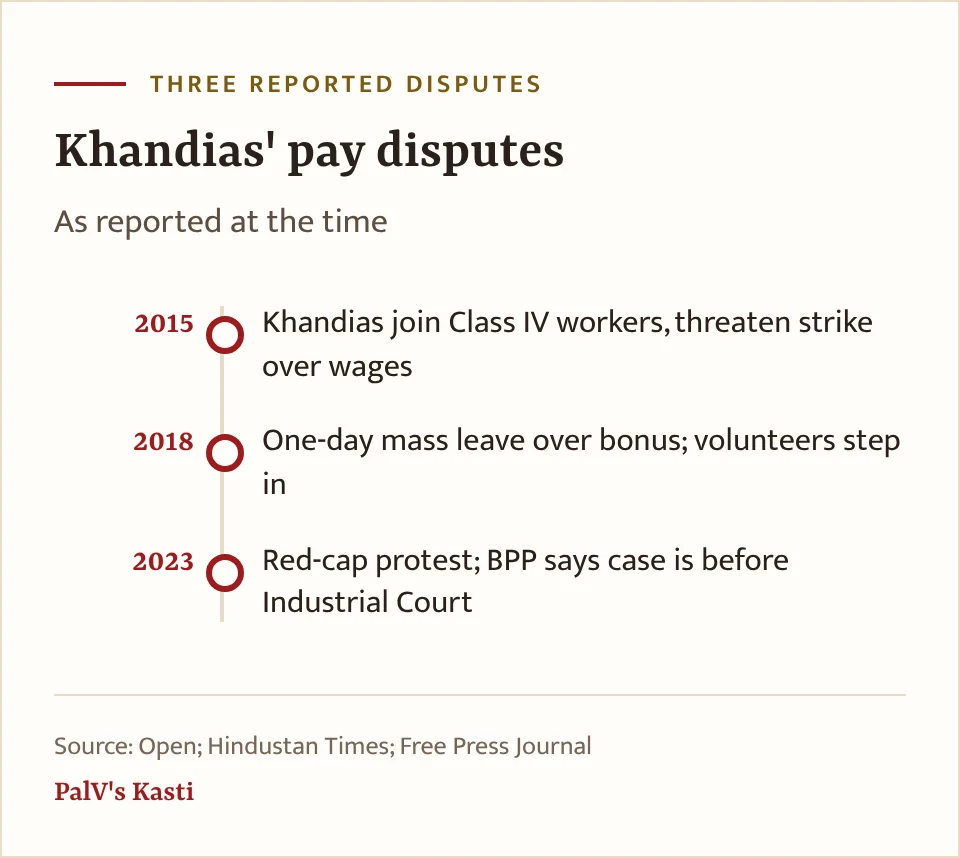
- 2015: Khandias joined other Class IV workers of the BPP in demanding better wages, and Pervez Wadia told Open they would strike if the demand was not met.
- August 2018: The Hindustan Times reported in its 22 August 2018 edition that Doongerwadi's ground staff, khandias included, took one day of mass casual leave to demand their bonus payments. Six office bearers and two young community members volunteered, and two bodies were consigned that day. BPP trustee Kersi Randeria called the work "essential services" and warned of action if the leave became a strike.
- May 2023: The Free Press Journal reported in May 2023 that BPP employees, including the pall-bearers at Doongerwadi, had protested for over a month in red caps. Their union said the BPP had agreed to revised pay and allowances but had not paid them. BPP chairperson Armaity Tirandaz said the issues were before the Industrial Court and the matter was sub judice.
We found no later report of how the 2023 Industrial Court case ended. For a fictional view of a khandia's life in pre-Independence Bombay, see our page on Cyrus Mistry's novel Chronicle of a Corpse Bearer.
What is being done about the shortage?
On the published record, the BPP's response has three strands. Khandias described in 2015 how it looks for recruits among Parsis in rural areas. Its Doongerwadi page says a separate team of engineers and operators runs the solar reflectors. When staff stayed away in 2018, its office bearers and young community volunteers did the work for the day. Beyond these, we could not find a dated recruitment drive, training scheme or pay agreement for khandias, so we have not described one.
Frequently asked questions
Why is there a shortage of khandias?
Khandias told Open magazine in 2015 that few people are willing to do the work, so most recruits come from outside Mumbai, found by BPP staff in rural areas. They also described social distance from other Parsis and heavier work since solar reflectors replaced the vultures. No published headcount shows the size of the shortage.
How much are khandias paid?
The BPP does not publish their salaries. Bakhtiar K. Dadabhoy wrote in an Outlook review, dated February 2022 on its site, that BPP khandias in Mumbai earn about Rs 20,000 a month. In 2015 khandias told Open they received Rs 9,000 each for a pit clearing done twice a year.
Did the khandias go on strike?
No full strike appears in the reports we found. In August 2018 Doongerwadi's ground staff, khandias included, took one day of mass casual leave over bonus payments, and volunteers consigned two bodies, the Hindustan Times reported. Khandias threatened a strike in 2015, and in 2023 BPP staff protested in red caps.
Who employs the khandias in Mumbai?
The Bombay Parsi Punchayet, which manages the Doongerwadi estate in Mumbai. Its website says Doongerwadi has a staff of over 100, with khandias working in shifts. The Free Press Journal's 2023 report listed the pall-bearers at Doongerwadi among BPP employees working mainly as subordinate staff.


