 PalV's Kasti

On this page
In 1914, Dr. Jivanji Jamshedji Modi described a Navjote that most Parsi families today would recognise. After a ritual bath, the child sat before the priests in a room full of relatives and friends. The priest recited the Patet, with the child joining in, the child declared the faith and was dressed in the sadra, the priest tied the kusti while both recited the kusti prayer, the child recited the articles of faith, and the priest gave the Tandarosti blessing. The differences are in the details. In Modi's day the child was expected to know more prayers by heart, and until a few years before his 1922 book the child also fasted until the ceremony was over and was always invested in the morning.
Below we follow Modi's account, with his 1922 additions, an 1884 description and today's practice. For an overview of the rite now, see our Navjote ceremony page.
અસપંદામેદ રોજ
Asfandarmad Roj, Tir Mah · 1396 Y.Z.
What did J.J. Modi write about the Navjote?
Modi's short pamphlet, The Navjote Ceremony of the Parsis, appeared in a second edition in Bombay in 1914. His foreword explains why he wrote it: Parsis had begun inviting non-Parsi guests to watch the ceremony, and there was a demand for a small booklet that explained it. The pamphlet has three parts: what the ceremony signifies, the investiture itself, and the symbolism of the sadra and kusti.
He returned to the subject at greater length in chapter seven of The Religious Ceremonies and Customs of the Parsees, published in 1922. It follows the 1914 description closely, adding footnotes and notes on what had changed "upto a few years ago".
Why was the Navjote age set at seven?
Modi wrote that seven is the age at which the ceremony is enjoined, and he built his case from Greek writers as well as Zoroastrian texts. Herodotus and Strabo, he noted, said ancient Iranians began educating their children at five, part of it religious schooling for the investiture. Plato gave seven as the age of education, which Modi took as the start of secular education after the Navjote, citing the Vendidad and the Denkard in support.
If a child was not yet able to understand the ceremony, or for other unavoidable reasons, Modi said it could be postponed, but only up to fifteen. Going without the sadra and kusti after that age, he wrote, was counted as the sin of kushad davarashni, which he glossed as running about improperly clothed. In his 1922 book he added a finer point from the Sad-dar: the fifteen years include the nine months before birth, so the latest permissible age is fourteen years and three months.
Not every writer of the period gave the same lower limit: Dosabhai Framji Karaka, in his History of the Parsis (1884), wrote that the investiture could take place any time after the child reached six years and three months, but not before.
How was the room prepared in 1914?
After the bath, Modi wrote, the child was brought into a room where the parents, relatives, friends and the priests had gathered, with a removable cloth over the upper body. In front of the officiating priest were placed:
- a new set of clothes for the child, with the new sadra and kusti
- a tray of rice for the family priest, which Modi called a remnant of the days when priests were partly paid in kind (in 1922 he gives its name, akhiana)
- a tray of flowers for the guests
- a lamp, usually burning clarified butter, sometimes with candles as well
- fire in a censer with sandalwood and frankincense
- a tray of rice, pomegranate seeds, coconut slices, raisins and almonds, to be showered on the child as a sign of prosperity
The clothes tray also held betel leaves and nuts, sugar candy, rice, a garland, red kanku powder and a few rupees. Modi said these had nothing to do with the religious ceremony; they were Indian emblems of good luck, handed to the child by the priest later. In 1922 he added that the money was taken by the family priest as part of his fee.
What happened during the ceremony in 1914?
The priest first placed the new sadra in the child's hands and recited the Patet, the prayer of repentance. The child joined in if it knew the prayer; if not, it recited the Ahunwar (Yatha Ahu Vairyo) several times. The priest then stood up and the child stood before him for what Modi called "the investiture proper", in four parts:
- The child recited the declaration of faith, and the priest put on the sadra while reciting an Ahunwar.
- The priest moved behind the child and tied the kusti while they recited the Nirang-i kusti together. Both faced east in the morning, or west in the evening.
- The child, now in sadra and kusti, recited the articles of faith with the priest.
- The priest recited the Tandarosti, a blessing for health and long life.
The words of the declaration, and what it means to profess oneself Mazdayasni, are covered in our post on the Navjote declaration of faith.
At the end, the priests were paid their fees and flowers were given to the guests. Modi's 1922 version adds that the priest made a red kanku mark on the child's forehead, a long vertical line for a boy and a round mark for a girl, before the blessing, and showered the child with the rice mixture while reciting it.
Practice varies between families and Agiaries; your family priest's guidance comes first.
What did a Navjote look like in 1884?
Karaka's account, thirty years before Modi's pamphlet, gives a sense of the occasion, with male and female guests invited to watch. The priests sat on a carpet, the family and guests on chairs or sofas, and Karaka noted "strict silence" throughout. Before the bath the child drank nirang three times and chewed part of a pomegranate leaf; later the dastur passed the kusti three times round the waist and closed with a shower of coconut, rice and almonds. The whole ceremony, he wrote, took about an hour.
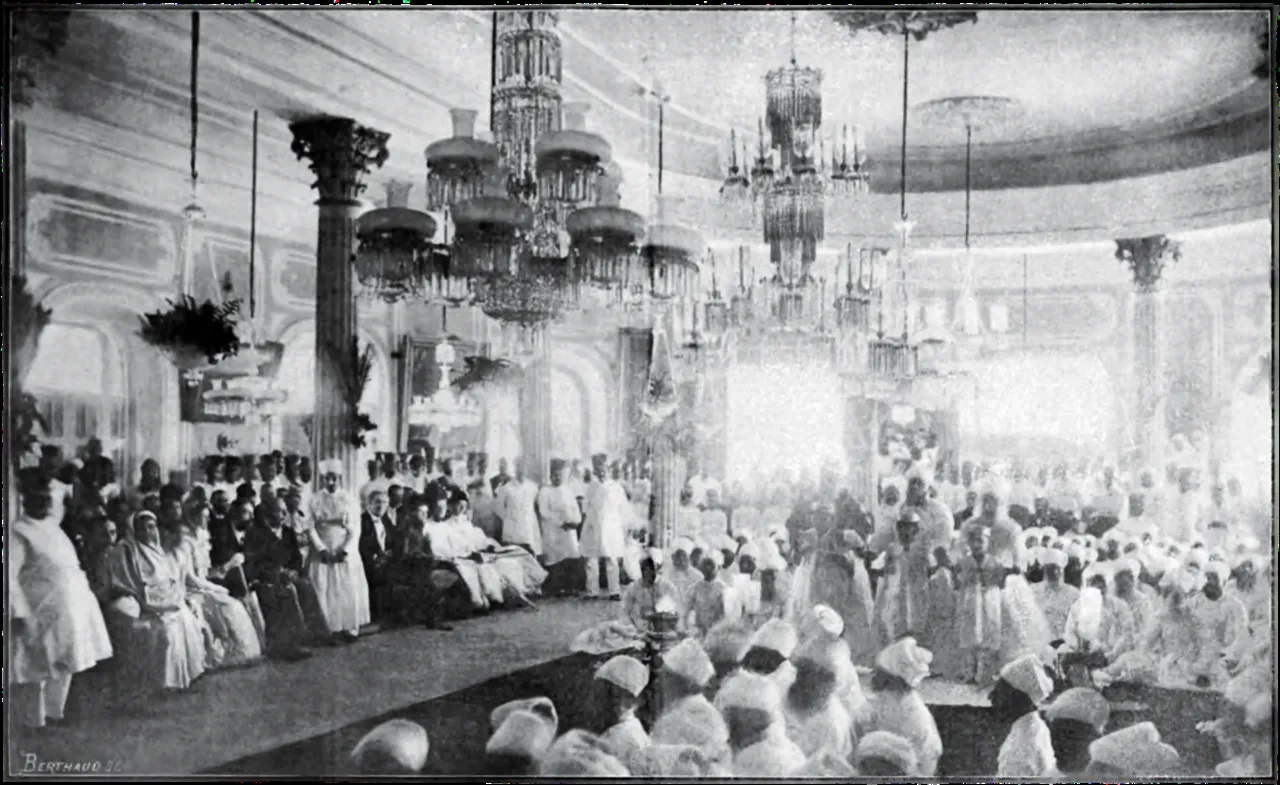
Afterwards the priests were paid according to their rank, the child was dressed in new clothes over the sadra, and gifts and a feast followed.
What had already changed by 1922?
In his 1922 chapter, Modi recorded several customs that had lapsed or loosened within living memory:
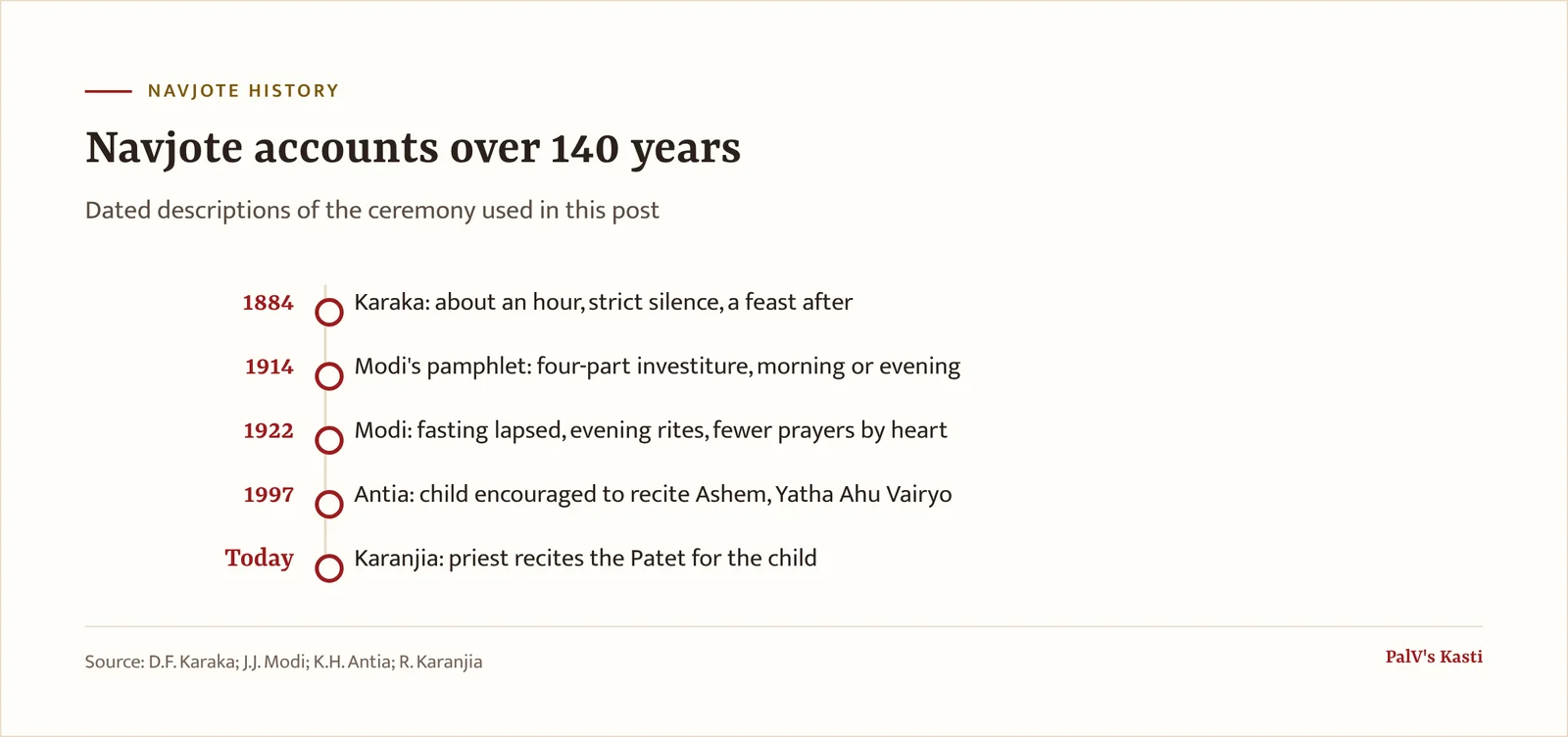
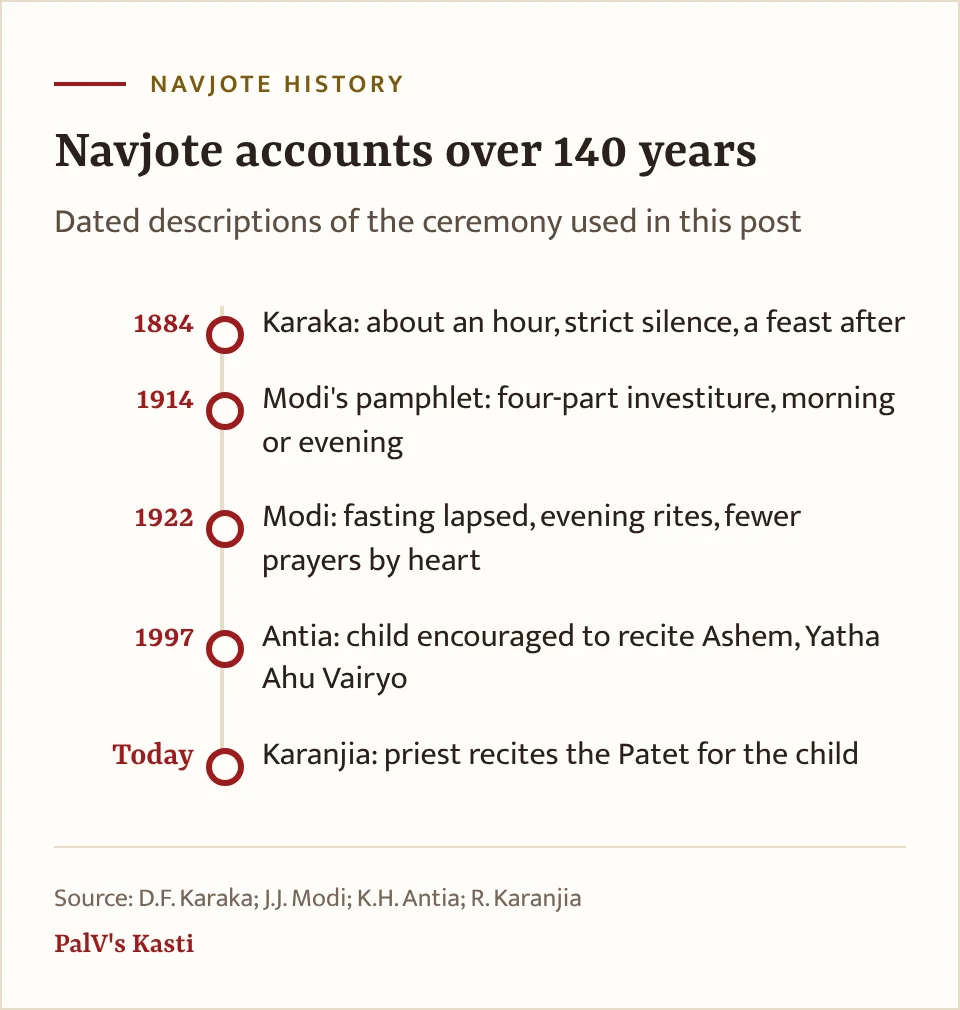
- Prayers by heart. The Nirang-i kusti was still essential, but the Patet, the Srosh Baj and the Nirang-i ab-i zar, once expected of the child, were "not deemed absolutely necessary".
- Fasting. Until a few years earlier, the child ate nothing in the morning until after the investiture, as a small sacrifice.
- Time of day. The ceremony had always been held in the morning, but was now held in the evening too, to suit the family. Modi argued that the rule that the priest recite the dawn prayer during the ceremony showed it was meant for the morning.
- The Patet itself. In some families, he noted, the Hormazd Yasht was now recited in place of the Patet.
He also recorded the toast at the dinner that followed: Jarthoshti sikkani salamati, which he translated as the prosperity of the Zoroastrian fold.
What has changed since Modi's time?
The order of the rite is the same in Ervad Dr. Ramiyar Karanjia's present-day description: bath, Patet, declaration of faith, sadra, kusti, blessing. The main shift is in how much of the Patet the child says. Modi had already noted in 1922 that the child generally recited the Yatha Ahu Vairyo instead. Karanjia writes that at the bath the priest now recites the whole Patet on the child's behalf, and that in the ceremony the child joins the priests only if it knows the prayer. Ervad Dr. Kersey Antia, writing in the FEZANA Journal in 1997, recalls that not long ago every initiate memorised the entire Patet, while today the child is encouraged at least to recite the Ashem Vohu and Yatha Ahu Vairyo.
Modi had priest and child face east in the morning and west in the evening. Karanjia writes that the child now faces east in either the Havan or the Uziran geh, because by tradition Navjotes were held only in the morning.
Antia also offers his own historical explanation. He argues that the Patet is a much later addition to the Navjote, written in Pazand a couple of centuries before the fall of the Sasanian empire, when only those over fifteen could be initiated in Iran. In his view, Parsis kept this adult prayer after lowering the age to childhood, and only later saw how odd it was to ask a young child to recite it. He records that when Dr. Dhalla, one of the Dasturs who raised the point, met priests unwilling to change the custom, he compromised by saying the Patet softly with them.
Modi wrote in 1914 that a Zoroastrian should wear the sadra and kusti at all times except while bathing, and Karanjia today writes that Zoroastrians are enjoined to wear them throughout life. How far families keep to it today is the subject of Why children stop wearing sadra-kusti. For what the sadra itself stands for, see Parsi Sadra meaning.
Practice varies between families and Agiaries; your family priest's guidance comes first.
Frequently asked questions
How was the Navjote performed 100 years ago?
Much as it is now. Modi's 1914 account has a ritual bath, the Patet, the declaration of faith, the sadra, the kusti tied with prayer, the articles of faith and the Tandarosti blessing. The child was expected to know more prayers by heart, and until shortly before 1922 fasted until the ceremony and was invested only in the morning.
Who was J.J. Modi and what did he write about the Navjote?
Dr. Jivanji Jamshedji Modi was a prolific Parsi Zoroastrian author. He wrote The Navjote Ceremony of the Parsis, second edition 1914, because Parsis had begun inviting non-Parsi guests, and a fuller chapter in The Religious Ceremonies and Customs of the Parsees (1922). Both describe each step and the symbolism of the sadra and kusti.
Why was the Navjote age set at seven?
Modi linked seven to the start of a child's education. He cited Herodotus and Strabo, who said ancient Iranians began schooling at five, and Plato, who gave seven, and he found support in the Vendidad and Denkard. The ceremony could be postponed for unavoidable reasons, he wrote, but no later than fifteen.
What has changed in the Navjote since 1914?
The order is the same, but the child now usually recites only short prayers such as the Yatha Ahu Vairyo while the priest recites the Patet, according to Karanjia and Antia. Morning fasting had lapsed by 1922, evening ceremonies became acceptable, and Karanjia writes that the child now faces east whatever the time of day.


