 PalV's Kasti
On this page
- Is the Navjote an initiation, or are Parsis born Zoroastrian?
- Is the Navjote only for boys?
- Can a Navjote be done at any age?
- Must a Navjote be held in the morning, in a fire temple?
- Are the tili, betel and achhu michhu religious requirements?
- Does the child have to recite the whole Patet?
- Can you wear only the sadra or only the kusti?
- Do the four knots and the word sudreh have one fixed meaning?
- Frequently asked questions
Most myths about the Navjote concern who it is for, when it must happen, and which parts are religion rather than custom. Karanjia, FEZANA and Karaka (1884) all say it is for girls and boys alike. The sources we read put the usual age between seven and eleven, and Modi gives fifteen as the latest. Karanjia sees nothing wrong with a Navjote outside a fire temple if the place is ritually pure, and Modi noted evening ceremonies by 1922, though Karanjia still advises an early morning. Modi and Karanjia class the betel, kanku, tili and achhu michhu as customs rather than the religious rite. Some questions have no single answer: priests and scholars disagree on whether the Navjote is an initiation, and on what the kusti's four knots and the word sudreh mean. We set out each point below with who says what.
અસપંદામેદ રોજ
Asfandarmad Roj, Tir Mah · 1396 Y.Z.
Is the Navjote an initiation, or are Parsis born Zoroastrian?
This is a real disagreement, not a myth with a simple answer.
J.J. Modi's 1914 pamphlet opens by calling the Navjote "the initiation of a Parsi into the fold of Zoroastrianism". FEZANA's 2023 teaching notes also describe it as the ceremony to initiate a child into the faith. Dasturji Maneckji Dhalla, in a passage of Homage Unto Ahura Mazda written in the voice of a child on its Navjote day, has the child say it was Parsi up to that day and that the ceremony "admits me as a member" of the religious fold.
Dr Ramiyar Karanjia takes the other view. He writes that the Navjote "is not an entrance into the Parsi Zoroastrian fold", because a child born to Parsi parents is already a Parsi Zoroastrian. For him, the ritual connects the child with the spirit of Prophet Zarathushtra and invests it with the sadra and kusti. Ervad Marzban Hathiram, writing on Frashogard in October 2016, puts it more sharply: "One is born into the faith."
The question of children of intermarried Parsi women is a separate debate, and we don't take it up here.
Practice varies between families and Agiaries; your family priest's guidance comes first.
Is the Navjote only for boys?
No. Karanjia writes that the Navjote is performed for Parsi Zoroastrian children, "both boys and girls". FEZANA's teaching notes say the same, and Dosabhai Framji Karaka's History of the Parsis (1884) describes the ceremony for a child "whether boy or girl". Ervad Dr Kersey Antia points out that this is one way it differs from the Hindu janoi, which only males of the priestly class receive.
Practice varies between families and Agiaries; your family priest's guidance comes first.
Can a Navjote be done at any age?
Not quite. Sources give a usual range and a latest age:
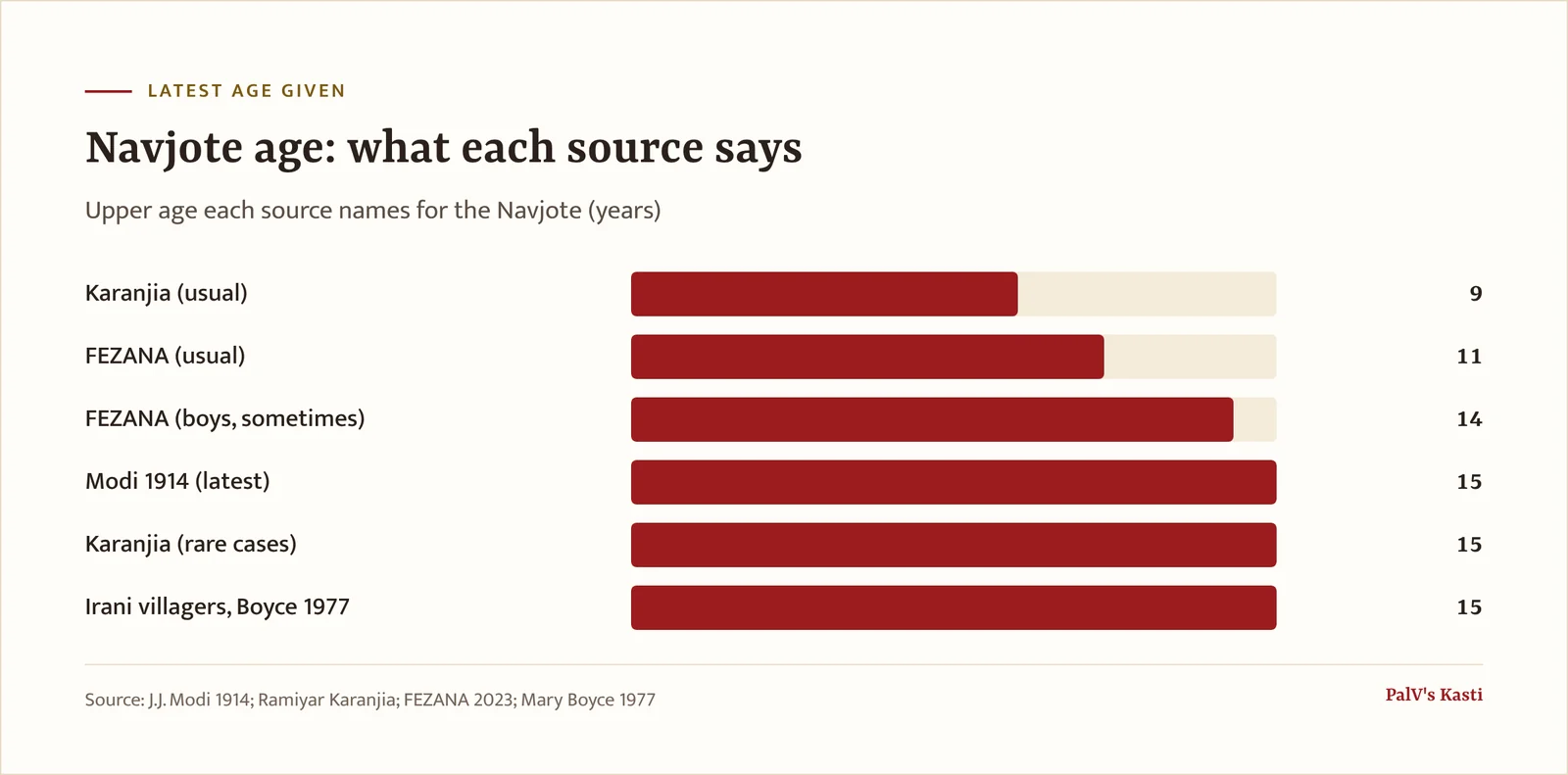
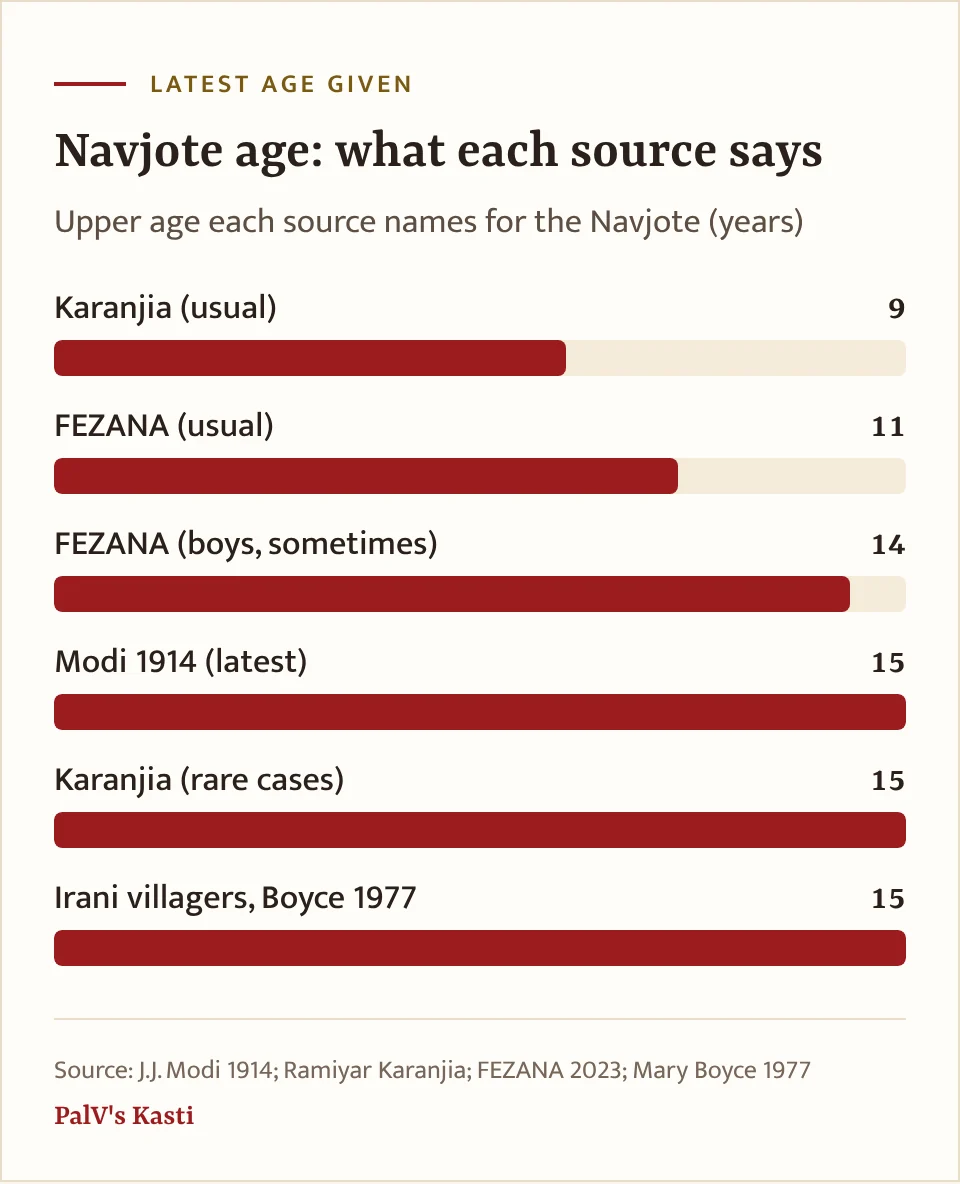
- Modi (1914) says seven is the age at which the Navjote is enjoined, and that it may be put off for certain reasons, but only up to fifteen.
- Karanjia gives "generally between the ages of 7 to 9", and up to fifteen only "in rare and unavoidable cases".
- Karaka (1884) gives the earliest age as six years and three months.
- FEZANA's teaching notes give seven to eleven, sometimes up to fourteen for boys.
- Among Iranian Zoroastrians, the scholar Mary Boyce recorded in 1977 that Irani villagers usually initiated their children between twelve and fifteen.
Antia attributes the lower Parsi age to Hindu influence. Boyce, who records the same lowering, compares it with the reduced age of confirmation in some Christian communities.
Practice varies between families and Agiaries; your family priest's guidance comes first.
Must a Navjote be held in the morning, in a fire temple?
Karanjia writes that the Navjote was traditionally performed in the morning in a fire temple. He still advises the morning, "as early as possible". But he also says there is nothing wrong in holding Navjotes outside an Agiary or Atash Behram if the place has the required ritual purity. Evening ceremonies are not new either: Modi wrote in 1922 that the Navjote, once always held in the morning, was "now performed in the evening also" to suit families.
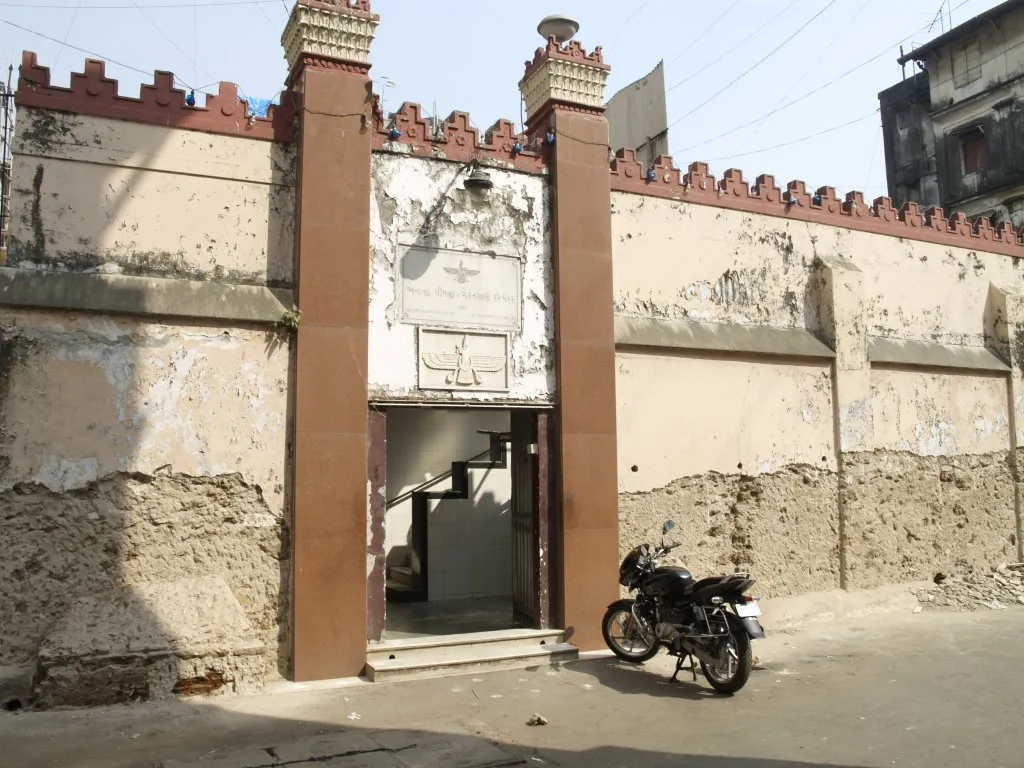
A stricter view exists. In a 2015 guest post on Frashogard, Hoshang H. Mandviwalla wrote that Navjotes and weddings should be held only in Agiaries or Atash Behrams, early in the morning.
Practice varies between families and Agiaries; your family priest's guidance comes first.
Are the tili, betel and achhu michhu religious requirements?
No, according to both Modi and Karanjia. Modi listed the betel leaves, sugar candy, rice, kanku and rupees placed on the tray with the child's clothes and said they "have nothing to do with the religious ceremony"; they are good-luck emblems in India. Karanjia groups achhu michhu, the sagan ni tili and the ses with customs and traditions, as distinct from practices like wearing the sadra and kusti, which he calls part of the religion. Karanjia also notes that family and friends give gifts after the ceremony; our page on Navjote gifts covers those.
Practice varies between families and Agiaries; your family priest's guidance comes first.
Does the child have to recite the whole Patet?
Not today. Modi noted in 1922 that the Patet and some other prayers, once expected to be known by heart, were "not deemed absolutely necessary". Karanjia writes that the child now recites the Yatha Ahu Vairyo while the priest recites the Patet Pashemani on the child's behalf, and Antia says the child is at least encouraged to recite the Ashem Vohu and Yatha Ahu Vairyo while the priests say the Patet.
Practice varies between families and Agiaries; your family priest's guidance comes first.
Can you wear only the sadra or only the kusti?
Karanjia says no. He notes that a few people wear only one of the two, which he calls "not correct", and writes that one is ineffective without the other. Modi's 1914 pamphlet makes a similar point: a Zoroastrian may wear any dress, but must put on both the sacred shirt and the thread. Why priests see the pair as protection is the subject of our page on Navjote as spiritual protection, and the garment itself is covered in Parsi Sadra meaning.
Practice varies between families and Agiaries; your family priest's guidance comes first.
Do the four knots and the word sudreh have one fixed meaning?
No, and the sources say so openly.
On the knots, Modi gives a meaning for each half-knot, starting with the thought that Ahura Mazda exists and is one. Antia, writing in 1997, says the exact symbolism of the four knots "is now lost to antiquity" because no scripture fixed it, so interpretations vary.
On the word sudreh, Karanjia gives two derivations: from the Persian sud, beneficial, and rah, path, or from the Avestan vastra, garment. Modi lists the "advantageous path" reading among several. Antia rejects it and says the word comes directly from vastra.
Practice varies between families and Agiaries; your family priest's guidance comes first.
For the fuller picture of the ceremony, start with our Navjote ceremony page.
Frequently asked questions
Is the Navjote an initiation?
Sources disagree. J.J. Modi (1914) and FEZANA's teaching notes call it an initiation into the faith. Dr Ramiyar Karanjia writes that it is not an entrance into the fold, because a child of Parsi parents is already a Parsi Zoroastrian, and Ervad Marzban Hathiram (2016) says one is born into the faith.
Can a Navjote be done for a girl?
Yes. Dr Ramiyar Karanjia writes that the Navjote is performed for both boys and girls, and FEZANA's teaching notes and Dosabhai Framji Karaka's 1884 History of the Parsis say the same. Ervad Dr Kersey Antia notes that this sets it apart from the Hindu janoi, given only to males of the priestly class.
What is the latest age for a Navjote?
J.J. Modi (1914) gives fifteen as the latest age, with seven as the age enjoined. Dr Ramiyar Karanjia says it is generally done between seven and nine, and up to fifteen only in rare cases. Mary Boyce's 1977 study of Iranian Zoroastrian villages records children there usually initiated between twelve and fifteen.
Can a Navjote be held at home or in a hall?
Dr Ramiyar Karanjia writes that there is nothing wrong in holding a Navjote outside an Agiary or Atash Behram, provided the place has the required ritual purity, though he still advises holding it as early in the morning as possible. A 2015 Frashogard guest post by Hoshang Mandviwalla argues it should be held only in a fire temple.
Is achhu michhu part of the religion?
Dr Ramiyar Karanjia classes achhu michhu, the sagan ni tili and the ses as customs and traditions, separate from religious practices such as wearing the sadra and kusti. J.J. Modi similarly wrote that the betel, rice, kanku and rupees on the clothes tray have nothing to do with the religious ceremony.


