 PalV's Kasti
On this page
- Is a Parsi cremation done with the same prayers as a Doongerwadi funer…
- How is a Parsi cremation performed, step by step?
- What prayers are said in the four days after a cremation?
- How is a cremation at Worli different from a Doongerwadi funeral?
- Do all Parsis accept these rites for a cremation?
- Frequently asked questions
In Mumbai, a Parsi cremation keeps the four-day funeral prayers. What changes is where the body goes at the end. Soon after death the body is given the sachkar, its last bath and dressing in Navjote.">sudreh and kusti. Two mobeds then recite the Geh Sarna, the Ahunavaiti Gatha, in daylight, and the family pays its last respects. The body is then taken to an electric furnace instead of the dokhma, and at Worli this takes about two hours. The Sarosh prayers follow on the first nights, the Uthamna on the third day and the Chahrum at sunrise on the fourth.
Below, each step is set out with who records it. For the background and the debate, see our Parsi cremation guide.
અસપંદામેદ રોજ
Asfandarmad Roj, Tir Mah · 1396 Y.Z.
Is a Parsi cremation done with the same prayers as a Doongerwadi funeral?
Largely, yes, according to those who run and report on cremations in Mumbai. Open magazine wrote in July 2016 that the prayers and rituals for Parsi cremations resemble those at the Towers of Silence. It said the big difference is that the family, non-Parsi members included, may attend. The Prayer Hall Services and Maintenance Trust, which runs the prayer hall at the Worli crematorium, says its hall exists for the customary four-day prayers of Zoroastrians. Not everyone accepts that the rites are complete without the dokhma, and that objection is covered further down.
How is a Parsi cremation performed, step by step?
The steps below draw on three priestly or community sources. One is J.J. Modi's Religious Ceremonies and Customs of the Parsees (1922). The second is the Bombay Parsi Punchayet's Doongerwadi page. The third is A Guide to Funeral Ceremonies and Prayers (FEZANA Journal, 2005) by Dr Kersey H. Antia, whom the guide describes as high priest of the Zarathushti community in Chicago. Antia wrote it for North American families, who cremate or bury because there is no dokhma there. Where only one of them records a step, we say so.
1. Tell your priest and make the arrangements
Call your family priest first, and get the death certificate from the doctor or hospital so the death can be registered. In Mumbai, if the prayers will be at the Worli hall, the Trust's rules say its Chief Priest must be told in advance, even when your own priest leads the prayers. He helps with hearse contacts, death registration and the bamboo bier. More on that in our guide to the Worli Parsi crematorium.
2. The sachkar: the last bath and dressing
Timing matters here. The BPP says the sachkar should be done in the same geh in which the person died, or at the latest by the next geh. Antia gives the same rule: the same or the next gah after death.
The BPP describes the deceased being bathed with taro and dressed in a sudreh and pyjama, with the kusti tied by relatives. In Antia's guide, close relatives of the same sex, where possible, wash the body with warm water while reciting Yatha Ahu Vairyo. They dress it in white with sudreh and kusti and cover the head. Antia says contact with the body should be avoided after the sachkar. The BPP says that, after it, non-Zoroastrians are not allowed to see the body.
3. The sagdid
In the sagdid, a dog is brought in to see the body. The BPP says this is done during the sachkar, again when the body is moved to the bier during the Geh Sarna, and after the prayers end. Antia notes that the sagdid is hardly practised in western countries. We found no published account of whether it is done at the Worli crematorium.
4. Prayers beside the body
The BPP says that after the sachkar and sagdid a mobed recites prayers for the soul, and that lay Zoroastrians may recite them if no mobed is available. Antia calls this a prayer vigil. Since mobeds are scarce, he encourages family members to keep up a string of Yatha Ahu Vairyo and Ashem Vohu until the Chahrum.
5. The Geh Sarna (paidast) prayers
This is the funeral service itself. Modi records that two priests, holding a paiwand between them and wearing the padan over the mouth, recite the Ahunavaiti Gatha (Yasna 28 to 34). Antia describes the same and puts its length at about an hour. Both the BPP and Antia say it must be held in daylight. The BPP's wording is after sunrise and up to an hour before sunset.
Partway through, the recital pauses. Modi places the pause at Yasna 31.4, roughly half-way, while the body is lifted from the stone slabs onto the bier, and the priests then complete the Gatha. The BPP also records the body being moved to the bier in the middle of the prayers.
6. The sezdo: last respects
When the Gatha ends, Antia's guide says everyone files past one at a time and bows to the deceased, without touching the body or the casket. This is the sezdo. At Doongerwadi, the BPP says the final farewell is bid at the last salutation slab by the Fravandian Gate.
7. To the furnace
Here a cremation parts company with dokhmenashini. At Worli, the Trust says there are no nasesalars. Friends or relatives usually wheel the body on an ambulance trolley down a short path from the prayer hall to the crematorium, and staff help when needed. The adjoining crematorium has two electric furnaces, one kept on standby, and the Trust gives about two hours for a cremation.
Antia's guide adds prayers at the crematorium. In his account the casket is opened in the antechamber for a last look, and the mourners, led by the mobeds, recite Ashem Vohu, Yatha Ahu Vairyo and the Homage unto the Urvans before the body goes in. This step appears only in Antia's North American guide.
8. The ashes
Antia writes that the ashes are given to the family a few days later and are dealt with as the deceased wished. We found no published guidance on what Mumbai families usually do with them, so ask your priest.
Practice varies between families and Agiaries; your family priest's guidance comes first.
What prayers are said in the four days after a cremation?
The prayers after the funeral do not depend on how the body was disposed of. Modi groups them as the Sarosh ceremonies of the first three days, and Antia sets out the same order day by day:
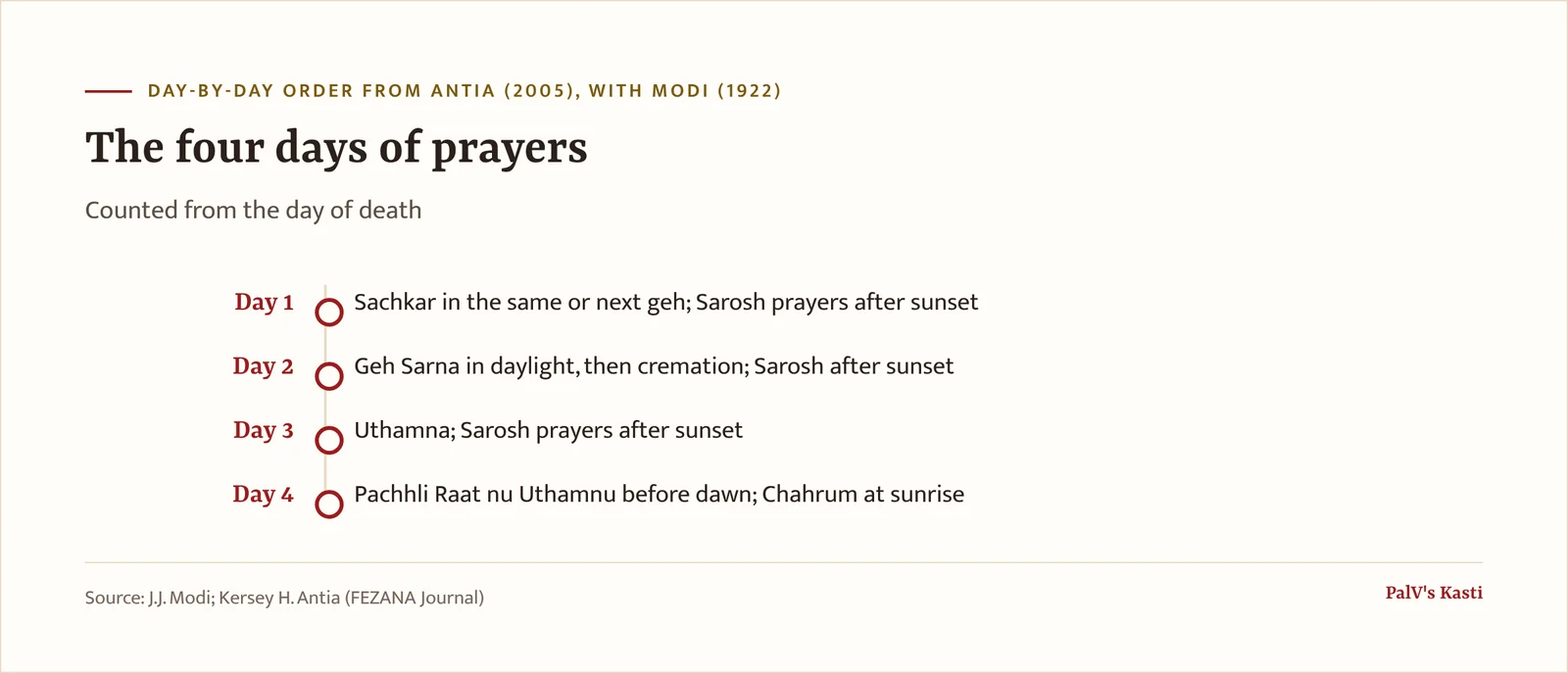
- Each of the first three nights: the Sarosh prayers (Sarosh nu Patru, which Modi calls Sarosh no Kardo) in the first part of the night, the Aiwisruthrem geh. Modi calls the Afringan of Sraosh at this hour indispensable.
- Third day: the Uthamna. Modi notes that some families hold it twice, on the afternoon of the third day and again at the end of the third night, and that the one at the end of the night is the essential one. Antia lists an afternoon Uthamna and the Pachhli Raat nu Uthamnu before dawn.
- Fourth day: the Chahrum, which Antia places at sunrise. Modi describes it as the fourth day ceremony.
The same rites appear in a Supreme Court of India order of 14 December 2017 (SLP (Civil) No. 18889/2012). It recorded an agreement about funeral prayers at the Doongerwadi complex in Valsad and named the Paidust, the Bhoi ni Kriya, the Sarosh nu Patru, the Uthamnu and the Pachli Raat nu Uthamnu ceremonies.
Families choose how much of this to hold. The Worli Trust's count to 31 August 2020 shows 374 funerals with the full four days of prayers at its hall and 62 with the paidast only. Its rules also let Parsi and Irani Zoroastrians hold any of the four days there even if the cremation happened elsewhere. The wider trend is covered in Parsi cremation in Mumbai.
Practice varies between families and Agiaries; your family priest's guidance comes first.
How is a cremation at Worli different from a Doongerwadi funeral?
Four practical differences are on record.
- Family members can stay with the body until the end. Open magazine reported this in 2016, contrasting it with the Tower of Silence, where no family member is allowed inside.
- Non-Parsi relatives and friends sit with the family. Jehangir Patel, editor of Parsiana, told the Free Press Journal in January 2024 that non-Zoroastrians are not made to sit separately at Worli as they are at Doongerwadi.
- There are no nasesalars. Relatives and crematorium staff move the body, according to the Trust.
- There is no overnight stay. The Trust says the Worli hall has no provision for relatives to stay the night. The BPP says its upper bunglis at Doongerwadi offer boarding and lodging for the four days, for Parsi and Irani Zoroastrians.
Do all Parsis accept these rites for a cremation?
No. The Free Press Journal reported in October 2024 that the Tower of Silence management had barred families of those who opted for cremation from using its prayer halls for the four-day rites. A member of the Prayer Hall Trust told the paper this left them no option but to create an alternative space.
One objection on record comes from a reader's letter in Parsi Times in July 2016, written after a funeral at Worli. The writer said there had been no sachkar or sagdid, that relatives had touched the body and put flowers on it, and that this was contrary to Zoroastrian traditions. On the other side, Jehangir Patel of Parsiana told the Free Press Journal in January 2024 that the hall has been "a real blessing" for families who wanted an alternative to Doongerwadi. The positions of the High Priests and the BPP are set out in our Parsi cremation guide.
Practice varies between families and Agiaries; your family priest's guidance comes first.
Frequently asked questions
How are Parsis cremated?
The body first receives the sachkar, a last bath and dressing in sudreh and kusti. Two mobeds then recite the Geh Sarna in daylight, and mourners pay their last respects. After that the body goes to an electric furnace. At Worli in Mumbai, the Prayer Hall Trust says this takes about two hours. The four days of prayers continue afterwards.
What prayers are said at a Parsi cremation?
The main funeral prayer is the Geh Sarna, in which two mobeds recite the Ahunavaiti Gatha, Yasna 28 to 34, near the body. Dr Kersey Antia's guide adds Ashem Vohu, Yatha Ahu Vairyo and the Homage unto the Urvans at the crematorium. The Sarosh prayers, the Uthamna and the Chahrum follow within the four days.
Is the four-day ritual the same as at Doongerwadi?
The order of prayers is the same: Sarosh prayers on the first three nights, the Uthamna on the third day and the Chahrum on the fourth. Open magazine reported in 2016 that cremation rites in Mumbai resemble those at the Towers of Silence. The Worli prayer hall exists so that cremating families can hold these four days of prayers.
How long does a Parsi cremation take?
At the Worli municipal crematorium, the Prayer Hall Trust says the electric furnace takes about two hours. The Geh Sarna before it lasts around an hour, according to Dr Kersey Antia's guide, and must be held in daylight. The Sarosh prayers, the Uthamna and the Chahrum then follow over the four days counted from the death.
What happens to the ashes after a Parsi cremation?
Dr Kersey Antia's funeral guide, written for North American Zoroastrians, says the ashes are handed to the family a few days after the cremation and are disposed of as the deceased wished. We found no published guidance on usual practice in Mumbai, so ask your family priest before you decide anything.


