 PalV's Kasti

On this page
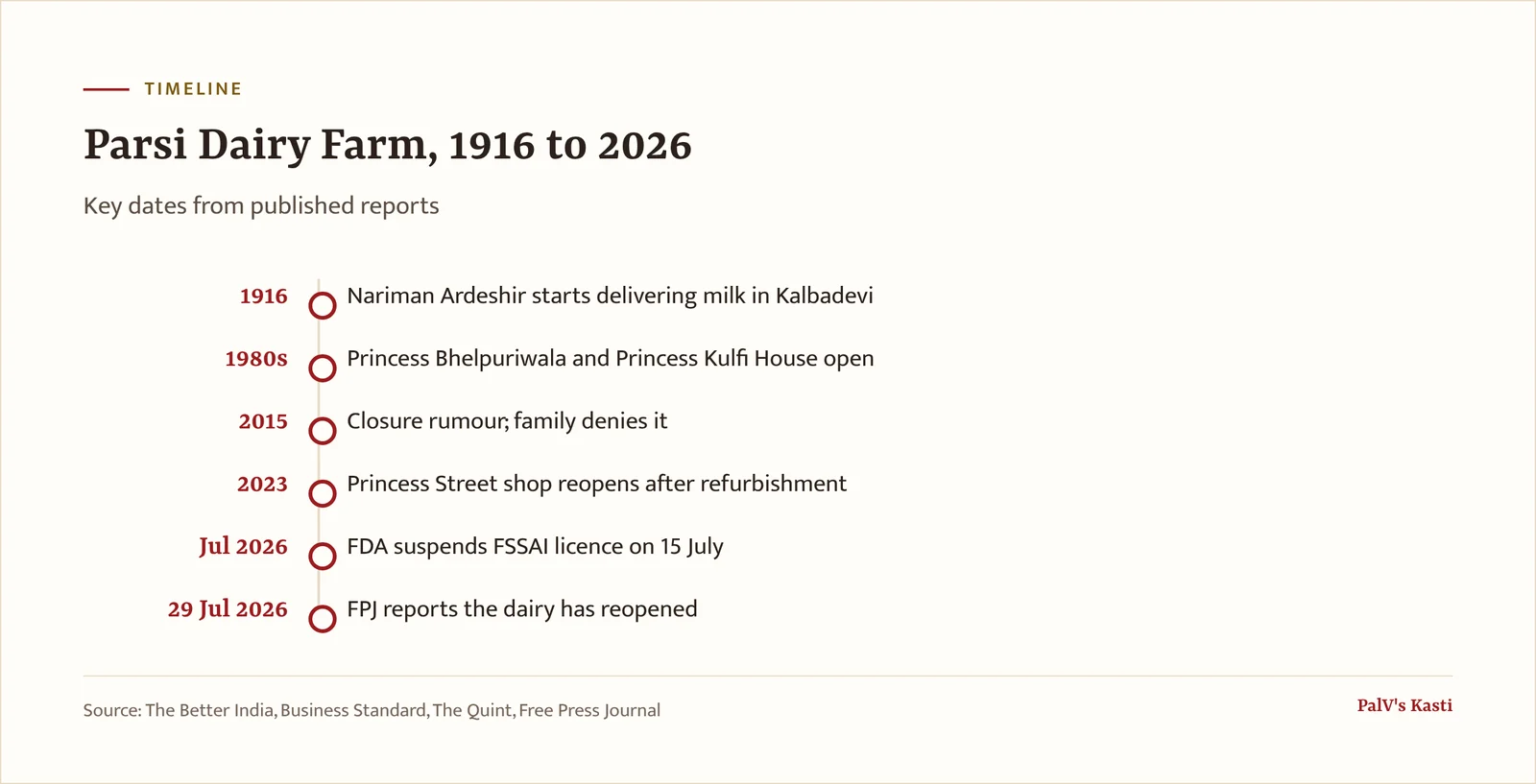
Parsi Dairy Farm is a family-owned dairy and mithai business on Princess Street, Marine Lines, in South Mumbai. It began in 1916, when a young Parsi named Nariman Ardeshir started carrying cans of milk to homes around Kalbadevi. His one rule, as his great-grandchildren tell it, was to sell only the purest milk. From that single can the business grew into door-to-door milk delivery, then ghee, curd, kulfi and Parsi sweets. Today it is run by the founder's fourth generation, with shops in Marine Lines, Borivali and Ghatkopar and a production unit at Talasari. Below we set out what the published record says about how it started, who runs it, and the two scares, in 2015 and 2026, that made Mumbai ask whether it had closed.
શહેરેવર રોજ
Shehrevar Roj, Tir Mah · 1396 Y.Z.
Who founded Parsi Dairy Farm, and when?
Nariman Ardeshir founded Parsi Dairy Farm in 1916. The Better India, Business Standard and YourStory's SMBStory all give that year and that name. (SMBStory prints his surname as "Arsheshir", which is a typo.)
His age at the time is less settled. The Better India (2024) and Slurrp (2025) both say he was 16 when he began. SMBStory (2025) says he was 18. We have not found a document that settles it, so we give both.
The family's account of his early life, as Bakhtyar Irani told it to The Better India, goes like this. Nariman lost his father when he was four. His mother could not keep up with the school fees, so the boy sold pens, pencils and stationery outside the school to stay enrolled. During the First World War he sold lemonade, and soldiers bought it. Shopkeepers in Kalbadevi trusted him enough to ask him to mind their cash counters over lunch. SMBStory adds that he also worked part-time in Irani cafes, the same kind of place we write about in our guide to the Irani cafes of Mumbai.
Then, in 1916, he started delivering milk cans to households in Kalbadevi. The Better India and Slurrp both record the single principle he worked by: "just sell the purest form of milk." Sarfaraz Irani, his great-grandson, told Slurrp how it grew from there. One can soon became two, and two became ten.
How did one milk can become a Mumbai dairy?
Milk came first, bought in. According to SMBStory, Nariman first sourced milk from cattle sheds at Mazgaon and, as orders grew, from sheds in Parel and Jogeshwari. As the city spread, the company's own tabelas (cattle sheds) were moved out to Talasari, in Palghar district. SMBStory and The Quint both put the Talasari land at 300 acres. SMBStory says it now holds sheds, the factory and a highway restaurant the family runs, called Dairyland Parlour.
The milkmen were part of the picture too. A Free Press Journal piece from September 2023 described Parsi Dairy Farm staff in khaki shorts and dark blue shirts, carrying metal handis of milk from door to door in the early morning.
Business Standard's 2019 profile, drawing partly on culinary anthropologist Kurush Dalal, adds three details from the later decades:
- Dalal said that in the 1980s the dairy had its own laboratory, and every barrel of milk that came in was tested there.
- He also recalled deliveries through the 1970s, 80s and 90s reaching as far as Bandra, in sealed aluminium cans with government-certified measuring jars, which he said were there to assure quality and a fair measure.
- The paper reports that in the 1980s the family opened Princess Bhelpuriwala and Princess Kulfi House.
Dalal also passed on a story from his father, who had newly settled in Bombay and could not find milk he liked. After asking around, he was sent to Parsi Dairy Farm by a local milkman, who said only one "mad man" in the city sold milk without adding water.
From milk, the range widened. SMBStory lists ghee, curd, mithai, Bengali sweets, paneer, sutarfeni, buttermilk, kulfi and yoghurt, and says the company now makes more than 80 products. It also reports that the dairy was the first to sell yoghurt in Mumbai, a claim we have seen in only that one article. What to order on a visit is a separate question, and we answer it in our guide to Parsi Dairy Farm kulfi and chhaas.
Where is Parsi Dairy Farm in Mumbai?
The flagship shop is on Princess Street at Marine Lines, in South Mumbai. In 2025 SMBStory listed three physical stores in the city: Marine Lines, Borivali and Ghatkopar. The brand's own Diwali announcement in October 2026 named the same three plus a store at Talasari, and said orders could also be placed through its app, its website, Swiggy and Zomato.
Is the Princess Street shop the very first one? Sources disagree. The Quint (2015) called it the first shop Nariman Ardeshir started. Slurrp (2025) put it "a stone's throw" from the original location. The founding story itself begins with deliveries in Kalbadevi rather than with a shopfront. We have left the exact first address open.
Who owns Parsi Dairy Farm today?
The company is Parsi Dairy Farm Pvt. Ltd., the name used in the Maharashtra FDA's 2026 order as reported by the Free Press Journal. It is still a family business. Business Standard (2019) and the brand's own October 2026 announcement both say the founder's fourth generation runs it, and The Better India (2024) and SMBStory (2025) both name the same four cousins. The roles below are as The Better India gave them:
- Bakhtyar K Irani, Managing Director
- Sarfaraz K Irani, who heads sales
- Zeenia K Patel, brand director (her title in the 2026 announcement is Director, Branding and Marketing)
- Parvana S Mistry, who heads operations
Zeenia Patel told The Better India that the cousins' mothers took the reins in the generation before them, at a time when it was not common for women to work.
The Princess Street shop was refurbished and reopened in 2023, according to the Free Press Journal, which welcomed the reopening on 4 September 2023, and The Better India, which dated the revamp to September 2023 and described its pastel interiors. Slurrp's August 2025 feature put the completion a year later, in September 2024; we go with the two earlier reports. Business Standard (2019) and SMBStory (2025) both note that the family kept the brand's blue and white colours. On money, SMBStory reported revenue of Rs 38 crore in FY2023-24, up from Rs 27 crore the year before, citing RoC filings it had seen.
Did Parsi Dairy Farm shut down?
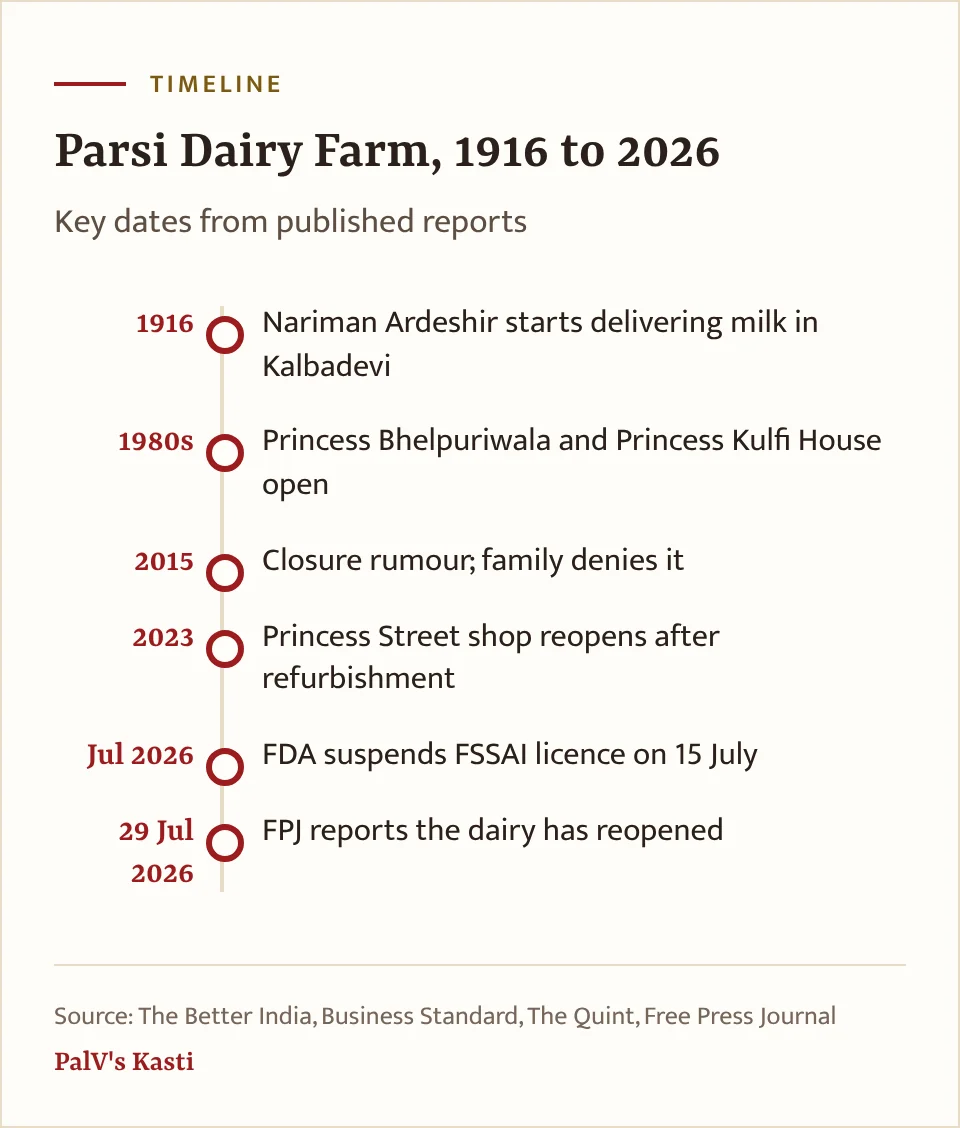
Not for good. It has had two scares, eleven years apart. In 2015 the closure story was a rumour. In July 2026 the shop really was shut, for nearly two weeks, after the state's food regulator suspended its licence. The Free Press Journal reported on 29 July 2026 that it had reopened, and the brand's own announcement dated 26 October 2026 listed Diwali hampers on sale at its four stores.
The 2015 closure rumour
In 2015 the Times of India reported that the dairy was closing. In a report dated 25 August 2015, The Quint said its reporters went to Princess Street, where people at the shop told them the story was not true. It also quoted a Mid-day report in which co-owner Silloo Nariman said the business was not going to close. The Quint traced the panic to the family's decision to sell its 300-acre land at Talasari. We could not open the original Times of India or Mid-day pieces, so this account rests on The Quint.
Is Parsi Dairy Farm's licence suspended?
It was suspended in July 2026, and the shop has since reopened. The Free Press Journal and WION both reported on 16 July 2026 that the Maharashtra Food and Drug Administration had suspended the company's FSSAI licence. The Free Press Journal and ThePrint (21 July 2026) both give the dates: inspectors visited on 14 July and the suspension order followed on 15 July, with immediate effect. The company was told to stop making, storing and selling food until further orders. The listed problems included mould and fungus on walls in production and storage areas, flies, raw material kept on the floor, no protected dock for receiving raw milk, no effluent treatment plant, incomplete medical records for food handlers, and products missing "Best Before" or expiry labels. WION noted that the company had not responded when it published. ThePrint reported that a company spokesperson told The Times of India the firm was in the process of complying with what it called procedural technical observations.
The Free Press Journal and ThePrint both placed the action within a statewide food-safety crackdown, and the Free Press Journal said the drive was run on the orders of FDA Commissioner Tukaram Mundhe. On 29 July 2026 the Free Press Journal reported that Parsi Dairy Farm had reopened and resumed operations that day, after being shut for nearly two weeks. That report did not say whether the licence had been formally restored, and as of 15 November 2026 we have not found a second report confirming the reopening date.
Why does Parsi Dairy Farm matter to Parsis?
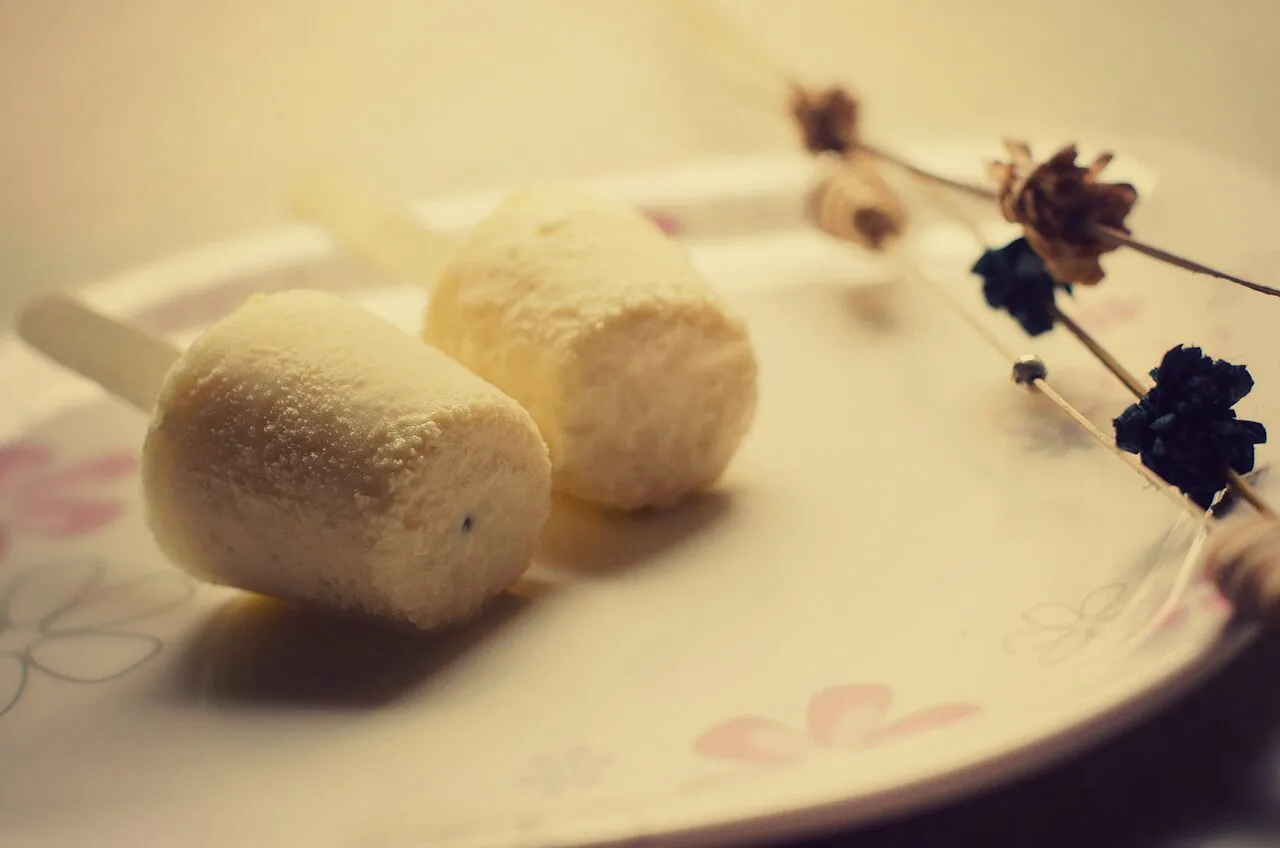
For many Parsi families in Mumbai it is the shop that supplies the sweets for the big days. When The Quint covered the 2015 rumour, it framed the worry as where the community would now get the malai kulfi that its navjotes and lagans need. Slurrp's 2025 Navroz feature described queues on Princess Street before the New Year, with mithai makers starting at 2 am so the sweets sold that day are fresh. Sarfaraz Irani told Slurrp that the mawa boi, a fish-shaped sweet of milk solids, is a very auspicious product for the community, standing for good luck, fertility and purity.
Practice varies between families and Agiaries; your family priest's guidance comes first.
There is a kindness story the family tells, too. Both The Better India and Slurrp record it, from Zeenia Patel and Sarfaraz Irani. A woman was once seen praying before Nariman Ardeshir's photograph in the shop. As a child she had lost her father, and her mother came to hand back the family's milk coupons because she could no longer pay. Ardeshir returned the coupons and kept the milk coming free until the children grew up. It is a family account, not a documented record. For more on the community that grew around shops like this one, see our page on Parsis in Mumbai.
Frequently asked questions
Who owns Parsi Dairy Farm?
Parsi Dairy Farm Pvt. Ltd. is owned and run by the founder's family. The fourth generation is in charge today: Bakhtyar K Irani as Managing Director, Sarfaraz K Irani on sales, Zeenia K Patel on branding and Parvana S Mistry on operations. In 2015 The Quint quoted Silloo Nariman, then described as co-owner, from a Mid-day report.
How old is Parsi Dairy Farm?
Parsi Dairy Farm dates from 1916, so 2026 is its 110th year. The brand marked the milestone in an October 2026 Diwali announcement describing a 110-year legacy. The Better India, Business Standard and SMBStory all give 1916 as the year Nariman Ardeshir started selling milk.
Who is the founder of Parsi Dairy Farm?
Nariman Ardeshir founded Parsi Dairy Farm in 1916 by delivering cans of milk to homes in Kalbadevi, Bombay. Sources disagree on his age then: The Better India and Slurrp say 16, SMBStory says 18. His family says he lost his father at four and sold stationery and lemonade before going into milk.
What happened to Parsi Dairy Farm in 2026?
After an inspection on 14 July 2026, the Maharashtra FDA suspended Parsi Dairy Farm's FSSAI licence on 15 July, citing lapses such as mould, flies and missing expiry labels. The Free Press Journal reported that the dairy reopened on 29 July 2026, after nearly two weeks shut, without saying whether the licence was formally restored.
Where is Parsi Dairy Farm in Mumbai?
The main Parsi Dairy Farm shop is on Princess Street, Marine Lines, in South Mumbai. The brand also lists stores in Borivali and Ghatkopar, and one at Talasari in Palghar district, where its production unit sits. Its products can also be ordered on its own app and website and through Swiggy and Zomato.


