PalV's Kasti
On this page
- Why is there no 1844 account in this post?
- Who wrote the 1838 and 1858 accounts?
- What happened at the deathbed and in the house in 1858?
- How was the body carried to the Tower of Silence in 1858?
- What happened in the three days after, and on the fourth day?
- What did Marianne Postans record in 1838?
- Where is the 1838 account wrong?
- How much of the 1858 funeral is still recognisable in 1922?
- Frequently asked questions
An 1844 account of a Parsi's last rites in Bombay circulates online, but we could not trace it to the newspaper it is said to come from, so this post does not repeat it. Neither of the accounts we could read comes from the 1840s. They are two published descriptions written either side of 1844. Marianne Postans described Parsi funerals in Western India in 1838 (London, 1839). Dosabhoy Framjee, a Parsi of Bombay, described them in The Parsees (London, 1858). Together they show a funeral held at home: prayers at the deathbed, the body laid on stone, two priests reciting the Gathas over an iron bier, a walking procession to the Tower of Silence on Malabar Hill, three days of visits and a solemn meal on the fourth day.
This post is part of our guide to Parsi death rituals, which explains how the rites are performed.
અસપંદામેદ રોજ
Asfandarmad Roj, Tir Mah · 1396 Y.Z.
Why is there no 1844 account in this post?
The 1844 story behind this page's title is told on community websites without a named author. It is said to come from the Bombay Courier of July and August 1844, by way of B.B. Patel's Gujarati chronicle Parsi Prakash. We could not open the newspaper, and the scanned Gujarati text of Parsi Prakash was too faint to check.
So we have used the two nearest accounts we could read in full, from 1838 and 1858, and we say which writer each detail comes from.
Who wrote the 1838 and 1858 accounts?
Marianne Postans published Western India in 1838 with Saunders and Otley, London, in 1839. Her description of the Parsis is in the first volume. She writes as an outsider, and parts of her account are second-hand: for the inside of the fire temples, for example, she relies on what a friend told her.
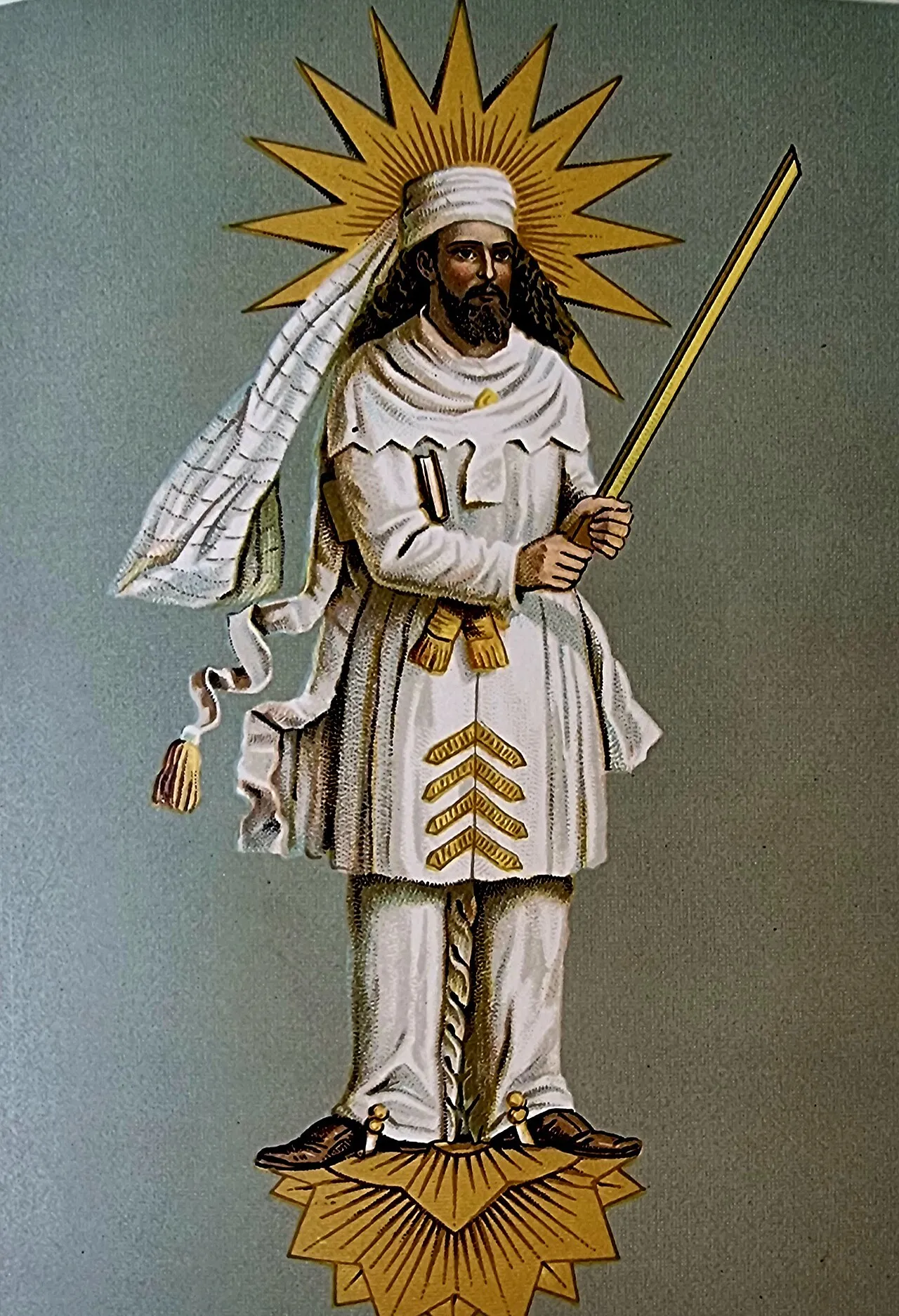
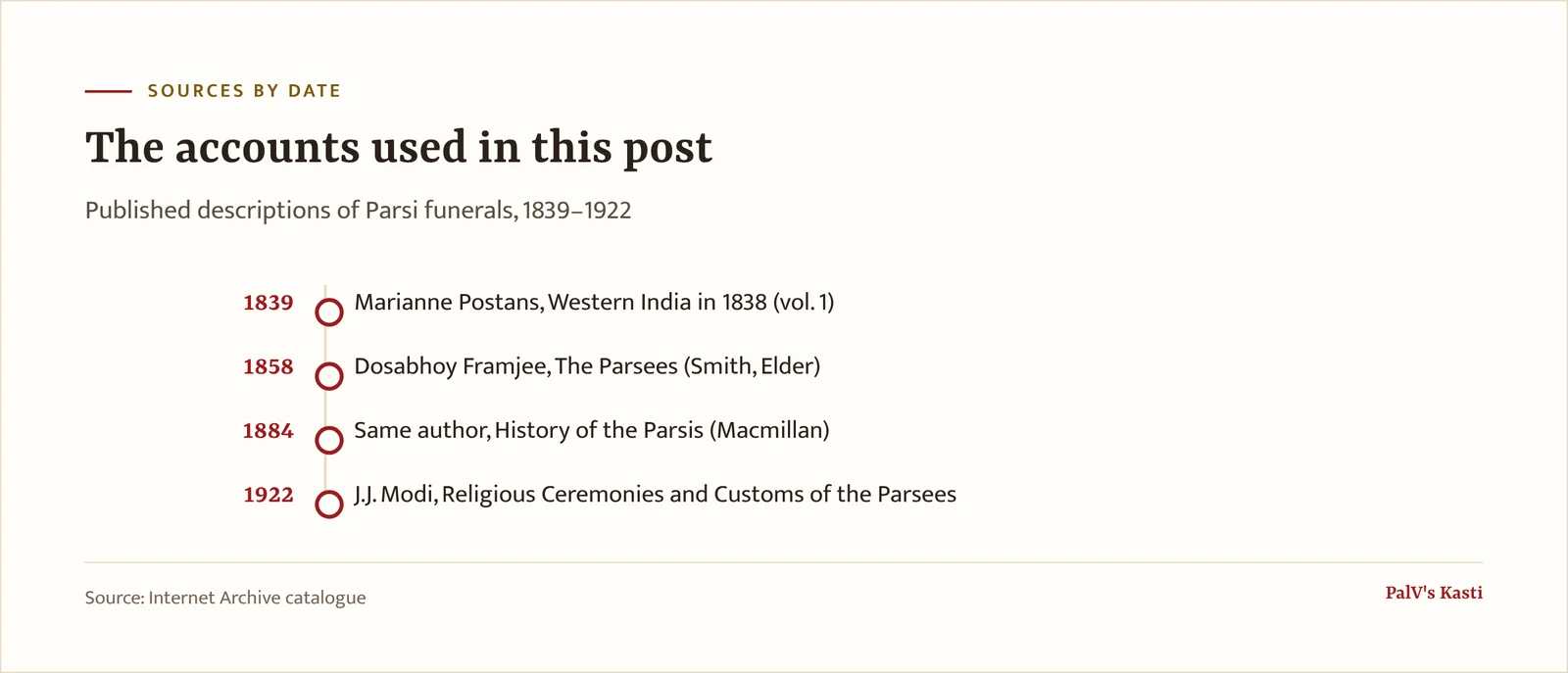
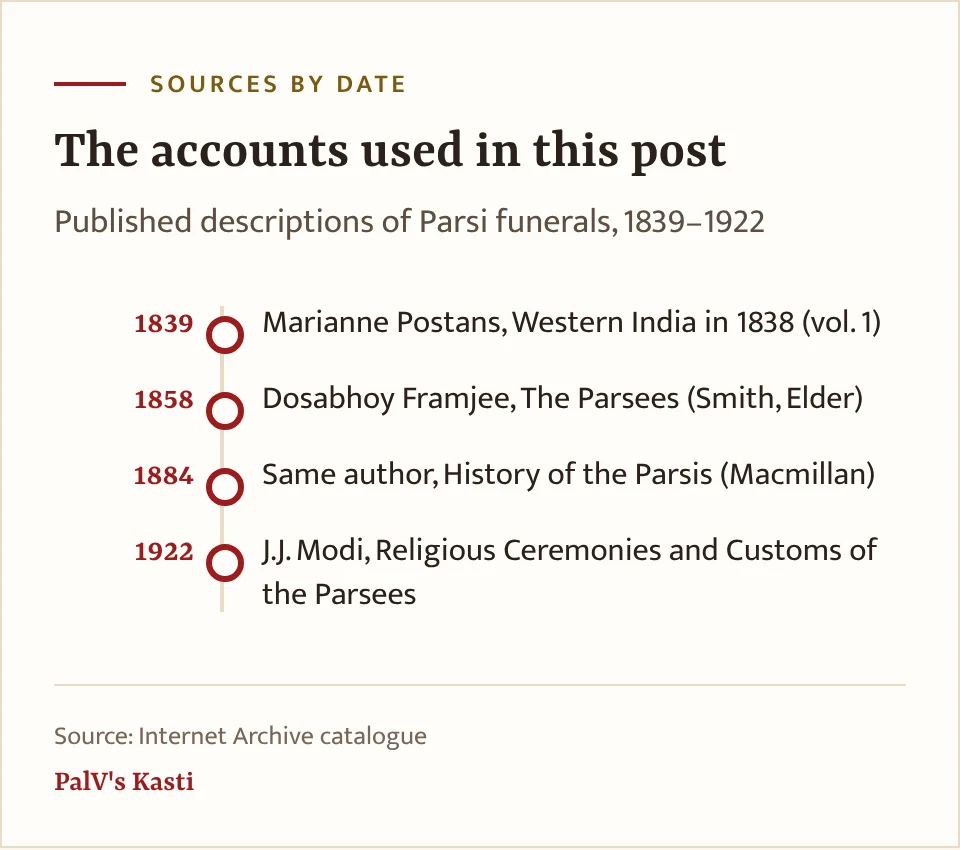
Dosabhoy Framjee published The Parsees: their history, manners, customs, and religion with Smith, Elder and Co., London, in 1858. The Internet Archive's catalogue identifies him as Dosabhai Framji Karaka, born in 1829. In 1884 he reworked the same description for his History of the Parsis (Macmillan), so we treat the 1858 and 1884 texts as one witness.
What happened at the deathbed and in the house in 1858?
Framjee begins before death. Once the doctor said there was no hope, the dying man was washed and dressed in clean clothes, and priests recited passages of the Avesta meant to console him and to ask forgiveness of his sins. In his English rendering, the prayer asks the Almighty to pardon the dying man and give him a happy abode in the next world. If the dying man could not join in, a son, a close relative or the family priest repeated the words into his ear.
After death, he writes, the body was wrapped in clean clothes and laid on an oblong slab of polished stone on the floor. The women of the family sat on a carpet in the same room. The men sat on benches in the verandah. In the 1884 version he adds that the hands were crossed on the chest, and that the priests had once argued over whether the feet should be crossed or kept straight. The Parsi Panchayet, he says, left it to the head of the family to decide.
Timing depended on the hour of death. If a person died at night, the body stayed in the house until morning. A death during the day, at least four or five hours before sunset, meant the funeral took place that evening. J.J. Modi's Religious Ceremonies and Customs of the Parsees (1922) gives the same rule from the religious side: removing the body at night is forbidden, and a death early in the night means removal the next morning. Modi also describes the body being laid on slabs of stone.
Practice varies between families and Agiaries; your family priest's guidance comes first.
How was the body carried to the Tower of Silence in 1858?
When it was time, the corpse bearers, whom Framjee calls nassesalars, brought in an iron bier and placed the body on it. Two priests stood facing the body and recited what he calls a part of the Izeshne (Yasna), "a sort of funeral sermon". It lasted about an hour. Its theme, as he summarises it, was that everyone must die and account for their deeds. In a footnote he notes that the effect was lost on listeners who did not understand the language it was recited in.
Framjee's 1884 version names the text precisely as the seven chapters of the Ahunavaiti Gatha. Modi's 1922 account of the Geh-sarna ceremony agrees: two priests, holding a paiwand between them, recite the Ahunavaiti Gatha, and the bearers move the body from the stone slabs onto the iron bier halfway through.
The procession then left the house. In Framjee's words, the male relatives and friends followed the body in procession (on foot, his 1884 version adds) to the Dokhma, the Tower of Silence. A footnote places the Bombay Dokhmas on the highest and most secluded part of Malabar Hill. At the Tower the bier was set down and the face uncovered for a few minutes so that everyone could take a last look and bow. Another footnote records that Parsis bowed to any Parsi funeral they met on the road, as a reminder that the same end awaits everyone. When the bearers came back, those who had attended washed their faces and hands and prayed together for the departed.
Practice varies between families and Agiaries; your family priest's guidance comes first.
What happened in the three days after, and on the fourth day?
For three days, Framjee writes, friends, neighbours and acquaintances visited the family every morning and evening to console them. On the fourth day there was a solemn feast, and the relatives went to the Fire Temple to pray again for the deceased. Women stayed in mourning for three, ten or thirty days, as suited them.
That fourth-day meal is the end of the three days without meat, explained in Vegetarian days after death. Framjee does not describe the prayers of the first three nights. Modi's 1922 book does, including the Sarosh-no-Kardo ceremony for the soul.
What did Marianne Postans record in 1838?
She writes that the body was wrapped in pure white linen with a small cap of the same cloth on the head, and carried with weeping to the "towers of silence". She compares the Towers to Martello towers standing on raised ground near the sea, away from houses. She also records that friends of the family did not go inside the house of mourning but sat outside on benches against the walls.
On timing she differs from Framjee. Postans says morning ceremonies were held for four days after the death of a man and twelve after the death of a woman. Framjee, twenty years later and from within the community, gives three days of visits for everyone and a fourth-day meal. Modi's 1922 account places the Cheharum ceremonies on the fourth day. Of the three writers, only Postans gives twelve days.
Where is the 1838 account wrong?
Postans was writing as an outsider, and parts of her description do not match Parsi sources. She places an ever-burning sacred fire, tended by a priest, at the bottom of the Tower's central pit, and says the bones either feed that fire or are washed into the sea. Modi's 1922 description is different. The dry bones are placed in a deep central well, the bhandar, where they crumble to dust. The fire he describes is kept burning in a separate small building in the compound, called the sagri.
She also describes the bearers of the bier as a despised class of priests. Modi describes two classes of corpse bearers instead: the Nassasalars, who come into the house and place the body on the bier, and the Khandhias, who carry it to the Tower. Her account is most useful for what could be seen from outside a house of mourning.
How much of the 1858 funeral is still recognisable in 1922?
Most of the steps Framjee lists also appear in Modi's 1922 description: the stone slabs, the Ahunavaiti Gatha recited by two priests as the body is moved to the iron bier, the last look and bow, the procession on foot and the fourth-day meal. Modi places the bow at the house and calls it sijda, while Framjee's 1858 text places it at the Tower. What the 1858 account adds is a picture of 1850s Bombay: the women on the carpet, the men in the verandah, and Parsis bowing to any Parsi funeral they met in the street. These are one Parsi writer's observations, and we have presented them as his.
Practice varies between families and Agiaries; your family priest's guidance comes first.
Frequently asked questions
What were Parsi funerals like in the 19th century?
Dosabhoy Framjee's 1858 account describes a funeral held from the family home. The body was laid on a stone slab, two priests recited over an iron bier for about an hour, and the men of the family followed it in procession to the Tower of Silence on Malabar Hill. Three days of visits and a fourth-day feast followed.
Did Parsis always use the Tower of Silence in Bombay?
Both of the earliest accounts we read describe the Tower of Silence as the place of disposal in Bombay. Marianne Postans wrote in 1838 that Parsis could neither bury nor burn their dead. Dosabhoy Framjee wrote in 1858 that the Bombay Dokhmas stood on the highest, most secluded part of Malabar Hill.
What did early travellers write about Parsi funerals?
Marianne Postans, in Western India in 1838, described bodies wrapped in white linen with a small cap and carried to Towers she compared to Martello towers. She wrote as an outsider, and her claim that the bones fed a sacred fire in the pit does not match J.J. Modi's later description of the Tower.
Is the 1844 Parsi funeral account reliable?
We could not verify it. The story is told online without an author and is said to come from the Bombay Courier of 1844 through the Gujarati chronicle Parsi Prakash. We could not read either original, so we have relied on the published accounts of 1838 and 1858, which can be read in full.