 PalV's Kasti
On this page
Parsi mawa cake is a dense, buttery tea cake made with mawa (milk cooked down for hours into caramelised solids), flavoured with cardamom and often baked as small cupcakes wrapped in wax paper. Mint traces it on the menus of Mumbai and Pune's Irani cafés and bakeries back to when they opened, in the late nineteenth and early twentieth centuries. Nobody can prove who baked it first. B. Merwan in Mumbai and Royal Bakery in Pune both claim it, and the Parsi food specialist Kurush Dalal traces it to kumas, a Zoroastrian tea cake. At home it is baked like a plain butter cake with mawa and milk folded into the batter. The recipe further down follows Chef Anahita Dhondy's version, as published by Outlook Traveller Eats in 2025.
શહેરેવર રોજ
Shehrevar Roj, Tir Mah · 1396 Y.Z.
What is Parsi mawa cake?
Writing in Mint in 2014, Pooja Vir described mawa cakes as soft, buttery cupcakes flavoured with cardamom and rolled in wax paper, and said they had been on the menu at Irani cafés and bakeries since those places opened in Bombay and Pune, in the late nineteenth and early twentieth centuries. The same article called it "the Bombay cupcake". Outlook Traveller Eats describes it as a dense, fragrant cake, and Dawn calls it rich and heavy.
You'll see it spelt mawa cake, mava cake or Parsi mava cake. Niloufer Mavalvala's 2019 cookbook The World of Parsi Cooking lists it as Mava nu Cake, or Rich Milk Cake. Dawn reports that some Mumbai bakeries also sell it as khoya cake, alongside cashew and chocolate versions.
Anahita Dhondy, who wrote Parsi Kitchen: A Memoir of Food and Family, told Outlook Traveller Eats it is "the Parsi quintessential tea cake", to be eaten as a snack with batasa biscuits or patrel. The same article says it goes well with tea or coffee.
What is mawa?
FEZANA's 2012 cookbook Eat, Live, Pray says you make mawa by simmering full-fat milk for several hours in an iron karahi until the water evaporates and only caramelised milk solids remain. Aban Kekobad, in her recipe on ParsiCuisine.com, gives the same idea in a sentence: milk cooked down until it turns thick and comes away from the sides of the pan. She made hers from two cans of evaporated milk and one of condensed milk. Mint and Dawn both use the other common name, khoya. For a quicker route, the FEZANA book suggests cooking 250 g of ricotta in the microwave for about three minutes to drive off the water, then stirring in ghee, full-fat milk powder and cream.
Where did mawa cake come from?
The honest answer is that no one knows. Mint's 2014 piece puts it plainly: almost every Irani bakery in the country says it invented the cake. Outlook Traveller Eats narrows the claimants to two, B. Merwan in Mumbai and Royal Bakery in Pune. Here are the three stories on record, each with the person who tells it, and what the old cookbooks show.
The B. Merwan story: milk boiled over and over
The Parsi chef Cyrus Todiwala told Mint he was sure the cake began at B. Merwan. His reasoning: in the early 1900s Bombay had neither pasteurised milk nor refrigeration, so milk was boiled again and again to stop it spoiling. By the end of the day a bakery would be left with a lot of thickened milk, in effect mawa, and the Irani owner tried adding it to a cake. B. Merwan, opposite Grant Road station, started in 1914, according to both Outlook Traveller Eats and DNA. Its full history, including its closure in January 2026, is in our piece on the B. Merwan mawa cake.
The Royal Bakery story: a sponge cake reworked
In Pune, Sheriar Irani told Mint that his grandfather, who started Royal Bakery in the old cantonment, kept trying new flavours in a sponge cake until he settled on the one he called mawa cake. British soldiers, he said, came by for cakes after their daily exercise. He also told Mint the bakery was still selling close to 70 kg of mawa cake a day in 2014, and that the recipe stays secret. Speaking to Punekar News in March 2026, he dated the bakery's start to 1914, which puts it in the same year as B. Merwan.
The kumas story: a Zoroastrian tea cake adapted
Kurush Dalal of Katy's Kitchen offered Mint a third theory. He sees mawa cake as an adaptation of kumas, a traditional Zoroastrian tea cake, reworked by Irani refugees who, in his words, "knew how to bake", using two local ingredients: khoya and cardamom.
What the old cookbooks say
Dan Sheffield, then a lecturer in Near Eastern Studies at Princeton, searched three older texts for Mint. One was Vividh Vani, the large Parsi cookbook by Meherbai Jamshedji Wadia. He counted recipes for 57 kinds of cake in it, from coffee cake to Cake Napoleon, and not one mawa cake. So in that book, at least, the cake leaves no trace. Mint adds that by the early 1920s it had become an everyday, affordable treat in Bombay.
The book's date needs a note. Mint gives Vividh Vani as published in 1903. Murali Ranganathan, writing in Scroll in 2020, dates its first edition to 9 August 1894, with later editions in 1901, 1915 and 1926, and lists none in 1903. The Parzor Foundation also places the book in the late nineteenth century. Mint does not say which edition Sheffield read, so we can't say how early the cake's absence runs.
Is mawa cake eaten outside Mumbai and Pune?
In Karachi, yes, though mostly at home. Dawn reported in November 2025 that mawa cake is a teatime favourite of Pakistan's Zoroastrians, most of whom now live in Karachi, but that it is hard to buy from shops there. Natalia Karanjia, who bakes it in Karachi, told Dawn she learned it over Zoom in 2019 from the chef Niloufer Mavalvala. Her method starts by browning the butter, and she tops the cake with pistachios, cashews, almonds and dried rose petals. If you want a layered, celebration-style take on those flavours, try our pistachio rose saffron mawa cake.
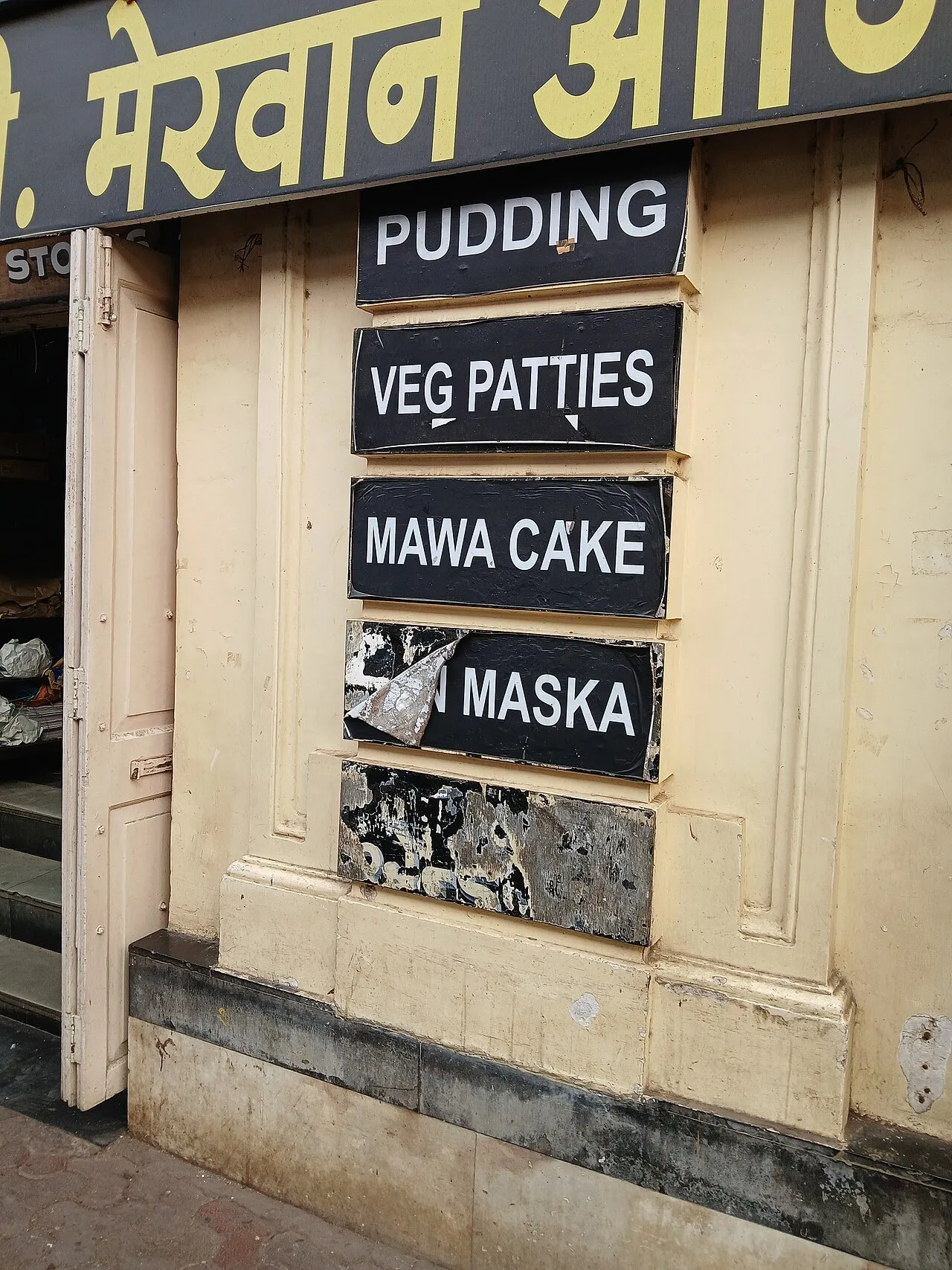
Back in Mumbai, Niloufer Mavalvala's cookbook headnote recalls the cake making headlines when a century-old family bakery shut, and warns that the city's Irani tea shops are in danger of dying out. For the wider story of those places, see our guide to the Irani cafes of Mumbai, and for why the cake earned its nickname, our post on the Bombay cupcake.
How do you make Parsi mawa cake at home?
This method follows Chef Anahita Dhondy's mawa cake recipe, the first recipe in her book Parsi Kitchen, as published by Outlook Traveller Eats on 18 July 2025. It makes about 10 servings. Allow 20 minutes to prepare and up to 50 minutes in the oven. We have kept her quantities and put the steps in our own words.

Ingredients
- 1½ cups flour
- 1 cup butter
- 2 cups icing sugar
- ½ cup milk
- 5 eggs
- ½ tsp vanilla essence
- 250 g fresh mawa
- 1 tsp baking powder
Method
- Heat the oven to 180°C.
- Beat the butter with the sugar until creamy, then beat in the eggs, one at a time.
- Mix in the vanilla essence.
- In a separate bowl, sift the flour with the baking powder (the published method also names the icing sugar here).
- Fold the dry mix into the butter and egg mixture a little at a time.
- Add the mawa and the milk and mix until even.
- Spoon into cupcake cases and bake for 15 to 20 minutes. In one large tin, it needs 45 to 50 minutes.
Notes before you bake
The published method creams the butter with "sugar" and then names icing sugar again in the dry mix, but the ingredient list gives a single 2-cup quantity of icing sugar. Our reading is that the 2 cups go in once, at the creaming stage, not twice. Dhondy's ingredient list also has no cardamom, even though the cake is known for it. Natalia Karanjia's two-pound cake in Dawn uses half a teaspoon of cardamom powder, and she told the paper the khoya keeps the cardamom gentle. Her version also uses more mawa (300 to 350 g) and bakes at 180°C for about 40 minutes. Whichever you follow, test with a skewer: it should come out clean.
Frequently asked questions
What is Parsi mawa cake made of?
It's a butter cake made with flour, butter, sugar, eggs, milk and mawa, the caramelised solids left when full-fat milk is simmered for hours. Mint and Dawn mention cardamom, but Dhondy's list has none. Chef Anahita Dhondy's recipe uses 250 g of fresh mawa with five eggs and a cup of butter, which gives the dense, moist crumb.
Who invented mawa cake?
Nobody knows for certain. B. Merwan in Mumbai and Royal Bakery in Pune both claim it, and both date their start to 1914. Chef Cyrus Todiwala credits B. Merwan, Royal Bakery's owner credits his grandfather, and Kurush Dalal links it to the Zoroastrian tea cake kumas. Dan Sheffield found no mawa cake in the old cookbook Vividh Vani.
Is there an eggless Parsi mawa cake?
Dawn notes that some mawa cake recipes skip eggs, but both recipes we checked, Anahita Dhondy's and Natalia Karanjia's, use them, with five and four eggs. We haven't found a tested eggless version from a named Parsi cook, so we don't give substitute quantities here. If you try one, treat it as your own experiment rather than the traditional cake.
Can I make mawa at home for the cake?
Yes. FEZANA's cookbook says to cook full-fat milk slowly in an iron karahi, for several hours, until only thick, caramelised solids remain. The same book offers a faster microwave route using 250 g ricotta, ghee, milk powder and cream. Aban Kekobad made hers by cooking down two cans of evaporated milk and one of condensed milk.
Why is mawa cake called the Bombay cupcake?
Mint used the name for the small, wax-paper-wrapped mawa cakes sold in Bombay's Irani cafés and bakeries since those places opened. The cafés sold them with cup after cup of cheap tea to the city's workers. Mint reported that by the early 1920s mawa cake had become an affordable everyday treat in Bombay.


