 PalV's Kasti

On this page
The "Bombay cupcake" is the mawa cake: a small, buttery cake flavoured with cardamom and made rich with mawa, milk cooked down to soft solids. It's baked in paper or foil cups and sold with chai at the Irani cafes and bakeries of Mumbai and Pune. The nickname itself has a thin paper trail. The only published use we could find is a 2014 headline in Mint. Where the cake came from is also undocumented. Three people quoted in the one detailed account give three different answers, and a researcher who checked a 1903 Parsi cookbook with 57 cake recipes found no mawa cake in it. Below, we set out what the record shows and where it runs out.
શહેરેવર રોજ
Shehrevar Roj, Tir Mah · 1396 Y.Z.
Is "Bombay cupcake" a real name for the mawa cake?
Only just. On 18 January 2014, Mint ran a feature by Pooja Vir under the headline "Urban Legend | How the Bombay cupcake survived". The article itself never uses the phrase again. Its text calls the cakes mawa cakes and describes them as soft, cardamom-scented cupcakes wrapped in wax paper. The piece was pegged to B. Merwan & Co., the Grant Road cafe that had just announced it would close.
That is the whole documented trail. We found no cookbook, cafe menu, bakery website or second newspaper that uses "Bombay cupcake" as a name. The chefs, bakers and food writers we read all say mawa cake (also spelt mava cake). A 2025 Dawn feature from Karachi adds a third name, khoya cake; khoya is another word for mawa. So "Bombay cupcake" reads as a headline writer's phrase, not a name anyone uses at the counter. Ask for a mawa cake.
What is a mawa cake, and what is mawa?
Mawa is milk cooked down until it turns into solids. FEZANA's 2012 cookbook Eat, Live, Pray describes it as full-fat milk simmered in an iron karahi for several hours until the water evaporates, leaving thick, caramelised milk solids. Writing for Taste in 2018, the food writer Nik Sharma described khoya the same way, as a solid made by slowly evaporating milk in large pans.

The cake is a butter cake with that mawa folded into the batter. Chef Anahita Dhondy, who wrote the book Parsi Kitchen: A Memoir of Food and Family, published her recipe with Outlook Traveller Eats in July 2025. It uses flour, butter, icing sugar, eggs, milk, a little vanilla, baking powder and 250 g of fresh mawa. Baked in cups, her version needs 15 to 20 minutes. In a large mould it takes 45 to 50.
The cafe version is small and individual. Nik Sharma wrote that Bombay's Irani cafes of the 1950s served mawa cakes baked in little tinfoil containers. Writing in the Free Press Journal in January 2026, S Balakrishnan described peeling the paper from the bottom and sides of B. Merwan's golden-brown cakes before biting in. For a full home method, see our guide to Parsi mawa cake.
Where did the mawa cake come from?
Nobody has documented it. Mint's 2014 article says the cake's origins are as uncertain as the identity of India's first Irani cafe. It also notes that nearly every Irani bakery in the country claims the invention.
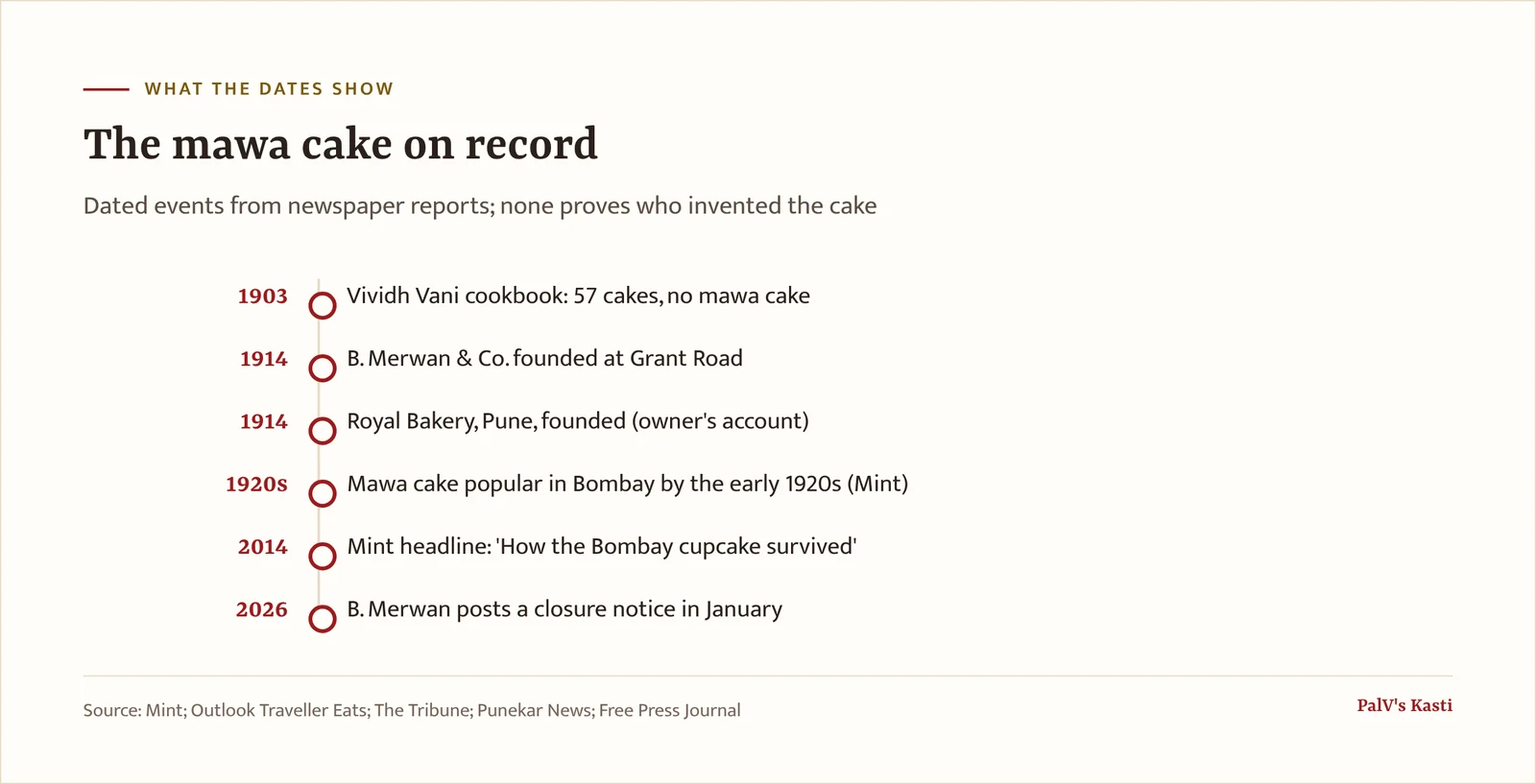

The one piece of research in the record is negative. Dan Sheffield, then a lecturer in Near Eastern Studies at Princeton, told Mint he had searched three older texts. They were the 17th-century Gujarati Zartoshtnamu, the Persian Khulāsat al-Maʼkūlāt va'l-Mashrubat, and the 1903 Parsi cookbook Vividh Vani. That book runs to about 1,500 pages and carries 57 cake recipes, from coffee cake to Cake Napoleon. None is a mawa cake. This shows the cake hadn't reached that Bombay cookbook by 1903. It doesn't tell us when or where the cake did appear.
The three origin stories
- B. Merwan, Mumbai. Chef Cyrus Todiwala told Mint the cake was B. Merwan's idea. His explanation: in the early 1900s, with no pasteurisation or refrigeration, milk was boiled again and again to keep it from spoiling, which left a lot of mawa by evening, and the owner tried adding it to a cake.
- Kumas, the Zoroastrian tea cake. Kurush Dalal of Katy's Kitchen told Mint he thinks Irani bakers adapted their traditional kumas using local khoya and cardamom.
- Royal Bakery, Pune. Sheriar Irani told Mint that his grandfather developed the cake at Royal Bakery by experimenting with a sponge cake, and that British soldiers from the cantonment came to buy it. He said the bakery sold almost 70 kg of mawa cake a day in 2014 and kept the recipe secret.
Outlook Traveller Eats, writing in 2025, also names B. Merwan and Royal Bakery as the two bakeries that claim to have created the cake. The founding dates don't settle it. Outlook Traveller Eats and The Tribune both give 1914 as B. Merwan's founding year, and Outlook names the founder as Boman Merwan Nazarabadi, a migrant from Iran. Royal Bakery's owner told Punekar News in 2026 that his grandfather also started that bakery in 1914. Mint also states, without naming its source, that the cake had become a popular, affordable treat in Bombay by the early 1920s.
Our view: all three accounts are attributed opinions or family memory. None comes with a dated document. We aren't going to pick one, and any page that names a single inventor as settled fact is going further than the evidence does.
Why is the mawa cake tied to the Irani cafes?
Because that is where Bombay bought it. Mint describes the early Irani cafes feeding the city's migrant male workers, who lived without family kitchens and needed cheap meals. Each day, cafes such as Kyani & Co., Ideal and B. Merwan poured hundreds of cups of tea for these men and sold mawa cakes and khari biscuits alongside. Nik Sharma put the number of Irani cafes in 1950s Bombay at some 350, and at fewer than 100 when he wrote in 2018. For the wider story of the cafes themselves, read our piece on the Irani cafes of Mumbai.

Is the mawa cake Parsi or Irani?
Both communities treat it as their own, and the sources back each side for different reasons. The commercial history runs through Irani bakeries: B. Merwan, Royal Bakery and the cafes named in Mint were all Irani businesses. Parsi cooks claim it too. Anahita Dhondy calls it the quintessential Parsi tea cake, eaten with batasa biscuits or patrel. In Karachi, Shazia Hasan of Dawn described it in 2025 as a teatime guilty pleasure of Pakistan's Zoroastrian community. She wrote that it is not sold in Pakistani bakeries, and she first tasted it at the stall of a Karachi baker, Natalia Karanjia.
What happened to B. Merwan, and where can you still buy mawa cakes?
B. Merwan has had two closures. Mint reported in January 2014 that it would shut on 31 March that year. It didn't stay shut: the Free Press Journal and Outlook Traveller Eats both say it closed briefly in 2014 for repairs and reopened. In January 2026 a handwritten notice appeared on the shutter: "We are closed. We thank you for your patronage." Outlook Traveller Eats reported that the notice had been up since 1 January 2026. An unnamed family member told the Free Press Journal there had been disputes, while Outlook said the reason had not been confirmed. In its busy years, Balakrishnan wrote, the day's mawa cakes were gone by 11 a.m.
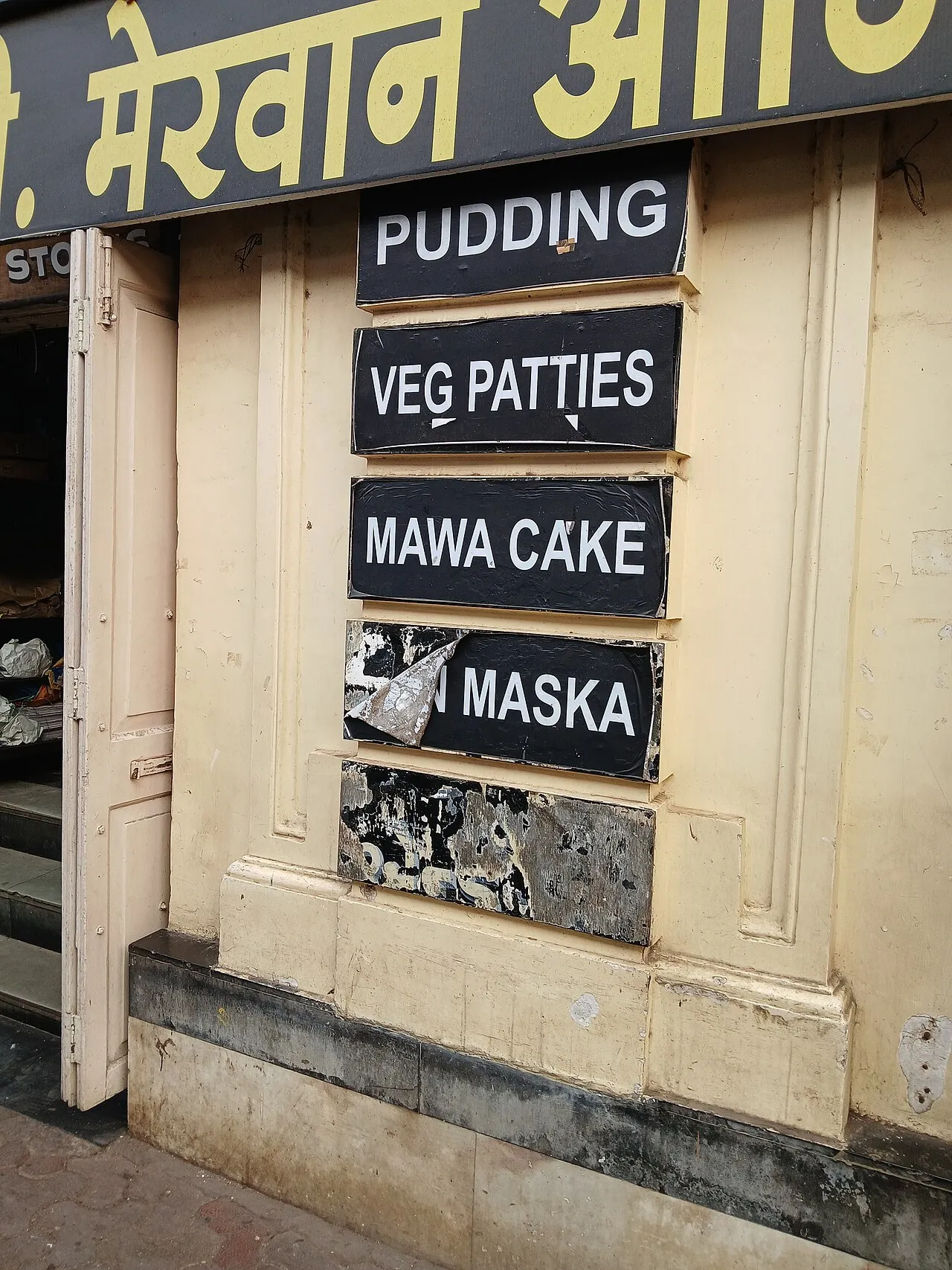
Other bakeries named for mawa cake in recent reports:
- Royal Bakery, Camp, Pune: run by the third generation of the family, according to a Punekar News report from March 2026, which links it with the mawa cake.
- Kayani Bakery, East Street, Pune: placed on Taste Atlas's list of the world's 150 most legendary dessert places, as Parsi Times and the Free Press Journal reported in September 2023. The Free Press Journal said its 18th-place spot was for its mawa cake.
- Yazdani Bakery, Fort, Mumbai: The Tribune listed mawa cake among its specialities in 2015. The Free Press Journal reported in 2026 that Yazdani had closed its dine-in section and kept take-away open.
- Sassanian, Dhobi Talao, Mumbai: named by TRT World for its plum and mawa cakes.
Dawn's 2025 feature adds that many places in Mumbai now offer several varieties, and names kaju and chocolate mawa cakes among them. Opening hours and stock change often, so check before you travel.
Frequently asked questions
What is a Bombay cupcake?
A Bombay cupcake is the mawa cake of Mumbai's Irani cafes: a small butter cake made with mawa (reduced milk solids) and cardamom, baked in a paper or foil cup. The nickname comes from a 2014 Mint headline. Bakeries, menus and cookbooks call it mawa cake, so use that name when buying one.
Who invented the mawa cake?
No one knows for certain. Chef Cyrus Todiwala credits B. Merwan in Mumbai, and Royal Bakery's owner credits his grandfather in Pune. Kurush Dalal of Katy's Kitchen links it to the Zoroastrian tea cake kumas. A 1903 Parsi cookbook with 57 cake recipes has no mawa cake, and no dated record names an inventor.
What is mawa?
Mawa, also called khoya, is full-fat milk simmered slowly for hours until most of its water evaporates. What's left is a thick, slightly caramelised mass of milk solids. FEZANA's cookbook describes cooking it in an iron karahi. Chef Anahita Dhondy's published mawa cake recipe folds 250 g of fresh mawa into a butter cake batter.
Where can you buy mawa cakes in Mumbai and Pune?
B. Merwan, the Grant Road cafe most linked with the cake, put up a closure notice in January 2026. Recent reports name Royal Bakery and Kayani Bakery in Pune, and Yazdani Bakery and Sassanian in Mumbai, as places selling mawa cakes. Many newer Mumbai bakeries sell flavoured versions too. Check hours before visiting.
Is mawa cake Parsi or Irani?
It belongs to both. Irani bakeries such as B. Merwan and Pune's Royal Bakery made and sold it, and both claim to have created it. Chef Anahita Dhondy calls it the quintessential Parsi tea cake. In Karachi, Dawn described it in 2025 as a teatime treat of the Zoroastrian community and reported that no bakery there sells it.


