PalV's Kasti
On this page
- What happens right after the Ashirwad?
- Why was the Parsi wedding repeated at midnight?
- What is chheda chhedi?
- Why is the groom's shoe hidden at a Parsi wedding?
- What is dahi kumro?
- How is the bride welcomed into her new home?
- What happens at the Parsi wedding feast?
- What happens on the eighth day after a Parsi wedding?
- Frequently asked questions
Parsi post-wedding ceremonies are the small customs that follow the Ashirwad, the blessings and admonitions two priests recite at the heart of the marriage ceremony. Accounts from 1884 to 2019 list a visit to a fire temple, a second recital of the blessing at midnight, the tying of the couple's garments together (chheda chhedi), the washing of the groom's feet with its hidden-shoe prank, the shared plate of curd called dahi kumro, games of luck, songs as the bride enters her new home, a feast with toasts, and Varovar on the eighth day. J.J. Modi set them apart from the solemn part of the marriage, writing in 1922 that it was the women of the family who kept them, and more in the spirit of fun than solemnity.
The ceremony itself, from the Ara Antar to the Ashirwad, belongs to our guide on Parsi wedding day ceremonies. This page picks up the moment the priests finish.
અસપંદામેદ રોજ
Asfandarmad Roj, Tir Mah · 1396 Y.Z.
What happens right after the Ashirwad?
Ervad Dr Ramiyar Karanjia, writing in his Jame Jamshed column in 2019, describes the order today. The two families first give shawls, garlands and cash to the officiating priests. The newly married couple then go to a nearby fire temple, and the guests greet them when they come back to the hall.
A Parsi Times feature from November 2016 adds a longer journey. It says couples, often with their families, traditionally go to Udwada after the wedding to pay respects to the Iranshah.
Practice varies between families and Agiaries; your family priest's guidance comes first.
Why was the Parsi wedding repeated at midnight?
For a long time, one recital was not enough. Three older sources agree that the blessing was said a second time late at night. Dosabhai Framji Karaka, in his 1884 History of the Parsis, says the priests repeated the nuptial benediction after midnight in front of a small circle of close friends and relatives. The Bombay Gazetteer of 1899 says the groom went home after the evening ceremony, returned to the bride's house around midnight, and the whole ceremony was performed again.
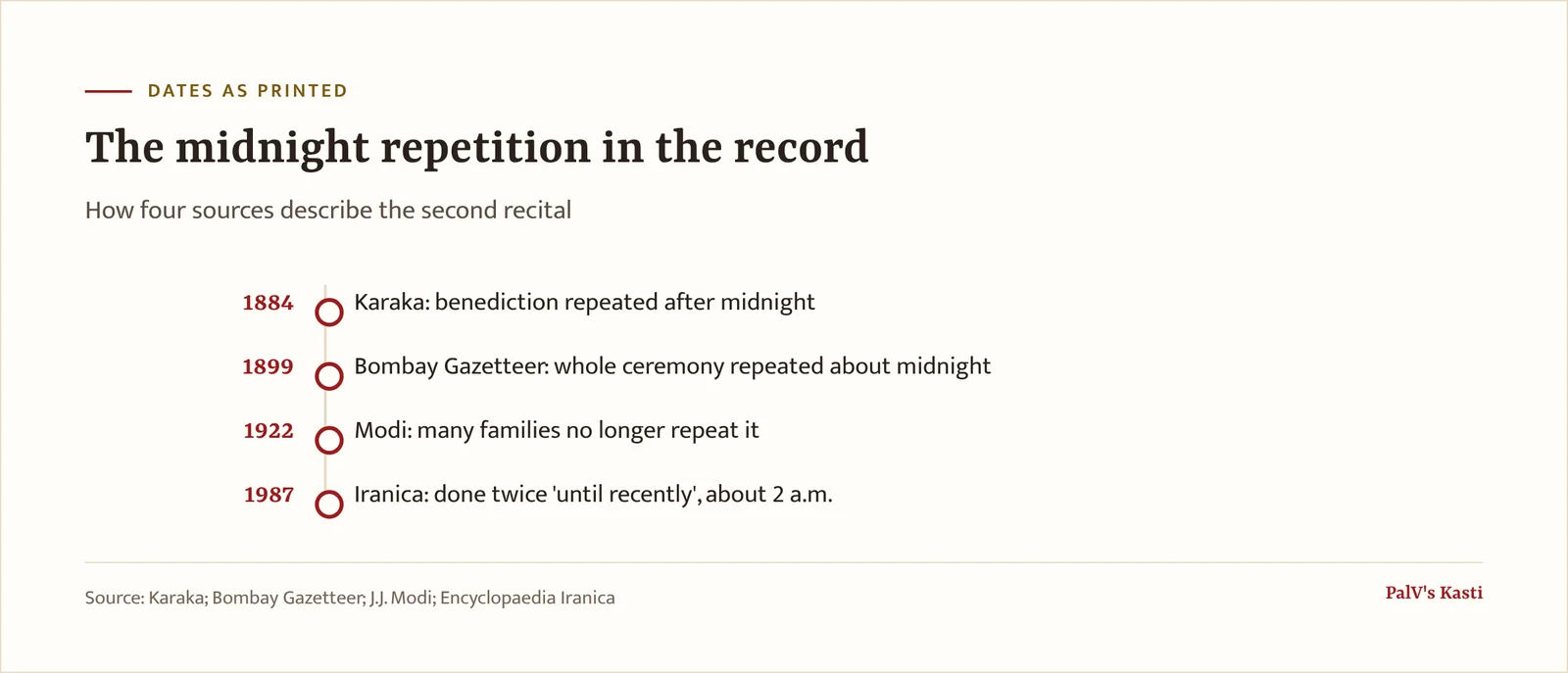
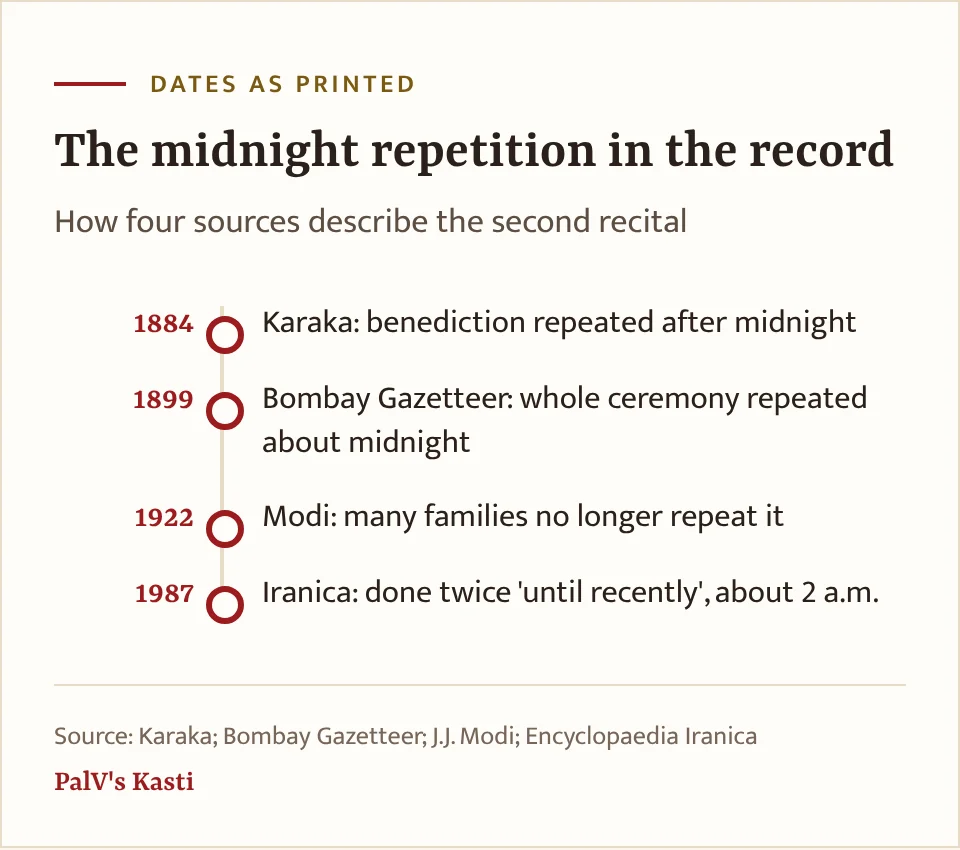
Modi records the same repetition and passes on the French scholar Anquetil du Perron's explanation, that it continued an old custom from Kerman in Persia, where weddings were held at midnight. But Modi also noted, back in 1922, that many families no longer repeated the ceremony at midnight. The Encyclopaedia Iranica entry on the Ashirwad (1987) puts the second recital early in the Ushahin Geh, at about 2 a.m., and calls it a practice that had lasted "until recently". Sunset, it says, is still the usual time for the main ceremony.
Practice varies between families and Agiaries; your family priest's guidance comes first.
What is chheda chhedi?
Chheda chhedi means tying the ends of the couple's clothes together. In Modi's description, the closest friend or relative knots the skirt of the groom's jama to the bride's sari, the women sing, and the bride walks to the groom's house tied to him in this way. Modi reads it as a picture of the two being joined. The 1899 Gazetteer has the same knot, tied after the midnight repetition, with the whole party then going back to the groom's home.
Why is the groom's shoe hidden at a Parsi wedding?
It began with washing the groom's feet. Modi says that around forty years before he wrote, when Parsis wore Indian shoes without socks, the feet really were washed. By 1922, with English shoes and stockings, only the front tip of the shoe got a splash of water, and sometimes a lady hid the removed shoe until she was paid a rupee. In the Gazetteer's 1899 version it's the bride's sister, using milk rather than water, who makes off with one shoe and holds it for a rupee.
Karanjia's 2019 account keeps both parts. One of the bride's sisters washes the groom's feet and he gives her a token sum. Sometimes the youngest sister hides his shoe and asks for a small ransom. He explains the meaning this way: the sisters accept the groom as an elder of the family, and the youngest, through her prank, casts herself as a child he must now look after. Modi offers different readings for the feet-washing, either washing away past faults or simply a gesture of welcome, and leans towards welcome.
What is dahi kumro?
Dahi kumro (Modi spells it Dahi-Koomro) is a meal the newly married couple share. They eat from one dish and feed each other mouthfuls that include dahi, or curd, which Modi calls an auspicious food for happy occasions. For him, sharing one plate shows that the two will now share a household, its joys and its troubles. The Gazetteer of 1899 describes the dish as rice, curds and sugar.
The ring hunt and Eki Beki
Both old sources add a game of chance. The Gazetteer says the couple took turns hiding a ring in the dish and searching for it, to see who was quicker and luckier. Modi describes Eki Beki, an odds-or-evens guess played with coins held in the hand, and already called it almost obsolete in 1922.
How is the bride welcomed into her new home?
With songs. Modi notes one nuptial song for when the bride is taken to her husband's house and another for the moment she steps inside it. The 2016 Parsi Times feature describes the welcome as it is often done now: at the end of the reception the bride's family escort the groom's family home, and there the groom's mother performs Achoo Michoo to bring the newly married couple in.
Practice varies between families and Agiaries; your family priest's guidance comes first.
What happens at the Parsi wedding feast?
Toasts were the formal part of the meal. Modi lists six that were usually proposed in his day:
- Yazdan ni yad, in remembrance of God
- The married couple
- The fire temples, that their sacred fires may burn for ever
- The guests
- The host, proposed by one of the guests
- The King
Some hosts added Asho Farohar ni yad, the remembrance of the pious departed. The Gazetteer's list of 1899 is close: "Glory to God" first, then the bride and bridegroom, the fire temple, the host and the guests. Karaka in 1884 also mentions several toasts, including one to the couple and one to the Queen-Empress.
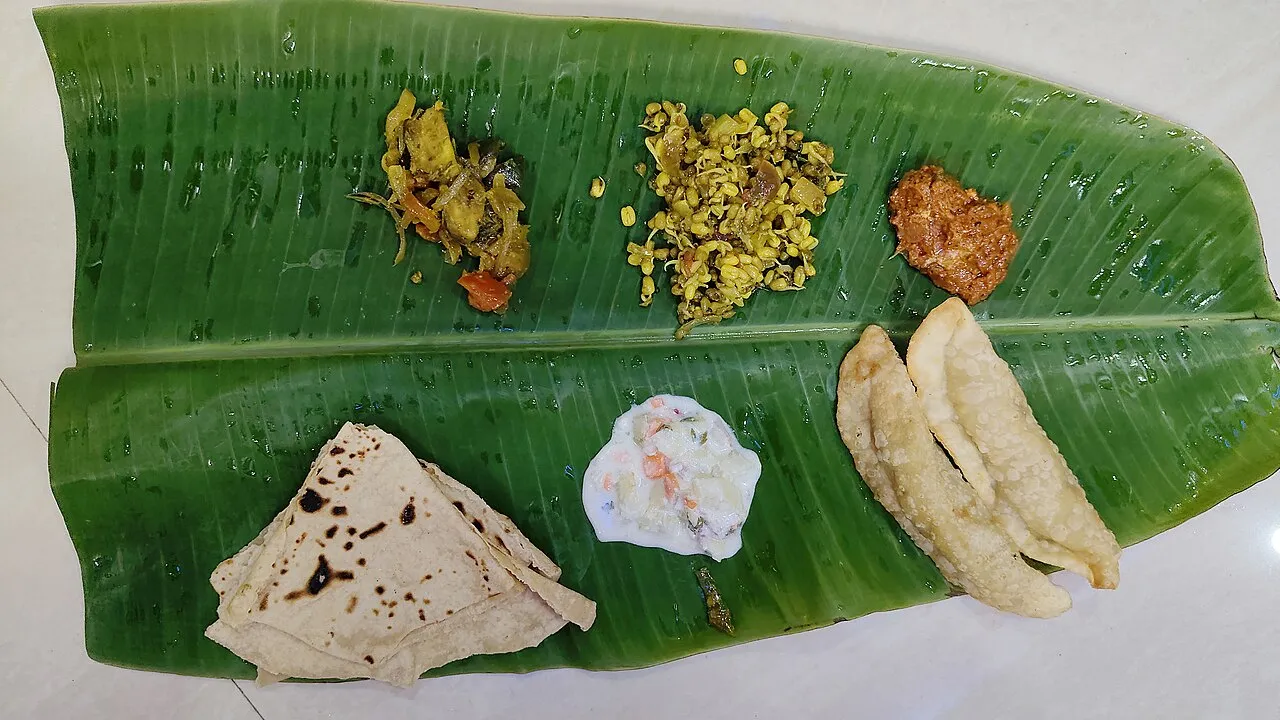
On the food, Modi says fish was essential as a sign of good luck, a sweet course was expected, and meat was generally not served. Karaka, too, lists fish, vegetables, sweetmeats and fruit. The two explain the absence of meat differently. Karaka gives one reason, to avoid offending Hindu guests. Modi gives that reason as Anquetil's, from the Surat years, and adds a second: a community meeting in Bombay on 18 October 1823, called to curb marriage and funeral costs, treated meat courses as an expense to cut. For the dishes on today's banana leaf, see our page on Lagan nu bhonu.
Keeping a record of gifts
Both Modi and the Gazetteer describe wedding gifts being written down. The Gazetteer says they went to the parents of the bride and groom. Modi says a friend or relative sat as collector and kept a book of names and amounts. The point was practical: when a wedding came up in the giver's family, the gift could be returned in kind.
What happens on the eighth day after a Parsi wedding?
The eighth day is Varovar: the 1899 Gazetteer records the new wife spending the day at her parents' home and returning in the evening, while food from both households is offered at the sea or a river, and our page on Varovar sets out the sources in full.

The eighth day also closes the life of the madav saro plant set up before the wedding. Noshir Dadrawala, writing in Parsi Times in January 2023, says it's watered each morning until the eighth day after the wedding and then planted out in a courtyard, garden or farm. The planting itself belongs among the Parsi pre-wedding ceremonies.
The Gazetteer records one more date: on the first Behram roj (the 20th day of the month) after the wedding, friends and relatives were invited to a feast.
Practice varies between families and Agiaries; your family priest's guidance comes first.
Frequently asked questions
What happens after a Parsi wedding?
After the Ashirwad, families thank the priests with shawls, garlands and cash, and the couple visit a nearby fire temple, according to Ervad Ramiyar Karanjia. Older customs include tying the couple's clothes together, washing the groom's feet, the curd dish dahi kumro, songs at the bride's new home, a feast with toasts, and Varovar on the eighth day.
Why do the bride's sisters hide the groom's shoe?
The prank grew out of washing the groom's feet. J.J. Modi (1922) and the Bombay Gazetteer (1899) both record a shoe being held back until the groom paid a rupee. Ervad Ramiyar Karanjia explains it as the sisters accepting the groom as an elder, with the youngest playing the child he must now care for.
What is dahi kumro at a Parsi wedding?
Dahi kumro is a meal the newly married couple share from one dish, with each feeding the other mouthfuls containing curd. J.J. Modi says curd counted as an auspicious food and the shared plate stood for a shared life. The Bombay Gazetteer of 1899 describes the dish as rice, curds and sugar.
Why was the Parsi wedding repeated at midnight?
Karaka (1884), the Bombay Gazetteer (1899) and J.J. Modi (1922) all record the blessing being recited a second time around midnight. Modi passes on Anquetil du Perron's view that it continued a midnight wedding custom from Kerman in Persia. Modi noted in 1922 that many families had stopped, and Encyclopaedia Iranica (1987) treats it as a recent past practice.
Is meat served at a Parsi wedding feast?
Historically, generally not. J.J. Modi (1922) wrote that meat was generally not eaten at marriage feasts while fish was essential, and Karaka (1884) agrees. Karaka links this to respect for Hindu guests. Modi gives that reason and a second one, cost, citing an 1823 community meeting in Bombay on wedding expenses.