 PalV's Kasti
On this page
Pachori and Dasori are two family days kept after a Parsi baby is born. Pachori is the fifth day after the birth and Dasori is the tenth. Jivanji Jamshedji Modi wrote in The Religious Ceremonies and Customs of the Parsees (1922) that some families, following the Hindu custom, kept these two days as gala days, and that they have no religious signification. The Gazetteer of the Bombay Presidency (1899) describes Pachori as a fifth-day meal and ceremony at the new mother's parents' house, and Dasori as the same ceremony held on the tenth day when it could not be done on the fifth. Neither source describes a prayer or any part for a priest on these days.
For the full sequence from pregnancy onwards, see our guide to Parsi pregnancy and birth ceremonies.
અસપંદામેદ રોજ
Asfandarmad Roj, Tir Mah · 1396 Y.Z.
What do the names Pachori and Dasori mean?
The names simply count days. Modi spells them pachory and dasori and glosses them as "the fifth day" and "the tenth day". The Gazetteer spells them pachori and dasori, the forms we use here.
What happened on Pachori, the fifth day after a birth?
The most detailed account is the 1899 Gazetteer, written about Parsis in Gujarat. In its description, the young wife goes to her father's house as the birth draws near (Modi says the same of a first delivery), and on the morning of the fifth day that household cooks a festive meal. The Gazetteer lists:
- five kinds of vegetables (bhajis), cooked with or without eggs or sheep's brain
- fowls
- small round chapatis or cakes
- sweet dishes made with dry ginger and wheat
The food was set beside the mother's bed in the very dishes it had been cooked in. Five cakes went at the foot of each bedpost and five more on the bed, and a little of the meal was served on the mother's own plate. Betel, dry dates, rice and red powder were placed in her hands. She then marked her forehead with the red powder, and the legs of her cot and of the baby's iron cradle too. To close the day, the Gazetteer says, a woman of the family put frankincense on a fire-urn and announced that the Pachori was over.
The meal did not stay in one house. The Gazetteer records that large quantities of every dish were sent, in separate plates, to the husband's family. Dosabhai Framji Karaka's History of the Parsis (1884) describes the same exchange in fewer words: if all was well, the fifth day was one of rejoicing, and the girl's parents sent a large bhona, a meal of choice dishes, to her husband's family. The Gazetteer adds that in some families, especially in villages, the mother was given a full bath on the fifth day.
What is Dasori, and is it a separate day?
Our two main sources read Dasori differently. Modi treats the fifth and the tenth days as two separate gala days that some families keep. The Gazetteer treats Dasori as a fallback: if the fifth-day ceremony could not be held for any reason, it was done on the tenth day instead, and then it was called Dasori. We have not found a source that settles the difference.
The Gazetteer also notes one exchange that belonged to the tenth day regardless: a tray of sugar-cakes sent from the husband's house to the new mother.
What gifts went between the two families in the first ten days?
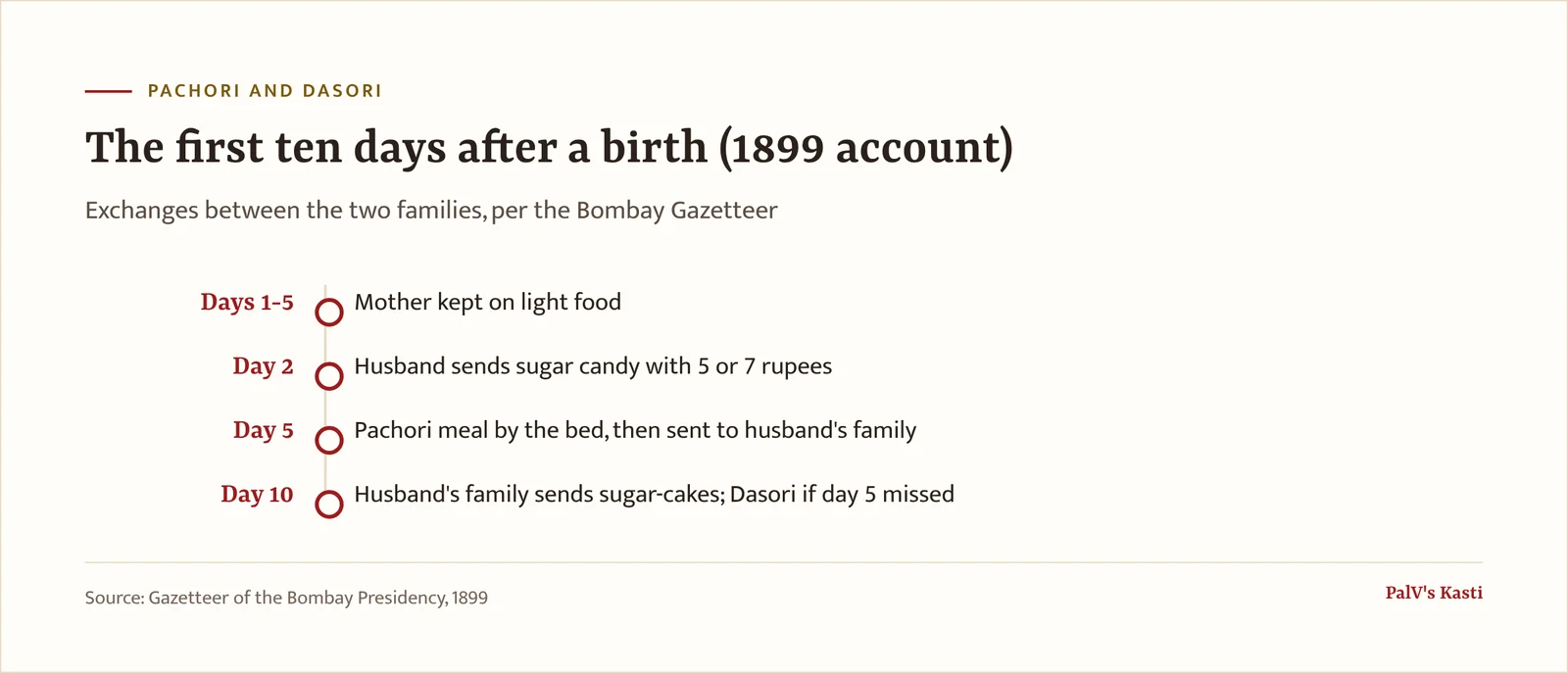
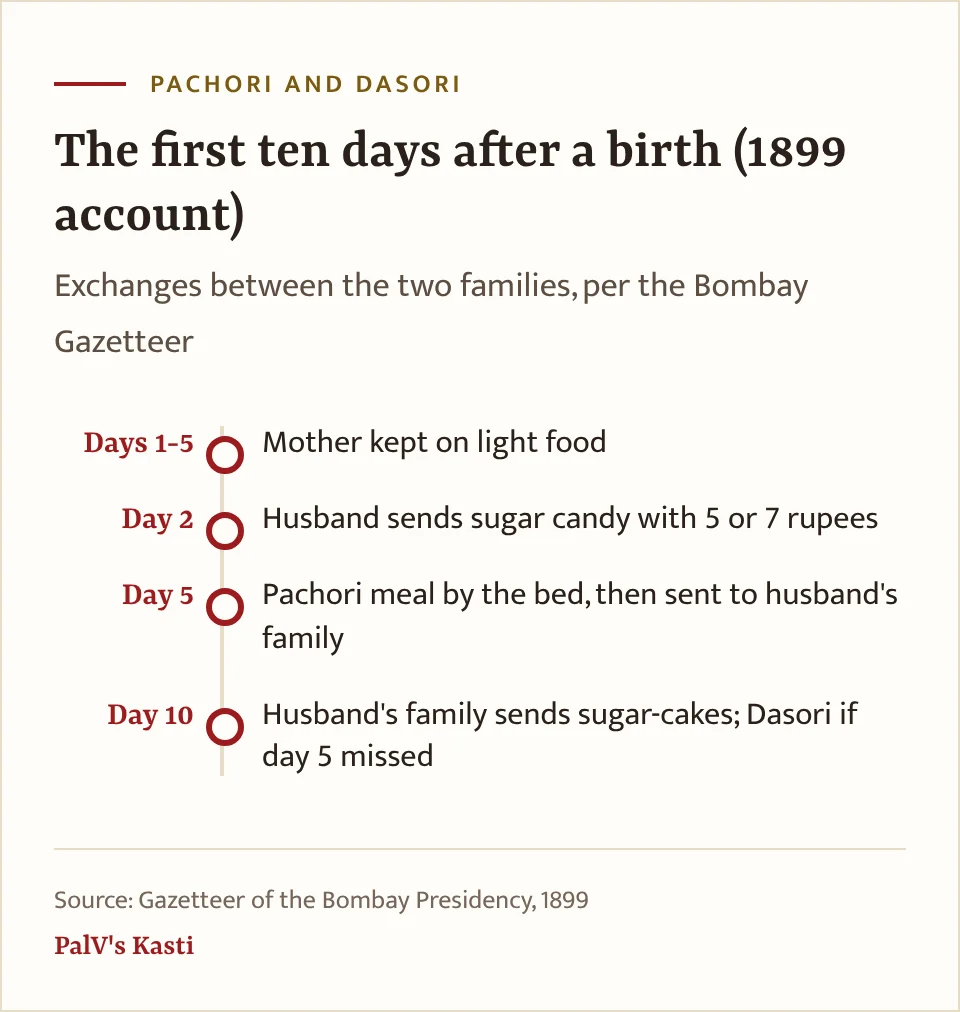
Pachori sat inside a run of small exchanges between the two families. According to the 1899 Gazetteer, on the second day after the birth the husband sent the mother a tray of sugar candy with five or seven rupees laid in it. On the fifth day the mother's family sent the Pachori meal to the husband's family, and on the tenth the husband's family sent sugar-cakes back. For the first five days, the same account says, the mother was kept on light food.
Customs for the new mother herself are covered in our post on the Suva postnatal custom. Gifts before the birth, in the seventh month of a first pregnancy, belong to the Agharni ceremony.
Are Pachori and Dasori religious ceremonies?
Not according to Modi. He writes that the fifth and tenth days are kept by some families "following the Hindu custom", and that they "have no religious signification". Writing about the fifth- and seventh-month pregnancy days in the same chapter, he adds that some of the customs kept on those occasions are more Indian in origin than Persian or Zoroastrian. Neither Modi nor the Gazetteer names a prayer for Pachori or Dasori, and we have not found one in any published source.
Do families still keep these days? We could not find a recent published account, so we can't say how widely. If your family keeps Pachori, ask the older relatives how your household has always marked it.
Practice varies between families and Agiaries; your family priest's guidance comes first.
Frequently asked questions
What is Pachori?
Pachori is the fifth day after a Parsi baby's birth, kept by some families as a gala day. The 1899 Bombay Gazetteer describes a festive meal cooked at the new mother's parents' house, laid beside her bed, and then sent in large quantities to the husband's family. J.J. Modi (1922) wrote that the day has no religious signification.
What is Dasori?
Dasori is the tenth day after a Parsi birth. J.J. Modi (1922) lists it as a second gala day that some families keep alongside the fifth. The 1899 Bombay Gazetteer instead says the fifth-day ceremony was moved to the tenth when it could not be held on time, and was then called Dasori.
What happens on the fifth day after a Parsi birth?
In the 1899 Gazetteer's account, the mother's family cooked five kinds of vegetables, fowl, small chapatis and dry-ginger and wheat sweets. The food was set by her bed, she marked her forehead, cot and the cradle with red powder, and frankincense was put on a fire-urn to close the day. The dishes then went to the husband's family.
Are Pachori and Dasori religious?
Not according to J.J. Modi, who wrote in 1922 that some Parsi families keep the fifth and tenth days after a birth following the Hindu custom, and that these days have no religious signification. No published source we found names a prayer for either day. For anything about prayers, your family priest's guidance comes first.


