 PalV's Kasti
On this page
- Which ceremonies mark a Parsi pregnancy and birth, in order?
- What ceremonies do Parsis do during pregnancy?
- Does the Avesta prescribe any rite for pregnancy?
- Where did the first delivery take place, and how was the room prepared…
- What is done when a Parsi baby is born?
- What happens in the first ten days after the birth?
- How long is the confinement period for a Parsi mother?
- What gifts pass between the two families?
- Are Parsi pregnancy and birth customs religious?
- Frequently asked questions
Parsi pregnancy and birth ceremonies follow a first child from the fifth month of pregnancy to the mother's fortieth day after delivery. The older accounts list them in order: Pachmasiyu in the fifth month, Agharni in the seventh, a lamp lit at the birth, Pachori on the fifth day, Chhatthi on the sixth night, Dasori on the tenth day, and a forty-day confinement that ends with a purifying bath. Jivanji Jamshedji Modi wrote in 1922 that the pregnancy days are kept without any religious injunction. The parts he ties to scripture or a priest include the lamp after birth, an Afringan over a new place of delivery, the forty-day confinement and the sacred bath that ends it.
અસપંદામેદ રોજ
Asfandarmad Roj, Tir Mah · 1396 Y.Z.
Which ceremonies mark a Parsi pregnancy and birth, in order?
The table below follows the order given in three published accounts: the Gazetteer of the Bombay Presidency (1899), Dosabhai Framji Karaka's History of the Parsis (1884) and Modi's The Religious Ceremonies and Customs of the Parsees (1922). They describe Bombay and Gujarat families of their own time. We have found no recent survey of how many families keep each custom today, so read this as the traditional sequence, not a rulebook.
| When | Custom | What the older accounts describe |
|---|---|---|
| End of the fifth month | Pachmasiyu (Panchmasyu) | Gifts of new clothes to the mother-to-be |
| Seventh month (Karaka: sometimes the ninth) | Agharni | New clothes, lap filled with a coconut and dry fruit, a visit to her parents' house |
| Birth | Lamp and first drink | A lamp kept burning for at least three days; a sweet first drink for the baby |
| Fifth day | Pachori | A meal cooked at the mother's parents' house, some sent to the husband's family |
| Sixth night | Chhatthi | A tray with blank paper, pen and ink kept by the mother's bed |
| Tenth day | Dasori | Kept by some families; the 1899 Gazetteer treats it as the fallback day for Pachori |
| Fortieth day | End of confinement | A bath, then the nahan given by the family priest (Modi) |
Modi says the two pregnancy days are kept only for a first pregnancy, and the Gazetteer describes both under a girl's first pregnancy.
What ceremonies do Parsis do during pregnancy?
Two days are marked, and in Modi's account both belong to the first pregnancy only.
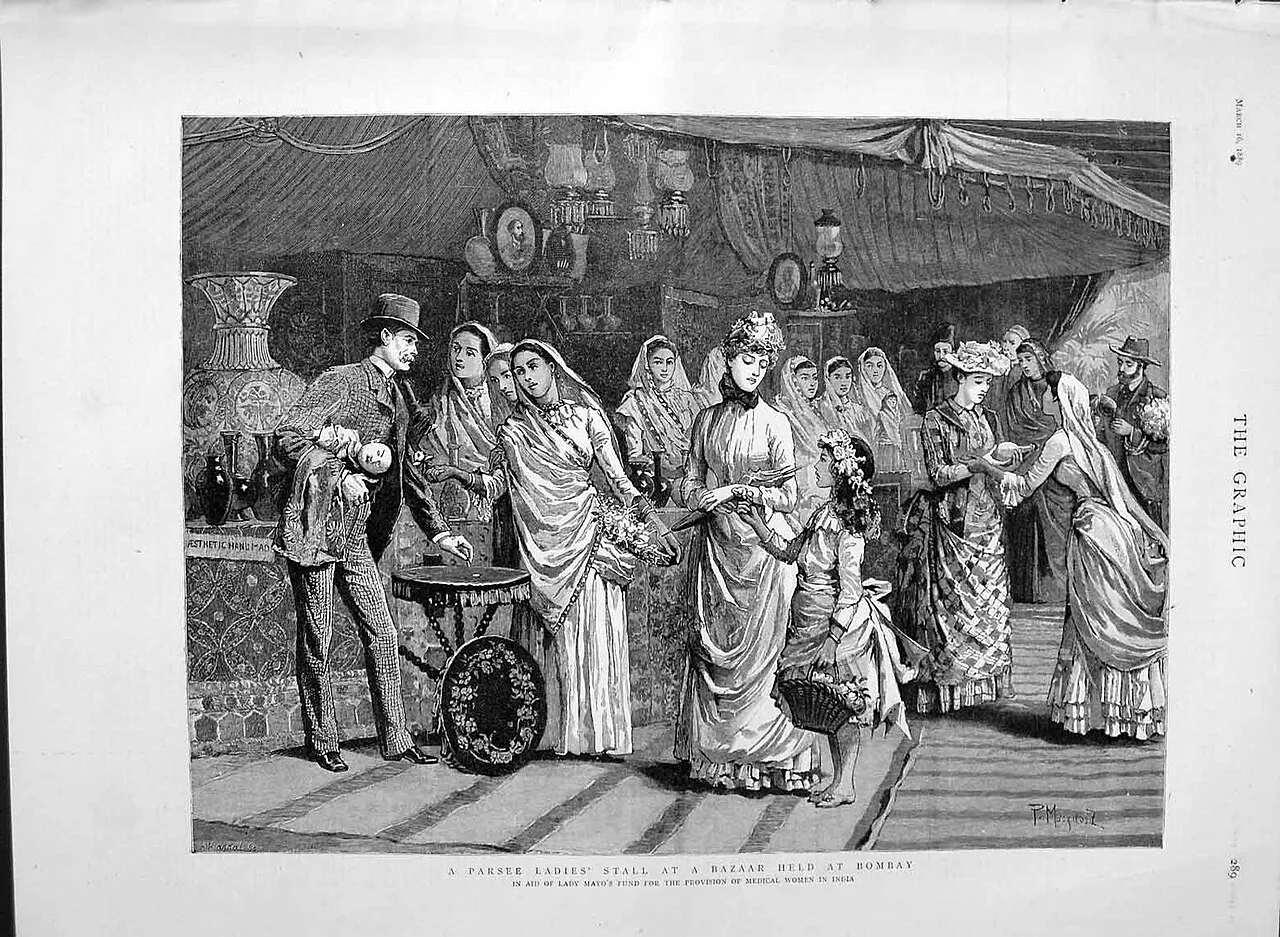
The fifth month: Pachmasiyu
Modi calls it "Panch masiun", the day of the fifth month, and the 1899 Gazetteer, Karaka and Encyclopaedia Iranica all describe gifts of new clothes to the mother-to-be that month. Our post on Pachmasiyu goes through the day in detail.
The seventh month: Agharni
Agharni is the larger of the two. The Gazetteer calls it "a more important pregnancy ceremony". Modi, the Gazetteer and Iranica all place it in the seventh month, while Karaka records that some families held it in the ninth. In the 1899 and 1884 descriptions she is dressed in new clothes from her husband's family, given a coconut and dry fruit to carry in her lap or sari, and taken to her parents' house, where she walks round her lying-in room seven times with a lamp and water. The full order of the day is in our Agharni ceremony post.
The ghee lamp in the fifth and seventh months
Modi records that some Parsis light a lamp of clarified butter at home when the fifth and seventh months are completed. He traces it to the Shayast-ne-Shayast and the Saddar, which direct that a fire be kept carefully in the house once a woman is known to be pregnant. The reason those books give, in Modi's reading, is that the fire keeps evil influences out of the house.
Practice varies between families and Agiaries; your family priest's guidance comes first.
Does the Avesta prescribe any rite for pregnancy?
No. Modi states plainly that the Avesta has no reference to any ceremony during pregnancy. The one allusion he finds is to women praying before Ardvisura for an easy delivery and, afterwards, for plenty of milk for the child. He adds that formal ceremonies may once have gone with those prayers, but that we do not know what they were.
So there is no set prayer for Pachmasiyu or Agharni in his account, which calls them auspicious days of rejoicing. Modi also says some of the customs kept on them are more Indian in origin than Persian or Zoroastrian. Encyclopaedia Iranica (1991) says the Persian Zoroastrian community has no formal prenatal rituals of this kind.
Practice varies between families and Agiaries; your family priest's guidance comes first.
Where did the first delivery take place, and how was the room prepared?
A first child was usually born in the house of the wife's parents. Modi, Karaka and the Gazetteer all say so. A room, often on the ground floor, was set aside for the birth. Modi notes that by 1922 the ground floors of storied town houses were generally the worst part of the house, and that delivery rooms there were by then condemned as unhealthy.
Where no birth had taken place in a house before, Modi writes that religious-minded families had the spot consecrated first. One or two priests performed the Afringan over it, and at times the Baj prayer was recited too.
Practice varies between families and Agiaries; your family priest's guidance comes first.
What is done when a Parsi baby is born?
A lamp for at least three days
A lamp is lit in the room where the mother is confined and kept burning for at least three days. Modi cites the Saddar for this, which calls a newborn especially delicate in those first three days. Some families, he adds, keep it lit for ten days and some for the full forty. Writing in 1991, Encyclopaedia Iranica noted that some Zoroastrians asked for the same lamp even when the baby was born in hospital.
The baby's first drink
Modi writes that in earlier times the mother drank a few drops of haoma juice consecrated at a fire temple, and that the Persian Farziat-nameh says the newborn should be given a few drops too. By his day this was rarely observed, and the baby was given a sweet drink of molasses or sugar instead. The 1899 Gazetteer describes a middle form: water in which a twig of the hom plant had been dipped, sweetened with sugar and dropped into the baby's mouth.
Practice varies between families and Agiaries; your family priest's guidance comes first.
What happens in the first ten days after the birth?
Modi says some families, following the Hindu custom, keep the fifth day (Pachori) and the tenth (Dasori) as gala days with no religious meaning. Our post on Pachori and Dasori sets out how the Gazetteer's account of these days differs.
Between them falls the sixth night. Karaka, the Gazetteer and Iranica all describe a tray placed by the mother's bed with blank paper, a pen and ink, because the child's destiny was believed to be written that night. The Chhatthi ceremony post covers it.
Naming falls somewhere in this stretch, though the sources differ on the day. Iranica says the name is chosen around the sixth day. The Gazetteer has an astrologer, either a Brahmin or a Parsi priest, called on the fifth or another convenient day to suggest lucky names.
How long is the confinement period for a Parsi mother?
Forty days is the figure in Modi, Karaka and the Gazetteer. Iranica gives forty-one nights, citing the Persian Rivayats, and noted in 1991 that a new mother attended no funerals or other formal rituals until forty-one days had passed or the bleeding had stopped.
The old rules were strict. In Modi's 1922 description the mother kept apart from others and from the household furniture, especially wooden furniture and linen, and her food was served to her on her own plate. Karaka, writing in 1884, says she touched nothing but her own bed and the baby's cradle.
The two writers explain the rule differently. Modi traces it to the Vendidad, which sets twelve days of separation after a stillbirth, and says later Pahlavi and Persian books extended this to forty days after every delivery. Karaka says the forty-day seclusion "is not based on any religious injunction". He also wrote that Parsis were "now beginning to see the folly" of strict seclusion. That was in 1884.
The forty days end with a bath. Modi says the mother first takes an ordinary bath and then the nahan, a sacred bath given by a priest, usually the family priest, with consecrated water. The Gazetteer records the bath and purification on the night after the fortieth day. What a new mother eats during these weeks is the subject of our Suva postnatal custom post.
Practice varies between families and Agiaries; your family priest's guidance comes first.
What gifts pass between the two families?
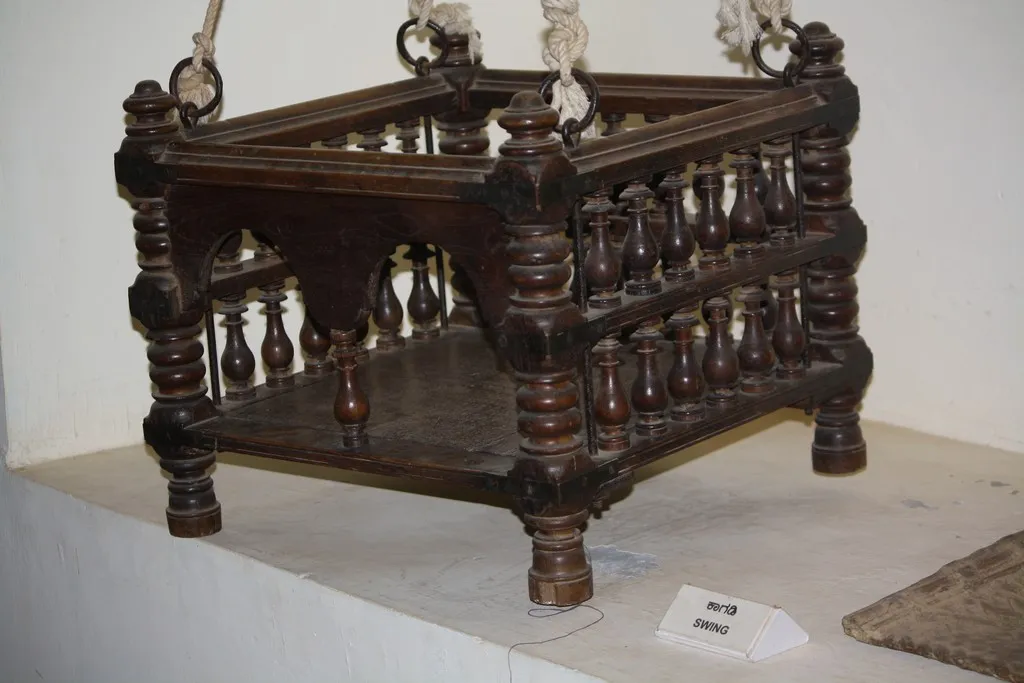
Gifts pass both ways. At the pregnancy days the husband's family dresses the mother-to-be, and at Agharni the wife's family sends a suit of clothes for the husband, as Modi and the Gazetteer both record. After the birth, the 1899 Gazetteer says the husband's family sent presents called vadhkavo within twenty days, mostly money towards the wife's family's costs, clothes for the baby and things for a feast. In the third or fifth month, the mother went back to her husband's house bringing a wooden cradle, bedding, toys and clothes for the child from her father.
Are Parsi pregnancy and birth customs religious?
Mostly not, on the evidence of the people who wrote them down. Modi says the pregnancy days are kept without religious injunction or rites, and that Pachori and Dasori have no religious significance. Karaka says the forty-day seclusion rests on no religious injunction, though Modi does trace it to scripture. The parts with a religious basis in Modi's account include the ghee lamp in pregnancy, the lamp after birth, the Afringan over a new place of delivery, the old haoma drink and the nahan at forty days.
Practice varies between families and Agiaries; your family priest's guidance comes first.
Frequently asked questions
What ceremonies do Parsis do during pregnancy?
Two days are marked, both only for a first pregnancy. Pachmasiyu falls at the end of the fifth month, when the mother-to-be receives new clothes. Agharni falls in the seventh month (Karaka says sometimes the ninth), with new clothes, a lap filled with coconut and dry fruit, and a visit to her parents' house.
What is done after a Parsi baby is born?
A lamp is lit in the mother's room and kept burning for at least three days, and the baby is given a sweet first drink. Some families then mark the fifth day (Pachori), the sixth night (Chhatthi) and the tenth day (Dasori). The mother's forty-day confinement ends with a bath and the nahan.
How long is the confinement period for a Parsi mother?
Traditionally forty days. Modi (1922), Karaka (1884) and the 1899 Gazetteer all give that figure, while Encyclopaedia Iranica gives forty-one nights from the Rivayats. In Modi's account the period ends with an ordinary bath followed by the nahan, a sacred bath given by a priest, usually the family priest, with consecrated water.
Are Parsi pregnancy customs religious?
Mostly not. J.J. Modi wrote in 1922 that the fifth- and seventh-month days follow no religious injunction and involve no religious rites, and that some of the customs are Indian rather than Persian in origin. The Avesta, he notes, describes no pregnancy ceremony at all. Your family priest can advise on any prayers.
Are these ceremonies done for every pregnancy?
The pregnancy days are not. Modi and the 1899 Gazetteer both say Pachmasiyu and Agharni are kept only for a woman's first pregnancy. The customs after birth are not limited in this way: Modi describes the lamp as lit on the birth of a child and the forty-day confinement as applying in all cases of delivery.


