 PalV's Kasti
On this page
Salli (also spelt sali) is potato cut into very thin sticks, deep-fried until crisp and salted. In English it usually goes by potato straws or shoestring potatoes. Parsis pile it over gravied mutton and chicken for crunch and salt, and set eggs on a bed of it. The potato itself reached India's western coast with the Portuguese, in the sixteenth or the early seventeenth century depending on the account, so salli belongs to the Parsis' Indian years and not to Persia. Which cook first scattered it over a curry is unknown. The explanations on offer come from people who know the food well: one says it stops gravy running across the banana leaf at a bhonu, another that it takes the place of birista, the crisp fried onions on a biryani.
શહેરેવર રોજ
Shehrevar Roj, Tir Mah · 1396 Y.Z.
What is salli, and what does the word mean?
Salli is the crisp topping, not a dish of its own. Meher Mirza, writing in SAVEUR in 2021, called it "skin-thin fried potato matchsticks" that bring salt and crunch to sauced chicken and mutton. Rita Jamshed Kapadia, on her ParsiCuisine.com site, says sali is a Gujarati word for "straw" or "sticks", which is why the community also says potato sali. We could not find a second source for that meaning, so take it as hers.
There are two cuts. At Metro Wafers in Mazgaon, which the food writer Roshni Bajaj Sanghvi visited for Mumbai Boss in March 2014, the machines turned out thin sticks and thicker ones, and she noted that Parsis prefer the thin kind. The thicker, older style has a name of its own, jaadi (fat) salli, which we come back to below.
Is salli Persian? How potatoes reached Parsi food
No. The potato comes from the Andes in South America. Accounts differ on when it reached India. A Scroll essay on the potato in Kolkata says the Portuguese brought it to India's western coast in the sixteenth century, and that only in the nineteenth century, after a British colonial push, did it become familiar in places like Bengal. Live History India, citing a paper by B. N. Srivastava for the International Potato Centre, puts the Portuguese introduction in the early seventeenth century instead.

The archaeologist and Parsi caterer Kurush Dalal told Sanghvi that both the potato and vinegar entered Parsi cooking through the Portuguese and owe nothing to Persia. Sanghvi, who had spent a few weeks in Iran, wrote that potatoes barely figured in the meals she ate there. Replying to a reader after the piece ran, she added that fried potato sticks are not absent from Iranian cooking, only far less common there than in Parsi food. The cookbook author Niloufer Mavalvala puts it more broadly, listing British and Portuguese food alongside Persian and Indian cooking as influences on the cuisine. For the wider story of how those strands came together, see our guide to Parsi food.
Why do Parsis put salli on so many dishes?
No source we found records who started it. Sanghvi wrote in 2014 that it was still hard to say which cook first put salli over spicy mince, over chicken with apricots and under eggs. What we do have are three explanations, each from a named person.
- A practical one, from Kurush Dalal: at a bhonu, where the meal is served on a patra (banana leaf), a layer of salli holds the gravy in place so it does not spread across the leaf.
- A culinary one, from the food writer Vikram Doctor, quoted by Sanghvi: salli is quite likely a stand-in for birista, the caramelised, slightly crisp onion slivers used on biryani and Irani polo, and gives the same contrast of textures.
- A matter of taste, from Shehriar Khosravi of Cafe Military, who told Sanghvi that for Parsis taste comes first and that someone, at some point, simply noticed salli tasted good.
None of these rules out the others. The dish people usually mean when they say salli is salli boti, mutton in a sweet, sour and spicy gravy, and our page on it covers the cooking. Salli par eedu, eggs set on a bed of salli, is the other household favourite.
How is salli made?
In a Mumbai wafer shop
Sanghvi's report describes the kitchen behind Metro Wafers on Mathar Pakadi Road. Each morning, workers peeled potatoes and pushed them through cutting machines. The sticks dropped into water, which washed off the surface starch, and were then spun dry in a drum before going into a huge kadhai of oil.
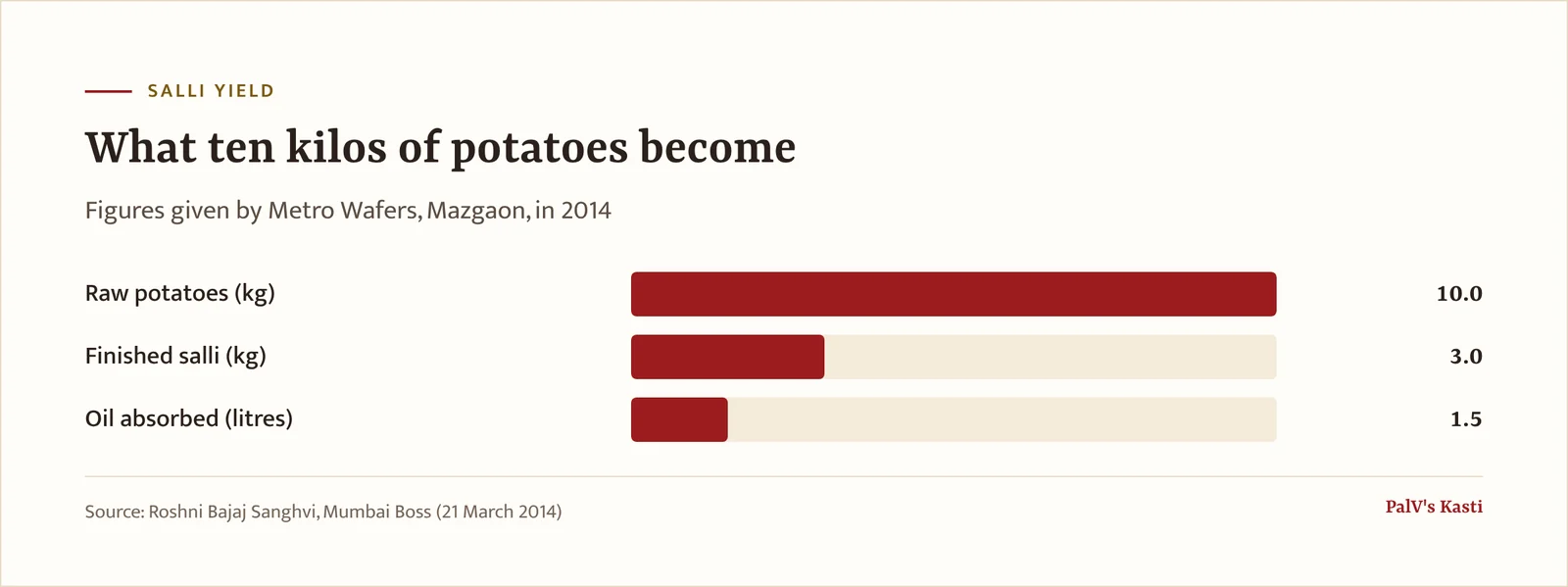
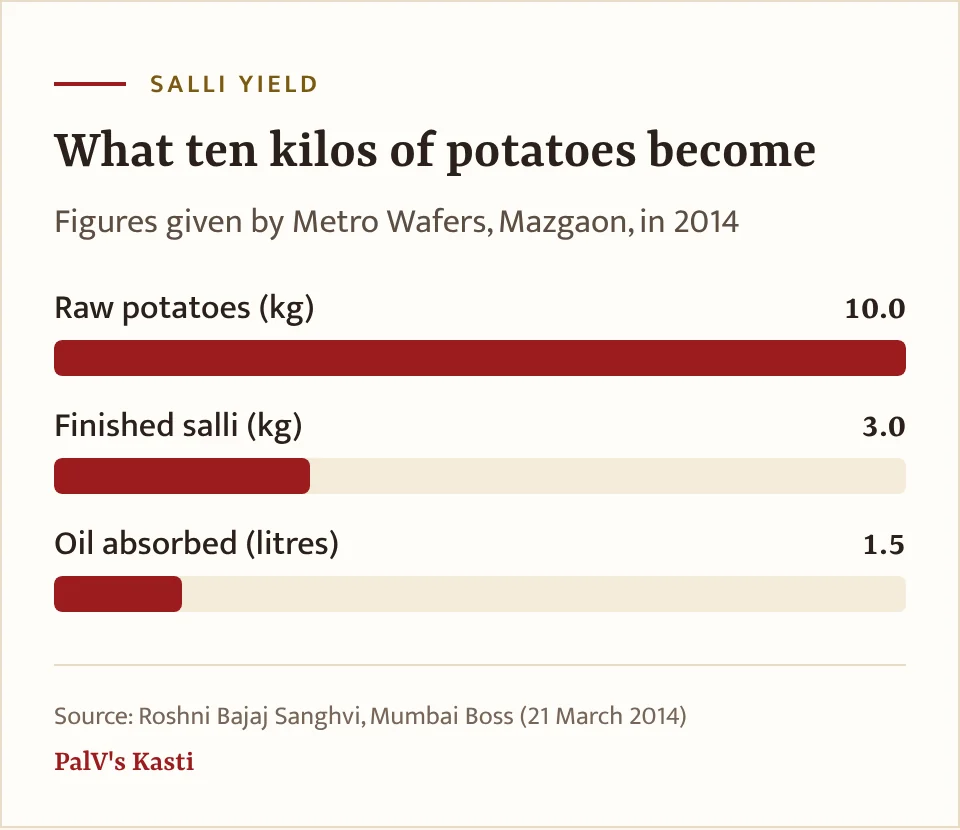
The salting surprised her. Once the sticks began to crisp, the workers flung very strong brine straight into the hot oil. The owner, Murtuza Ujjainwala, said this spreads the salt through the salli instead of leaving it on the surface, where it would collect in the packet and hit your tongue first. He also gave her the numbers: ten kilos of potatoes made only three kilos of salli and took up one and a half litres of oil.
At home
Home cooks work the same way on a smaller scale. In her recipe for chicken with apricots and potato straws in The Cook's Cook, Mavalvala has you peel the potatoes, slice them as finely as you can, then twist them hard in a tea towel to wring out the water. Fry them in small batches, drain on kitchen paper and salt them lightly. She allows machine-shredded or hand-cut potatoes, fried to golden brown.
Kapadia shreds hers with an old machine, salts the potatoes before frying and again as soon as they come out, and prefers an electric deep-fryer because it holds the oil temperature steady. She says homemade sali stays good in an airtight container for about 15 days.
Before machines
Dalal told Sanghvi that before mandolines and cutting machines, all salli was cut by hand and came out as jaadi salli. As a boy he watched workers at Golden Wafers on Grant Road squeeze brined potato sticks in a cheesecloth gone grey with starch.
What makes good salli?
Dalal's test has two parts. The cut has to be right, because sticks that are too long start to curl. The frying has to be right too: the best salli snaps cleanly and stays pale, cream with a flush of gold rather than brown. Mavalvala, cooking at home, takes hers to golden brown, so there is room for preference here.
It is also an oily product by nature, and Ujjainwala used that to explain the price. In 2014, he told Sanghvi, potatoes cost about Rs 10 a kilo while salli sold for around Rs 250.
Where do people buy salli?
In Sanghvi's 2014 report, Boman Kohinoor of Britannia said he bought the restaurant's salli for its salli boti, salli kheema and salli chicken only from Camy Wafers on Colaba Causeway. That shop told her it sold about ten kilos a day, mostly to Irani restaurants, Parsi eateries and Parsi and Sindhi households. Metro Wafers in Mazgaon, a smaller shop, was selling 60 to 70 kilos a day. These are 2014 figures, so check before you go.
Outside India it is harder. Perzen Patel writes that not every Indian grocer stocks salli and the fine kind is rarer still; her mother carries three to four kilos back from India. Patel and Mavalvala both name shop-bought crisps or ready-made potato sticks as a fallback.
Do other communities eat salli?
Yes, though not as a topping. Sanghvi, who is Sindhi, wrote that Sindhis eat salli with their tea as a snack sprinkled with red chilli and salt, and that Maharashtrians turn it into a sweet-salty chiwda. In her account, piling it over a gravy is the Parsi way of eating it.
Frequently asked questions
What is jaadi salli?
Jaadi means fat, and jaadi salli is the thicker cut of potato stick. Kurush Dalal told the food writer Roshni Bajaj Sanghvi in 2014 that before mandolines and cutting machines, all salli was cut by hand and came out this way. Machine-cut thin salli is the kind Parsis now prefer, Sanghvi wrote.
Is salli the same as potato chips?
Not quite. Chips or wafers are thin round slices, while salli is cut into fine sticks. At Metro Wafers in Mazgaon, the same potatoes became either wafers or salli depending on the blade fitted to the cutting machine, Sanghvi reported in 2014. Both are deep-fried, but salli is the one Parsis scatter over gravies.
Did salli come from Persia?
No. Potatoes reached India's western coast with the Portuguese, in the sixteenth century according to Scroll and Kurush Dalal, or the early seventeenth according to Live History India. Dalal counts potatoes and vinegar as Portuguese influences on Parsi food. Roshni Bajaj Sanghvi found fried potato sticks far less common in Iranian cooking than in Parsi food.
How long does homemade salli keep?
Rita Jamshed Kapadia of ParsiCuisine.com says homemade sali keeps for about 15 days in an airtight container. She salts it the moment it leaves the oil, which she says keeps it crisp, and lets it cool fully before it goes into the container. Her method uses an electric deep-fryer for a steady oil temperature.
Why is salli put on top of the dish and not cooked in it?
Salli is there for crunch, which is why recipes by Perzen Patel and Niloufer Mavalvala add it only when serving. Kurush Dalal gives a practical reason too: at a bhonu served on banana leaves, a layer of salli keeps the gravy from running across the leaf. Vikram Doctor sees it as standing in for crisp fried onions.


