 PalV's Kasti
On this page
- What does lagan mean, and what is the Ashirwad?
- Why does marriage matter so much in the Parsi faith?
- What happens before a Parsi wedding?
- What happens on the Parsi wedding day?
- What happens during the Ashirwad?
- What time do Parsi weddings take place, and why?
- Does the Ashirwad make a Parsi marriage legal?
- What happens after the ceremony?
- Where should a family or guest go next?
- Frequently asked questions
A Parsi wedding, called a lagan, comes in three parts. First come the pre-wedding customs: money and gifts exchanged between the two families, then four days of home festivities that start with planting a mango twig (madav saro). Then comes the wedding itself: a purifying bath (nahan) for bride and groom, a few short customs on the stage, and the Ashirwad, the religious ceremony in which two priests question the couple and their witnesses and recite blessings over them, usually after sunset. Last comes the reception, a feast that FEZANA says was customarily served on banana leaves in India. Ervad Dr Ramiyar Karanjia calls the Ashirwad the main religious part of the marriage, and describes the customs before it as socio-religious and less sacrosanct.
This page is the map. Each step links to a fuller guide in our Parsi wedding series.
અસપંદામેદ રોજ
Asfandarmad Roj, Tir Mah · 1396 Y.Z.
What does lagan mean, and what is the Ashirwad?
Lagan is simply the everyday Parsi word for a marriage or wedding. Parsi Times used it that way in a 2016 feature on wedding rituals, and the writer Noshir H. Dadrawala calls the whole occasion "a Parsi Lagan" in a January 2023 Parsi Times column.
The Ashirwad is the ceremony at the heart of it. Dadrawala explains that the word comes from Sanskrit, was taken up by the community after it reached India, and means blessings. Karanjia calls it the main religious part of the marriage. The Encyclopaedia Iranica entry on it (M.F. Kanga, 1987) defines it as prayers and admonitions recited by the two officiating priests. Our guide to the Zoroastrian wedding ceremony walks through the questions, the vows and the legal side, and the Parsi wedding Ashirwad page looks at the prayer itself.
Why does marriage matter so much in the Parsi faith?
Both J.J. Modi, writing in 1922, and Dadrawala, writing in 2021 and 2023, quote the same verse of the Vendidad (4.47), in which a man with a wife is ranked above a Magava. Modi glosses Magava as an unmarried man, while Dadrawala's rendering gives it as holy man. Modi's version of the verse goes on to rank a man with children above one who has none. Modi states that the Parsi books treat marriage as an institution favoured by God. Dadrawala goes further: the scriptures, he writes, enjoin marriage, the clergy included. What those prayers ask of the couple is covered in the meaning of Zoroastrian marriage, and why each custom exists is in significance of marriage customs.
Practice varies between families and Agiaries; your family priest's guidance comes first.
What happens before a Parsi wedding?
Karanjia notes that the pre-wedding customs are mostly carried out by the women of the house, and that they can be done days, months or even years ahead. Dadrawala calls them more cultural than religious. In the order Karanjia gives for Shahenshahi families:
- Rupia peravanu. A morning exchange of money gifts, at the girl's home and then the boy's. Dadrawala calls it the unofficial engagement.
- Adravanu. The families exchange clothes and gifts, and the boy and girl exchange rings at the girl's home.
- Adarni. Gifts between the families, and here the sources do not agree on who gives to whom. Karanjia says the bride's family takes them to the groom's house. Modi (1922) describes the bride's father's dowry being presented to the groom's family. Parsi Times (2016) has the groom's family visiting the bride, with the bride's side returning the visit, and Dadrawala (2023) speaks of gifts exchanged by both families.
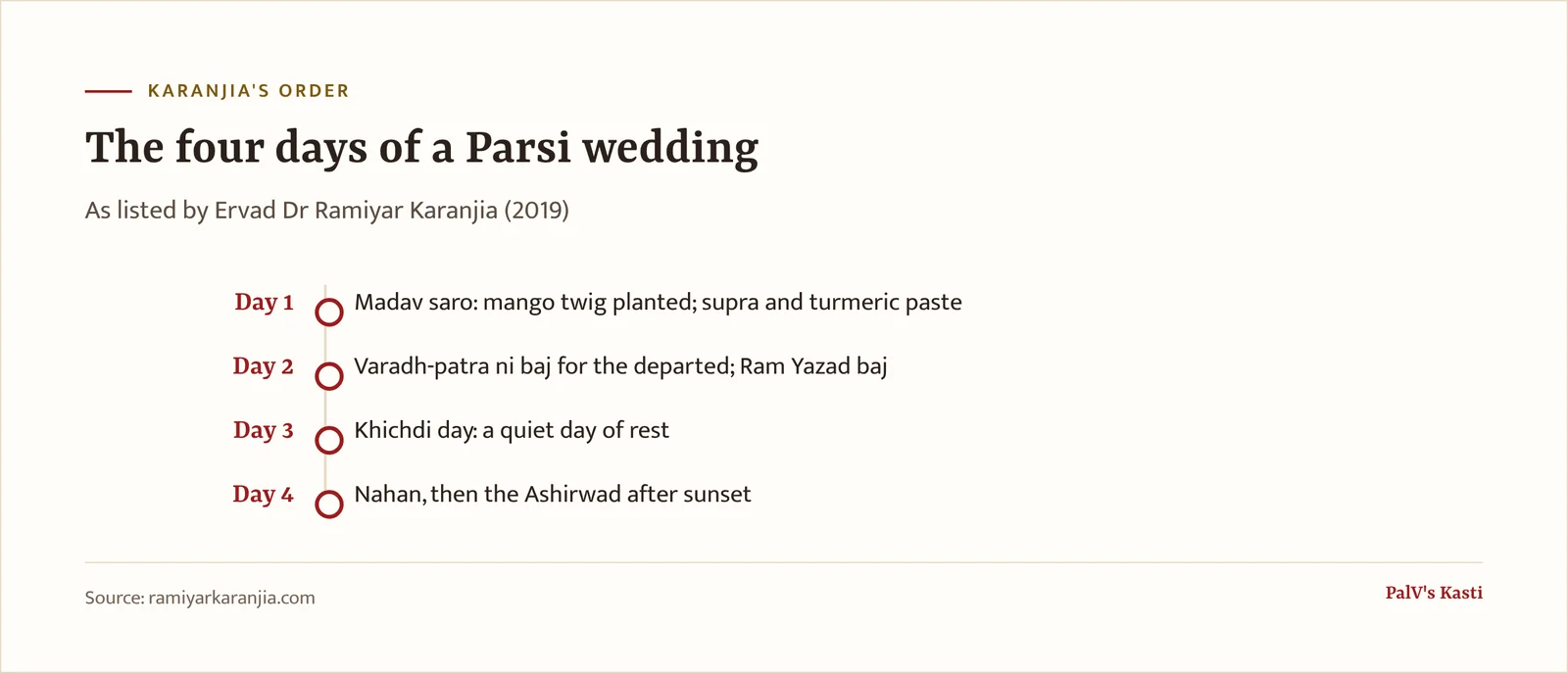
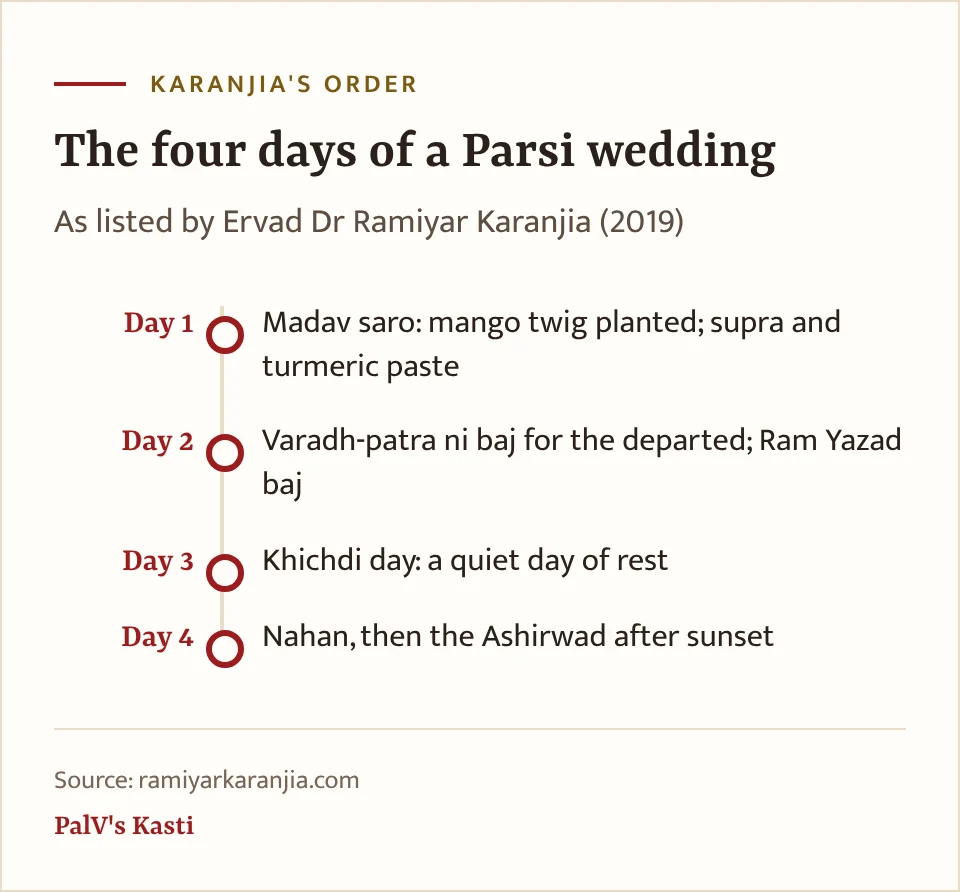
Then come four days of festivities. Karanjia lists them like this. Day one is madav saro, when a mango twig is planted in the garden or in a pot near the door, along with the supra custom, in which four married women take part and turmeric paste is applied to the couple. Day two is the varadh-patra ni baj at the fire temple, in memory of the family's departed, together with a baj for Ram Yazad. Day three, khichdi day, is a quiet day of rest. Day four is the wedding. Modi's 1922 account also describes four days, but treats both the second and third as varadh-patra days.
Each of these customs is explained step by step in Parsi wedding rituals. The jobs that pile up on the eve of the wedding have their own list in day before a Parsi wedding.
Practice varies between families and Agiaries; your family priest's guidance comes first.
What happens on the Parsi wedding day?
The day starts with the nahan. Modi records that bride and groom take this sacred bath with consecrated water in the morning or afternoon, and Karanjia describes it as the purificatory bath that opens the marriage ritual.
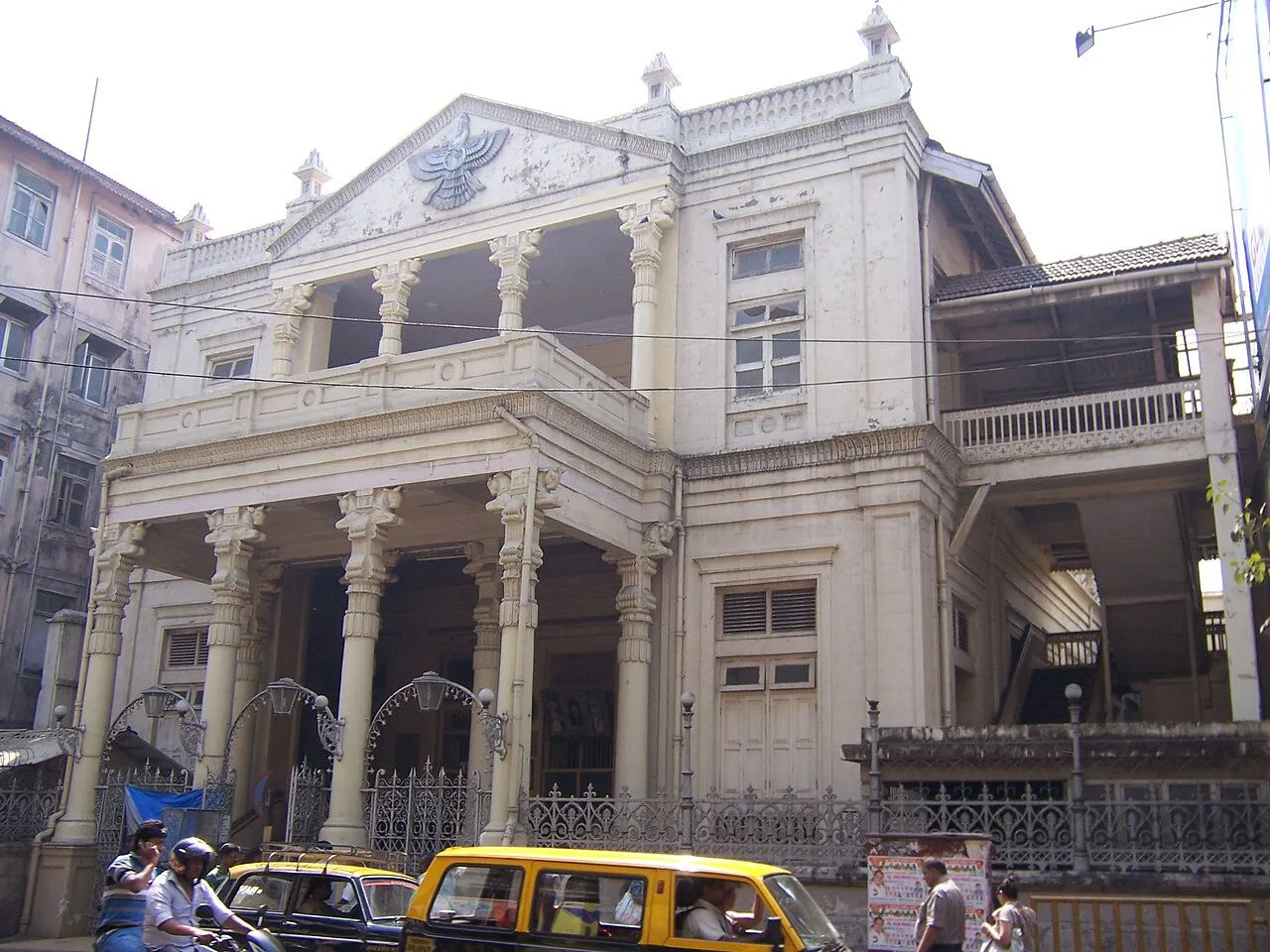
Weddings are held at a baug or a fire temple, according to Parsi Times, where a stage is set up for the couple. A baug, as an O Heraldo food feature put it, is the garden attached to an Agiary. How that stage is dressed is the subject of Parsi wedding stage decoration, and Parsi baug wedding photos shows a Mumbai baug on the day.
On the stage, Karanjia and Parsi Times describe much the same order:
- Achu michu. Before the groom steps up, the bride's mother or another senior woman of her family performs it for him. Parsi Times (2016) describes her circling a tray around him seven times. A woman from the groom's family then does the same for the bride. Karanjia says it is meant to ward off the evil eye.
- Ara antar. The couple sit facing each other with a white cloth held between them by the witnesses, and rice in their left hands. The priests wind a thread around them seven times while reciting Yatha Ahu Vairyo. When the last round ends, bride and groom throw the rice at each other and the cloth comes down.
- The Ashirwad. Now seated side by side, the groom on the bride's right and both facing east, the couple hear the questions and blessings of the two priests.
The full running order, ceremony by ceremony, is in Parsi wedding day ceremonies. The smaller, playful customs, such as the bride's sisters claiming money from the groom, are collected in unique Parsi wedding customs.
Practice varies between families and Agiaries; your family priest's guidance comes first.
What happens during the Ashirwad?
Modi's paper The Marriage Ceremony of the Parsis (second edition, 1921) divides the Ashirwad into three parts: opening blessings, questions put to the witnesses and to the couple, and a joint address by both priests. The questions ask the witnesses and then the couple whether they agree to the marriage, and Modi notes they are asked three times. Karanjia's 2019 account says the same. Karanjia adds that the priests shower the couple with rice grains, coconut shreds, pomegranate seeds and rose petals. Modi, and Dosabhai Framji Karaka before him in 1884, record that the ceremony closes with the Tan-dorosti benediction. The Iranica entry records that in Parsi use, the vows and blessings are recited in Pazand and then repeated in Sanskrit. The wording of the questions is set out in our Zoroastrian wedding ceremony guide.
Practice varies between families and Agiaries; your family priest's guidance comes first.
What time do Parsi weddings take place, and why?
After sunset is the usual time. Modi (1922) says Parsi marriages are generally performed in the evening, and Karanjia places the ceremony at the start of the Aiwisruthrem geh. Morning ceremonies also happen now. Karanjia notes that some families now hold it in the morning and again in the evening, and Dadrawala writes that many now choose the morning.
The reason for the evening is not settled. Dosabhai Framji Karaka, writing in 1884, and Karanjia both link it to a promise made to the Rana of Sanjan when the Parsis came to India. The Iranica entry presents that promise as tradition. Dadrawala, in 2023, calls it debatable whether the Rana ever set this condition. The calendar side of things, including which days families choose, is in Parsi wedding season.
Practice varies between families and Agiaries; your family priest's guidance comes first.
Does the Ashirwad make a Parsi marriage legal?
Yes, under Indian law it is a requirement. Section 3(1)(b) of the Parsi Marriage and Divorce Act, 1936 says a marriage is not valid unless it is solemnised by the Parsi ceremony called Ashirvad, performed by a priest with two Parsi witnesses present besides the priest. Section 6 requires the officiating priest to certify the marriage straight after the ceremony and send the certificate to the Registrar. The minimum ages in the Act, and a 2026 Bombay High Court ruling on what counts as an Ashirvad, are covered in our Zoroastrian wedding ceremony guide.
This is general information, not legal advice; for a specific case, speak to a lawyer.
What happens after the ceremony?
Once the Ashirwad is over, Karanjia writes, the couple go to a nearby fire temple and are greeted by the guests when they come back. Parsi Times (2016) also describes the couple heading to the fire temple for blessings. The same Parsi Times feature says it is a tradition for couples to visit Udwada afterwards, usually with family, to pay their respects at the Iranshah.
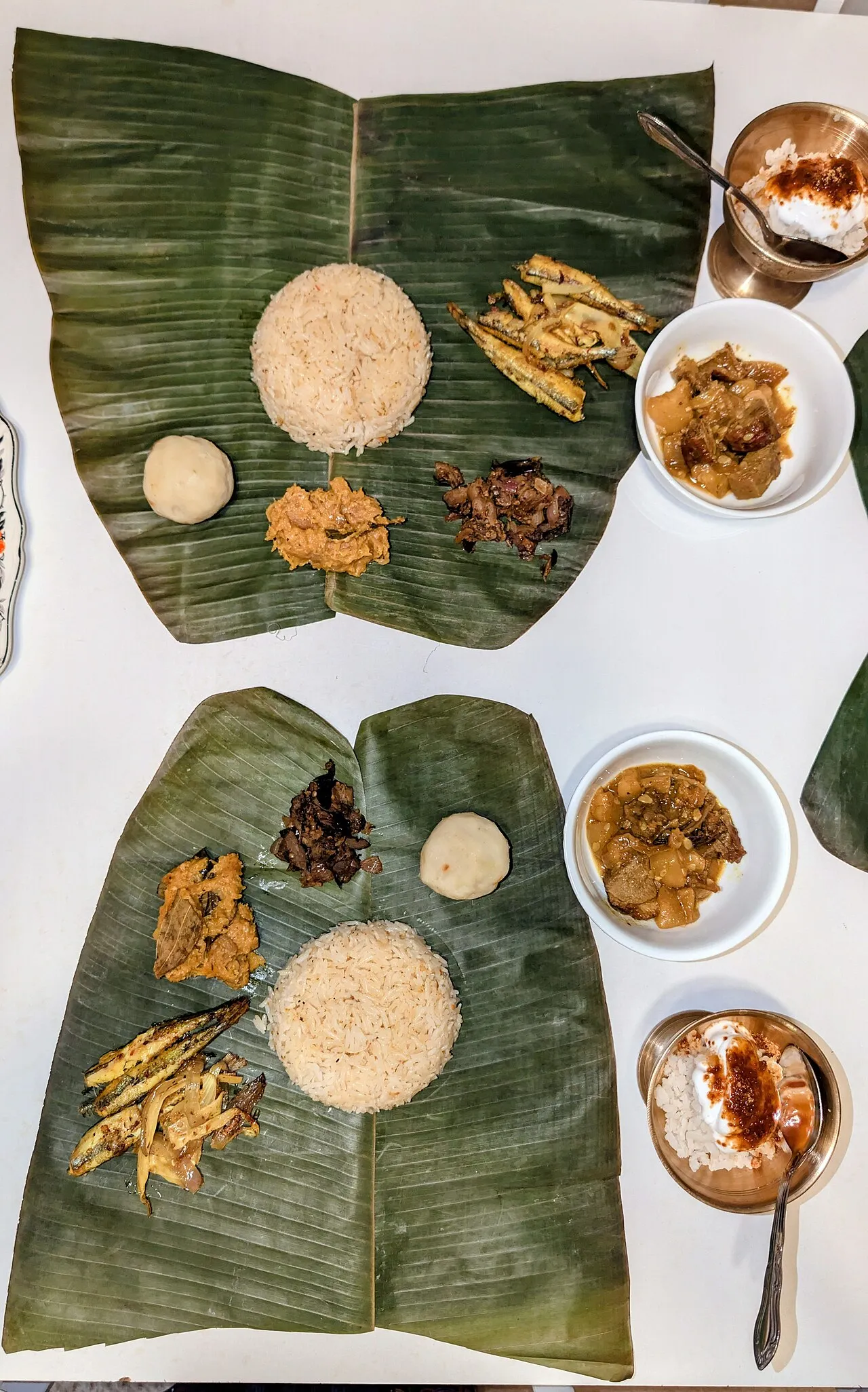
Then the feast. FEZANA's 2012 publication Eat, Live, Pray describes the traditional wedding meal as six to eight courses, served in India as a sit-down meal on banana leaves. Dadrawala's 2023 piece recalls the call to the feast: "Jamva chaloji!" The dishes and the etiquette of the table are in Parsi wedding food customs.
Where should a family or guest go next?
If you are planning a wedding, start with the Parsi wedding planning guide for the timeline, and keep the Parsi wedding day checklist open on the day itself. If you are invited to one, the Parsi wedding guest guide covers what to expect. Zoroastrian weddings in Iran have their own customs, and our page on the Iranian Zoroastrian wedding explains how. For the long view, the history of Parsi wedding rites compares today's wedding with what Modi recorded a century ago, and Louis Malle's Parsi wedding film looks at the Bombay wedding in Louis Malle's documentary.
Frequently asked questions
What happens at a Parsi wedding?
Bride and groom take a purifying bath, the nahan, and then come to a stage at a baug or fire temple. Short customs such as achu michu and the ara antar rice throw come first. Two priests then perform the Ashirwad, asking for the consent of the couple and the witnesses and blessing them. A feast follows.
How long is a Parsi wedding?
The festivities generally run over four days, as both J.J. Modi (1922) and Ervad Ramiyar Karanjia describe. They start with madav saro, the planting of a mango twig, and end with the wedding on the fourth day. The first pre-wedding custom, rupia peravanu, can come days, months or even years earlier, Karanjia notes.
What is lagan in Parsi?
Lagan is the Parsi word for a wedding or marriage, and Parsi Times uses it in exactly that sense. It covers the whole occasion: the family customs before the day, the religious Ashirwad ceremony performed by two priests, and the wedding feast after it. Lagan nu bhonu, for example, means the wedding meal.
What time do Parsi weddings take place?
Usually in the evening, after sunset, at the start of the Aiwisruthrem geh, according to Ervad Ramiyar Karanjia. Some families now hold the ceremony in the morning, or in the morning and again in the evening. Karaka (1884) links the evening timing to a promise made to the Rana of Sanjan. Noshir Dadrawala calls that link debatable.
What is the Ashirwad in a Parsi wedding?
The Ashirwad, meaning blessings, is the religious marriage ceremony. Two priests ask the witnesses and the couple, three times, whether they agree to the marriage, then recite blessings and advice and close with the Tan-dorosti prayer. Under the Parsi Marriage and Divorce Act, 1936, a Parsi marriage is valid only if solemnised by Ashirvad.


