PalV's Kasti
On this page
Set Modi's 1921 and 1922 accounts beside Ervad Dr Ramiyar Karanjia's today and the religious heart of the Parsi wedding looks much the same. Two priests bless a couple seated facing east, with rice, a white cloth, a thread wound around them and a fire nearby. Almost everything around that core has changed. Child marriage, which Dosabhai Framji Karaka still recorded in 1884, is now barred by law: since 1988 the Parsi Marriage and Divorce Act has set the minimum age at 21 for men and 18 for women. The wedding has moved from the bride's house to the baug. The sources describe the midnight repeat and the Sanskrit benedictions as fading, and several playful customs were already rare in Bombay when Modi wrote. Some couples now marry in the morning.
અસપંદામેદ રોજ
Asfandarmad Roj, Tir Mah · 1396 Y.Z.
What did J.J. Modi record about the Parsi wedding?
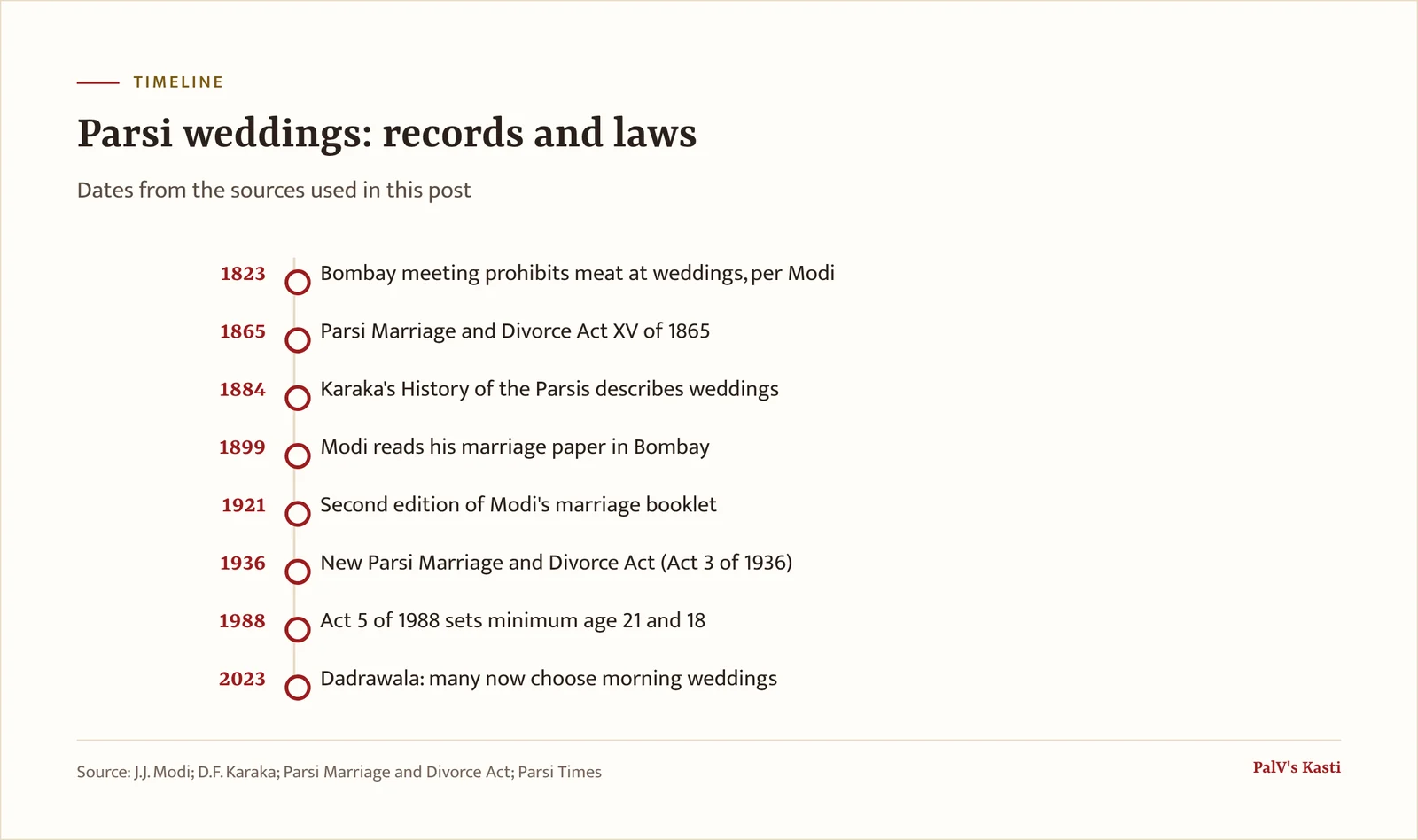
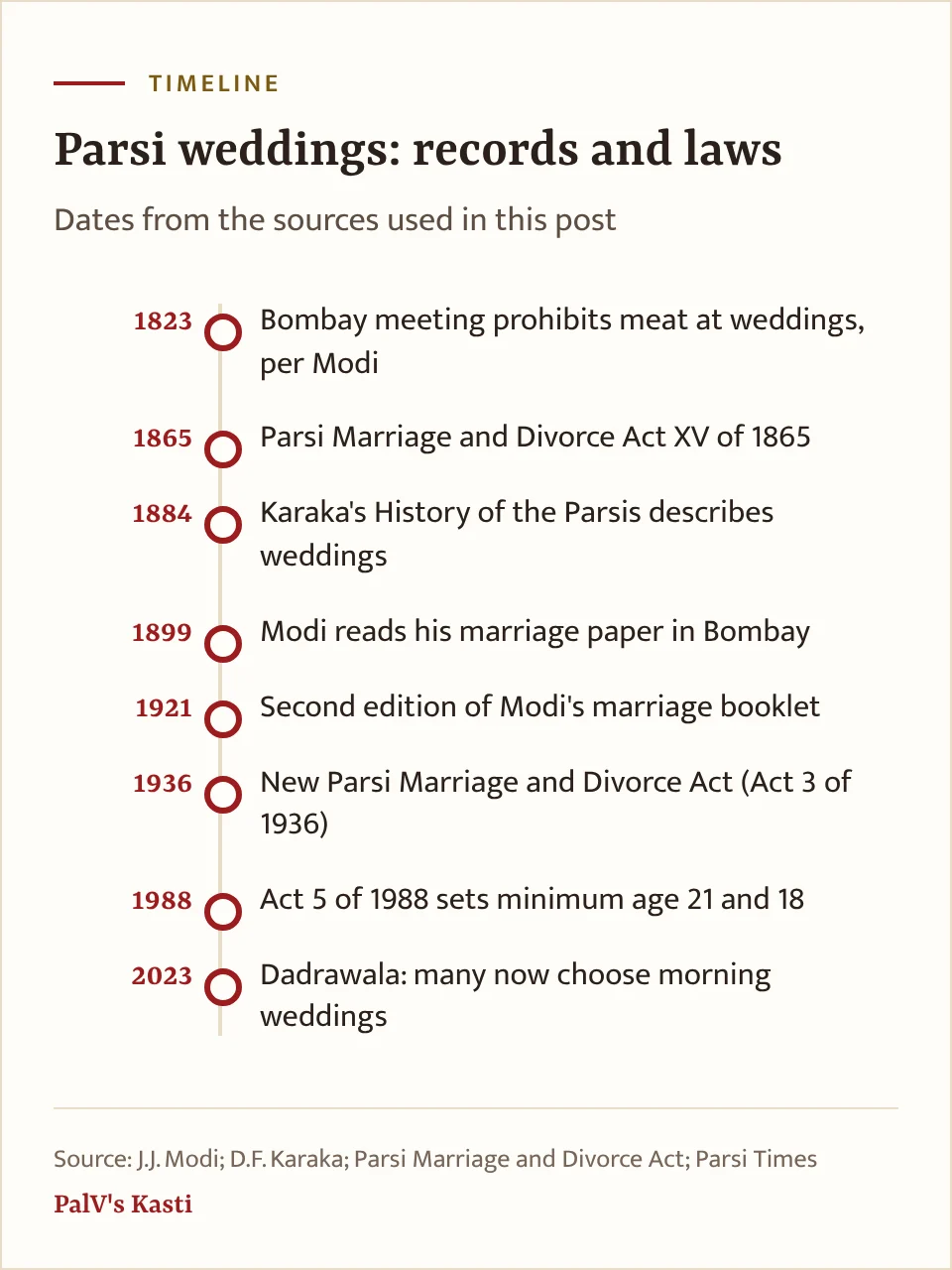
Jivanji Jamshedji Modi first read his paper on the Parsi marriage ceremony to the Anthropological Society of Bombay in two sittings, on 22 February and 26 July 1899. A shortened version came out as a booklet, whose second edition is dated Bombay, 1921. He then gave marriage a long chapter in The Religious Ceremonies and Customs of the Parsees (1922).
Modi himself was careful about origins. He wrote that it is hard to say which marriage customs are originally Zoroastrian or Persian and which were picked up from neighbouring communities in India, but that the solemn religious part, where the priests take part, is more or less Persian in origin.
Did Parsis marry as children?
Yes, in the nineteenth century. Karaka wrote in 1884 that the latest age for a girl's marriage was, as far as possible, soon after puberty, and that betrothal and marriage sometimes took place when the couple were little more than infants. Modi noted that about 70 years before he wrote in Bombay, and about 45 years before in Navsari, it was common to see the husbands, usually boy-husbands, riding on horseback.
Matches were made differently too. Karaka describes priests who worked as professional matchmakers and horoscopes handed to an astrologer, whose verdict could end a proposal. Modi notes some families still consulted one in his day.
The law has changed alongside custom. In Modi's day Parsi marriages were governed by the Parsi Marriage and Divorce Act (Act XV of 1865), which Modi dates to 7 April 1865. It was repealed and replaced by the Parsi Marriage and Divorce Act, 1936 (Act 3 of 1936). The amending Act 5 of 1988 set the minimum age in section 3(1)(c): a marriage is not valid if the man has not completed 21 years or the woman 18. Section 3(1)(b) still requires the marriage to be solemnised by the Ashirvad ceremony, performed by a priest in the presence of two Parsi witnesses. This is general information, not legal advice; for a specific case, speak to a lawyer.
Where did Parsi weddings take place, and how big were they?
In Modi's account the wedding generally took place at the bride's house. The groom's party arrived in procession, sometimes led by a band, with the men seated in the compound and the women inside. Karaka put a wealthy family's wedding party at one thousand to fifteen hundred people.
Karaka notes in a footnote that the sons of Edalji Framji Albless had built Albless Bag so that families without enough room at home could hold weddings there without payment. He also wrote that the long processions, decorated horses and silver-plated palanquins had almost entirely disappeared by 1884. By 2016, Parsi Times described the wedding venue as usually a baug. How those venues are dressed is covered in our guide to Parsi wedding stage decoration.
Has the time of the Parsi wedding ceremony changed?
The evening wedding goes back at least to Karaka's and Modi's accounts, and the reason given for it is debated. Karaka (1884) says the ceremony took place in the evening following Hindu custom and the promise given to the Rana of Sanjan. Ervad Dr Ramiyar Karanjia also links sunset weddings to an assurance given to the Hindu king Jadav Rana. Encyclopaedia Iranica (Maneck Kanga, 1987) presents the promise as tradition, and Noshir Dadrawala wrote in Parsi Times in January 2023 that whether the Rana really set this condition is debatable.
The second ceremony at night has faded. Modi wrote that the ritual was repeated at midnight, but that many families no longer did so. Karaka saw the blessing repeated after midnight before a few close friends, and Iranica says the ceremony was performed twice until recently, once after sunset and again in the early-morning Ushahin Gah. Karanjia writes that in olden times it was repeated before the next day's sunrise.
Morning weddings are the newer shift. Karanjia writes that some people now hold the ceremony in the morning and again in the evening, and Dadrawala that many now choose the morning. Parsi Times reported in 2016 that lagans usually take place after sunset or very early in the morning, though most begin at 6:40 pm.
Practice varies between families and Agiaries; your family priest's guidance comes first.
Which wedding customs have faded since 1921?
Some were fading even as Modi wrote:
- Sanskrit benedictions. Iranica notes that in Parsi usage the vows and blessings are recited in Pazand and then repeated in Sanskrit. Modi said many families had dropped the Sanskrit address. Karanjia, writing of the Shahenshahi ceremony, says the Sanskrit benedictions are rarely recited nowadays.
- Playful customs. Modi called a group of customs very rare in Bombay, though still seen in smaller towns: tying the hems of the couple's garments together (chheda-chhedi), the shared dish of curd called dahi-koomro, and eki-beki, an odds-and-evens game with coins that he called almost obsolete.
- Washing the groom's feet. Modi recorded that once Parsis began wearing English boots, only the tip of the boot was washed.
- Royal toasts. Karaka describes a toast, always drunk at wedding dinners, to the Queen as Empress of India. Modi's list of toasts, beginning with the remembrance of God, includes His Majesty the King.
- The meatless feast. Modi wrote that meat was not generally eaten at wedding feasts. The reasons given differ. Karaka says it was to avoid offending Hindu neighbours, and Modi cites Anquetil du Perron for a similar reason, but Modi adds that a Bombay community meeting of 18 October 1823 prohibited meat to keep costs down.
What has stayed the same?
The ceremony itself. Modi in 1922 and Karanjia in 2019 both describe the couple seated facing east, rice used in the blessing, a white cloth held between them, and a fire near the couple. Karaka's account of 1884 already has the thread wound seven times around the pair and the race to throw rice first. One difference shows up: Parsi Times reported in 2016 that the couple exchange rings about an hour into the prayers, whereas Modi records rings as presents exchanged on an earlier day.
What the prayers say about marriage is the subject of our piece on the meaning of Zoroastrian marriage, and the blessing itself is explained in the Parsi wedding Ashirwad. For a wedding today from start to finish, see our Parsi wedding guide.
Practice varies between families and Agiaries; your family priest's guidance comes first.
Frequently asked questions
How old are Parsi wedding customs?
Two detailed accounts date from the late nineteenth century: D.F. Karaka's of 1884 and J.J. Modi's paper of 1899, which he reissued in 1921 and expanded in 1922. Modi judged the religious part of the ceremony, led by the priests, to be more or less Persian in origin, and said the origins of the other customs are hard to determine.
Which Parsi wedding customs come from India?
Modi said it is difficult to tell which customs are Persian and which were adopted in India. Noshir Dadrawala notes that the word Ashirwad is of Sanskrit origin, taken up after the Parsis arrived. Karaka linked the evening wedding to Hindu custom and the Sanjan promise, which Dadrawala calls debatable.
Did Parsis marry as children?
Yes, in the nineteenth century. Karaka wrote in 1884 that girls were married soon after puberty and that some couples were little more than infants. Modi recalled boy-husbands riding to their weddings on horseback. Since the 1988 amendment, the Parsi Marriage and Divorce Act sets the minimum age at 21 for men and 18 for women.
Is the Parsi wedding ceremony still repeated at midnight?
The sources describe the repeat as fading. Modi wrote in 1922 that many families had already stopped repeating the ceremony at midnight. Encyclopaedia Iranica (1987) says it was performed twice until recently, and Ervad Dr Ramiyar Karanjia describes the repeat as a practice of olden times. He adds that some families now hold a morning ceremony and an evening one.