 PalV's Kasti
On this page
Plan a Parsi wedding backwards from the date. Settle the date with your family priest, agree who will officiate, and book the venue. Then fit in the pre-wedding customs. Ervad Dr Ramiyar Karanjia writes that the betrothal can come days, months or even years ahead, and that the engagement and the Divo Adarni can be done well before or inside the four days of festivities. Those four days end with the wedding, generally in the evening. For the marriage to be valid under the Parsi Marriage and Divorce Act, 1936, a priest must perform the Ashirvad with two Parsi witnesses present, and the priest then certifies the marriage and sends the certificate to the Registrar. The sections below take each stage in turn.
અસપંદામેદ રોજ
Asfandarmad Roj, Tir Mah · 1396 Y.Z.
How far ahead do the pre-wedding customs happen?
Karanjia, in a 2019 article on wedding customs, calls these customs socio-religious and says they are not as sacrosanct as the marriage ritual, so they may be done a few days or months before the wedding. He puts the betrothal (rupya paheravanu) first, and says it could come days, months or even years ahead. The engagement (adravvu) and the Divo Adarni can be done any time before, he writes, and if they were not done earlier, during the four days before the wedding.
For detailed instructions on each custom, Karanjia points families to books written for the purpose by the late Perin Naval Hormasji and the late Banubai Cawasji Driver.
What happens in the four days before a Parsi wedding?
J.J. Modi wrote in 1922 that the festivities generally last four days. Karanjia's 2019 account gives this order for Shahenshahi families:
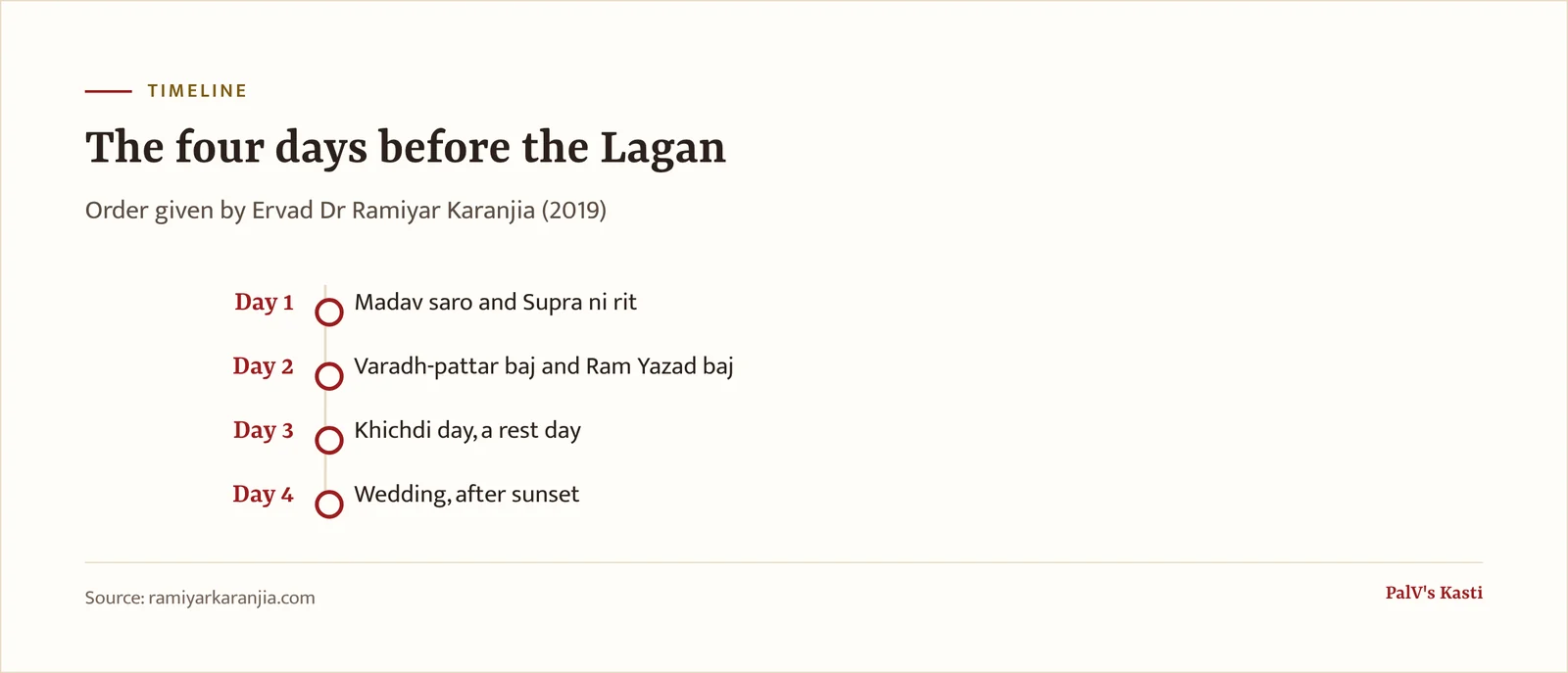
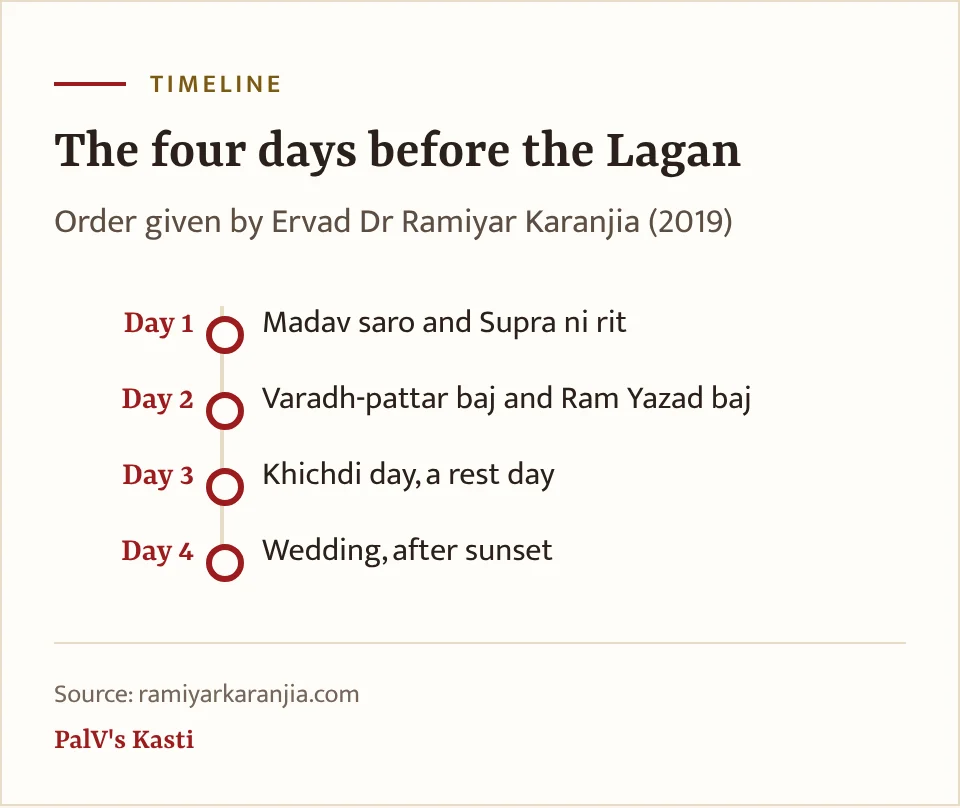
- Day one: the madav saro, when a fresh mango twig is planted in the garden or in a pot near the door at both houses, and the Supra ni rit.
- Day two: the Varadh-pattar ni baj at the fire temple in memory of the departed, and a Baj for Ram Yazad.
- Day three: khichdi day, which he calls a sort of rest day with nothing significant to be done.
- Day four: the wedding, generally in the evening at the start of the Aiwisruthrem geh, after sunset.
The two accounts differ on the middle days. Modi calls both the second and the third days Varadh-patra days, kept for ceremonies in honour of the dead. Karanjia puts the Varadh-pattar baj on day two only. Ervad Marzban J. Hathiram, writing on his Frashogard website in 2012, says only that a specific day before the marriage is set aside to remember the departed, with Baj, Afringan, Farokshi and Stum prayers and a Mino Ram ni Baj by another priest. He objects that the couple are almost always absent and one older family member is sent instead, and wants the couple present. He also writes that a family can book the Machi in all five gehs at its family Agiary or Atash Behram. Our post on the day before a Parsi wedding goes through the eve in more detail.
Practice varies between families and Agiaries; your family priest's guidance comes first.
Who chooses the priests and the witnesses?
Karanjia writes that it is the groom's family's prerogative to select the priests who perform the wedding. Speak to them early so the date and time suit them. The witnesses matter in law. Section 3(1)(b) of the Parsi Marriage and Divorce Act, 1936 says a marriage is not valid unless it is solemnised by the Ashirvad ceremony, by a priest, with two Parsi witnesses present other than that priest. So confirm early that both people you have in mind are Parsi and will be there on the day. What the priests recite is explained in our post on the Parsi wedding Ashirwad.
How is a Parsi marriage registered?
Through the officiating priest. Section 6 of the 1936 Act says the priest must certify the marriage immediately after it is solemnised, in the form set out in Schedule II. The certificate is signed by the priest, the couple and the two witnesses, and the priest sends it to the Registrar of the place where the marriage took place, with a fee of two rupees paid by the husband. The Registrar enters it in a register kept for the purpose. Section 17 adds that a marriage is not invalid only because it was not certified, the certificate was not sent, or the certificate was defective.
A 2026 ruling shows what can turn on the ceremony itself. On 23 September 2026 the Bombay High Court (Justice Somasekhar Sundaresan, H v. S, IA (L) 30398/2023 in Parsi Suit 2/2018) accepted the unanimous answer of the delegates, the community jurors who sit in Parsi matrimonial cases, that a November 2010 ceremony in Mumbai was a Tandoorasti, a blessing, and not an Ashirvad. The couple had married in a civil ceremony abroad earlier that year. The delegates' statement, quoted in the judgment, says such blessings have become common among Zoroastrian couples who married abroad, and says the signing of the registration document, missing from the video in that case, is a compulsory part of the marriage ceremony in India. The court dismissed the suit for want of jurisdiction. That is the position as reported by Verdictum on 27 September 2026.
This is general information, not legal advice; for a specific case, speak to a lawyer.
How do you choose a venue and set a budget?
Parsi Times wrote in 2016 that the wedding venue is usually a baug. Our Parsi baug wedding photos post shows what a baug wedding looks like, from the stage to the dinner tables. Ask the venue how many guests it can seat for a sit-down dinner, and book once the date is fixed.
Wedding costs have worried the community for a long time. Dosabhai Framji Karaka wrote in 1884 that lavish wedding customs were extremely injurious to poorer families, who often ruined themselves trying to imitate richer neighbours and borrowed at heavy interest to do it. Modi records a community meeting in Bombay on 18 October 1823 that was called to consider ways to regulate funeral and marriage expenses.
What should go on the family's planning list?
These are practical steps, not customs, and the order can change to suit your family:
- Fix the wedding date and time with your family priest.
- Agree which priests will officiate (the groom's family's choice, per Karanjia).
- Book the venue and the caterer once the date is set.
- Decide when the betrothal, engagement and Divo Adarni will be held.
- Book the fire temple for the Varadh-pattar baj and any Machi.
- Choose two Parsi witnesses and confirm they can attend.
- Check with the priest that the marriage certificate will be signed on the day and sent to the Registrar.
For the whole sequence from the first custom to the reception, see our Parsi wedding page.
Frequently asked questions
How do you plan a Parsi wedding?
Start with the date and the priests, then the venue. Schedule the betrothal, engagement and Divo Adarni, which Ervad Ramiyar Karanjia says can be done well ahead or within the four days before the wedding. Book the fire temple for the Varadh-pattar baj, and choose two Parsi witnesses. Your family priest should confirm every date.
How many days does a Parsi wedding last?
Four days, by the older accounts. J.J. Modi wrote in 1922 that the festivities generally last four days, and Ervad Ramiyar Karanjia's 2019 account lists them as madav saro, the Varadh-pattar baj, the khichdi rest day, and the wedding. Earlier customs such as the betrothal and Divo Adarni can fall well before these four days.
What is legally needed for a Parsi marriage?
Under section 3 of the Parsi Marriage and Divorce Act, 1936, the marriage must be solemnised by the Ashirvad ceremony, by a priest, with two Parsi witnesses besides the priest. It also bars listed degrees of relationship and sets minimum ages of 21 for men and 18 for women (Act 5 of 1988). This is general information, not legal advice.
How is a Parsi marriage registered?
Section 6 of the Parsi Marriage and Divorce Act, 1936 makes the officiating priest certify the marriage immediately after the ceremony. The priest, the couple and two witnesses sign, and the priest sends the certificate with a two-rupee fee, paid by the husband, to the local Registrar, who enters it in the marriage register.
Who chooses the priest for a Parsi wedding?
Ervad Dr Ramiyar Karanjia writes that choosing the priests who perform the wedding is the prerogative of the groom's family. In his account two officiating priests recite the Ashirvad prayers in unison. Since the priests' availability affects the date and time, it helps to speak to them as soon as the date is being discussed.


