 PalV's Kasti
On this page
- When was Yazdani Bakery founded, 1950 or 1953?
- Who founded Yazdani Bakery, and where did the family come from?
- Was Yazdani Bakery's building really a Japanese bank?
- How does Yazdani Bakery make its bread?
- What is Yazdani Bakery famous for?
- Who was Zend Meherwan Zend?
- Is Yazdani Bakery closed?
- Frequently asked questions
Yazdani Bakery is an Irani bakery at 11A Cawasji Patel Street in Fort, south Mumbai, opened in the early 1950s by Meherwan Zend, a Zoroastrian baker of Iranian descent. The Free Press Journal gives the year as 1950. Al Jazeera, TRT World, Business Today and the Irani Chai, Mumbai archive all say 1953. According to his son, the family's baking in Bombay goes back further, to a bakery near the Alexander cinema opened around 1900. Yazdani works out of a building that two published accounts describe as a former Japanese bank from around the First World War, and it became known for brun maska, mawa cake, apple pie and bread from a wood-fired oven. It closed for renovation from 29 September 2026, and as of 15 November 2026 no reopening date has been announced.
શહેરેવર રોજ
Shehrevar Roj, Tir Mah · 1396 Y.Z.
When was Yazdani Bakery founded, 1950 or 1953?
Published sources disagree, and none of them shows a dated document. A March 2023 Free Press Journal feature says Meherwan Zend established the bakery in 1950. A 2014 Al Jazeera photo essay, a TRT World feature and an October 2026 Business Today report all give 1953, as does the Irani Chai, Mumbai oral-history archive, which lists the bakery as "Fort, Est. 1953". Outlook Traveller (November 2025) does not pick a year and says "the early 1950s".
We lean towards 1953 because more independent sources use it, but 1950 is in print too and we can't rule it out. For comparison, the Sassanian Boulangerie dates from 1913, according to both Al Jazeera and The Better India.
Who founded Yazdani Bakery, and where did the family come from?
The Free Press Journal and Gulf News both name Meherwan Zend as the founder, and his son's interview speaks of "the bakery established by his father". Gulf News calls Meherwan an Indian Zoroastrian of Iranian descent. The Free Press Journal says he named the bakery after his hometown, Yazd, in Iran.
The fullest family story comes from Meherwan's son, Zend Merwan Zend, in a Times of India interview by Sharada Dwivedi that the Irani Chai, Mumbai archive reproduced in 2008. In his telling, his grandfather Zend Merwan Abadan reached Bombay around the turn of the century and opened a bakery near the Alexander cinema. His grandmother Jerbanoo got up at 3 am to knead the dough. After Abadan died, Meherwan went to work at the age of 11 at the Rising Sun bakery in Golpitha. That bakery sent cakes and pastries by bullock cart from the Colaba military camp to Chembur Naka, and Meherwan drove the cart.
Other versions get the generations mixed up. The Free Press Journal says the earlier bakery was started by Meherwan's grandfather. The Better India credits Zend Merwan Abadan with setting up Yazdani itself. We go with the son's account, because it is the only one that comes straight from the family.
Was Yazdani Bakery's building really a Japanese bank?
Two published accounts say so. Gulf News reported that the building had been a Japanese bank during the First World War. The Dishoom cookbook (Dishoom: From Bombay with Love, Bloomsbury) describes it as a former Japanese bank building from about the same period. The Better India is more careful and says only that "stories suggest" it. We found no land record or bank history that confirms it, so treat it as a well-reported account, not a settled fact.
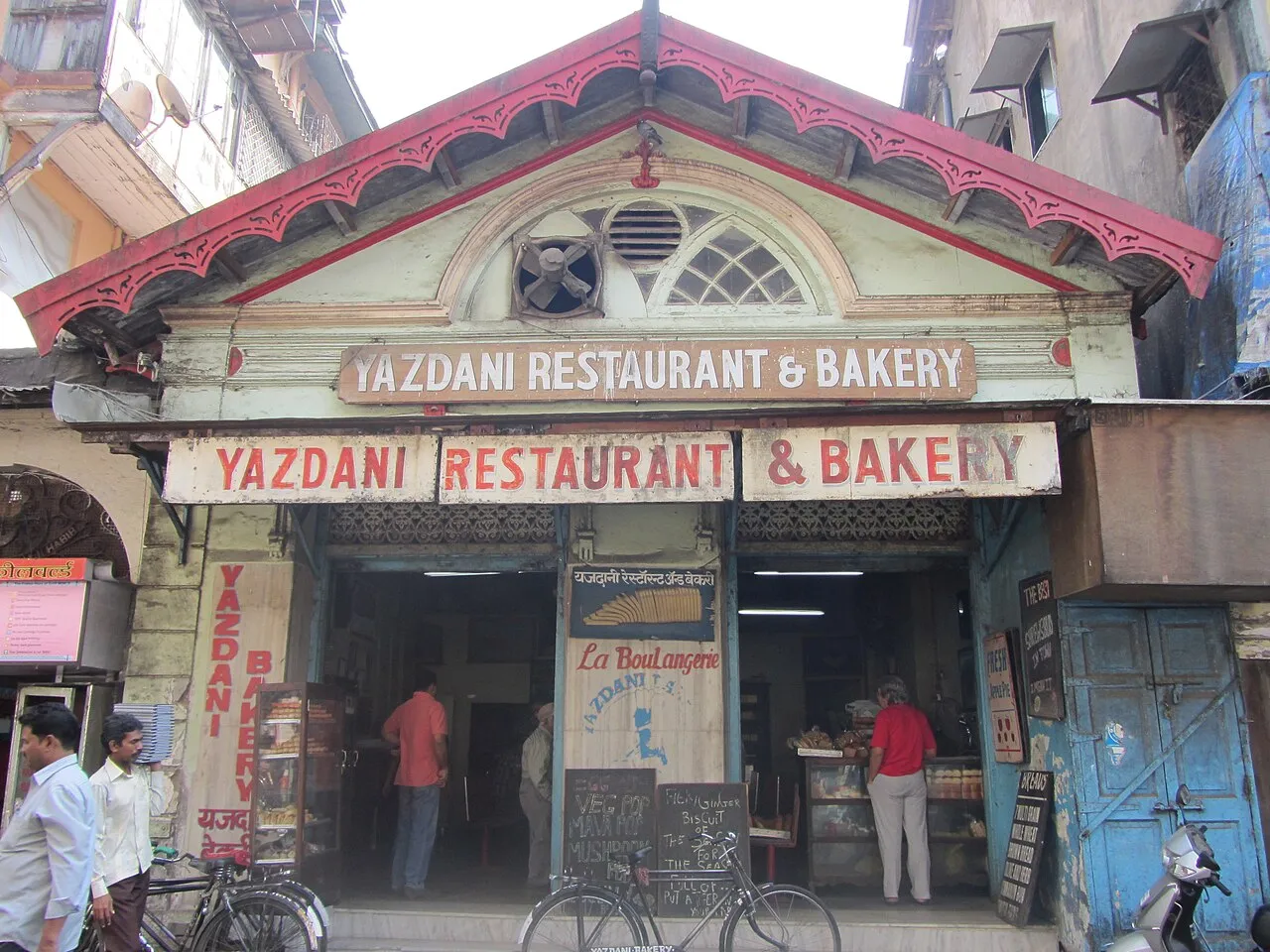
The building itself is hard to miss. Gulf News describes a short building with a red tiled roof and green, peeling paint. TRT World mentions its pointed red roof and cornflower-blue exterior. Inside, the Dishoom book notes a chalkboard telling customers to eat fresh ginger biscuits to get rid of a cough. According to Gulf News, a Faravahar and a portrait of Zarathushtra hang on the walls.
How does Yazdani Bakery make its bread?
In the Times of India interview, Zend explained that the family's bread started from khamir, a sourdough-style ferment. A lump of each day's dough was kept back to raise the next batch, a technique he said came from Iran. The family also used hops. Two spoonfuls were boiled in water and added to the ferment once it cooled, and he said the bread then lasted for days without spoiling: it dried out but stayed edible. At the time of the interview, kneading at Yazdani began at 3 am and baking at 6.
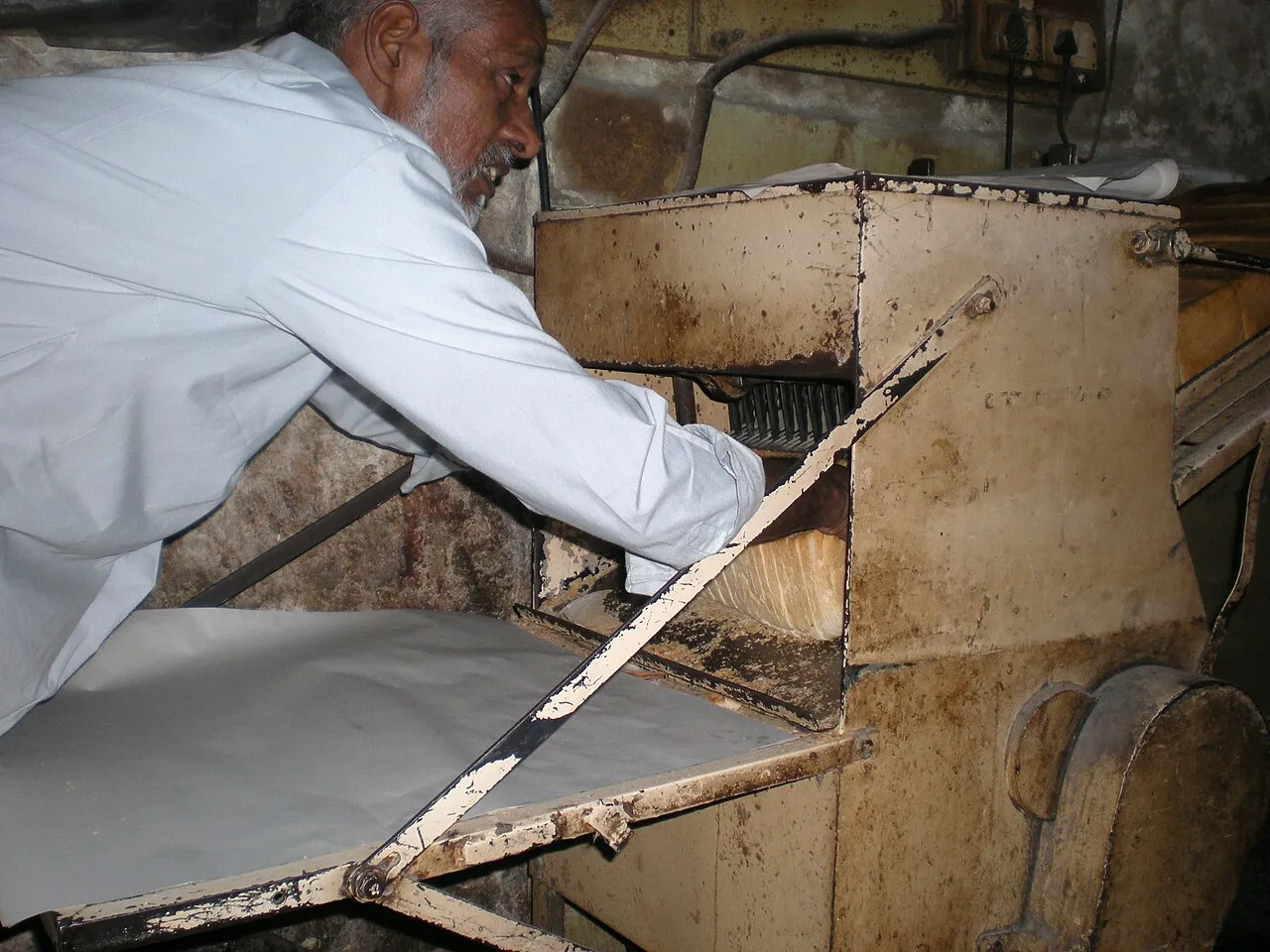
Later accounts still mention the old oven. TRT World quotes a regular who says the bakers still work manually without much use of machines and use a wood-fired oven, and the Free Press Journal also mentions wood-firing. Zend wanted bread with a bite to it and a harder crust from longer baking, so that it held together when dipped in gravy, dal or tea.
One more detail from that interview is worth keeping. Unsold bread was turned into toast, which Zend said only Zoroastrian Iranis really appreciated. He described how, during the days of persecution in Iran, people broke dry naan or toast into a bowl of salted curd with chopped onion, mint and pepper for breakfast.
What is Yazdani Bakery famous for?
Brun maska with cutting chai is the order most writers mention first. Gulf News calls it what the cafe is most famous for, and TRT World and Outlook Traveller both list bun maska. The rest of the counter, as different publications list it:
- Mawa cake and apple pie (Free Press Journal, Outlook Traveller, TRT World)
- Khari, Shrewsbury biscuits and fiery ginger biscuits (TRT World)
- Bread pudding, ladi pav and jumbo sandwich loaves (Outlook Traveller)
- Nankhatai, according to the Free Press Journal
- Fortune cookies, a slightly unexpected one, which Outlook Traveller mentions
Food historian Kurush Dalal, in a tribute quoted by Mumbai Live, called Zend perhaps the first Mumbai baker to move past bun, brun, ladi pav and sliced bread. Dalal also said Yazdani regularly supplied major canteens across the city, including the one at Mantralaya. For how Yazdani's menu compares with the city's other old cafes, see our guide to the Irani cafes of Mumbai.
Who was Zend Meherwan Zend?
Zend Meherwan Zend (spelt Zend Merwan Zend in the 2008 interview) was Meherwan's son and Yazdani's baker. He died on Sunday, 10 January 2021, at the age of 86. Mumbai Live gives the day and age, and the Irani Chai archive gives January 2021. Mumbai Live reported that he had been a boxer in his younger days and had left a white-collar job to join the family bakery. He was diagnosed with Parkinson's more than a decade before his death, but he still came in to instruct the staff by the wood-fired oven or sit behind the cash counter.
He did not run Yazdani alone. A Gulf News piece (last updated in 2018) described the bakery as run by Meherwan's two ageing sons: Zend, the baker, and Parvez Irani Zend, who looked after customers and told stories of the old days. Mumbai Live quoted Zend's son, Zyros, who said his father just wanted to give people good bread and a nice cup of tea.
Is Yazdani Bakery closed?
Yes, as of 15 November 2026. Business Today (3 October 2026) and Restaurant India (5 October 2026) both reported that Yazdani closed for renovation from 29 September 2026 and had not announced a reopening date. We searched on 15 November 2026 and found no report of it reopening, so check its social media before you go.
The closure came while the Maharashtra Food and Drug Administration, under Tukaram Mundhe, was stepping up inspections across the state. Business Today reported that the FDA had suspended the FSSAI licence of Kyani & Co. after an inspection. People online started calling Yazdani's closure the "Mundhe effect". Both reports were clear on this point: there was no evidence that the FDA had shut Yazdani, and the bakery itself said the closure was for renovation.
Even before the renovation, how much of Yazdani was open seemed to change. In March 2023 the Free Press Journal wrote that the restaurant side had shut a couple of years earlier and only the bakery was running. But in November 2025, Outlook Traveller described long wooden tables and benches and gave opening hours of 7 am to 7 pm from Monday to Saturday, and 7 to 11 am on Sunday. Those hours may not hold after the renovation.
Frequently asked questions
How old is Yazdani Bakery?
Yazdani Bakery opened in the early 1950s, which makes it a little over 70 years old in 2026. Sources split on the exact year. The Free Press Journal says 1950, while Al Jazeera, TRT World, Business Today and the Irani Chai, Mumbai archive say 1953. No dated founding document has been published.
What is Yazdani Bakery famous for?
Yazdani Bakery is best known for brun maska with cutting chai, along with mawa cake, apple pie, khari, ginger biscuits, bread pudding and ladi pav. The founder's son described raising its bread with khamir, a sourdough-style ferment, and newer accounts mention a wood-fired oven. The building, reported to be a former Japanese bank, adds to the draw.
Who owns Yazdani Bakery?
Outlook Traveller wrote in November 2025 that the Irani family who founded Yazdani still runs it. Founder Meherwan Zend's sons, Zend and Parvez, ran it for decades, and Zend died in January 2021. We found no recent public statement naming the current owner, so we have not named one here.
Is Yazdani Bakery closed because of the FDA?
No source shows that it is. Yazdani closed for renovation from 29 September 2026. Business Today and Restaurant India both noted online talk of a "Mundhe effect" during the Maharashtra FDA inspection drive, and both reported that there is no evidence the FDA shut the bakery, which says the closure is for renovation.
Where is Yazdani Bakery in Mumbai?
Yazdani Bakery is at 11A Cawasji Patel Street in Fort, south Mumbai, and Outlook Traveller lists the address under Kala Ghoda, Fort. Gulf News describes the lane as lying somewhere between the Asiatic Library, Flora Fountain and the Strand bookstall. As of 15 November 2026 it is closed for renovation.


