 PalV's Kasti
On this page
- When did Sassanian Boulangerie open, and who started it?
- Why is it called Sassanian?
- How did the Kola family come to run it?
- What did Sassanian serve at first, and what is it known for now?
- What was an Irani cafe like when Sassanian was young?
- Is there a Zoroastrian link to the bakery's fire and its birthday?
- Frequently asked questions
Sassanian Boulangerie is an Irani bakery and cafe at Dhobi Talao, near the Gol Masjid in Marine Lines, south Mumbai. Rustom K. Yazdabadi opened it in 1913, and DNA reported in 2014 that its first name was KR Sassanian Restaurant and Bakery. It started out serving chai and bun maska. In 1947 Khodadad Kola, an Irani who had worked at Kyani, joined Yazdabadi as a partner, and his son Meheraban Kola later sat at the cash counter. The cafe added Parsi dishes such as dhansak in 2000. It takes its name from the Sassanid dynasty of ancient Iran.
અસપંદામેદ રોજ
Asfandarmad Roj, Tir Mah · 1396 Y.Z.
When did Sassanian Boulangerie open, and who started it?
The founding year is 1913. DNA (2014), Al Jazeera (2014), TRT World and The Better India (2023) all give it, and so did Meheraban Kola when the Irani Chai, Mumbai oral history project recorded him in April 2007. All of these accounts name the founder as Rustom K. Yazdabadi.
According to Al Jazeera's 2014 photo essay, the founder came to India from Yazd in Iran and was the great-grandfather of Meheraban Kola's wife. DNA puts the family link one generation further back, calling Kola's wife Yazdabadi's great-great-granddaughter. DNA adds that the two were married in 1978. We can't settle the generation count from the sources we have, so we're giving both.
The DNA piece gives the original trading name as KR Sassanian Restaurant and Bakery. The Irani Chai archive shows a "K.R. Sasanian" newspaper advertisement from around 1940, so you'll see both the one-s and two-s spellings. For the wider story of these cafes, see our guide to the Irani cafes of Mumbai.
Why is it called Sassanian?
The name comes from the Sassanid (or Sasanian) dynasty, which Al Jazeera and TRT World both describe as ruling Iran for more than 400 years. "Boulangerie" is the French word for a bakery, and DNA uses it for the bakery side of the business. Inside, photographs of historical monuments in Iran hang on the walls, as both Al Jazeera and DNA noted in 2014.
How did the Kola family come to run it?
DNA and Meheraban Kola's own interview agree on the key date: 1947, when his father Khodadad Kola became Yazdabadi's partner.
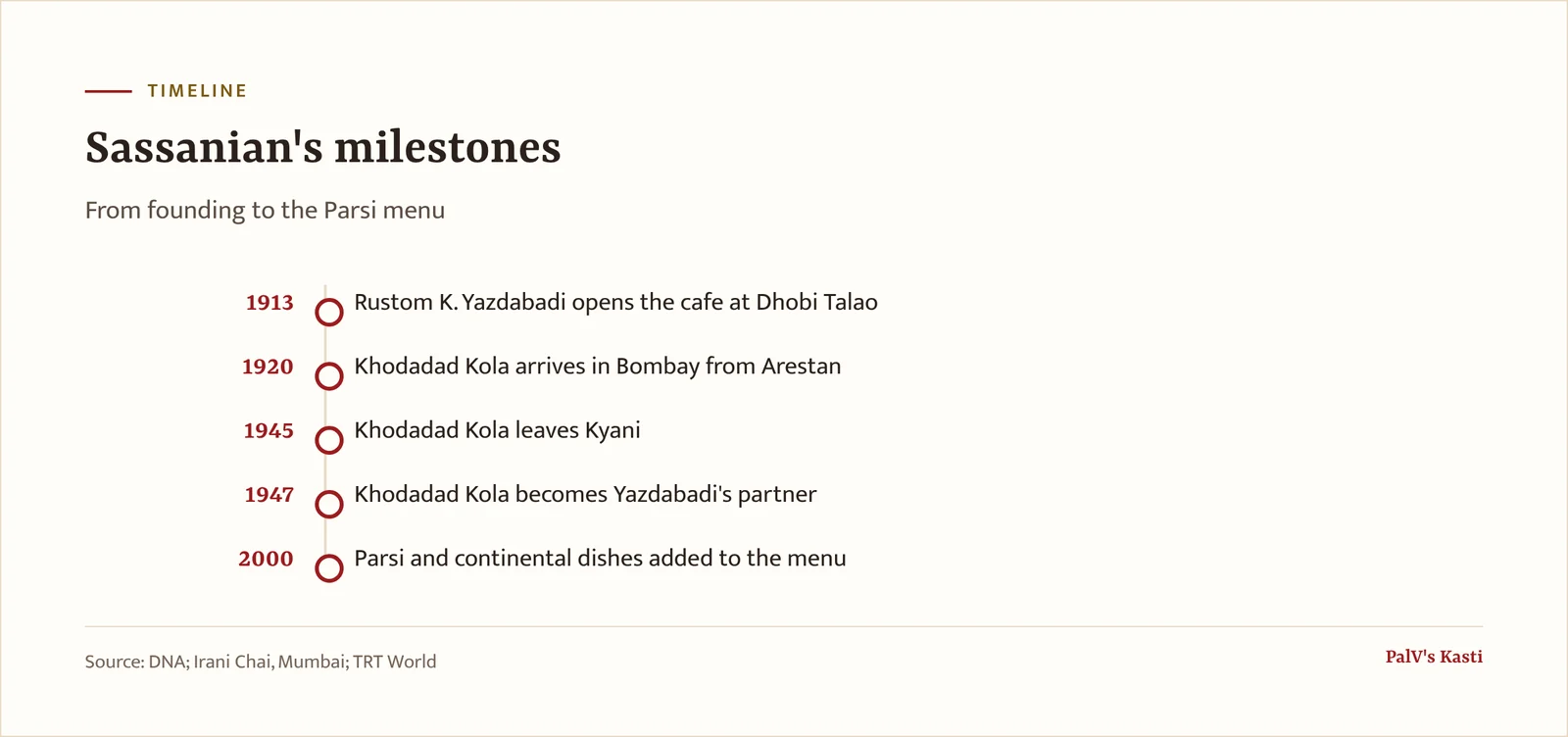
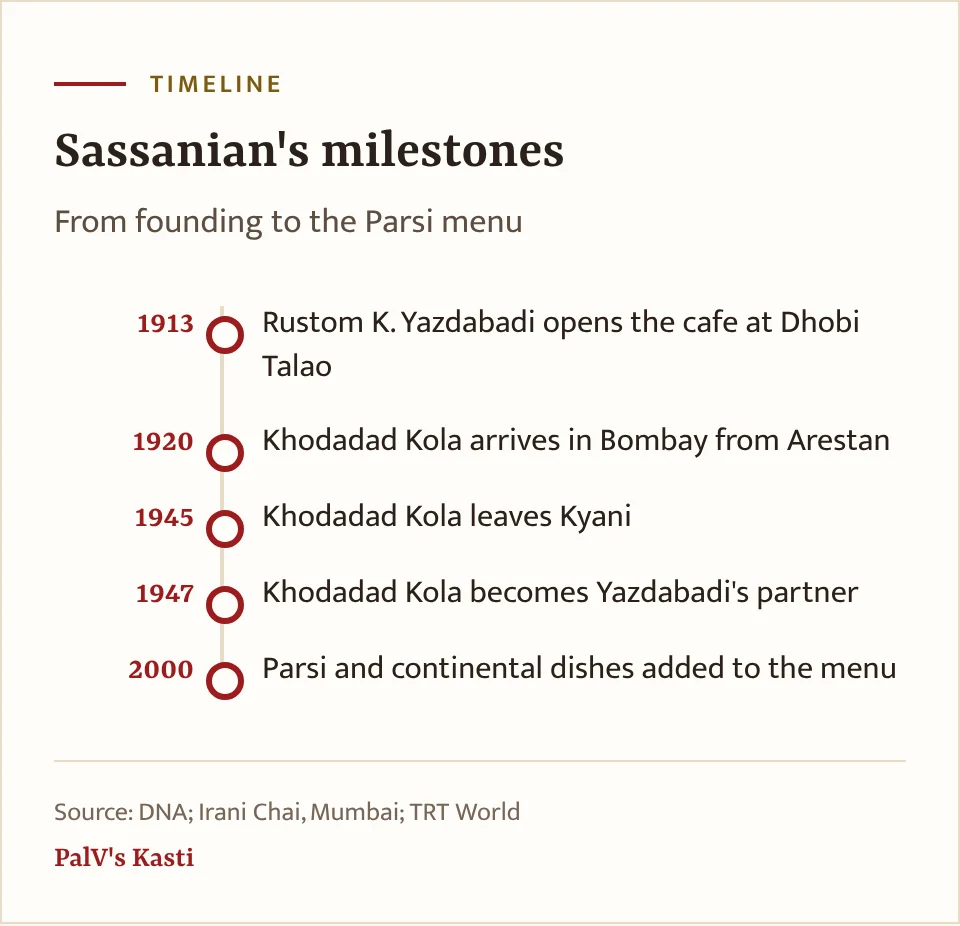
Meheraban told the Irani Chai project that his father came from Arestan, a village in Iran, where the family grew fruit such as pomegranates and apples. Khodadad reached Bombay in 1920. He first worked at Goodman Restaurant, a Persian bakery that later closed, then moved to Kyani, where he served as waiter, cashier and baker until 1945. Two years later he took up Sassanian. If you want the story of the cafe where he trained, read our Kyani & Co. history.
By 2014, DNA listed three partners: Meheraban Kola, Adi K. Yazdabadi and Irandokhd Behjat. Day-to-day running was with Meheraban, his sister Dilnaz and his brother-in-law Shahrukh, the paper said.
What did Sassanian serve at first, and what is it known for now?
Early Sassanian was a tea-and-bread place. The two main accounts differ slightly on the details:
- DNA (2014) says it served only bun maska, chai, mawa cakes and kheema at first.
- Meheraban Kola, in 2007, remembered "only bun maska, chai and omelette" and no proper meals.
Both agree on bun maska and chai. The big change came in 2000. Kola said that was the year they changed the menu and began serving Parsi and continental dishes, and DNA and TRT World both date the move to 2000 as well. DNA named dhansak, salli chicken and roast chicken as the dishes the place had become famous for. Kola said the dhansak was probably its most popular dish.
What to try from the bakery counter
The baked goods still carry the name. DNA reported that mawa cakes, plum cakes and chicken puffs were the bakery's best sellers. TRT World mentions sweet and salted biscuits, scones and keema patties, while The Better India's 2023 list recommends the chicken rolls and mutton cutlets and singles out the mawa cakes. Menus change, so check what's on the shelf when you visit.
What was an Irani cafe like when Sassanian was young?
Meheraban Kola's memories give a picture of the old trade. An Irani restaurant opened at 5 in the morning, he said, and the papers arrived by about a quarter to five, still warm from the press. Besides tea, bun maska and omelettes, these cafes kept toothpaste, soap, hair oil, envelopes and cigarettes. "Just like a small convenience store," in his words.
The room has kept an old look. Writing in 2023, The Better India described a pre-Independence style and bentwood chairs. DNA named actresses Mumtaz and Helen among the cafe's regulars, and TRT World says writers, film stars and well-off Mumbaikars came in the past. Kola's rule, as he put it, was that a poor person, a rich person and a middle-class person all come to an Irani restaurant, so the food had to be good and value for money.
Is there a Zoroastrian link to the bakery's fire and its birthday?
Two details tie the cafe to the owners' faith, and both come from the owners themselves. DNA reported in 2014 that Sassanian marks its birthday on 21 March, the date the paper gave for the community's Navroz. And in his 2007 interview Meheraban Kola said the bakery fire had not gone out since 1913, even when the bakery was repaired. He linked this to his own belief as a Zoroastrian and credited it for the cafe's success. We report it as one owner's personal belief, not as a rule for bakeries.
Practice varies between families and Agiaries; your family priest's guidance comes first.
Frequently asked questions
When was Sassanian Boulangerie founded?
Sassanian Boulangerie was founded in 1913. DNA, Al Jazeera, TRT World and The Better India all give this year, and co-owner Meheraban Kola gave the same date in a 2007 oral history interview. DNA reported in 2014 that the cafe celebrates its birthday on 21 March, which the paper noted is Navroz for the community.
Who founded Sassanian in Mumbai?
Rustom K. Yazdabadi founded the cafe in 1913. Al Jazeera reported that he had migrated from Yazd in Iran. In 1947 Khodadad Kola, who had worked at Kyani until 1945, became his partner. Khodadad's son Meheraban Kola later ran the cafe, and in 2014 DNA listed him with Adi K. Yazdabadi and Irandokhd Behjat as partners.
Where is Sassanian Boulangerie?
Sassanian Boulangerie is at Dhobi Talao, near the Gol Masjid, in the Marine Lines area of south Mumbai. DNA gave this location in 2014 and The Better India listed it under Marine Lines in 2023. Opening hours aren't confirmed in recent reports, so it's sensible to check with the cafe before making a special trip.
What is Sassanian famous for?
Sassanian is best known for its mawa cakes and plum cakes, chicken puffs and patties, bun maska and chai. Since 2000 it has also served Parsi food. DNA in 2014 named dhansak, salli chicken and roast chicken as its famous dishes, and co-owner Meheraban Kola said the dhansak was probably its most popular dish.
Why is the cafe named Sassanian?
The cafe is named after the Sassanid dynasty, which Al Jazeera and TRT World describe as ruling Iran for more than 400 years. Its founder came from Yazd in Iran, according to Al Jazeera. The second word, Boulangerie, means bakery in French. DNA reported the original trading name as KR Sassanian Restaurant and Bakery.


