 PalV's Kasti
On this page
Kolah vinegar is a family-run sugarcane vinegar business from Navsari in south Gujarat. According to E.F. Kolah's own website, Eduljee Faramji Kolah set up the company in 1885, and for its first years it made one thing only: brewed sugarcane vinegar, the dark Sarko of Parsi kitchens. Condé Nast Traveller India gave the same year and town in 2021. The company says the business has passed from father to son ever since. A second Navsari maker, R.E. Kolah, also says it began in 1885.
શહેરેવર રોજ
Shehrevar Roj, Tir Mah · 1396 Y.Z.
Who founded Kolah vinegar, and when?
E.F. Kolah's website names Shri Eduljee Faramji Kolah as the founder and 1885 as the year the company was established. At the start, it says, the firm made only "Genuine Brewed Sugarcane Vinegar (Sarko)". Pickles and other condiments came later.
Condé Nast Traveller India, in a 2021 piece on century-old Parsi food brands, said the brand began by making sugarcane vinegar in Navsari in 1885. It spells the founder's name Edalji Kolah. The company writes Eduljee, and we follow the company's spelling here. Both sources agree on the year and the place. We have not found a record older than the company's own account, so treat 1885 as the date the family gives.
How did E.F. Kolah grow after its founder?
Everything in this section comes from the company's About Us page. No independent history of the family firm is in print that we could find.
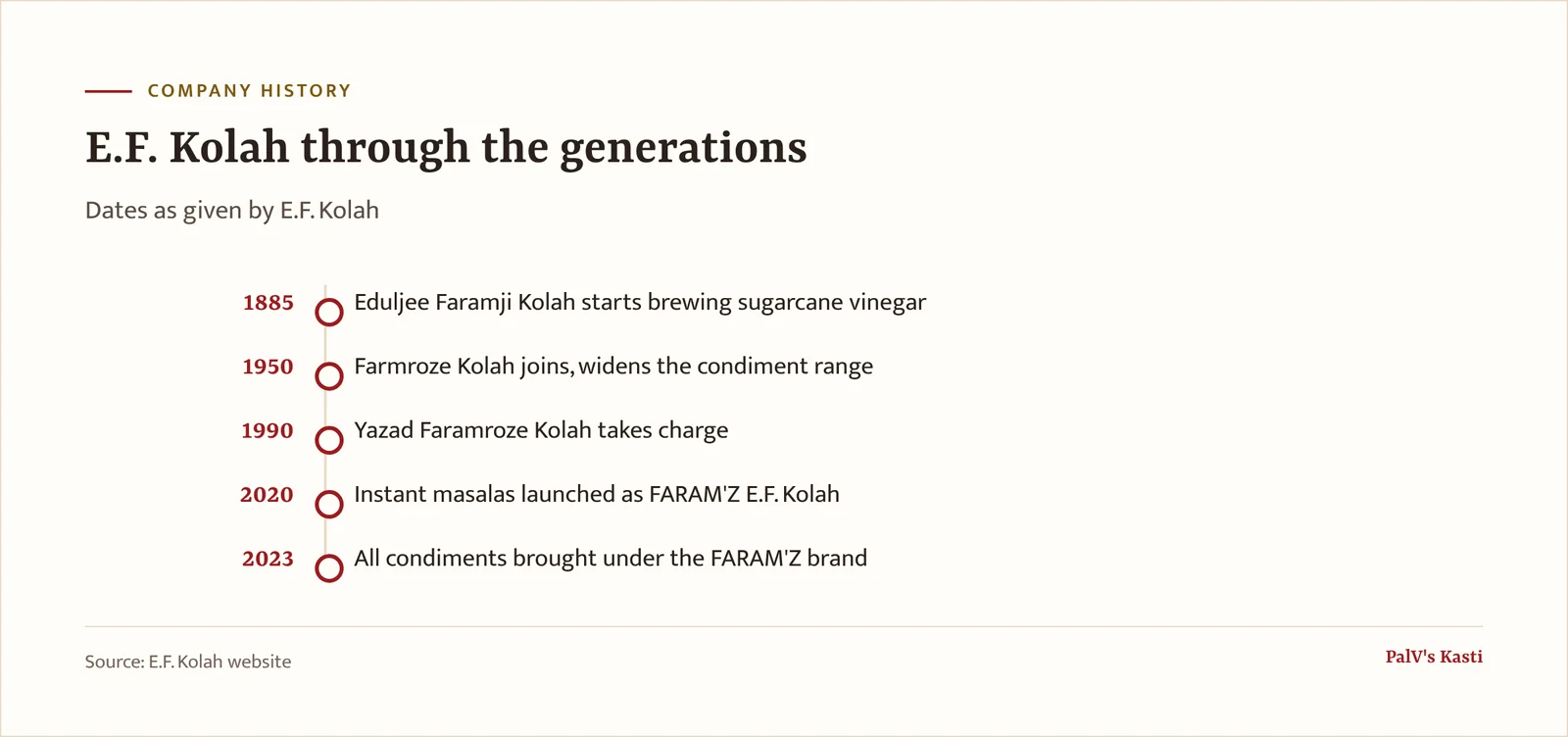
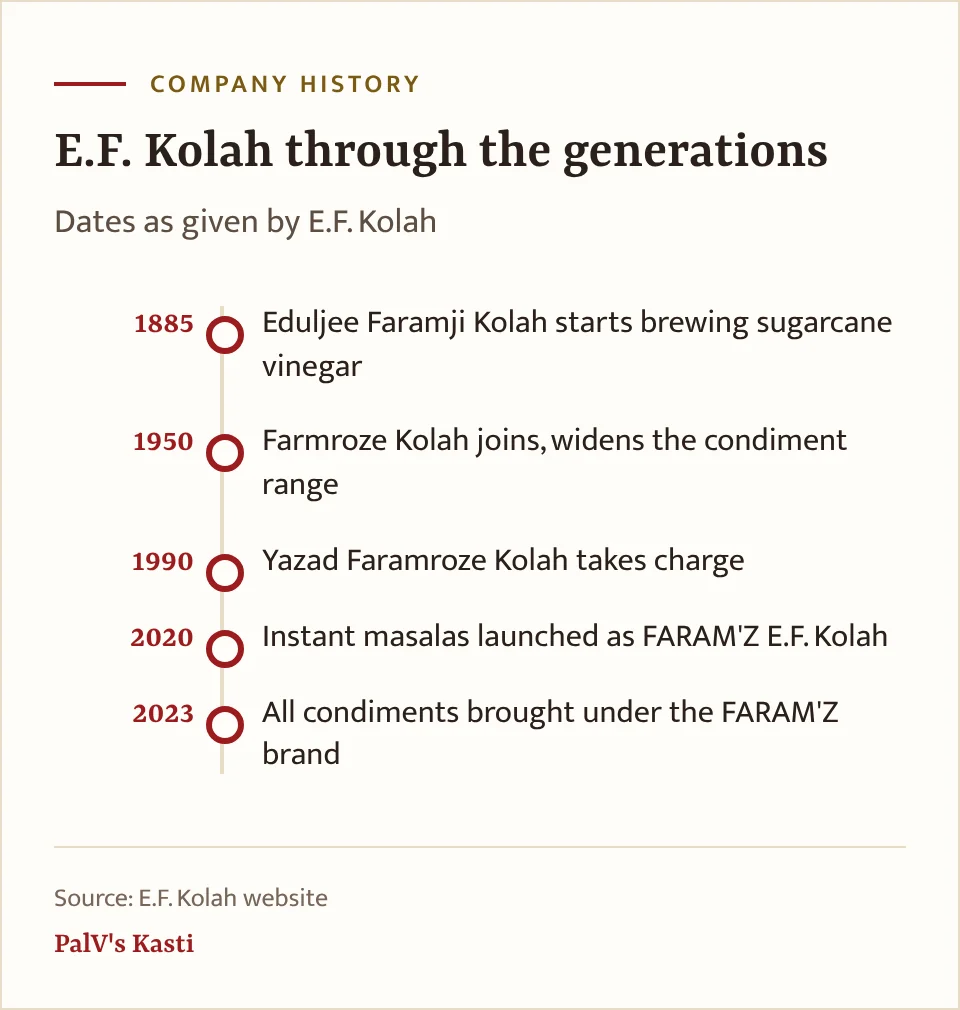
- Second generation: Jehangirji Kolah, Eduljee's eldest son, carried on the Sarko trade, made it bigger and started a small line of condiments.
- 1950: Farmroze Kolah, Jehangirji's eldest son, joined and widened the range of condiments. The company says it grew a great deal through the 1960s and 1970s.
- 1990: Yazad Faramroze Kolah took charge.
- 2020: Yazad started a range of instant masalas under the name FARAM'Z E.F. Kolah.
- 2023: all the condiments were brought under one brand, FARAM'Z. The site lists more than 30 products.
- Fifth generation: Hanosh, Yazad's elder son, added canned mango pulp and tomato ketchup.
Condé Nast Traveller India reported in 2021 that the brand also made masalas, pickles and ice cream. The company's current product list does not mention ice cream, so we can only say the magazine reported it.
Why is Kolah vinegar made in Navsari?
Neither company explains why it chose Navsari, but the town's place in Parsi life is well recorded. Encyclopaedia Iranica describes Navsari becoming the centre of Parsi religious authority in 17th-century India, and notes that the 1881 census counted 8,118 Parsis there, four years before E.F. Kolah's founding year. Niloufer Ichaporia King, in her cookbook My Bombay Kitchen, calls Navsari the stronghold of Parsi religion and traditional culture when she names Kolah's as the vinegar brand Parsis cherish. For more on the town itself, see our Navsari Parsi history.
What is the difference between EF Kolah and RE Kolah?
They are two separate brands of sugarcane vinegar. Writing in Traveldine in 2022, Shabnam Minwalla reported that both are based in Navsari, both make their vinegar in wooden barrels, and both claim to have started in 1885. She added that cooks do not treat one as a swap for the other.
In the same article, caterer and food anthropologist Dr Kurush Dalal names three Kolahs a cook might swear by: EF Kolah, Framroz Kolah and Rustomji Edulji Kolah. Why Parsi cooks hold on so hard to one bottle is a story we tell in our Sarko guide.
We could not find a website or a published history for R.E. Kolah, so we cannot say who founded it or how it is related to the E.F. Kolah family. Whether "Framroz Kolah" in Dr Dalal's list is a third maker or another way of naming E.F. Kolah, now sold as FARAM'Z, is also something the sources do not settle.
How is Kolah sarko made?
Very little is on record. E.F. Kolah calls its product genuine brewed sugarcane vinegar, and Traveldine reports wooden barrels at both Navsari makers. Neither company publishes its method, ageing time or recipe, and we found no newspaper or book that describes the process. We would rather leave the gap than guess.
Where do people buy Kolah vinegar outside Navsari?
In 2022 Traveldine described EF Kolah vinegar as hard to find in Mumbai: a pouch at the shop in Cusrow Baug or at Grub Corner in Fort on a good day, otherwise a trip to Kerawalla and Co near Dhobi Talao. It said the RE Kolah vinegar could be ordered online. Outlook Traveller wrote in 2014 that Grub Corner stocked E.F. Kolah pickles such as lagan nu achar and fish egg achar. Condé Nast Traveller India said in 2021 that the products still travel from Navsari to Mumbai and Pune, on a 48-hour advance order. Abroad, Niloufer Ichaporia King wrote that Kolah's could be bought in the United States. Stockists change, so check before you travel for a bottle.
Frequently asked questions
When was E.F. Kolah founded?
E.F. Kolah gives 1885 as its founding year, and Condé Nast Traveller India reported the same year in 2021. The company says it began in Navsari, Gujarat, making only brewed sugarcane vinegar, known in Parsi homes as sarko. Its condiments, masalas, ketchup and mango pulp were added by later generations of the Kolah family.
Who founded Kolah vinegar?
According to E.F. Kolah's website, the founder was Shri Eduljee Faramji Kolah. Condé Nast Traveller India spelled his name Edalji Kolah. The business then passed to his eldest son Jehangirji, then to Farmroze Kolah, who joined in 1950, and in 1990 to Yazad Faramroze Kolah, who introduced the FARAM'Z name.
What is the difference between EF Kolah and RE Kolah vinegar?
EF Kolah and RE Kolah are separate sugarcane vinegar brands. A 2022 Traveldine report said both are made in Navsari in wooden barrels and both claim an 1885 start. The report added that cooks do not swap one for the other. We found no public record of who founded RE Kolah or how the two families are linked.
Where is Kolah vinegar made?
Kolah vinegar is made in Navsari, in south Gujarat. E.F. Kolah lists its address as 5/844 Bamji Street, opposite Sorab Baug, Navsari 396445. Traveldine reported in 2022 that RE Kolah is also based in Navsari. Encyclopaedia Iranica describes the town as the centre of Parsi religious authority in 17th-century India.
Is Faramz the same as E.F. Kolah?
Yes. FARAM'Z is the brand name E.F. Kolah now uses. The company's website signs itself "E. F. Kolah : Faramz", and its About Us page says that in 2023 all its condiments were brought under the single FARAM'Z brand. The name first appeared on its instant masala range, launched in 2020.


