 PalV's Kasti
On this page
Kyani & Co. is an Irani cafe and bakery at Dhobi Talao, near Marine Lines in south Mumbai, and every source we checked dates it to 1904. Al Jazeera called it the oldest Irani cafe still operating in Mumbai in 2014, and Outlook Traveller said the same in November 2025, when it was 120 years old. Gateway House says the cafe moved into its present home, the Jer Mahal building, in 1913. Who founded it is less settled: the Shokriye family and Gateway House name two brothers from Yazd, Khodadad and Khodamorad, while DNA and The Better India name a single founder. Aflatoon Shokriye's family has run it since 1959, and DNA reported in 2018 that his son Farokh took charge in 2000.
શહેરેવર રોજ
Shehrevar Roj, Tir Mah · 1396 Y.Z.
When was Kyani & Co. founded, and by whom?
The year is not in dispute. Al Jazeera, Gateway House, DNA, The Better India and Outlook Traveller all give 1904, and the cafe's own long-time owner said the same in an interview recorded in April 2007 for the Irani Chai, Mumbai oral history project.
The founder is where the accounts split. In that 2007 interview, Aflatoon Khodadad Shokriye said Kyani was set up in 1904 by his father Khodadad and his father's brother Khodamorad. Sifra Lentin, writing for Gateway House in 2019, gives the same pair, "Khodadad and Khodamorad Shukriye of Yazd". A 2014 DNA report names one founder instead, an Irani migrant it calls Khudamarad Marziban, and The Better India (2023) also names a single man, spelt Khodram Marezban. We have not found a document, such as a licence or deed, that settles it, so we give both.
Gateway House adds one more date: Kyani "shifted to its current premises in Jer Mahal building in 1913." That is the only source we found for the move.
Is Kyani the oldest Irani cafe in Mumbai?
It is the oldest one still open, as far as the press is concerned. Al Jazeera's 2014 photo essay on Mumbai's Irani cafes described Kyani as "the oldest operating Irani cafe in Mumbai". Outlook Traveller, in November 2025, called it Bombay's oldest Irani cafe "that's still open for service". Gateway House is more careful and says "possibly the oldest existing". Aflatoon Shokriye himself put it modestly in 2007: Kyani was "supposed to be" the oldest still operating.
Every one of these claims is about the oldest cafe still trading, not the first Irani cafe ever opened in the city. For how Kyani sits among the other old names, see our guide to the Irani cafes of Mumbai.
Who runs Kyani & Co. today?
The Shokriye family. In his 2007 interview, Aflatoon Khodadad Shokriye said he came to Bombay from Yazd in 1948, aged 18, on a student visa his father sent him, travelling overland through Kerman, Zahedan and Quetta to Karachi and then by steamer. His father was already at Kyani. DNA (2014) and The Better India both date Aflatoon's takeover to 1959.
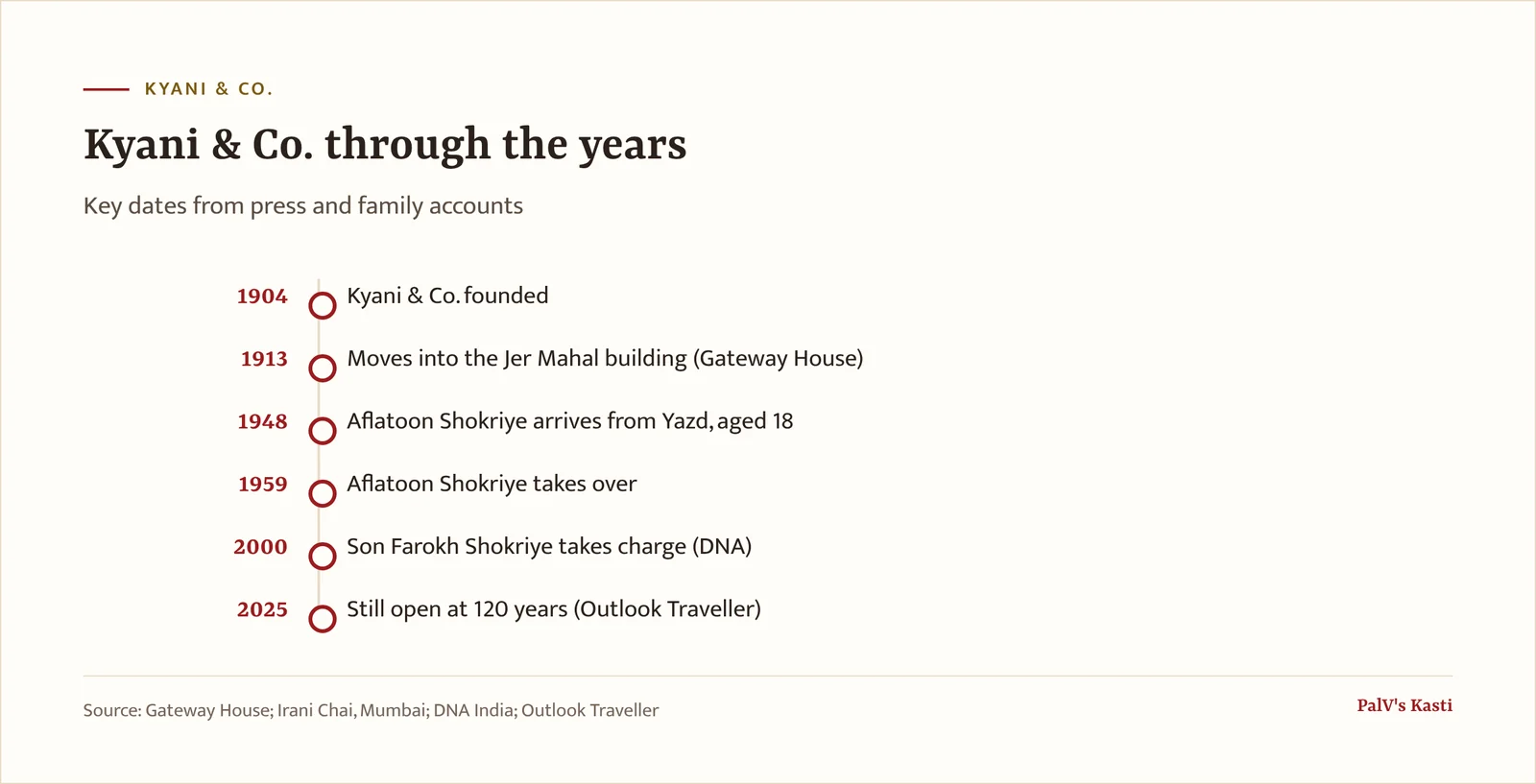
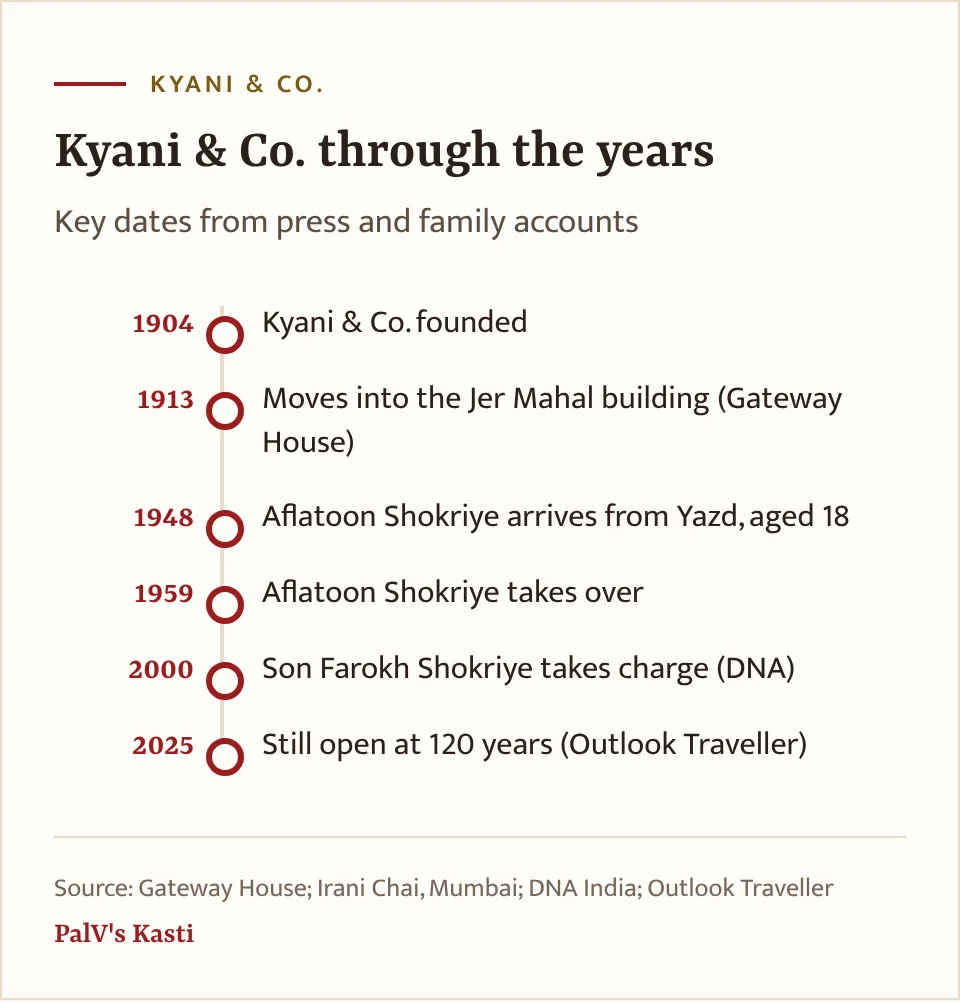
By 2007 he had made his sons Farookh and Farad partners. The oral history site records that he died in Mumbai in December 2015, though DNA had already called him "the late Aflatoon Shokri" in September 2014, so we cannot give a firm date. DNA reported in 2018 that his son Farokh Shokriye, who holds a law degree and had settled in New Zealand, took over in 2000 and promised his father he would not sell the cafe in his lifetime. That 2018 report is the latest ownership detail we could confirm.
What was Kyani like in its early decades?
Most of what we know comes from Aflatoon Shokriye's own memories, so read this section as one family's account.
He described the early Kyani as staffed entirely by Iranis and called it "a training college": young men learned the trade there, then went into partnerships and opened Irani cafes of their own. When he arrived in 1948, he recalled, Dhobi Talao was full of Parsis and Christians, the customers came in "tie, coat and all", and the cafe sometimes stayed open until midnight. By 2007 it was closing at 9 pm.
Across the road stood Bastani & Co., a confectioner in the same line of business. Office workers from Fountain and Colaba, he said, would buy sweets at one and walk over for tea at the other. DNA reported in 2018 that Bastani had shut more than a decade earlier after a family quarrel, and Aflatoon said its closure hurt Kyani's trade too.
Two other stories are worth knowing. DNA (2014) wrote that freedom fighters and journalists held meetings at Kyani during the Congress movement, and Outlook Traveller (2025) repeats that the cafe served them. And Aflatoon recalled that around 1952 Kyani, like many Irani cafes, briefly put kus-kus (poppy seed) in its tea until the Municipality stopped it.
What does Kyani & Co. look like inside?
Four published accounts describe much the same room. DNA's 2018 report lists Burmese teak tables with Italian marble tops under checked cloths, Belgian bentwood chairs, a grandfather clock, a mosaic floor and mirror-panelled walls. Al Jazeera's photographs show images of Parsi family members and religious icons high on the walls. Food writer Nik Sharma, visiting for Taste in 2018, noted the dim light, black-and-white photographs and large wood-and-glass cabinets of breads and biscuits. The Better India mentions glass jars of biscuits stacked towards the ceiling.
One recent change is structural. DNA reported two red pillars added to protect the building from vibration during Metro Line construction underneath.
What should you order at Kyani?
Outlook Traveller's November 2025 visit found office workers having bun maska with Irani chai for breakfast, students sharing mutton keema pav and cherry custard, and regulars over omelettes. The writer's own picks were kaju nankhatai, chicken cheese omelette and custard. The Better India recommends keema gotala, chicken cheese burji and chicken Irani kebabs. DNA in 2014 also listed farcha, dhansak and mawa cakes.
The longer menu is fairly new. Farokh Shokriye told DNA in 2018 that Kyani once served only breakfast fare such as sandwiches, omelettes, samosas and falooda, and that he added lunch dishes after a Parsi customer warned the family that the cafe would not survive the arrival of McDonald's and KFC without changing.
Where is Kyani & Co., and when is it open?
Outlook Traveller gives the address as Jer Mahal Building, 657 Jagannath Shankar Seth Road, opposite Metro Inox, Dhobi Talao, Marine Lines, Mumbai 400002. Its listed hours in November 2025 were 7 am to 7 pm Monday to Saturday and 7 am to 4 pm on Sunday. Hours have changed over the years, so check before you travel.
Frequently asked questions
When was Kyani & Co. founded?
Kyani & Co. was founded in 1904, a date given by Al Jazeera, Gateway House, DNA, The Better India and the owning Shokriye family. Gateway House adds that the cafe moved to its present premises in the Jer Mahal building at Dhobi Talao in 1913. Sources disagree on the founder's name.
Is Kyani the oldest Irani cafe in Mumbai?
Kyani is described as the oldest Irani cafe in Mumbai that is still operating. Al Jazeera said so in 2014 and Outlook Traveller in November 2025, when it was 120 years old. Gateway House is more cautious and calls it "possibly the oldest existing" Irani cafe in the city. No source claims it was the first ever opened.
What should I order at Kyani & Co.?
Press visits point to bun maska with Irani chai, mutton keema pav, omelettes, cherry custard and kaju nankhatai, according to Outlook Traveller in 2025. The Better India suggests keema gotala, chicken cheese burji and chicken Irani kebabs. DNA reported in 2018 that lunch dishes came only after Farokh Shokriye took over in 2000.
Where is Kyani & Co. located?
Kyani & Co. is in the Jer Mahal Building, 657 Jagannath Shankar Seth Road, opposite Metro Inox at Dhobi Talao, near Marine Lines in south Mumbai. Outlook Traveller listed its hours in November 2025 as 7 am to 7 pm Monday to Saturday and 7 am to 4 pm on Sunday.
Who owns Kyani & Co. today?
The Shokriye family has run Kyani since 1959, when Aflatoon Shokriye took over, according to DNA and The Better India. DNA reported in 2018 that his son Farokh Shokriye had taken charge in 2000 and promised his father not to sell the cafe. We found no later report on ownership.


