 PalV's Kasti
On this page
A Zoroastrian wedding ceremony, known among Parsis in India as the Ashirwad, is a set of questions, vows and blessings recited by two priests over the bride and groom in front of their witnesses. The priests ask the witnesses and the couple, three times over, whether they agree to the marriage, then bless the couple and give them advice for married life. On marriage age, J.J. Modi wrote in 1922 that the Avesta puts it at fifteen for both men and women, and that the marriage prayers assume a grown-up couple. Indian law is stricter today. Under the Parsi Marriage and Divorce Act, 1936, a Parsi groom must be at least 21 and a bride at least 18.
For the whole occasion, from the first exchange of gifts to the feast, see our guide to the Parsi wedding. This page stays with the ceremony itself.
અસપંદામેદ રોજ
Asfandarmad Roj, Tir Mah · 1396 Y.Z.
What happens in a Zoroastrian wedding ceremony?
J.J. Modi's paper The Marriage Ceremony of the Parsis (second edition, 1921) splits the religious part into three stages, all performed by two priests:
- Opening blessings, recited in Pazand by the senior priest, who stands before the groom while the junior priest stands before the bride.
- Questions to the witnesses and then to the couple, asking whether they consent.
- A joint address by both priests, full of blessings and advice, which closes with a benediction called the Tan-dorosti.
The Encyclopaedia Iranica entry on the Ashirvad (M.F. Kanga, 1987) describes the same core: prayers and admonitions recited by two officiating priests, with the vows said before the witnesses three times. Dosabhai Framji Karaka's History of the Parsis (1884) also names two dasturs reciting the blessings.
According to Dadrawala and Modi, the first words declare that the ceremony is held according to the rules and customs of the Mazdayasni religion: avar dad va ain-i-Din-i-Mazdayasni. Ervad Dr Ramiyar Karanjia writes that while the priests recite, they shower the couple with rice, coconut shreds, pomegranate seeds and rose petals. In his account the coconut stands for helpfulness, rice for plenty, pomegranate for children and rose petals for happiness.
What are the questions asked at the wedding?
Modi gives the questions in English. The groom's witness is asked, before the assembly, whether he has agreed to take the bride for the groom by the rules of the Mazdayasnans, with a promise to pay her 2,000 dirams in white silver and two gold dinars struck at Nishapur. Karaka's 1884 account records the same sum. Modi suggests this was the usual gift from the groom's family to the bride in ancient Persia. The bride's witness is then asked whether the family agrees to give her in marriage. Finally the couple are asked whether they choose this marriage for the rest of their lives, with a righteous mind. Each answers that they have.
All of this is said three times. Modi explains it as making the matter "doubly or trebly sure", and Karanjia also notes that this part is repeated thrice.
Who performs it, and how are the couple seated?
Karanjia states that choosing the two priests is the groom's family's right. The couple sit side by side, the groom on the bride's right, facing east, while the priests face west. Modi records the same east-facing seats and the groom on the right, which he calls the place of honour. Each side has one witness. Modi's 1921 paper adds that the nearest relatives usually serve as witnesses, and married people are preferred over bachelors.
The stage itself, with its lamps, Ses and fire vase, is the subject of Parsi wedding stage decoration.
In which language is the ceremony said?
The Iranica entry says that in Parsi usage the vows and blessings are recited in Pazand and then repeated in Sanskrit. Karaka (1884) explains the Sanskrit repetition as a promise made to the Rana of Sanjan when the Parsis landed. Modi gives the same reason but adds that there is "no written authority" for it, and that by his time many families no longer had the Sanskrit address recited.
Practice varies between families and Agiaries; your family priest's guidance comes first.
Is a Zoroastrian wedding held in the evening or the morning?
Among Parsis, the evening. The Iranica entry calls sunset the usual time and contrasts it with Irani Zoroastrian usage, which it says prefers the morning. Modi (1922) and Karanjia both place Parsi weddings after sunset. Even so, Karanjia notes that some families now hold the ceremony in the morning and again in the evening, and Noshir H. Dadrawala wrote in Parsi Times in January 2023 that many now choose the morning.
Karanjia also points out that the Kadimi, Irani and Shahenshahi ceremonies differ, and his own description follows the Shahenshahi form. How the rite has shifted since Modi set it down is traced in our history of Parsi wedding rites.
Practice varies between families and Agiaries; your family priest's guidance comes first.
What does the Zoroastrian religion say about marriage age?
The one published account we could check on this is Modi's, so what follows is his reading. In The Religious Ceremonies and Customs of the Parsees (1922), he writes that in the Avesta a man came of age at fifteen and so could marry then, citing the Tir and Behram Yashts and the Pahlavi Bundahishn. For women, too, he puts the age at fifteen, citing Vendidad 14.15. He reads the Avesta as showing no early marriages, since its brides pray for suitable husbands. He adds that the Paewand-nameh, the wedding prayer recited in his day, points the same way, because it asks the couple to consent after "truthful consideration".
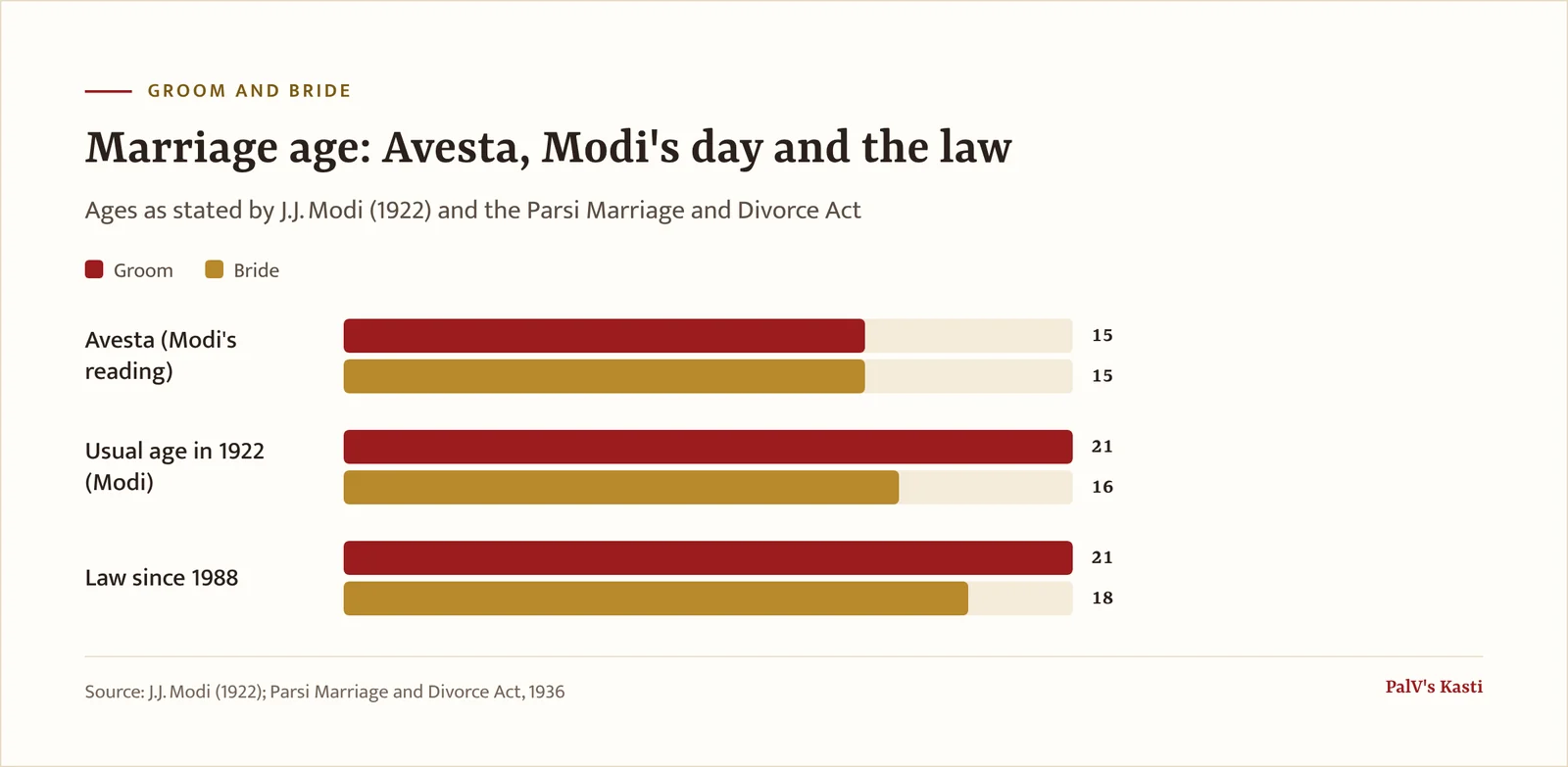
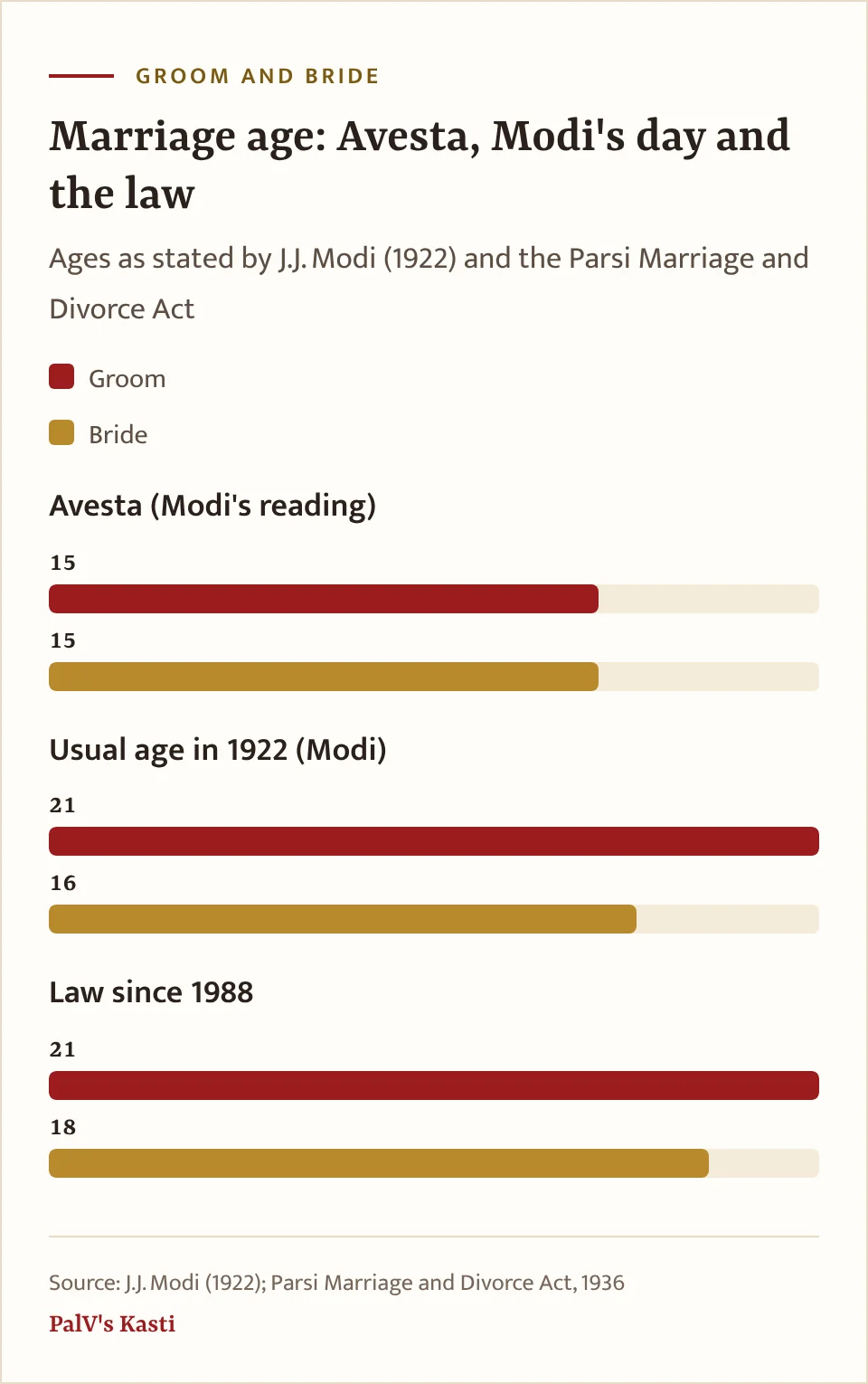
For his own day, Modi reports that Parsis generally married after 21 for men and after 16 for women. He notes that the Parsee Marriage Act then in force set 21 and 18, with parents signing the marriage certificate when the couple were younger. We could not find a published statement from today's High Priests setting a religious minimum age.
Practice varies between families and Agiaries; your family priest's guidance comes first.
What is the legal marriage age for Parsis in India?
Twenty-one for the groom and eighteen for the bride. Section 3(1)(c) of the Parsi Marriage and Divorce Act, 1936 says no marriage is valid if the man has not completed twenty-one years or the woman eighteen. The clause applies whether or not the Parsi concerned has changed religion or domicile. Its current wording was substituted by the Parsi Marriage and Divorce (Amendment) Act, 1988 (Act 5 of 1988), with effect from 15 April 1988.
The same section sets two other conditions. The couple must not be within the prohibited degrees listed in Schedule I (s.3(1)(a)), and the marriage must be solemnised by the Parsi ceremony called Ashirvad, by a priest, with two Parsi witnesses besides him (s.3(1)(b)). Under Section 6, the officiating priest certifies the marriage right after the ceremony. The priest, the couple and the two witnesses sign the certificate, and the priest sends it to the Registrar. Before 1988, fathers or guardians could sign for a party under 21. The 1988 Act removed those words.
Is a blessing ceremony the same as an Ashirvad?
Not in law, according to a Bombay High Court judgment of 23 September 2026 (Justice Somasekhar Sundaresan, Interim Application (L) No. 30398 of 2023, reported by Verdictum as H v. S). The couple had married in a civil ceremony in Perth, Australia, in August 2010 and held a ceremony in Mumbai that November. A panel of delegates, the community jury under the Act, watched a video of the Mumbai event and found it was a Tandoorasti blessing, not an Ashirvad. They noted that the marriage document had not been signed by the parties and witnesses. The court accepted that finding and dismissed the matrimonial suit for want of jurisdiction. This is the position as Verdictum reported it on 27 September 2026. We found no later report of an appeal.
This is general information, not legal advice; for a specific case, speak to a lawyer.
The prayer's own words, line by line, are on our Parsi wedding Ashirwad page.
Frequently asked questions
What happens in a Zoroastrian wedding?
Two priests perform the Ashirwad. They open with blessings, then ask the witnesses and the couple, three times, whether they consent to the marriage. Both priests then recite blessings and advice for the couple, showering them with rice and rose petals, and end with the Tan-dorosti benediction. Among Parsis this is usually done after sunset.
What is the legal marriage age for Parsis?
Under Section 3(1)(c) of the Parsi Marriage and Divorce Act, 1936, a Parsi marriage is not valid unless the groom has completed 21 years and the bride 18. This wording dates from the 1988 amendment (Act 5 of 1988), in force from 15 April 1988. It applies even if the Parsi has changed religion or domicile.
Who can perform a Zoroastrian wedding?
Priests perform it. J.J. Modi and the Encyclopaedia Iranica both describe two officiating priests. The Parsi Marriage and Divorce Act requires the Ashirvad to be performed by a priest in front of two Parsi witnesses besides him. Ervad Ramiyar Karanjia writes that the groom's family has the right to choose the priests.
What is the Ashirvad?
The Ashirvad, also spelt Ashirwad, is the religious marriage ceremony of the Parsis. The word means blessings. The Encyclopaedia Iranica defines it as the prayers and admonitions recited by two officiating priests. In Parsi usage these are said in Pazand and then repeated in Sanskrit. Indian law treats it as essential to a valid Parsi marriage.
Can Parsis marry in the morning?
Yes, some do. Sunset remains the usual time for Parsi weddings, but Ervad Ramiyar Karanjia notes that some families now hold the ceremony in the morning and again in the evening. Noshir Dadrawala wrote in 2023 that many choose the morning. The Encyclopaedia Iranica says Irani Zoroastrians prefer the morning.


