 PalV's Kasti
On this page
- What is Agharni in a Parsi family?
- In which month is Agharni done?
- How is the Agharni ceremony performed?
- What do the coconut, the wheat and the seven rounds mean?
- Is Agharni a religious ceremony, and is there a prayer for it?
- What gifts are given at Agharni?
- What happens after Agharni?
- Frequently asked questions
Agharni is the day a Parsi family keeps once a woman has completed the seventh month of her first pregnancy. J.J. Modi, in his 1922 book on Parsi ceremonies, describes it as a day of rejoicing held only for a first pregnancy, and the 1899 Bombay Gazetteer gives the same timing. In the older accounts, the mother-to-be stands on a low wooden stool over chalk designs, is dressed in new clothes from her husband's family, and has her lap filled with a coconut, dates and other dry fruit. She then walks to her parents' home, enters right foot first, and circles the room where she will give birth seven times, holding a lamp and water. Modi writes that these days are kept without religious injunction or rites.
શહેરેવર રોજ
Shehrevar Roj, Tir Mah · 1396 Y.Z.
What is Agharni in a Parsi family?
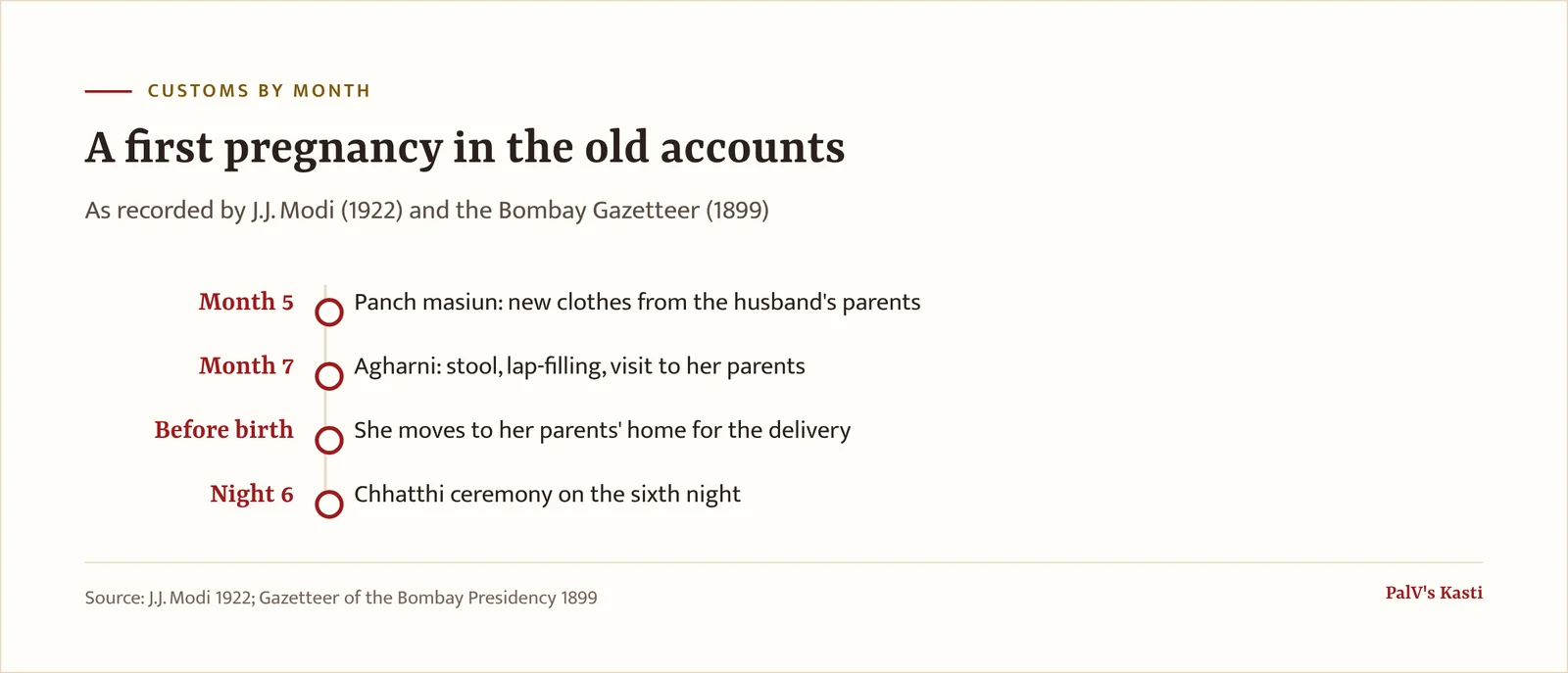
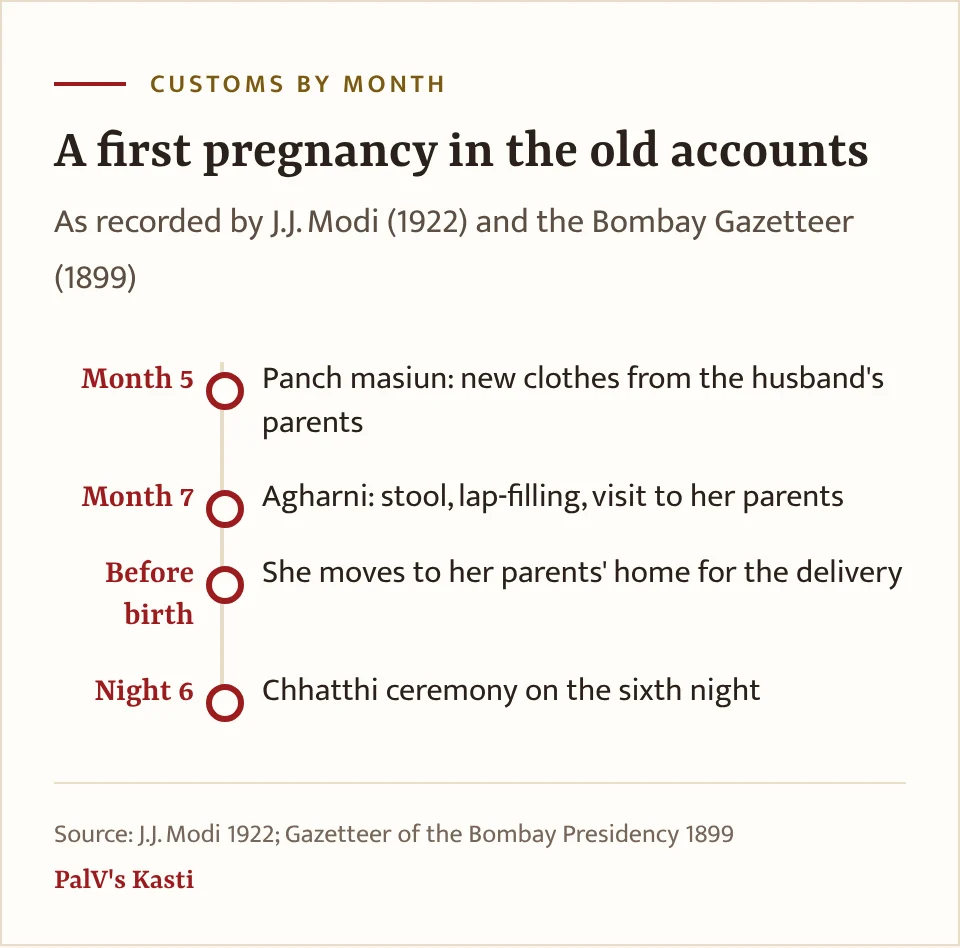
Agharni (also written Agarni or Aghrni, and sometimes called Agharni Karvani Reet) is a social celebration of a first pregnancy. It is the second of two such days. The first comes at the end of the fifth month, which Modi calls "Panch masiun". The Gazetteer says the husband's parents give the young woman new clothes on that day, and Iranica says both sets of parents do. The Gazetteer of the Bombay Presidency calls Agharni the more important of the two pregnancy ceremonies.
Encyclopaedia Iranica's entry on childbirth in Zoroastrianism (Jenny Rose, 1991) lists both days among Parsi pregnancy practices and adds that Agharni takes place in the presence of married women who have had children. For how Agharni fits alongside the customs that follow a birth, see our overview of Parsi pregnancy and birth ceremonies.
In which month is Agharni done?
Three sources place it in the seventh month: Modi (on its completion), the 1899 Gazetteer and Encyclopaedia Iranica. Dosabhai Framji Karaka, writing his History of the Parsis in 1884, says it was held after either seven or sometimes the full nine months.
The exact day was picked for luck. Karaka and Iranica both speak of an auspicious day. The Gazetteer is more specific: a Thursday or Sunday in the seventh month, at a morning or evening hour that a Hindu or Parsi astrologer had fixed as lucky. If you are planning one now, settle the date with your elders and your family priest.
How is the Agharni ceremony performed?
The fullest descriptions are Karaka's (1884) and the Gazetteer's (1899). They agree on the main steps and differ on small details, which are noted below. This is the order they record.
- The morning at the husband's home. Karaka says the mother-in-law dressed the young woman in new clothes early in the day and sent her parents a gift of fish, curds, milk and sugar, which they returned with additions.
- Chalk designs and a stool. Lucky patterns were drawn on the floor. Karaka mentions lime and coloured powders worked into fish, peacocks, birds and flowers. A low wooden stool was set in the middle. The Gazetteer notes it was made without metal nails, and Karaka puts its height at two or three inches.
- Dressing on the stool. Standing on the stool, she put on the new clothes from her husband's parents. The Gazetteer's 1899 list is a silk sari, silk trousers, a Navjote.">Sadra and Kusti, a head-cloth, a bodice and new shoes. Her forehead was marked with red powder (kunku), garlands went round her neck, and the women showered rice over her head as they blessed her.
- Filling the lap. A coconut, dates, betel nut and leaves and other dry fruit were placed in the fold of her sari. The Gazetteer adds sweet-balls and almonds and says the mother-in-law or sister-in-law did this.
- The walk to her parents' house. Relatives and friends went with her, carrying a basket of wheat and trays of sweets.
- Welcome at the threshold. Karaka says her mother greeted her at the door; the Gazetteer says her mother or another elderly woman. Both accounts mention rice, an egg and a coconut being broken. The Gazetteer describes a plate of rice and water waved round her head first. She stepped in with her right foot.
- Seven rounds of the birth room. Holding a lamp in one hand and water in the other, she walked round the room set aside for the delivery seven times, sprinkling water as she went.
- Back to her husband's home. Karaka says her mother changed her into another new dress, gave her something sweet to eat and sent her back with the wheat and sweets, topped up.
Soon after, the wife's family sent gifts to the husband. Modi, Karaka and the Gazetteer all record a suit of clothes for him, and Karaka adds rings and shawls. Karaka also says the women who carried these gifts were given dinner at the husband's house and sang songs suited to the day.
Practice varies between families and Agiaries; your family priest's guidance comes first.
What do the coconut, the wheat and the seven rounds mean?
The sources give their own explanations, and they don't always agree.
- The coconut. Karaka calls the coconut and dry fruit in her lap symbols of fruitfulness. Modi notes that among the sweets sent out for these days, one shaped like a coconut takes pride of place, and he explains that the coconut stands for a man's head and so for fertility.
- Wheat and sweets. Karaka says these were carried as signs of plenty and happiness.
- The seven rounds with lamp and water. Karaka gives the meaning as a popular saying of his time put it: so that her children would never see darkness or drought, never short of sunshine or water. The Gazetteer gives a different reason, that the rounds were meant to drive evil spirits from the room.
Is Agharni a religious ceremony, and is there a prayer for it?
No. Modi writes that the fifth- and seventh-month days are kept without any religious injunction and without religious ceremonies or rites, and that some of the customs used on these occasions are more Indian in origin than Persian or Zoroastrian. He also states that modern Parsis have no religious ceremonies during pregnancy. Iranica adds that there are no such formal prenatal rituals among Zoroastrians in Iran.
None of the sources we checked (Modi, Karaka, the Gazetteer, Iranica) records a set prayer for Agharni, so we haven't printed one. The one practice Modi links to the religious books is a lamp of clarified butter (ghee) that some Parsis lit at home on completing the fifth and seventh months. He says Pahlavi and Persian texts explain such a fire as keeping evil influences out of the house, and he connects it with a blessing still heard in his day, "Tamaro cherag roshan rahe", may your lamp always burn, meaning may your line continue.
Practice varies between families and Agiaries; your family priest's guidance comes first.
What gifts are given at Agharni?
Clothes are the constant. Iranica says the mother-to-be receives a new set of clothes and jewellery from each set of parents, and sweets as a sign of happiness. Modi mentions suits of clothes from her parents, relatives and friends, and above all from her husband's family. In return, the husband gets a suit of clothes from his wife's side, which the Gazetteer valued at Rs 10 to Rs 50 in 1899. Modi adds that the husband's family sends sweets to the wife's home and to close relatives and friends.
What happens after Agharni?
Modi, Karaka and the Gazetteer all say a first baby was usually delivered at the wife's parents' home. Karaka describes the mother-in-law, as the due date neared, giving the young woman a little money and a coconut, marking her forehead with red powder and sending her to her mother's house. After the birth, the next custom in the old accounts falls on the sixth night, the Chhatthi ceremony.
Frequently asked questions
What is Agharni in Parsi?
Agharni is a family celebration held once a woman completes the seventh month of her first pregnancy. She is dressed in new clothes from her husband's family, her lap is filled with a coconut and dry fruit, and she visits her parents' home. J.J. Modi records it as a social custom, not a religious rite.
In which month is Agharni done?
Modi, the 1899 Bombay Gazetteer and Encyclopaedia Iranica all place Agharni in the seventh month of pregnancy. Karaka, writing in 1884, says it was sometimes held after the full nine months. The day itself was chosen as auspicious, and the Gazetteer mentions a Thursday or Sunday fixed by an astrologer.
Is Agharni only for the first pregnancy?
Yes, in the published accounts. Modi says the fifth- and seventh-month days are kept as days of rejoicing only for a first pregnancy, and the 1899 Gazetteer describes both as ceremonies connected with a Parsi woman's first pregnancy. Neither source describes an Agharni for a second or later child.
What gifts are given at Agharni?
The mother-to-be receives new clothes. Encyclopaedia Iranica says she gets clothes and jewellery from each set of parents, and sweets. Her husband receives a suit of clothes from her family in return. Sweets, including one shaped like a coconut, are sent to relatives and friends, according to J.J. Modi's 1922 account.
Is there a prayer recited at Agharni?
No set prayer appears in Modi, Karaka, the 1899 Gazetteer or Encyclopaedia Iranica. Modi says the pregnancy days follow no religious injunction and involve no religious rites. Modi records that some families lit a ghee lamp at home on completing the fifth and seventh months. Ask your family priest if you would like a prayer said.


