 PalV's Kasti
On this page
The Baj ceremony is a short priestly service in which consecrated bread, fruit, ghee and water are offered before a fire while the priest recites chapters 3 to 8 of the Yasna. In Parsi Gujarati it is also called the Baj-dharna, and its older name is the Dron Yasht. J.J. Modi, writing in 1922, lists it among the inner ceremonies, done only by a priest holding the Bareshnum, and Ervad Ramiyar Karanjia describes it being performed inside a marked-off ritual space called the pavi. Families know it best as a prayer for the departed: it is performed on the fourth, tenth and thirtieth days after a death, every month in the first year, and on each death anniversary. Karanjia calls it an essential prerequisite for a priest's other inner rituals. Modi puts a full Baj at a quarter of an hour to half an hour, and Karanjia at about twenty minutes.
શહેરેવર રોજ
Shehrevar Roj, Tir Mah · 1396 Y.Z.
Which "Baj" does this article mean?
Parsis use the word Baj in several senses. Modi lists four, among them a death anniversary and a muttered tone of prayer, and Ervad Ramiyar Karanjia, writing in Jame Jamshed in December 2018, counts seven. This article is about the ceremony itself: the Baj-dharna performed by a priest over offerings. The word's other senses are covered in our piece on the Meaning of Baj in the Avesta, and the short prayers that lay Zoroastrians say before and after daily acts are gathered in our Baj prayers list.
Why is the Baj ceremony considered indispensable?
Our sources give two reasons.
The first is that the Baj is the ground floor of the priestly rituals. Ramiyar Karanjia writes that a priest must first perform a Baj-dharna, for himself or for all souls, before any inner ritual, and that this gives him the ritual power of the "nani khub". Encyclopaedia Iranica's entry on the Dron says the same thing in its own words: the service is a basic preliminary for all the other high ceremonies. Modi records that the Baj of the five wires (Panch tai) is recited for the small Khub, which is needed before all the Bajs and the Yasna.
The second reason is its place in the rites after a death. Modi records four Bajs recited after midnight of the third day, those of Rashne-Astad, Ram, Srosh and Ardafrawash. Iranica places four Dron services just before the dawn that follows the third night, and names them for Vayu, for Rashnu and Arshtat, for Sraosha and for the Fravashis. In a 2016 Parsi Times interview, Ervad Pervez Karanjia, panthaky of the Sodawaterwalla Agiary, called the four Bajs of the Chaharum morning the most crucial. His list names Rashne and Ashtad, Mino-Ram and the Arda Fravash. He said that unless these four are performed, the soul cannot go on to its final destination. That is his teaching, given in his words.
A Baj is also required inside some longer ceremonies. According to both Ervad Pervez Karanjia and Ervad Ramiyar Karanjia, the Fareshta ceremony needs Bajs for the 33 divine beings, with 33 eggs and 33 bananas.
Practice varies between families and Agiaries; your family priest's guidance comes first.
Who can perform a Baj?
Only a qualified priest can perform the Baj ceremony. Modi sets out the conditions: the priest must hold the Bareshnum and be qualified with a Khub, the Baj is recited over offerings, a fire must burn with sandalwood and frankincense, and the place must be enclosed, either the Yazashna-gah of a fire temple or a washed and marked-off area in a home. Ervad Pervez Karanjia puts it as a priest who has been ordained both Navar and Maratab.
This is what makes the Baj an inner ceremony. Modi's 1922 definition of the inner services is that they are done in a place set apart for them, by priests who keep the Bareshnum, whereas outer services can be done in an ordinary house. Ramiyar Karanjia names a set of four rituals performed after a death: the Afringan, the Farokhshi, the Stum and the Baj. Elsewhere he lists the first three as outer rituals that a priest can perform once he has passed the Navar, and he calls the Baj-dharna a prerequisite for the other inner rituals. Our guide to the Zoroastrian outer ceremonies explains how those other three differ.
Practice varies between families and Agiaries; your family priest's guidance comes first.
What offerings are placed in the Baj?
The offerings themselves are also called "the Baj". Modi explains that the vessel with the offerings for a particular person is spoken of as that person's Baj, so on a day that is the anniversary of more than one death, a separate set is prepared for each.
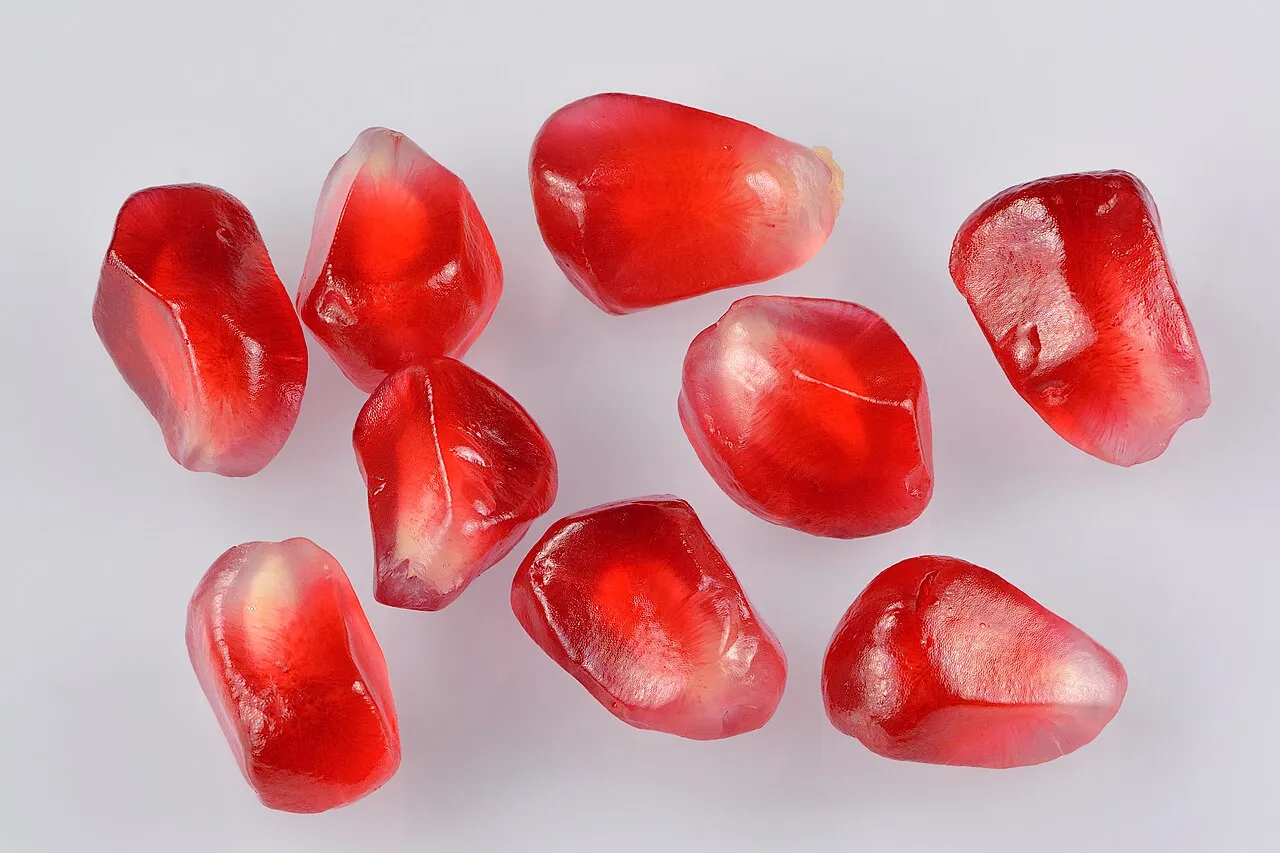
Modi and Ervad Pervez Karanjia name the same core requisites:
- Darun (dron): small round discs of unleavened wheat bread. Four are used for every Baj except the Baj of Sraosh, which uses six. Half are marked with nine marks and half are left plain.
- A fruit, usually a few pomegranate seeds. Modi adds that in India one banana was placed in each Baj, and that for those who could not afford much, a date or two or a few pomegranate seeds were enough.
- Ghee, standing for the animal creation. Modi wrote that in India an egg was treated as essential, with a little ghee being enough for those who could not afford one.
- Water made ritually pure.
- Fire in a vase, fed with sandalwood and frankincense.
Pervez Karanjia also lists the metal tools, including two German silver mugs (karasya), a water pot (kahana), a small bowl (fulya), five small wire chains and two German silver chains.
How the bread is made, why it carries nine marks and where its ritual power is said to come from are covered in Baj and the Dron.
Practice varies between families and Agiaries; your family priest's guidance comes first.
How is the Baj ceremony performed?
The outline below follows Modi's 1922 description and Ramiyar Karanjia's account of the Baj-dharna. It is a summary for families, not a priest's manual.
- The priest washes and purifies the utensils, fills two water mugs and lays out the breads with ghee and pomegranate seeds inside the pavi.
- If he has not already done so, he performs the Panch tai Baj with the five wires, which Modi says is needed for the small Khub. Pervez Karanjia says it gives the priest the endurance for further Bajs.
- He recites a Pazend introduction, the Dibacheh, naming the person, living or departed, for whom the Baj is done. Modi records that the name of the person who ordered the ceremony is recited too, as the Farmayashni.
- He recites Yasna chapters 3 to 8, the section known as the Sarosh Darun. Modi, Ramiyar Karanjia and Iranica all name these chapters.
- In chapter 8 he tastes the consecrated bread with ghee and fruit. This is the chashni. Modi and Karanjia count five tastings, and Modi seven in the Baj of Sraosh.
- Ramiyar Karanjia writes that the priest then puts three pieces of wood and some incense on the fire, steps out of the pavi and does the kusti.
- Anyone present may then take a little of the consecrated food as chashni. Modi and Karanjia both describe this sharing.
Modi writes that the Yasna chapters recited are mostly the same in every Baj, and that what changes is the being in whose honour it is performed. He reproduces a list of 30 kinds from the Parsi ritual books, from the Baj of the five wires and the Baj of Sraosh to the Bajs for the Gahambars and the Baj of Rapithwin. The full sequence, with what each part means, is set out in our post on Baj-dharna (Dron Yasht).
Practice varies between families and Agiaries; your family priest's guidance comes first.
When is a Baj performed for someone who has died?
Ramiyar Karanjia lists the days after a death on which the Baj-dharna is part of the prayers: the fourth day (Chaharum), the tenth (Dasma), the thirtieth (Siroza), the first month, the monthly days, the sixth month (Chhamsi), the first anniversary (Varsi) and the later anniversaries, as well as Parab days, Gahambars and the Farvardegan days. Modi gives the same main days, adding that in the first year the Baj is done every month on the roz of the death.
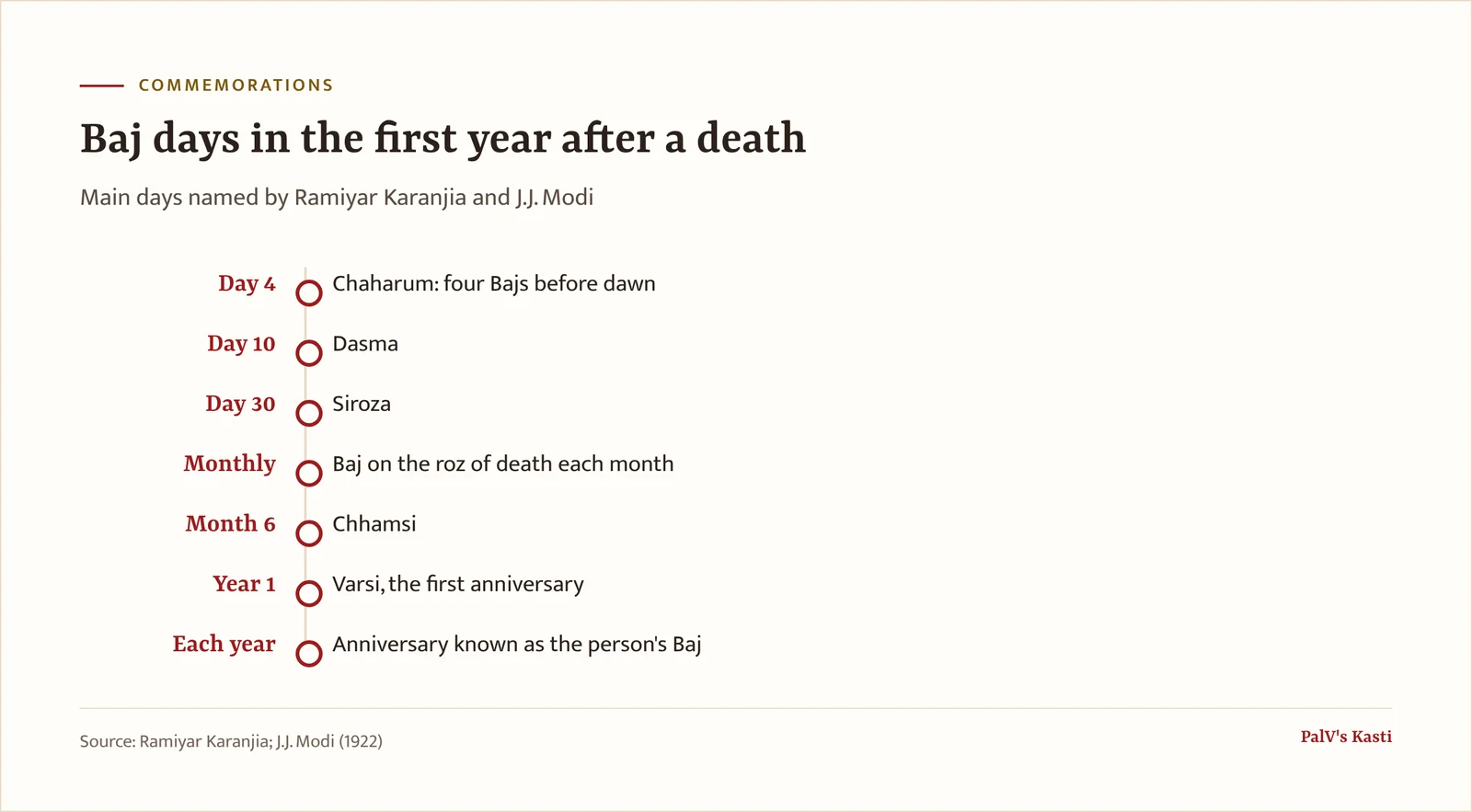

After the first year, the anniversary itself takes the name. Modi's example is that a Parsi would say "today is the fifth Baj" of someone, where an English speaker would say the fifth anniversary.
Modi wrote in 1922 that the son or nearest heir was considered to have the duty of having the Baj performed. He also described "Baj-rozgar" ceremonies, paid for from the interest on sums set aside in a person's lifetime or by will. He recorded that the townspeople of Navsari still marked the Baj of Dastur Meherji Rana by public subscription, about 300 years after his death. Modi also recorded that some people had the Baj of Homaji Jamshedji, a Broach Parsi hanged in 1783 whom many considered innocent, recited on his death anniversary, and that some made vows to do so. Our article on Homaji ni Baj tells that story.
How many years should a family keep the annual Baj? Ramiyar Karanjia writes that no religious text fixes a number. The past tradition, he says, was to keep the Muktad and the annual Baj for one generation, and today each family has to decide for itself.
Practice varies between families and Agiaries; your family priest's guidance comes first.
Frequently asked questions
What is a Baj in Parsi religion?
In the sense used here, a Baj is a priestly ceremony in which bread, fruit, ghee and water are consecrated before a fire while chapters 3 to 8 of the Yasna are recited. It is also called the Baj-dharna or Dron Yasht. The word also names a muttered tone of prayer and a death anniversary.
Who can perform the Baj?
Only a priest can. J.J. Modi wrote that the priest must hold the Bareshnum and be qualified with a Khub, and Ervad Pervez Karanjia says the priest must be ordained Navar and Maratab. The Baj is performed in a pavi, usually in a fire temple, which is why it counts as an inner ceremony.
What offerings are placed in the Baj?
The core offerings are small round unleavened breads called darun or dron, pomegranate seeds or another fruit, ghee and purified water, before a fire fed with sandalwood and frankincense. Four breads are used for most Bajs and six for the Baj of Sraosh. Modi adds that in India an egg and a banana were usually placed as well.
Why is the death anniversary called someone's Baj?
Because the Baj ceremony is the main prayer performed on that day. J.J. Modi recorded in 1922 that after the first year the Baj is performed on each anniversary of the death, so a Parsi would say "today is the fifth Baj" of a relative, meaning the fifth anniversary of that person's death.
How long does a Baj take?
Modi wrote that the full priestly Bajs take from about a quarter of an hour to half an hour, while the short Bajs said on everyday occasions take from half a minute to five minutes. Ervad Ramiyar Karanjia puts the Baj-dharna at about twenty minutes, performed by a single priest.


