 PalV's Kasti

On this page
Baj-dharna is the Parsi Gujarati name for the Dron Yasht, the short priestly ritual in which round consecrated bread (dron) is blessed and tasted. A single priest performs it. J.J. Modi (1922) requires him to hold the Bareshnum and a Khub, and he works inside a pavi, a space marked off by furrows, usually in the ritual area of a fire temple. Before him, Modi lists four breads (six in the Baj of Sraosh), ghee, pomegranate seeds, consecrated water and a fire fed with sandalwood and frankincense. He recites a Pazend Dibacheh naming the person and the yazata the rite is for, then Yasna chapters 3 to 8, tasting the bread during chapter 8. Ervad Ramiyar Karanjia puts it at about twenty minutes. Afterwards those present may share the consecrated food.
શહેરેવર રોજ
Shehrevar Roj, Tir Mah · 1396 Y.Z.
What is Baj-dharna, and why is it also called the Dron Yasht?
Ervad Ramiyar Karanjia explains that Baj-dharna is the everyday Parsi Gujarati name for what was first called the Drōn Yasht. Encyclopaedia Iranica's entry on the drōn, by Jamsheed Choksy, adds that Parsis have come to call the service the bāj, and know one form of it as the bāj of panj tāy, the five wires. Karanjia dates the way it is performed today to at least Sasanian times, and lists Pahlavi texts that refer to it, among them the Ardā Virāz Nāmag, the Nērangestān and a short text given entirely to the ritual, the Cim ī Drōn.
Indian priests, Karanjia adds, also use the full word Baj-dharna for the Avestan texts said before and after the Visperad and Vendidad. The several other things "Baj" can mean are set out in our post on the Meaning of Baj in the Avesta.
Who can perform the Baj-dharna?
Today, a qualified priest. J.J. Modi, in The Religious Ceremonies and Customs of the Parsees (1922), lays down that the liturgical Bajs may only be recited by a priest who keeps the Bareshnum and has the qualification of a Khub. Ervad Pervez Karanjia, described by Parsi Times in 2016 as Panthaky of the Sodawaterwalla Agiary at Dhobi Talao, told the paper that only priests who have become both Navar and Maratab can perform it. Ramiyar Karanjia notes that it is done by one priest alone.
It also comes first in a priest's own ritual life. Ramiyar Karanjia writes that before any inner ritual, a priest performs a Baj-dharna, either in his own name or remembering all souls, and that this gives him the ritual power of the nani khub. Modi makes a similar point about the Baj of the five wires (panch tai), which is recited for the small Khub needed before all Bajs and the Yasna. Iranica calls the service a basic preliminary for all other high ceremonies.
The sources put the reach of that preparation differently. Modi says a barsom tied by a priest who has done the small Khub can be used for three more Bajs, and one tied with the great Khub of Mino-Navar for nine. Pervez Karanjia says the Panj-Tae Baj gives the priest the endurance to perform four more Baj rituals.
It was not always only a priestly rite. Boyce and Kotwal, quoted on avesta.org, write that the simple dron service was once performed by laity as well as priests, and by women as well as men, though today it is mainly used by priests.
Practice varies between families and Agiaries; your family priest's guidance comes first.
Where and when is it performed?
Ramiyar Karanjia says it is performed mainly in the urwis gāh within the fire-temple precincts, but can be done in any ritually pure place within a pavi once certain requirements are met. Modi, a century earlier, says much the same in his own terms: in the Yazashna-gah of a temple, or in a private house in a place specially cleaned and enclosed by a pavi.
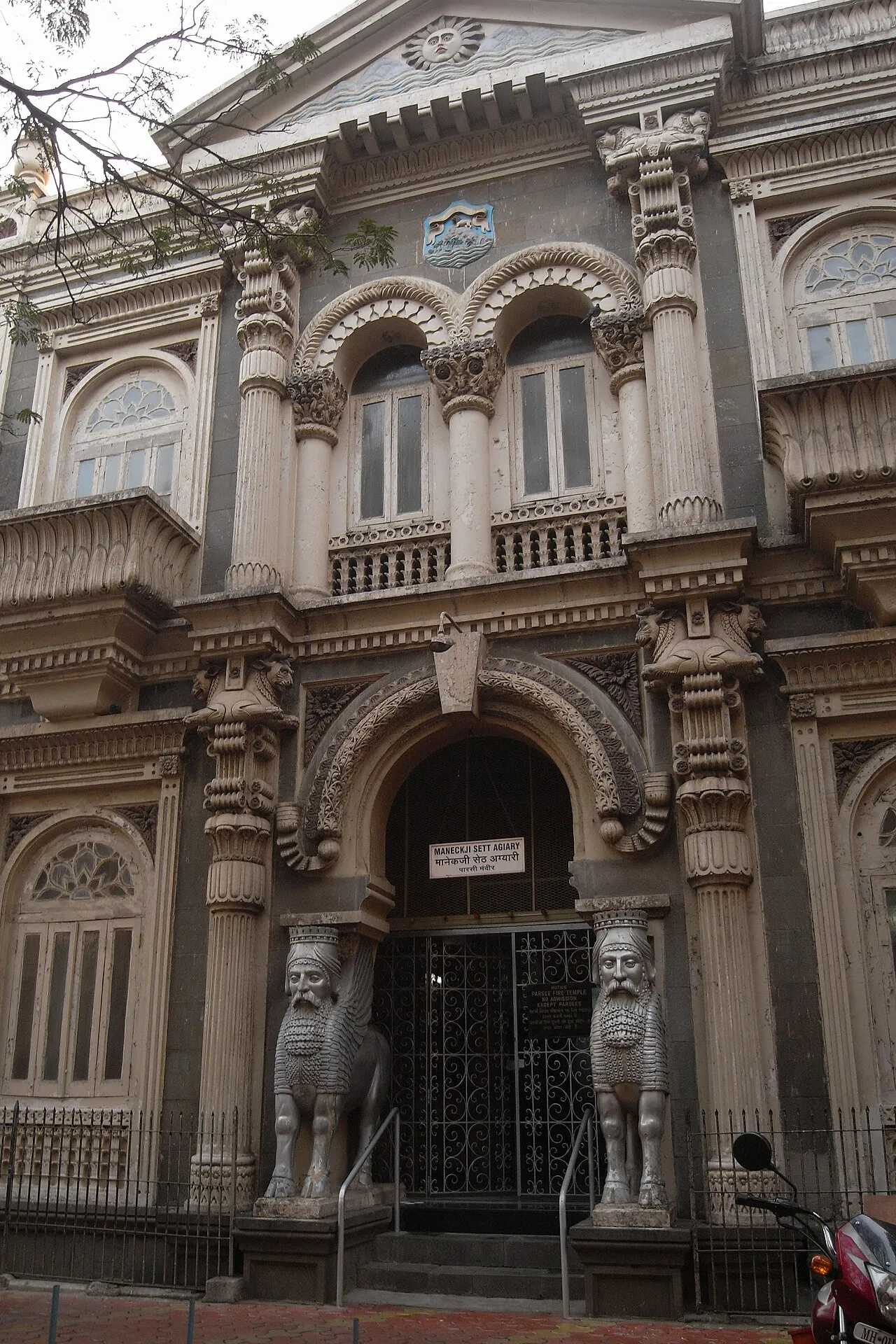
Once a priest has done it for himself, Karanjia writes, he performs it at the request of lay families, especially in memory of the departed. He lists the occasions after a death on which it forms part of the set of rituals, from the fourth day (Chahrum) and tenth day to the thirtieth day, the monthly roj, the sixth month and each anniversary, as well as important days of the calendar such as the Parabh, the Gahambars and the Frawardegan. How these occasions fit together is the subject of our main guide to the Baj ceremony. Pervez Karanjia told Parsi Times that a Baj is performed on all the days a family has the Afringan and Farokhshi said for a deceased person; our post on Zoroastrian outer ceremonies compares these rites.
Practice varies between families and Agiaries; your family priest's guidance comes first.
What does the priest need for the ritual?
Modi lists the requisites placed inside the pavi:

- fire burning in a vase, with sandalwood and frankincense
- water made pav, or ritually pure
- four daruns (dron breads), or six for the Baj of Sraosh, half of them marked with nine marks and half unmarked
- a few pomegranate seeds
- ghee (goshudo)
- an egg, which Modi says was thought essential in India, though a little ghee was enough for those who could not afford one
Pervez Karanjia describes the metal implements: two karasya (mugs), a kahana (a larger water pot), a fulya (a small bowl), five small metal wire chains and two German-silver chains, a khumcha (tray) and a stone slab for the sandalwood and loban. Ramiyar Karanjia names the special requisites as the metallic barsom and aiwyaonghan, generally called the tae-sankli. He also notes that all seven creations are present: the priest for humans, ghee for animals, the utensils for metal, the furrowed ground for earth, fruit and dron for plants, along with water and fire. The bread itself has a separate post in this series.
How is the Baj-dharna performed, step by step?
Ramiyar Karanjia describes the ritual acts in this order:
- The priest washes, cleanses and purifies the ritual utensils, which Karanjia describes as three levels of cleaning.
- Two kalashyas (water vessels) are purified and filled with water.
- He places four drons, with ghee and pomegranate seeds on them.
- He cleanses his left hand with the five wires and two chains, then ties the chains.
- He exchanges the places of the unmarked bread (frasast) and the dron.
- He tastes the consecrated offerings, the chashni, five times in different combinations.
- He takes a sip of water from the fulyu.
- He puts three pieces of wood and some incense on the fire.
- He steps out of the pavi and performs the Kusti, without reciting Kem na Mazda.
Modi sets out what is recited. The priest opens with a Pazend Dibacheh that names the person, living or dead, for whom the rite is done and the yazata it honours. He then recites Yasna chapters 3 to 8, the passage known as the Srosh Dron, and makes the chashni during chapter 8, five times in small bits. Iranica and Joseph Peterson's notes on avesta.org both place the tasting at Yasna 8.4.
After the ritual, Karanjia writes, members of the laity partake of the chashni of the consecrated items, and Modi likewise says the bread is passed round for all present to take a bit. Karanjia also notes that the priest glances at the requisites several times during the rite, and Pervez Karanjia stresses that the prayers are said mutely from start to finish, without any spoken or physical interruption.
Practice varies between families and Agiaries; your family priest's guidance comes first.
How long does it take?
About twenty minutes, according to Ramiyar Karanjia. Joseph Peterson's notes on avesta.org give about fifteen minutes for the dron ritual, and Modi put the Bajs of this priestly class at a quarter of an hour to half an hour.
What is the Baj-dharna performed for?
Ramiyar Karanjia groups its uses under six heads: invoking divine beings, consecration, remembering persons and events, as part of a set of Bajs, as part of a larger group of rituals, and special purposes. He adds that a manuscript of about 1750 lists 65 different purposes for which it was then performed. Whenever rituals are performed together as a group, he says, the Baj-dharna is always one of them.
Modi gives some of the consecrations. The Baj of Sraosh, for example, was also recited to consecrate new iron biers (gehan). Pervez Karanjia names a Dokhme Nashini Baj performed before a new dokhma is built, and says that in the Fareshta ceremony two priests usually perform the Baj because different Baj prayers are offered to each of the 33 divine beings.
The everyday bajs that laypeople say, around meals and daily ablutions, are much shorter prayers without offerings, and our Baj prayers list covers them.
Practice varies between families and Agiaries; your family priest's guidance comes first.
Frequently asked questions
What is Baj-dharna?
Baj-dharna is the Parsi Gujarati name for the Dron Yasht, a priestly ritual in which round dron bread, ghee and fruit are consecrated by reciting Yasna chapters 3 to 8. Ervad Ramiyar Karanjia describes it as the foundation for all higher rituals, and writes that priests perform it for families especially in memory of the departed.
Who performs the Baj-dharna?
A single priest performs it. J.J. Modi wrote in 1922 that he must hold the Bareshnum and be qualified with a Khub, and Ervad Pervez Karanjia told Parsi Times in 2016 that only priests who have become both Navar and Maratab can do it. Boyce and Kotwal note that laity, including women, once performed the simple dron service.
How long does the Baj-dharna take?
Ervad Ramiyar Karanjia gives about twenty minutes for one Baj-dharna. Joseph Peterson's notes on avesta.org say about fifteen minutes for the dron ritual, and J.J. Modi in 1922 put the priestly Bajs that are recited over offerings at between a quarter of an hour and half an hour.
Can the family eat the consecrated food after a Baj?
Yes. Ramiyar Karanjia writes that after the ritual, members of the laity partake of the chashni of the consecrated items, and Modi says the bread is passed round for everyone present to take a bit. Iranica likewise notes that the congregation may eat the consecrated food afterwards. Ask your family priest how it is done at your Agiary.


