PalV's Kasti
On this page
The Bombay Panjrapole is a charitable shelter for sick, old and unwanted animals in the Bhuleshwar bazaar of Mumbai, founded in 1834. A 1971 Supreme Court judgment records that it began when Hindu and Parsee gentlemen of Bombay wanted to stop East India Company sepoys from killing the city's stray dogs. Parsi patrons were part of it from the first deed. The Panjrapole's own website names Jamsetjee Jeejeebhoy and Amichand Shah as its founders, says Cowasjee Patel helped them, and describes the shelter as run by a Parsi trust. By the figures on its website, cows make up most of its animals.
અસપંદામેદ રોજ
Asfandarmad Roj, Tir Mah · 1396 Y.Z.
When was the Bombay Panjrapole founded, and why?
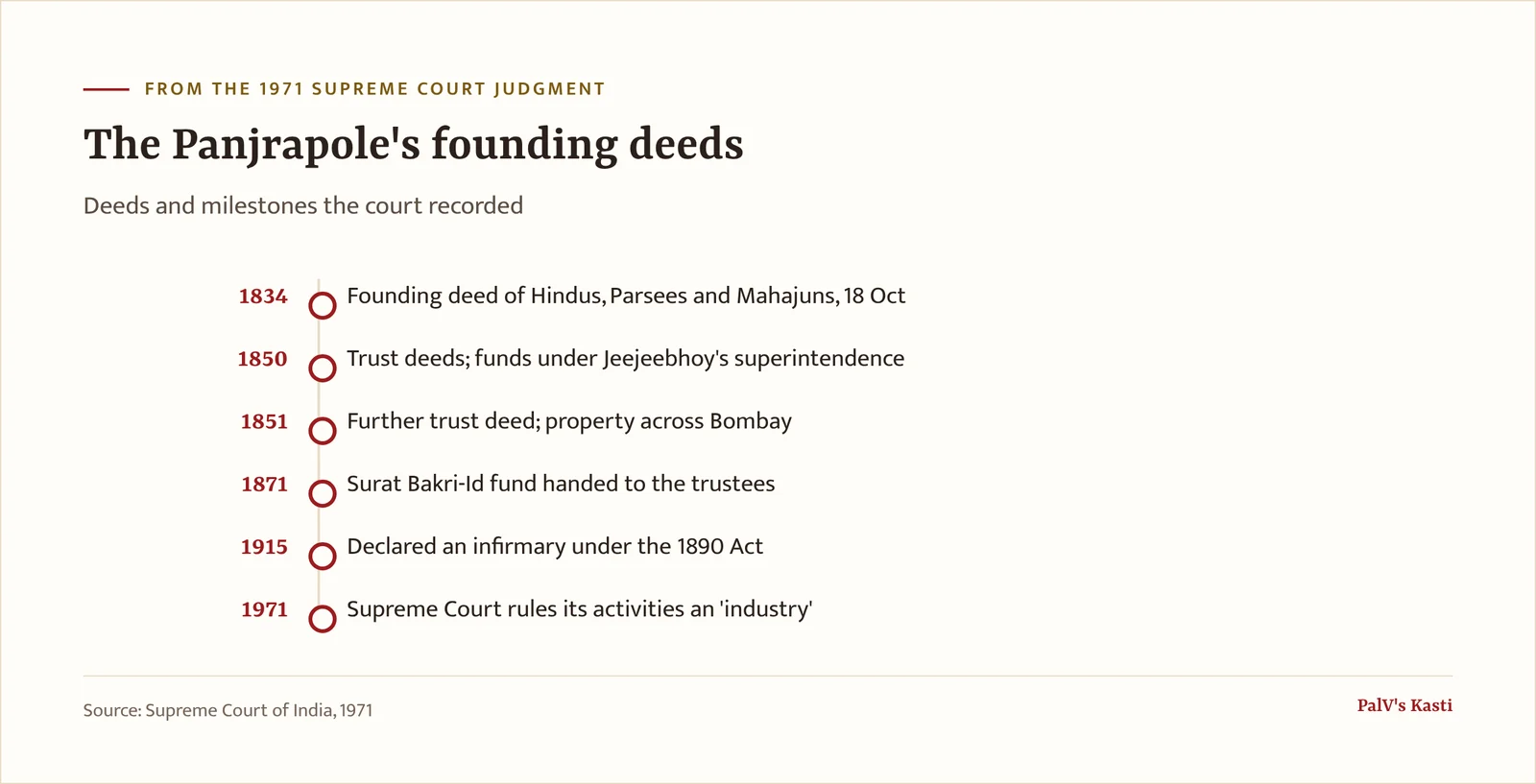
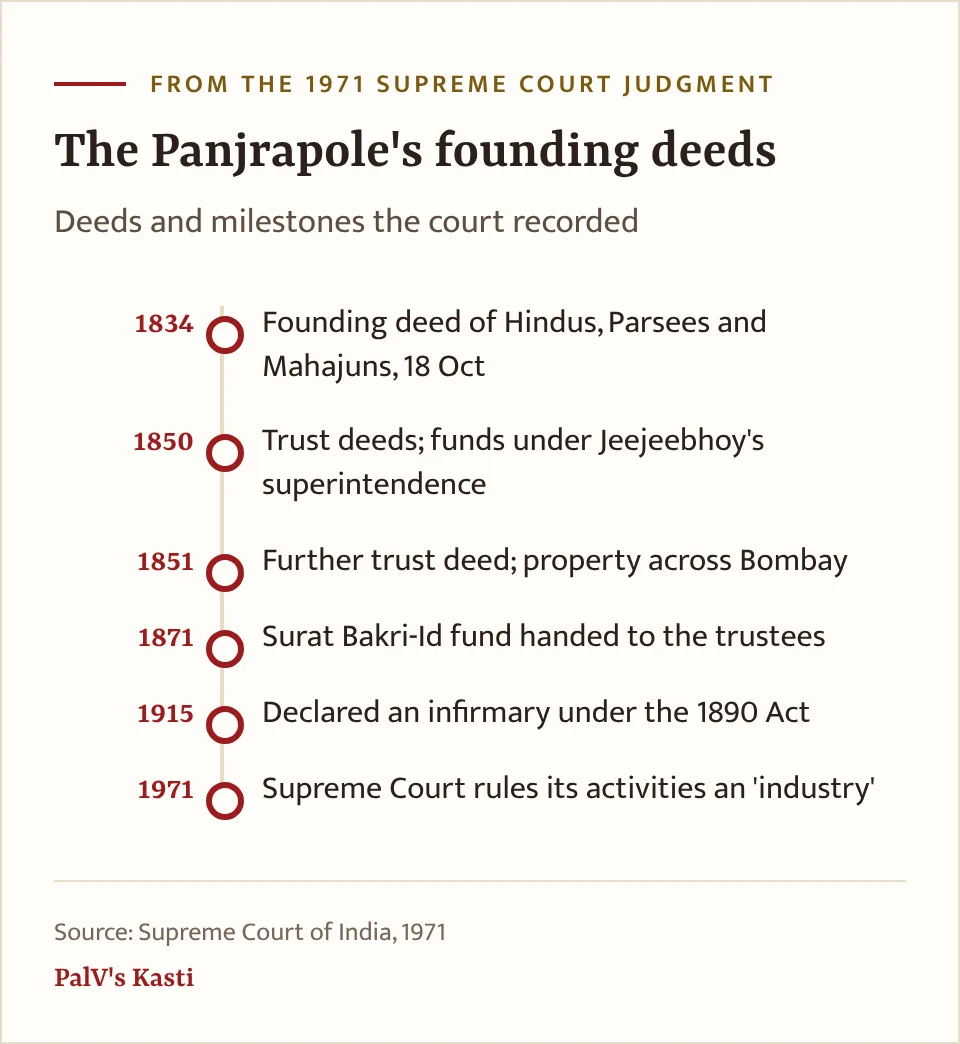
Two independent records give 1834 as the founding year: the Panjrapole's own history page and the Supreme Court's 1971 judgment in Bombay Panjrapole, Bhuleshwar v. The Workmen (1971 AIR 2422). The judgment goes further and describes the founding deed itself. Dated 18 October 1834, it shows Hindus, Parsees and Mahajuns agreeing to start a Panjrapole with suitable buildings. They would fund it by subscription and by paying fees on certain trade goods, and the shelter would keep stray cattle and other animals alive.
The two sources tell the trigger in similar terms. The court says the founders wanted to end the killing of stray dogs by the Company's sepoys. The Panjrapole's website quotes its secretary, Adi Mogralia, saying the British had ordered stray dogs and pigs on Bombay's roads to be shot on sight. According to the website, the shelter at first looked after stray dogs and pigs.
Which Parsi patrons shaped the Bombay Panjrapole?
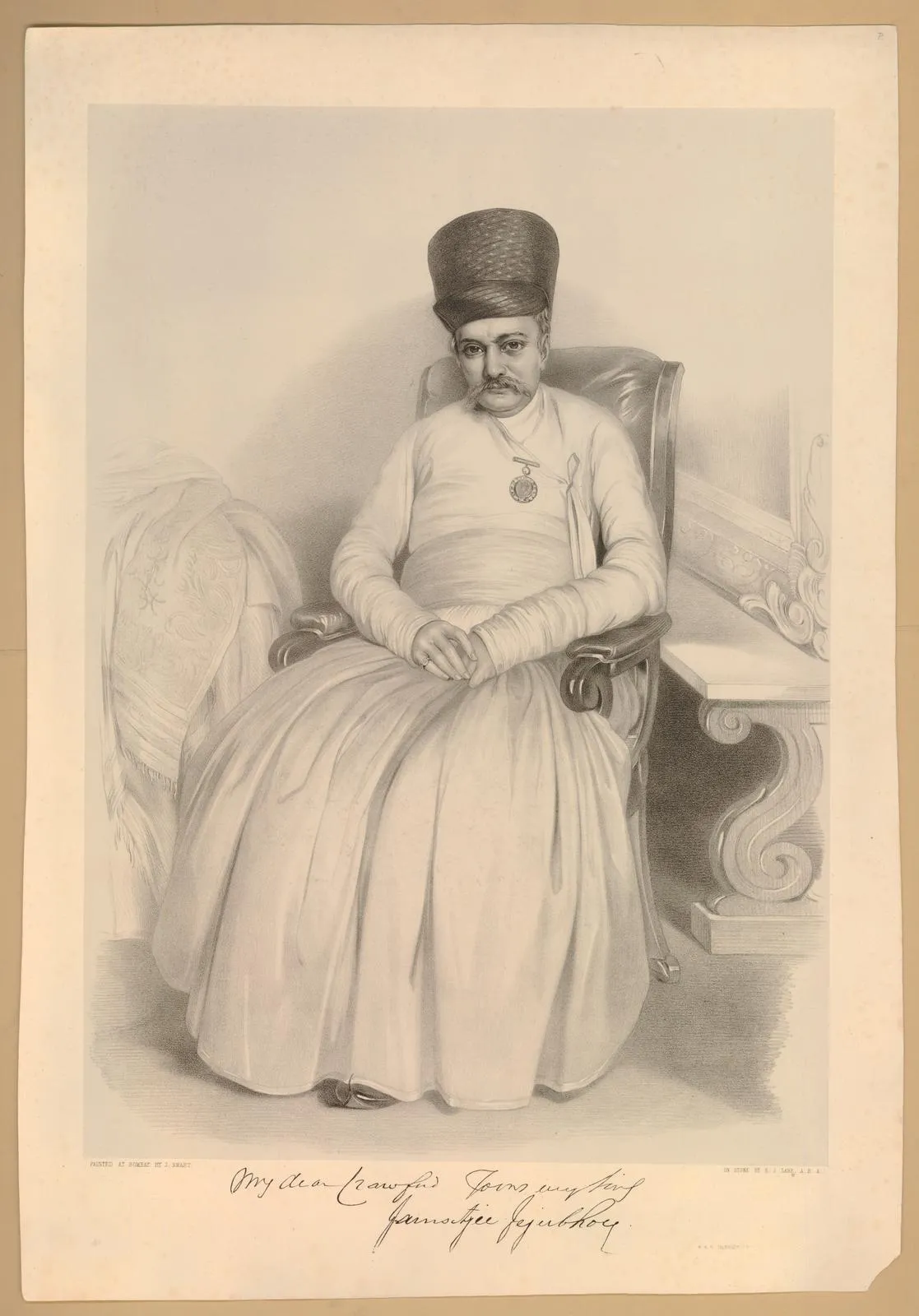
Jamsetjee Jeejeebhoy
The Panjrapole's website calls Jamsetjee Jeejeebhoy one of its two founders, alongside the businessman Amichand Shah. The Supreme Court judgment, reading the old trust deeds, shows how closely Jeejeebhoy was tied to the shelter's money. A deed of 2 November 1850 records that its funds were managed by certain Banians "under the superintendence of Sir Jamshedjee Jeejeebhoy", and that Rs. 75,057 of surplus had gone into Government promissory notes. On the same date Jeejeebhoy executed a deed of assignment in the Panjrapole's favour to Khimchand Motichand, covering lands and houses bought from surplus funds. A further trust deed of 5 September 1851, executed by Khimchand Motichand, Jeejeebhoy and others, shows an institution with promissory notes, houses, land and other property across the islands of Bombay.
The website adds one more detail about his support: Jeejeebhoy built a complex of 200 shops and 450 tenants in the area so that the rent would pay for the animals' care. In the same text, Mogralia says the rent is no longer enough to run the Panjrapole.
Cowasjee Patel and CP Tank
According to the Panjrapole's website, the Parsi philanthropist Cowasjee Patel helped the two founders, and the CP Tank area takes its name from him. We found no second source for either point, so we give them as the Panjrapole's own account.
Parsi and Hindu donors after 1850
Parsi donors appear again in a later deed. The Supreme Court judgment describes a deed of 10 June 1871 under which Hindus and Parsees who had raised a fund in Surat, to buy and free animals meant for slaughter at Bakri-Id, handed that fund to the Bombay Panjrapole's trustees. The trustees agreed to use it to buy cows, sheep and other animals in Surat and keep them under the Panjrapole's rules. For the wider story of how Parsi families set up endowments like these, see our guide to Parsi charitable trusts.
Why are there so many cows at the Panjrapole in Bhuleshwar?
The Panjrapole's website says the cows were "more incidental than intended". In its account, Mogralia explains that cows were brought in to give milk to the stray animals and their numbers grew over time. He describes the place as not a typical gavshala (cow shelter). The same text gives these figures: 1,800 animals across seven branches, of which 1,300 were cows, and 800 to 1,000 litres of milk a day from the Bhuleshwar shelter, sold to local residents rather than to dairies, with the money going to upkeep.
Those numbers are not current. The website's About page calls the shelter "176-year-old", which by our calculation places the text around 2010. The same page describes about two acres in the middle of the bazaar, 350 cows, and donkeys, dogs, goats, hens, ducks and parrots. It also lists rearing Gir cows for milk as one of its activities.
The website says the cows, along with the many temples nearby, have given the shelter a sacred air that draws pious residents and shopkeepers. A shopkeeper quoted there says crowds come every amavasya (new moon) to feed the cows and birds. How Zoroastrian teaching itself regards the cow and other animals is a separate subject, covered in our post on Animals in Zoroastrianism.
What did the Supreme Court decide about the Panjrapole in 1971?
On 16 August 1971, Justices G.K. Mitter and P. Jaganmohan Reddy ruled that the Panjrapole's activities, as shown in the case, were an "industry" under section 2(j) of the Industrial Disputes Act, 1947. The ruling left in place the Industrial Tribunal's award in a dispute its workers had raised over wages, leave, bonus, gratuity and reinstatement. The court noted that the milk sold had been worth well over Rs. 2 lakh a year for the previous three or four years, while the milk given to the animals themselves was a small share of the total. It dismissed the Panjrapole's appeal with costs.
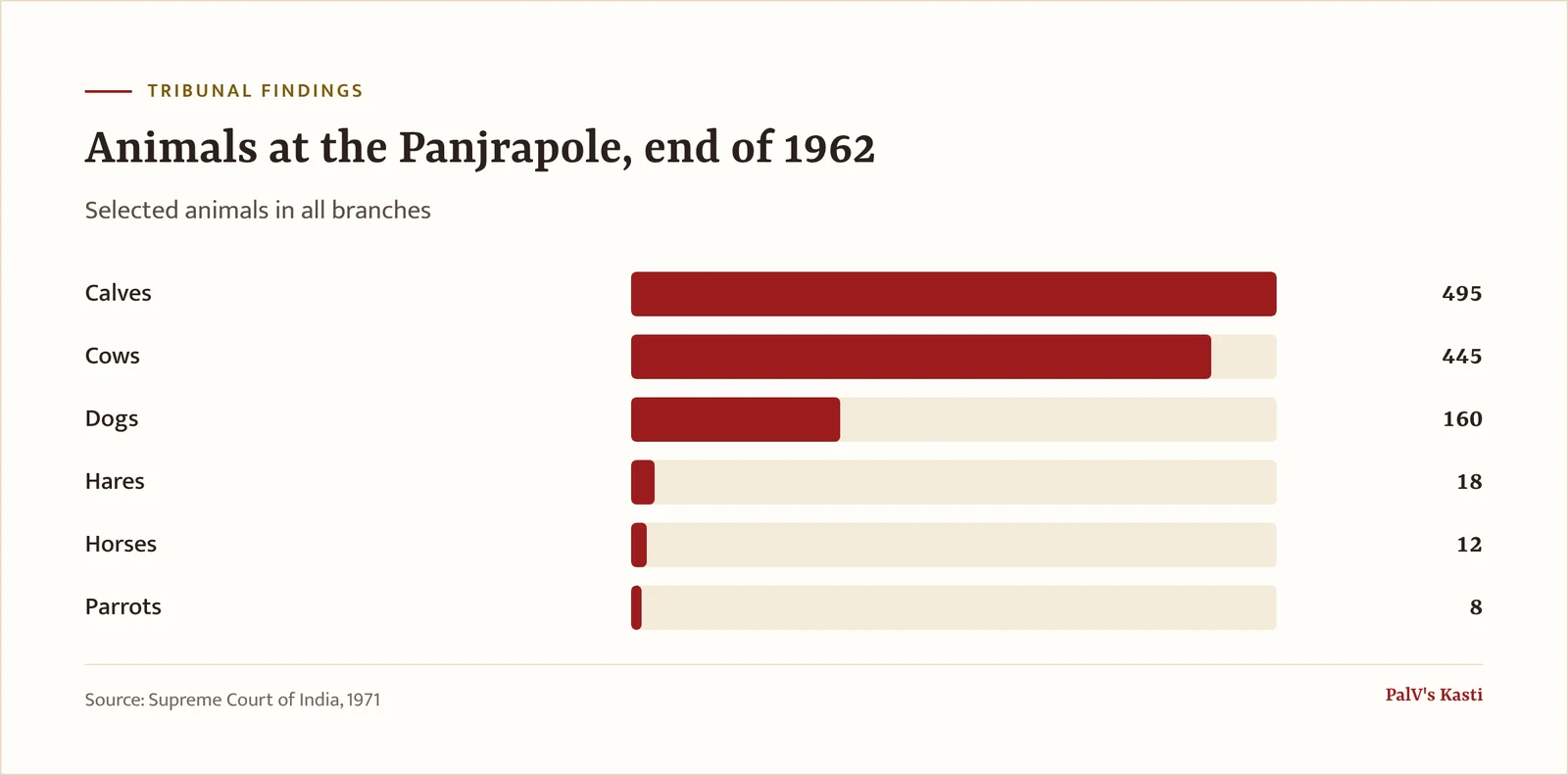
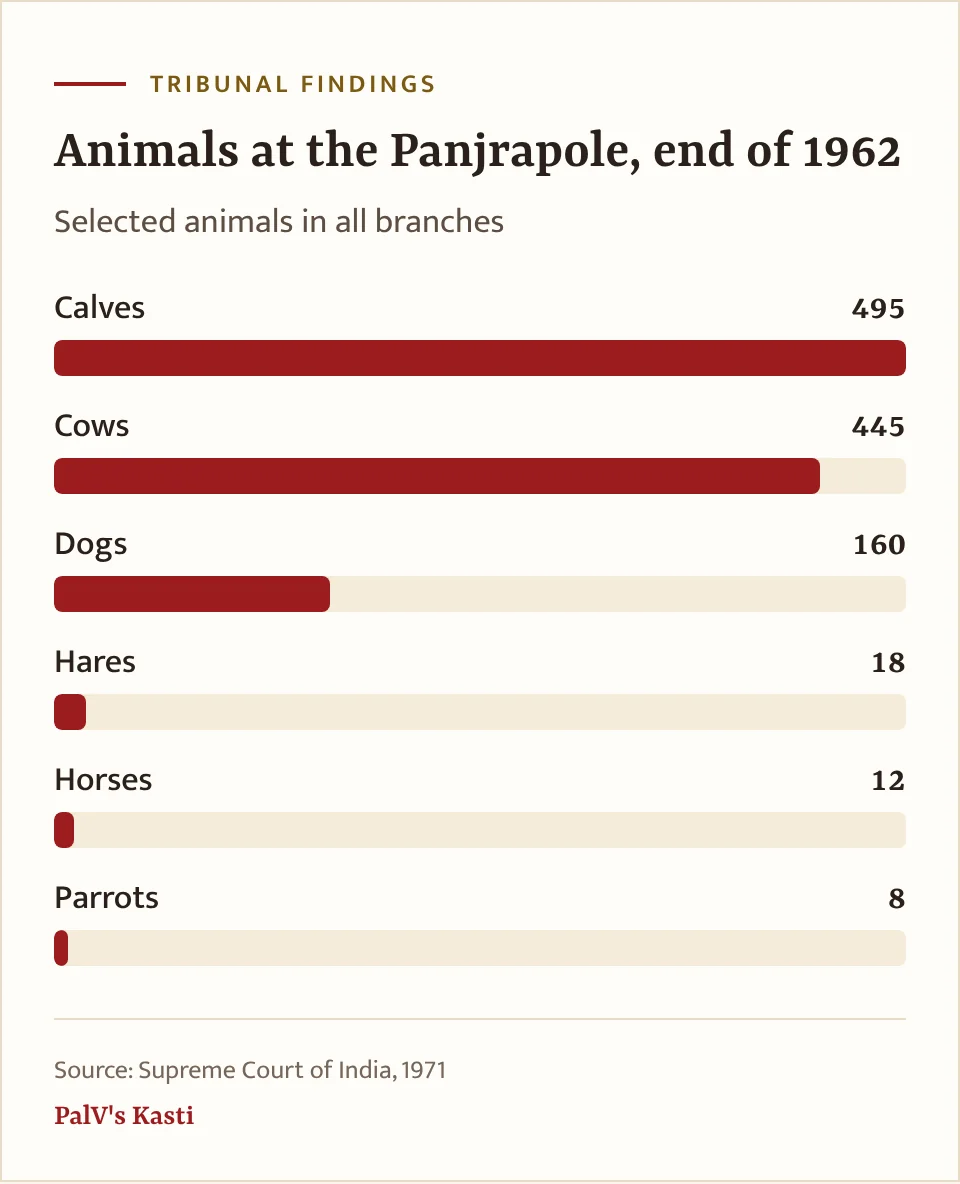
The judgment also preserves two other facts. The Government declared the Panjrapole an infirmary under the Prevention of Cruelty to Animals Act (IX of 1890) in 1915. And the Tribunal found that at the end of 1962 it held 1,754 animals, including 445 cows, 495 calves, 160 dogs, 12 horses, 18 hares and 8 parrots.
Where are the Bombay Panjrapole's branches?
The main shelter is in Bhuleshwar. In the 1960s, according to the 1971 judgment, the Panjrapole had three branches besides Bombay: Raita, Bhiwandi and Chembur. The Branches page of the Panjrapole's website now lists five: Chembur, Raita, Walsind, Bhiwandi and Bhilad. The older text on its History page names Kalyan, Chembur, Bhiwandi and Bhilad in Gujarat instead, so the website does not agree with itself. Its About page says the trust owns land in north Mumbai and on the Gujarat border.
Frequently asked questions
Who founded the Bombay Panjrapole?
The Panjrapole's website names two businessmen, Jamsetjee Jeejeebhoy and Amichand Shah, with help from Cowasjee Patel. The 1971 Supreme Court judgment describes the 1834 founding deed as an agreement among Hindus, Parsees and Mahajuns of Bombay, and records that by 1850 its funds were managed under Jeejeebhoy's superintendence.
When was the Bombay Panjrapole established?
The Bombay Panjrapole was established in 1834. Both the shelter's own website and the Supreme Court's 1971 judgment give that year, and the judgment dates the founding deed to 18 October 1834. Later trust deeds followed in November 1850, September 1851 and June 1871, which added funds and property to the institution.
Where is the Bombay Panjrapole located?
The main Bombay Panjrapole sits inside the crowded Bhuleshwar bazaar in Mumbai. Its website describes the site as about two acres, airy and calm despite the market around it. The trust also has other branches, and its website currently lists Chembur, Raita, Walsind, Bhiwandi and Bhilad.
Why does the Bombay Panjrapole keep so many cows?
According to the Panjrapole's website, cows were first brought in to supply milk for the stray animals in its care, and the herd grew over the years. The 1971 Supreme Court judgment adds that the trustees decided to upgrade infirm cattle for good milk, and that milk sales became a large source of income.
Is the Bombay Panjrapole a Parsi institution?
The Bombay Panjrapole was founded jointly by Hindus, Parsees and Mahajuns, according to the 1971 Supreme Court judgment. Its website names Jamsetjee Jeejeebhoy as a co-founder and says a Parsi trust runs the shelter. Local residents also come to feed its cows on new-moon days, the website says.