PalV's Kasti
On this page
- Who founded Mama Parsi Girls School?
- Where did Karachi's Parsi girls study before 1918?
- When was the Mama Parsi school building built?
- Is Mama Parsi school only for Parsi girls?
- How did the school grow after 1925?
- What was school life like at Mama Parsi?
- How did Mama Parsi school mark 100 years?
- Is Mama Parsi school still running today?
- Frequently asked questions
Mama Parsi Girls Secondary School is a girls' school on M.A. Jinnah Road, the old Bunder Road, in Karachi. It opened in 1918. Jamshed Nusserwanjee Mehta, later the city's first mayor, gathered three large gifts from Parsi families, and the first classes were held in a borrowed part of the Bai Virbaijee Soparivala (BVS) Parsi school. In June 1919 the girls moved to Mama Mansion, and on 1 April 1925 they began lessons in the school's own stone building. Until 1943 only Parsi girls studied there. The school opened its admissions to girls of all communities in 1944, and widened them again in 1947 at Mohammad Ali Jinnah's request. It turned 100 on 1 April 2018.
અસપંદામેદ રોજ
Asfandarmad Roj, Tir Mah · 1396 Y.Z.
Who founded Mama Parsi Girls School?
The school credits Jamshed Nusserwanjee Mehta with making it happen. In 1918 he collected the donations that paid for it, and Dawn writers in 2018 describe him as its founder. Dawn's 2011 profile of Mehta says he was born in Karachi in 1886 and was elected the city's first mayor for 1933 to 1934.
The money came from three Parsi donors. The school's own account gives the amounts:
- Khan Bahadur Ardeshir Hormusji Mama: Rs 3,00,000 towards the building.
- The trust of the late Seth Nowroji Nusserwanji Pochaji: Rs 1,35,000. The school says Mehta obtained this from his own father, K.B. Nusserwanji R. Mehta, who was the trust's sole trustee.
- Seth Edulji Dinshaw and his family: Rs 75,000. The family also started a hostel for Parsi girls and kept it running until it closed.
Dinshaw had wanted a Parsi girls' school for years. The school says his offers of 1903 and 1911 came to nothing. Writing in Dawn in 2018, the former pupil Maheen A. Rashdi gives a reason: proposals for a girls' school were turned down more than once because the boys' school, BVS, came first for funds.
Ardeshir Mama died in 1952. According to the school, his daughter-in-law, Mrs Mehra Z. Mama, then looked after it for nearly twenty years.
Where did Karachi's Parsi girls study before 1918?
They went to a school that was already 59 years old. The school's history says Parsi girls had received elementary lessons at the Parsi Balak Shala since 1859, and that this school later became the BVS Parsi High School.
Dawn's 2015 feature on Pakistan's Parsis fills in the start. It says the small Balak Shala was housed in the home of Dadabhoy Palonji Paymaster, and credits Seth Shapurji Hormusji Soparivala and his family with starting it in 1859. In 1869 Seth Shapurji gave Rs 10,000 and asked that the school be named after his late wife, Bai Virbaiji. Dawn treats BVS and the girls' school as two branches that grew from that 1859 start. For the wider story of how the community built its schools, see our guide to Parsis and education.
When was the Mama Parsi school building built?
The girls moved twice before they had a building of their own. The dates below come from the school and match The Express Tribune's 2018 report:
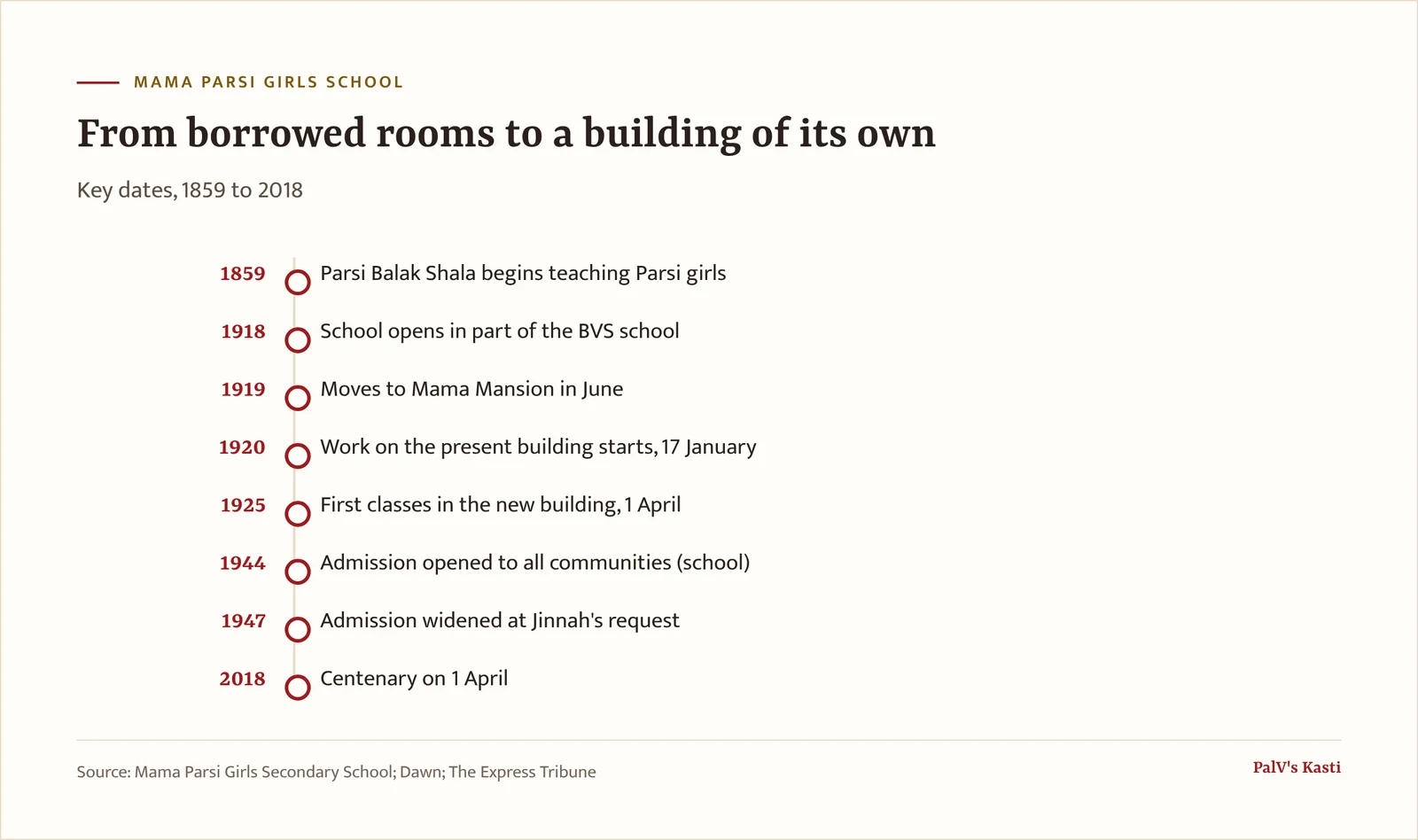
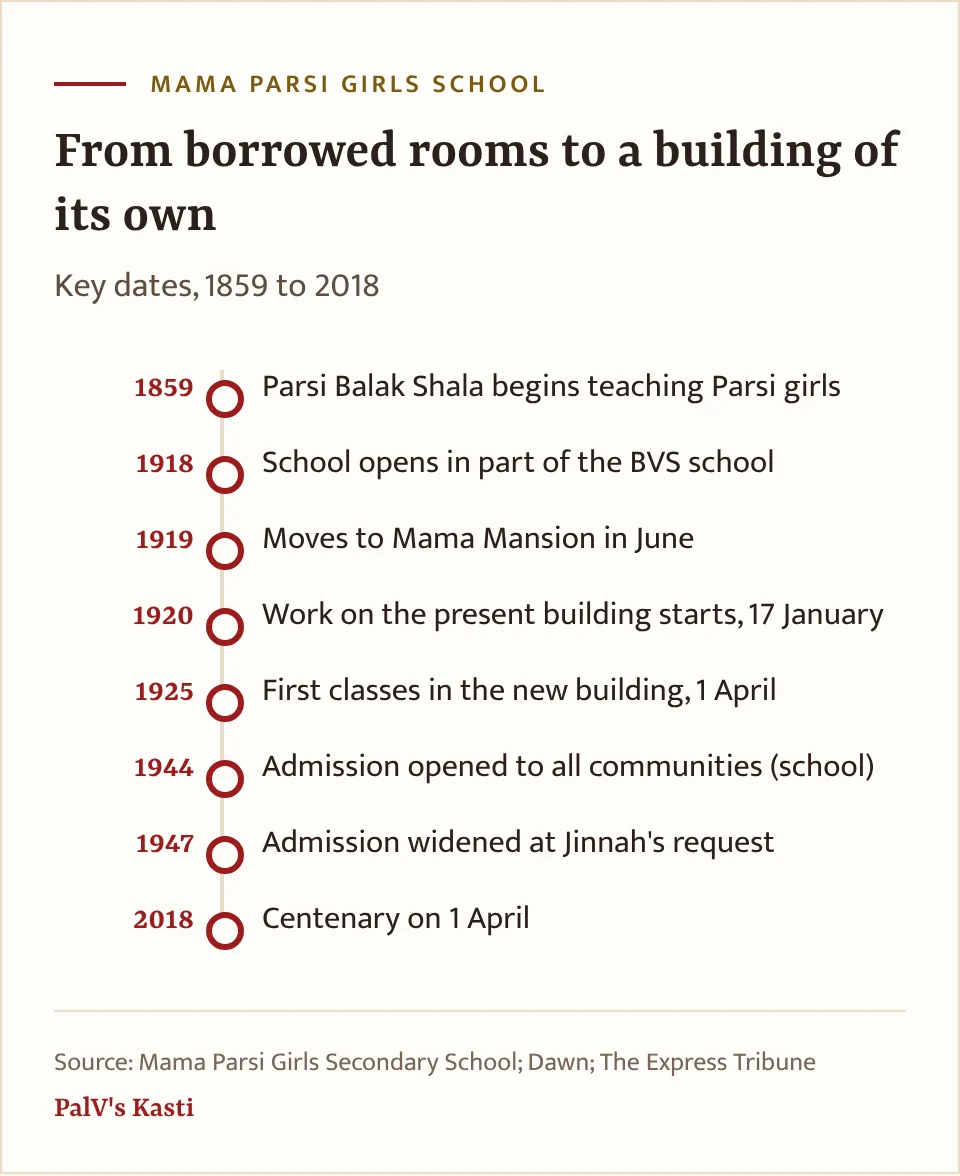
- 1918: classes begin in a portion of the BVS school.
- June 1919: the school shifts to a large building known as Mama Mansion.
- 17 January 1920: work starts on the present building.
- 26 January 1925: the building is completed.
- 1 April 1925: the first classes are held in it.
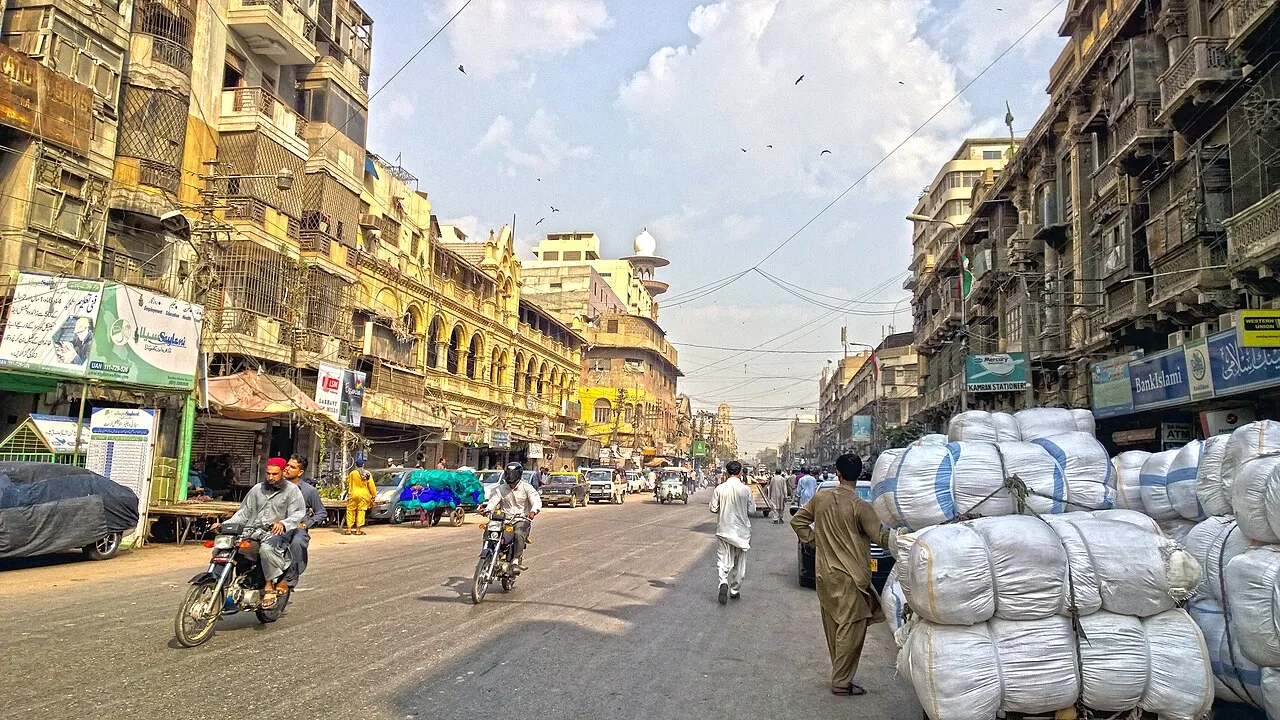
The building stands on Bunder Road, renamed M.A. Jinnah Road. Rafia Zakaria, another former pupil, placed it in "the very heart of Karachi's Saddar area" in Dawn. The Tribune called it a "fine sandstone edifice" in 2013, while Rashdi remembers it as yellow limestone. She also recalls a statue of Bai Homlibai H. Mama, Ardeshir Mama's mother, on the campus.
Is Mama Parsi school only for Parsi girls?
No. It has taken girls of every community since the 1940s, though it is still a girls' school.
The school says only Parsi girls were admitted until 1943, when it had about 200 pupils. Its chronology says it was "declared a Cosmopolitan School" in 1944 and opened admission to all communities that year. In 1947, at Jinnah's request, it widened admission for non-Parsi girls further. Dawn's 2015 feature gives 1947 as the year the school took in girls of other faiths, and its 2018 centenary report says Muslim girls were admitted after 1947 at Jinnah's request. So the school's account and Dawn's differ by three years.
The change shows in the numbers. At the centenary, Dr B.N. Mama, chairperson of the management committee, said the school began with 50 Parsi girls and now taught 2,220, most of them Muslim. Rashdi writes that Parsi prayers for the Zoroastrian girls and Islamic recitation for the Muslim girls sat side by side in her time.
How did the school grow after 1925?
The school's own chronology lists these milestones:
- 1925: the Old Girls' Association is formed.
- 1937: domestic accomplishment classes begin. They were dropped in 1993.
- 1964: the building is extended with a second floor and science laboratories. The school says it then had more than 500 pupils, and that the principal, Miss I. Thompson, raised money for it through melas and concerts.
- 1974: a Students' Council is formed.
- 1975: an afternoon shift opens.
- 1976: commerce subjects arrive for the S.S.C. exam.
- 1984: computer studies start from Class VII.
- 1985: the Cambridge system is introduced.
- 1991: a new wing is added, and the school is split into four sections, each with its own headmistress.
The new wing was built with community gifts. The school names the Cowasjee Foundation, the Jehangir Rajkotwala Trust and Dr Burjor Anklesaria among the donors. Dawn reported in 2018 that the school had moved its Matric classes to the Aga Khan University Examination Board in 2007.
What was school life like at Mama Parsi?
Strict, if the two former pupils who wrote in Dawn are a guide. The house system dates from 1943, the Tribune reported. Rashdi lists the four houses, each named after a benefactor: Dinshaw (green), Mama (blue), Pochaji (yellow) and Contractor (red).
She recalls minus marks for small lapses such as long nails or mehndi. Lessons went well past the syllabus into manners, music, ballet, cooking, art, needlework and even laundry. She calls it "the local answer to the finishing schools of the West". Zakaria remembers the gates shutting at 8:05 and a ban on henna "with no exceptions ever".
The motto, quoted by the school and by both writers, is "Let humility, charity, faith & labour light our path."
How did Mama Parsi school mark 100 years?
The school turned 100 on Sunday, 1 April 2018. Dawn's report of the day says it opened with a milad, after which priests led Zoroastrian prayers. Sindh Governor Mohammad Zubair spoke, calling it, in Dawn's report, "one of the best girls' schools" in the country. Zakaria adds that the celebration was simple, with a blue and white cake, flowers for every student, and prayer.
Is Mama Parsi school still running today?
Yes, going by its own website, which we checked on 16 November 2026. The site lists primary, Matriculation, Cambridge and afternoon sections, a morning and an afternoon shift, and a Class I registration notice for 2027-28. For admission details, the school's website is the only reliable guide.
It is one of several institutions Karachi's Parsis built in the early twentieth century. Our page on the Parsis of Karachi covers the rest of that story.
Frequently asked questions
When was Mama Parsi Girls School founded?
Mama Parsi Girls School was founded in Karachi in 1918. Its first classes were held in part of the BVS Parsi school. It moved to Mama Mansion in June 1919, and lessons began in its own building on M.A. Jinnah Road on 1 April 1925, after five years of construction. The school marked its centenary on 1 April 2018.
Who founded Mama Parsi school in Karachi?
Jamshed Nusserwanjee Mehta, later Karachi's first mayor, raised the money in 1918. The school names three donors: Khan Bahadur Ardeshir Hormusji Mama, who gave Rs 3,00,000, the trust of Seth Nowroji Nusserwanji Pochaji, which gave Rs 1,35,000, and Seth Edulji Dinshaw's family, who gave Rs 75,000 and ran a hostel for Parsi girls.
Is Mama Parsi school only for Parsi girls?
No. It admitted only Parsi girls until 1943. The school says admission opened to all communities in 1944 and widened in 1947 at Jinnah's request, while Dawn dates the change to 1947. In 2018 the school had 2,220 pupils, most of them Muslim. It remains a school for girls only.
Where is Mama Parsi Girls School located?
The school's building stands on M.A. Jinnah Road, formerly Bunder Road, in Karachi's Saddar area. Construction began on 17 January 1920 and finished on 26 January 1925. The Express Tribune described it as sandstone, while a former pupil recalls yellow limestone. Before 1925 the school used part of the BVS school and then a building called Mama Mansion.
What is the motto of Mama Parsi school?
The motto is "Let humility, charity, faith & labour light our path." The school uses it on its website, and two former pupils quoted it in Dawn for the 2018 centenary. The four houses, named after benefactors, are Dinshaw (green), Mama (blue), Pochaji (yellow) and Contractor (red).