PalV's Kasti
On this page
Capitol Cinema, the worn building that faces Chhatrapati Shivaji Terminus (the old Victoria Terminus) in Mumbai, started life in 1879 as the Gaiety Theatre. Its builder, according to theatre historian Rashna Darius Nicholson, was Kuvarji Sorabji Nazir, a Parsi theatre manager who had founded the Elphinstone Theatrical Club. The Gaiety opened on 6 December 1879 for English touring companies. By 1881 Nazir was deep in debt and had lost his older Elphinstone Theatre at auction. The Gaiety passed to another company, was bought in 1893 by Chhotalal Mulchand Kapadia of the Gujarati Natak Mandali, and was converted into a cinema in 1928, when it took the name Capitol. NPR reported in 2021 that it is permanently shut.
શહેરેવર રોજ
Shehrevar Roj, Tir Mah · 1396 Y.Z.
When was Capitol Cinema in Mumbai built?
The Capitol Cinema building dates from 1879. NPR's 2021 report on Mumbai's single screens gives that year for its construction, and Nicholson's account in The Wire (1 May 2023) follows the theatre from the land grant in July 1879 to its first night that December.
The site came from the Government. Nicholson cites the Times of India of 19 July 1879, which reported that Nazir had been allotted land at the end of Hornby Row, looking straight at the Victoria Terminus. The theatre was meant for three audiences: Europeans living in Bombay, travellers passing through, and what the paper called the "enlightened native community".
What did the Gaiety look like?
John Campbell designed it with Bombay's humid climate in mind. Per Nicholson, it was built of teak, brick and Mangalore tiles in a style termed "composite Italian", held about 1,000 people and cost Rs 36,000.
Nazir's own notice in the English press, quoted in The Wire, laid out the seating:
- 23 private boxes on the upper tier, the Governor's double box among them
- two large stage boxes and two orchestra boxes below
- 220 orchestra stalls
- a gallery and a pit
He also promised that numerous ventilators in the side walls would keep the hall cool.
Who built Capitol Cinema, and was its founder a Parsi?
The founder was a Parsi. Nicholson, an assistant professor of Theatre Studies at the University of Hong Kong and author of a history of the Parsi stage, names Kuvarji Sorabji Nazir (also written Cooverji) as the man who built the Gaiety. He came from a modest home in Chandanwadi. In 1864 he founded the amateur Elphinstone Theatrical Club, and by 1874 he owned the Victoria and Elphinstone theatrical companies and the Elphinstone Theatre, and leased two more playhouses.
One record names the builder differently. The Brihanmumbai Municipal Corporation's heritage sheet for D Ward says the Gaiety was "built by Kunvarji Paghtivala as a performing arts theatre". The sheet does not say whether this is the same man as Nazir, and we have not found a source that settles it. We give both names as the sources give them.
So the record shows one Parsi founder. We could not find a source that calls any later owner a Parsi.
What was the Gaiety Theatre in Bombay?
The Gaiety Theatre was built as Bombay's home for visiting English companies. Nicholson writes that touring companies from England and Australia used to skip Bombay for Calcutta, and Nazir set out to change that. He hired an English comedy and burlesque company through a London theatrical agent for a guaranteed season of 20 weeks.
The company opened on Saturday 6 December 1879 with James Albery's comedy The Pink Dominos. The notices that followed were less kind. The Times of India judged the performance poorer than those of visiting American troupes, and the Rast Goftar called the building "ugly" beside its neighbours, according to Nicholson.
Why did Kuvarji Nazir lose the Gaiety?
Nazir's trouble began on his benefit night, 13 April 1880. On stage after the play, he told a full house that the London agent had not kept his promises and that the actresses' personal appearance had disappointed him. A Times of India report quoted by Nicholson describes howls and hisses. He apologised in public, but the benefit raised just Rs 10.
Lawsuits followed quickly, Nicholson writes:
- a claim of Rs 24,000 from the builders of the theatre
- a furniture dealer, Somejee Parpia, for Rs 4,000
- a debt of Rs 27,000 owed to Major Cowper and C.W.L. Jackson
A warrant for his arrest came at the end of it. The Jam-e-Jamshed printed an appeal for him the next year, asking the city's European patrons of drama to help him out of his money troubles. Nicholson writes that the Europeans ignored it. The paper's own view, as she quotes it, was that ordering out a company from England had "involved him further". On 14 November 1881 his older Elphinstone Theatre was auctioned by the Deputy Sheriff for Rs 1,800.
How did the Gaiety become Capitol Cinema?
After Nazir, the Original Victoria company took over the Gaiety for Hindustani plays. In 1893, Nicholson writes, the theatre was bought by Chhotalal Mulchand Kapadia of the Gujarati Natak Mandali.
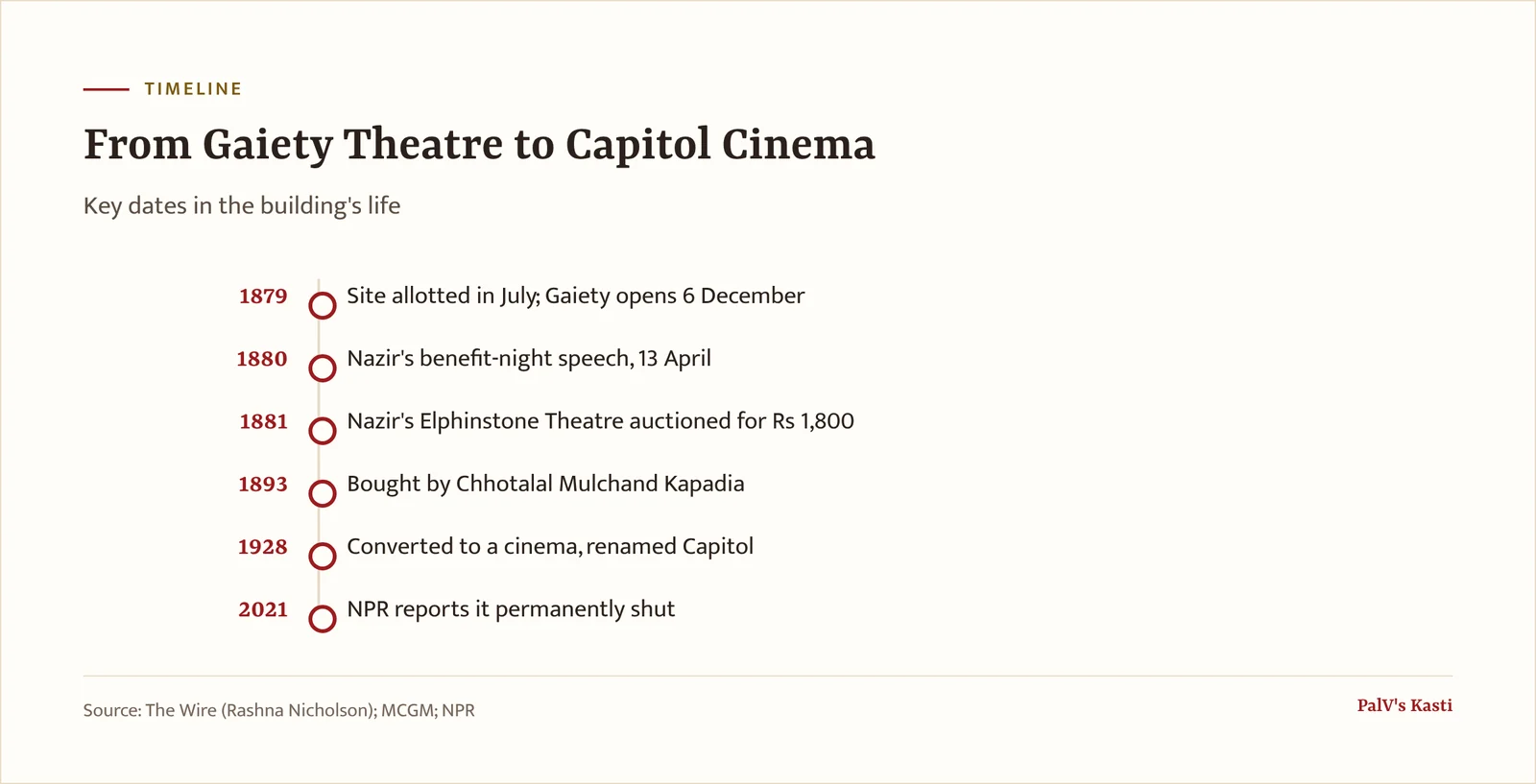
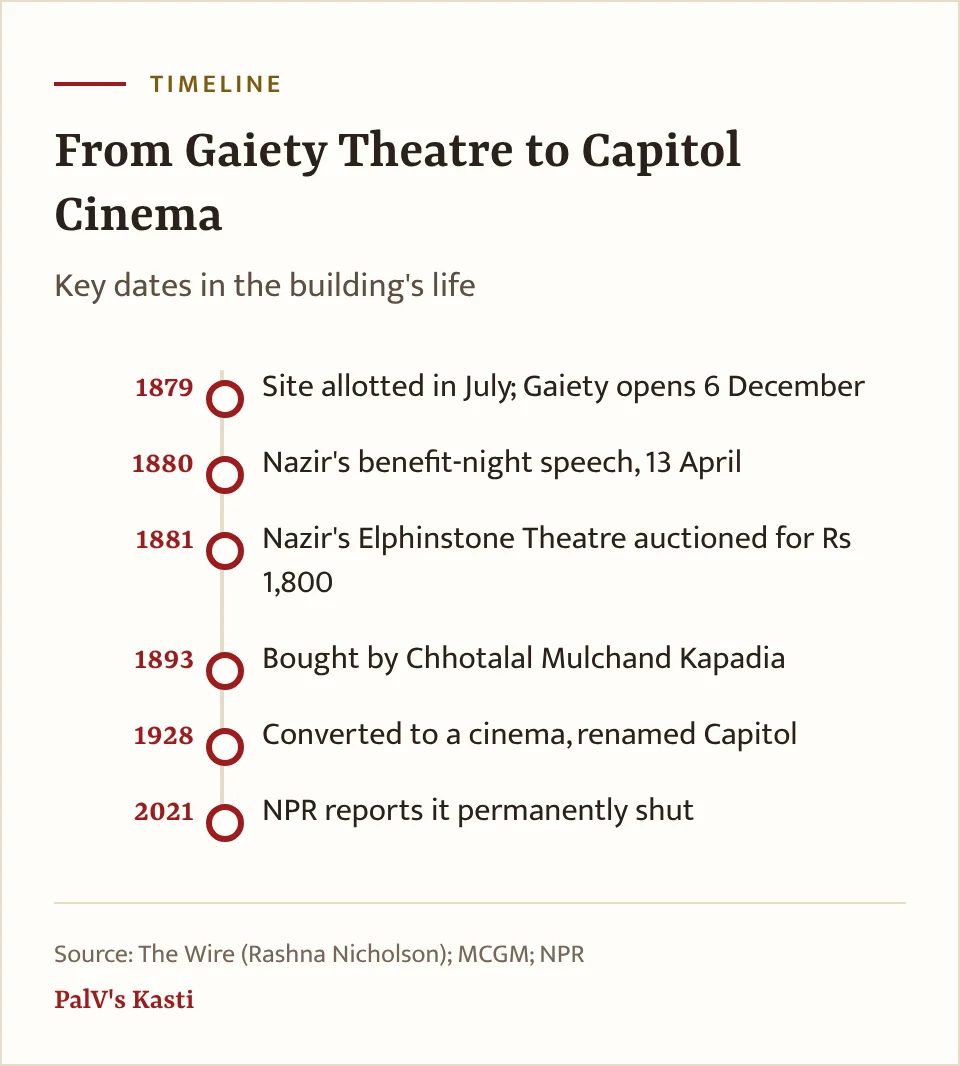
The switch to film came in 1928. The BMC heritage sheet says the Gaiety was converted into a cinema that year and renamed Capitol Cinema House, and NPR also gives 1928 as the year it opened to the public. The same BMC sheet calls the Gaiety "the first cinema theatre in Mumbai". That is the corporation's description, and we leave it attributed.
For Parsis on the screen itself, see our piece on Parsi actors in Bollywood.
Is Capitol Cinema Mumbai closed?
Yes, as of the latest sources we found. A caption in NPR's report of 17 July 2021 by Sushmita Pathak says the Capitol "is permanently shut now", and Nicholson described it as "now closed" in May 2023. Neither source gives the year it stopped screening, and we have not found one. We also could not confirm who owns the building today or its heritage grade, so we have left both out.
Frequently asked questions
When was Capitol Cinema Mumbai built?
The building went up in 1879 as the Gaiety Theatre. The Government allotted the site in July 1879, and the theatre opened on 6 December 1879 with an English comedy company. It became a cinema in 1928, according to the BMC's heritage sheet and NPR, and took the name Capitol at that time.
Who built Capitol Cinema in Mumbai?
Theatre historian Rashna Darius Nicholson names Kuvarji Sorabji Nazir, a Parsi theatre manager, as the builder of the Gaiety Theatre, and John Campbell as its architect. The BMC's heritage sheet gives the builder as "Kunvarji Paghtivala". Neither source explains the difference between the two names, so we report both.
Is Capitol Cinema Mumbai closed?
Yes, as far as the latest sources show. NPR reported in July 2021 that the Capitol cinema was permanently shut, and historian Rashna Nicholson described it as closed in The Wire in May 2023. We have not found a reliable source for the exact year screenings stopped, or for who owns the 1879 building today.
What was the Gaiety Theatre in Bombay?
The Gaiety was a playhouse for about 1,000 people, opened in December 1879 at the end of Hornby Row facing Victoria Terminus. Historian Rashna Nicholson names Kuvarji Nazir as its builder, for English touring companies and Bombay's European audience. It later hosted Hindustani plays, was sold in 1893 and became Capitol Cinema in 1928.
Where is Capitol Cinema in Mumbai?
Capitol Cinema stands opposite Chhatrapati Shivaji Terminus, the railway station once called Victoria Terminus. The Times of India of July 1879, quoted by historian Rashna Nicholson, placed the original site at the end of Hornby Row, facing the terminus. The building has been closed to the public since at least 2021.